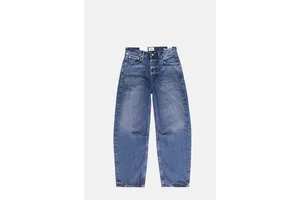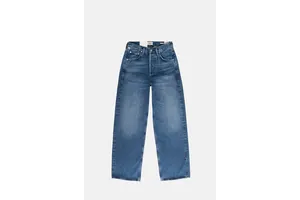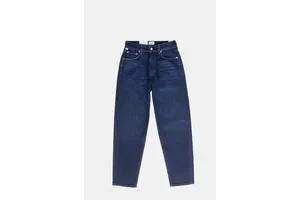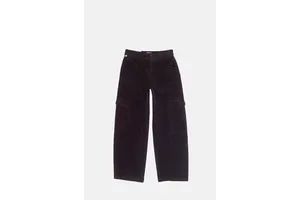
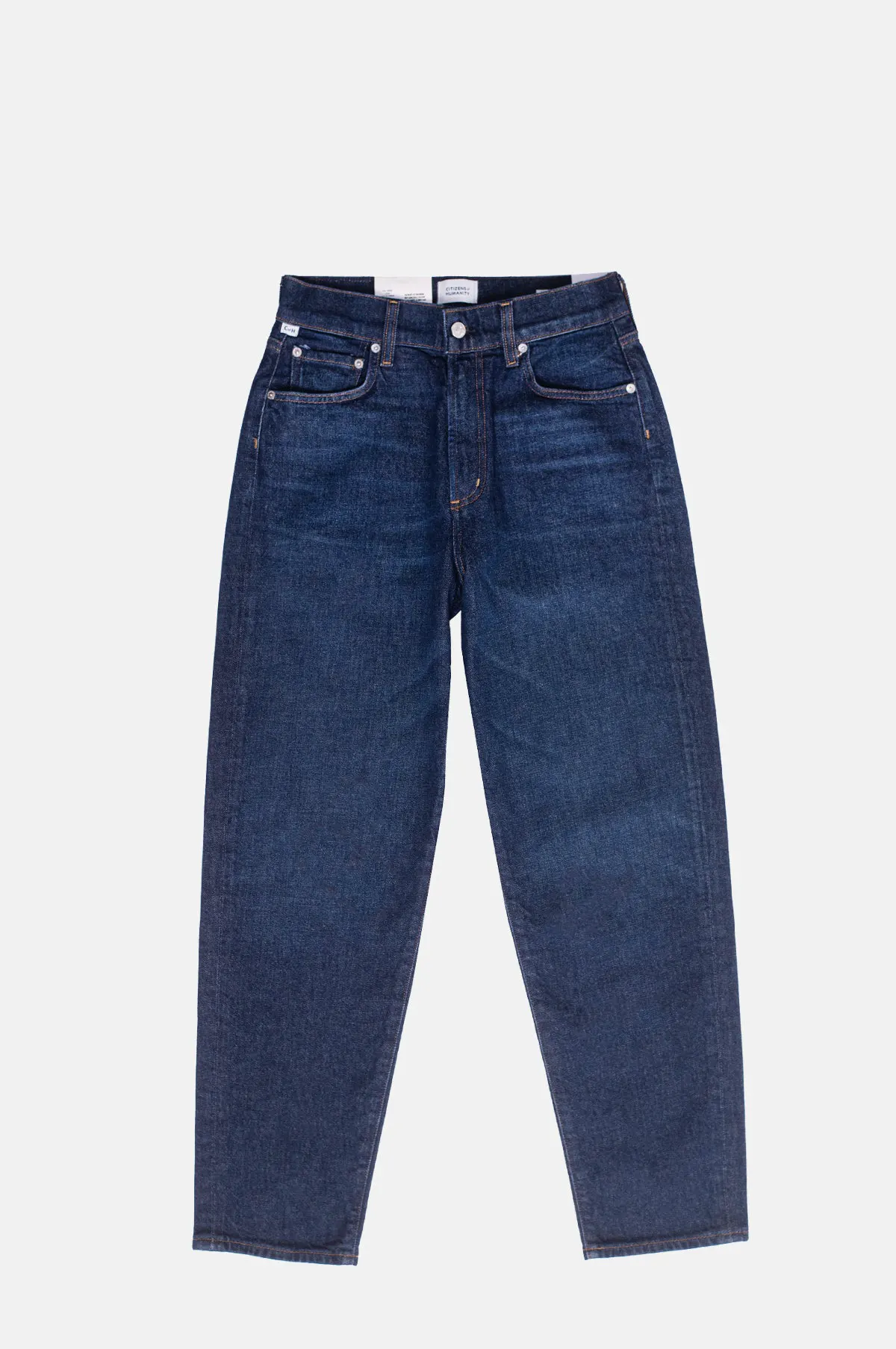

The Taper Jean from Citizens of Humanity in a rich dark indigo, made from a heavyweight bio stretch denim with eco indigo, regenerative cotton and bio based elastane, with a high rise, a soft taper and a button fly, listed at 320 GBP with five of eight sizes left. It is worth setting out the contradiction first because it is on the page twice and it is about the most basic property of the cloth. The bullet list says rigid denim construction. The description says heavyweight bio stretch denim with comfortable stretch. The fibre panel says 99% cotton and 1% elastane. In denim, rigid is not a loose word, it is the opposite of stretch: rigid denim means denim with no elastic fibre in it. So the page says the garment has no stretch and then says it has stretch, and the panel settles it by showing that it has 1% elastane and is therefore not rigid. This run can put a finer point on it than usual, because in the same batch from the same brand there is another pair of jeans whose bullets say made from a rigid, non stretch cotton denim, and that one is 100% cotton with no elastane at all, so on that one the word is true. Same word, same brand, same season, and it is right on one garment and wrong on the other, and the only way to tell is the fibre panel. The other thing worth setting out is a positive result, and this run wants to record it because it validates a method. When a page publishes both an inseam and an outseam, the difference is the rise. Here the inseam is 73 and the total length is 103, so the rise is about 30 centimetres, or about 11.8 inches. The bullet says high rise. And a high rise is around eleven to twelve inches. So the number and the word agree. That matters because this run used the same subtraction on another garment from this same brand and found that a rise of about 26 centimetres was being called low rise, which is a contradiction. One garment cleared and one caught by the same method is what tells you the method works. The reference is the Taper Jean in Aries. Dongguan Bafinasa Garments Co., Ltd. develops comparable denim and jeans on OEM and ODM terms, from cloth sourcing by weight and stretch to retail or FBA ready packing. We publish this as a development reference and build your own version of it, and we do not supply the branded original or reproduce anyone else's label.
Key Features
- Rigid denim construction in the bullet and bio stretch denim with comfortable stretch in the description, with 1% elastane in the panel. See the note below
- A rise of about 30 cm derived from the published lengths, which agrees with the high rise the page claims. See the note below
- Eco indigo, regenerative cotton and bio based elastane all stated, three claims in one sentence and no certifier, standard or percentage for any of them. See the note below
- Heavyweight as stated, with no weight in ounces or grams. See the note below
- Inseam 73 cm and total length 103 cm, both frozen across all eight sizes. See the note below
- Machine wash on a cold cycle as the entire care label, with no drying instruction at all. See the note below
- Waist stepping 2, 2, 1, 1, 2, 2 and 2 cm, which no uniform grade produces. See the note below
Customisable Options
- Cloth: heavyweight bio stretch denim to the reference, with the weight in ounces stated, or a midweight denim, or a rigid denim with no elastane, or a higher stretch denim, each quoted separately
- Fibre: regenerative cotton to the reference, with the programme named, or organic cotton, or conventional cotton, or a recycled cotton blend, each quoted separately
- Dye: eco indigo to the reference, with the process named and the reduction measured, or conventional indigo, or a foam dye process, or a sulphur dye, each quoted separately
- Elastane: bio based elastane to the reference, with the bio based percentage and the test method stated, or conventional elastane, or no elastane, each quoted separately
- Rise: high rise to the reference, with the rise published at every size, or a mid rise, or a low rise, each quoted separately
- Leg: soft tapered to the reference, with the leg opening and knee measured, or a straight leg, or a slim taper, each quoted separately
- Cloth weight in ounces and grams per square metre, stretch percentage and recovery, regenerative programme and certifier, eco indigo process and certifier, bio based content percentage and test method, rise at every size, leg opening and knee measurements, hip and thigh, button count and size, size set, colour development, private label and care labelling
Specifications
| Style | High rise tapered jean with a soft taper, a dark indigo wash and a button fly |
| Reference | Citizens of Humanity, Taper Jean, style 2313-1854, colour arie, sizes 24 to 31 |
| Composition | 99% cotton and 1% elastane as stated in the panel. See the note below |
| Cloth | Heavyweight bio stretch denim as stated, with no weight given. See the note below |
| Cloth Weight | Not stated, though the description says heavyweight. See the note below |
| Stretch | Comfortable stretch as stated, and no stretch percentage and no recovery given. See the note below |
| Rigid Claim | Rigid denim construction as stated in the bullet, contradicted elsewhere on the page. See the note below |
| Cotton | Regenerative cotton as stated, with no programme and no certifier named. See the note below |
| Dye | Eco indigo as stated, with no process and no certifier named. See the note below |
| Elastane | Bio based elastane as stated, with no bio based percentage and no test method. See the note below |
| Fit Word | Softly tapered silhouette as stated |
| Rise | High rise as stated, and about 30 cm derived from the published lengths. See the note below |
| Leg | Soft tapered as stated, with no leg opening, no knee and no thigh measured. See the note below |
| Hip | Not measured. See the note below |
| Wash | Rich dark indigo wash as stated, with no wash process and no colourfastness given |
| Closure | Button fly closure as stated, with no button count and no button size given |
| Care | Machine wash on a cold cycle as stated, and nothing else. See the note below |
| Certification | None named, despite three separate sustainability claims. See the note below |
| Sizes Offered | 24, 25, 26, 27, 28, 29, 30 and 31, eight sizes, with 24, 26, 27, 28 and 31 in stock at the time of writing |
| Size Conversion | None published |
| Fit Guidance | None published, and no true to size statement. See the note below |
| Model | Five foot ten, wearing a size 27, as stated |
| Measurements Published | Waist, inseam and total length for all eight sizes. See the note below |
| Published Waist | 33, 35, 37, 38, 39, 41, 43 and 45 cm flat, stepping 2, 2, 1, 1, 2, 2 and 2. See the note below |
| Waist Around | 66, 70, 74, 76, 78, 82, 86 and 90 cm, or 25.98, 27.56, 29.13, 29.92, 30.71, 32.28, 33.86 and 35.43 in. See the note below |
| True Waist Grade | None: no uniform grade rounds to this column. See the note below |
| Ease Against Label Size | About 1.98, 2.56, 3.13, 2.92, 2.71, 3.28, 3.86 and 4.43 in. See the note below |
| Published Inseam | 73 cm at every size, frozen across all eight. See the note below |
| Published Total Length | 103 cm at every size, frozen across all eight. See the note below |
| Rise Derived From The Two | About 30 cm, or about 11.8 in, at every size, which agrees with the high rise claim. See the note below |
| Cloth Weight | Not stated. See the note below |
| Leg Opening | Not measured. See the note below |
| Photographs | Six |
| Production | Made in Turkey as stated, with no certification named |
| Reference Retail | 320 GBP as listed, quoted to show the price band this sits in, not as our price |
| Category | Filed by the reference under jeans |
| Occasion | Autumn and winter, everyday, smart casual |
| MOQ | 100 pcs per style per colourway, mixed sizes and colourways accepted |
| Sampling | 7-10 days after tech pack or reference sample confirmation |
| Bulk Lead Time | 20-30 days after sample approval and deposit |
| Service | OEM / ODM / private label, denim sourcing by weight and stretch, certified and regenerative cotton sourcing, reduced impact indigo dyeing, tapered and straight leg development, button fly hardware, retail or FBA ready packing |
Size Chart as Published by the Reference
| Size | Waist (flat) | Inseam | Total Length |
|---|---|---|---|
| 24 | 33 cm | 73 cm | 103 cm |
| 25 | 35 cm | 73 cm | 103 cm |
| 26 | 37 cm | 73 cm | 103 cm |
| 27 | 38 cm | 73 cm | 103 cm |
| 28 | 39 cm | 73 cm | 103 cm |
| 29 | 41 cm | 73 cm | 103 cm |
| 30 | 43 cm | 73 cm | 103 cm |
| 31 | 45 cm | 73 cm | 103 cm |
The waist figures are flat half measures taken with the jeans laid down, doubling to 66, 70, 74, 76, 78, 82, 86 and 90 cm around, or 25.98, 27.56, 29.13, 29.92, 30.71, 32.28, 33.86 and 35.43 in. Against the label sizes of 24 to 31 in, the ease is about 1.98, 2.56, 3.13, 2.92, 2.71, 3.28, 3.86 and 4.43 in. The waist steps 2, 2, 1, 1, 2, 2 and 2 cm, which no uniform grade produces. The inseam is 73 cm and the total length is 103 cm at all eight sizes, so the rise works out at about 30 cm, or about 11.8 in, which agrees with the high rise the page claims.
Our Proposed Body Chart
| Size | Body Bust | Sleeve | Body Waist | Body Hips | Length | Source |
|---|---|---|---|---|---|---|
| 24 | 31 in / 79 cm | 0 cm | 24 in / 61 cm | 34 in / 86 cm | 103 cm / 40.6 in | Our proposal |
| 25 | 31 in / 79 cm | 1 cm | 24 in / 61 cm | 34 in / 86 cm | 105 cm / 41.3 in | Our proposal |
| 26 | 33 in / 84 cm | 2 cm | 26 in / 66 cm | 36 in / 91 cm | 107 cm / 42.1 in | Our proposal |
| 27 | 33 in / 84 cm | 3 cm | 26 in / 66 cm | 36 in / 91 cm | 109 cm / 42.9 in | Our proposal |
| 28 | 35 in / 89 cm | 4 cm | 28 in / 71 cm | 38 in / 97 cm | 111 cm / 43.7 in | Our proposal |
| 29 | 35 in / 89 cm | 5 cm | 28 in / 71 cm | 38 in / 97 cm | 113 cm / 44.5 in | Our proposal |
| 30 | 37 in / 94 cm | 6 cm | 30 in / 76 cm | 40 in / 102 cm | 115 cm / 45.3 in | Our proposal |
| 31 | 37 in / 94 cm | 7 cm | 30 in / 76 cm | 40 in / 102 cm | 117 cm / 46.1 in | Our proposal |
Occasions and Styling
Suits autumn and winter and everyday dressing. A dark indigo high rise taper is the jean that works with a fluid blouse or a tailored jacket, and the taper keeps the line clean under a boot.
Production and Quality Control
The reference publishes three columns for all eight sizes, gives a model height and the size worn, states the fibre to the percentage, names three separate sustainability attributes in one sentence, describes the cloth, the rise, the leg, the wash and the closure, gives a care instruction that names a cycle, names the country of production and names the style and colour codes. It gives no cloth weight, no stretch or recovery figures, no rise measurement, no leg opening, knee, thigh or hip measurement, no button specification, no colourfastness, no size conversion and no fit guidance of any kind, and no certifier or standard for any of its three sustainability claims, and one of its bullets contradicts its own description. Three things follow: the word rigid that is wrong, the rise that is right, and the three claims with nothing behind them.
Rigid, and stretch, and one per cent, and that is the first thing, and it is worth setting out because the word rigid has a precise meaning and the page uses it in two opposite ways. The bullet list says rigid denim construction. The description says crafted from heavyweight bio stretch denim with a super soft hand and comfortable stretch. The fibre panel says 99% cotton and 1% elastane. Now, rigid is not a vague word in denim. It means denim with no elastic fibre in it, and it is used precisely to distinguish it from stretch denim. A customer who wants rigid denim wants the break in, the way it moulds to the body over weeks, and the fact that it will not sag by the end of the day. A customer who wants stretch wants the opposite. These are two different products and people choose between them deliberately. So a page that says rigid in one place and stretch in another is not being imprecise, it is describing two different garments. And the panel settles it: there is 1% elastane, so this is stretch denim, and the bullet is wrong. It is worth pausing on the 1%, because it is unusual and it is the kind of detail that matters. This run has met 2% elastane on a great many garments in this run, and 2% is the normal comfort stretch level. One per cent is half that, and at 1% the elastane is doing very little: it takes the edge off a rigid hand without giving real recovery. So there is an argument that someone at the brand thought of this as close enough to rigid to call it rigid. But it is not rigid, and the description on the same page calls it stretch, and a customer reading only the bullets gets the wrong garment. This run can say something stronger than usual here, because the same word appears in the same batch from the same brand on another garment, and there it is true. The Ayla, published alongside this one, says made from a rigid, non stretch cotton denim, and its panel says 100% regenerative cotton with no elastane at all. So the word rigid is correct on that one and incorrect on this one, and both pages use it in the bullet list, and the only way a reader can tell which is which is to scroll down to the fibre panel. That is the same shape as a finding this run made one batch ago about negative ease, where two garments from two brands both had ease below zero and only the fibre panel revealed which was by design and which was a fault. The lesson is the same and this run will keep repeating it: when a garment makes a structural claim, the claim is testable, and the test is in the composition panel.
One hundred and three minus seventy three, and that is the second thing, and this run wants to record it because it is a positive result and it validates a method the run has been using for two batches. When a page publishes both an inseam and an outseam, the difference between them is the rise. Here the inseam is 73 centimetres and the total length is 103, so the rise is about 30 centimetres, which is about 11.8 inches. The bullet says high rise. And rises have a working scale: a low rise is around seven to eight inches, a mid rise around nine to ten, and a high rise around eleven to twelve. Eleven point eight is a high rise. So the number and the word agree. That may sound like a small thing, but it is the control this run needed, and it is worth explaining why. Two batches ago this run subtracted the same two numbers on a different garment from this same brand and got about 26 centimetres, or about 10.2 inches, on a page that called itself a low rise. And a 10.2 inch rise is a mid rise, not a low rise. But on its own, that result could have been challenged: the rise is not published, the derivation assumes the total length runs down the side seam, and the true front rise might differ by a centimetre or two. A critic could reasonably have said the whole method was guesswork. It is not guesswork. Apply the identical subtraction to this garment and it returns a rise that matches the word on the page exactly. One garment cleared and one caught by the same method is what tells you the method discriminates rather than merely accusing. It is worth adding the run's tally now, because with three garments from this brand measured the same way there is a shape to report. This one has a rise of about 30 centimetres and calls itself high rise, which agrees. Another has about 26 and calls itself low rise, which does not. A third has about 25 and makes no claim at all. So the brand's rises span five centimetres across its range and the only one that gets its own rise wrong is the one that claims the lowest. It is worth closing this on what the freezing costs, because both columns are frozen here. The inseam is 73 centimetres at all eight sizes and the total length is 103 at all eight, so the rise is 30 centimetres at all eight too. The waist grows by 24 centimetres across those sizes while the rise does not move. A fixed rise across a size range is normal practice and this run has said so, but it does mean the jeans are cut for one body shape and widened for everyone else, and there is no thigh, no knee, no hip and no leg opening published to let a customer judge whether that shape is hers.
Eco indigo, regenerative cotton, bio based elastane, and that is the third thing, and the density is the story. Three separate sustainability claims appear in a single sentence of the description, and not one of them carries a programme, a certifier, a standard, a percentage or a test method. That is the densest cluster of unbacked claims in this run, and it is worth taking them one at a time because each one has a different reason to be backed. Eco indigo: indigo dyeing is among the most water and chemical intensive processes in all of textiles, and when a brand says eco indigo it is claiming to have changed something specific, whether that is pre reduced indigo, foam dyeing, or a closed loop bath. There are certifications for this. The process is not named and nothing is certified. Regenerative cotton: there are programmes that certify regenerative agriculture, and brands making the claim normally name the programme and often the farms and the acreage. Nothing is named here, and this is the second garment in this run from this same brand to say regenerative cotton and name nothing, so it is a house habit rather than an oversight on one page. Bio based elastane: bio based content is measured, as a percentage of biobased carbon against a recognised test method. There is no percentage and no method. So a reader is offered three words that sound like three credentials and can verify none of them. It is worth putting that beside the rest of the run, because the run has now catalogued both kinds of unbacked claim. One garment said organic cotton and named no certifier, and organic is a regulated claim, so the omission is a compliance matter. These are voluntary claims, so the omission is not a compliance matter, but that is precisely the problem: with a voluntary claim and no programme behind it, there is nothing at all for anyone to check. A reader cannot even look it up. It is worth ending on the care label, because here the brand's inconsistency is measurable inside its own batch. This garment's entire care instruction is machine wash on a cold cycle. One clause. It does at least name a cycle, which this run will credit, since most pages do not. But there is no drying instruction whatsoever. And the two other garments from this brand in this same batch say machine wash cold and tumble dry low, and machine wash cold inside out with like colours, do not bleach, and tumble dry low. So within one brand, one season, three pairs of trousers in the same fibre family: one gets four clauses, one gets two, and this one gets one and no drying instruction at all. It is worth noting which is which, because the pattern is the wrong way round. The garment with four clauses is 100% cotton, the simplest cloth of the three. The garment with one clause is this one, with the most complex fibre story on the page. The more there is to get wrong, the less the page says. There is no ironing instruction, no detergent, no shrinkage figure and no colourfastness on a dark indigo wash, and the run has been recording for many batches that the delicate garments get the shortest labels. Every bulk shipment gets a measurement report against your approved chart.
Optional upgrades include quoting the cloth weight in ounces and grams per square metre, giving the stretch percentage and the recovery, resolving the rigid contradiction by saying stretch denim in the bullets, naming the regenerative programme and certifier, naming the eco indigo process and its certification, giving the bio based content percentage and the test method, publishing the rise at every size and grading it, adding hip, thigh, knee and leg opening measurements, giving the button count and size, adding a drying instruction and replacing cold with a temperature in degrees, adding colourfastness and shrinkage figures, adding a size conversion and fit guidance, a midweight denim, a rigid denim with no elastane and a higher stretch denim, conventional, organic and recycled cotton, conventional indigo and foam dye, conventional elastane and no elastane, mid and low rise options, straight leg and slim taper options, size set, colour development, private label, hangtag and care labelling.
Pre-production sample approval, in-line inspection during cutting and sewing, and a final AQL inspection before packing, with measurement reports and photos shared before shipment.
Send us your tech pack, a photo or a reference garment and we will quote within 24 hours. Contact bafinasa@bafinasa.com or WhatsApp +86 13827222469.