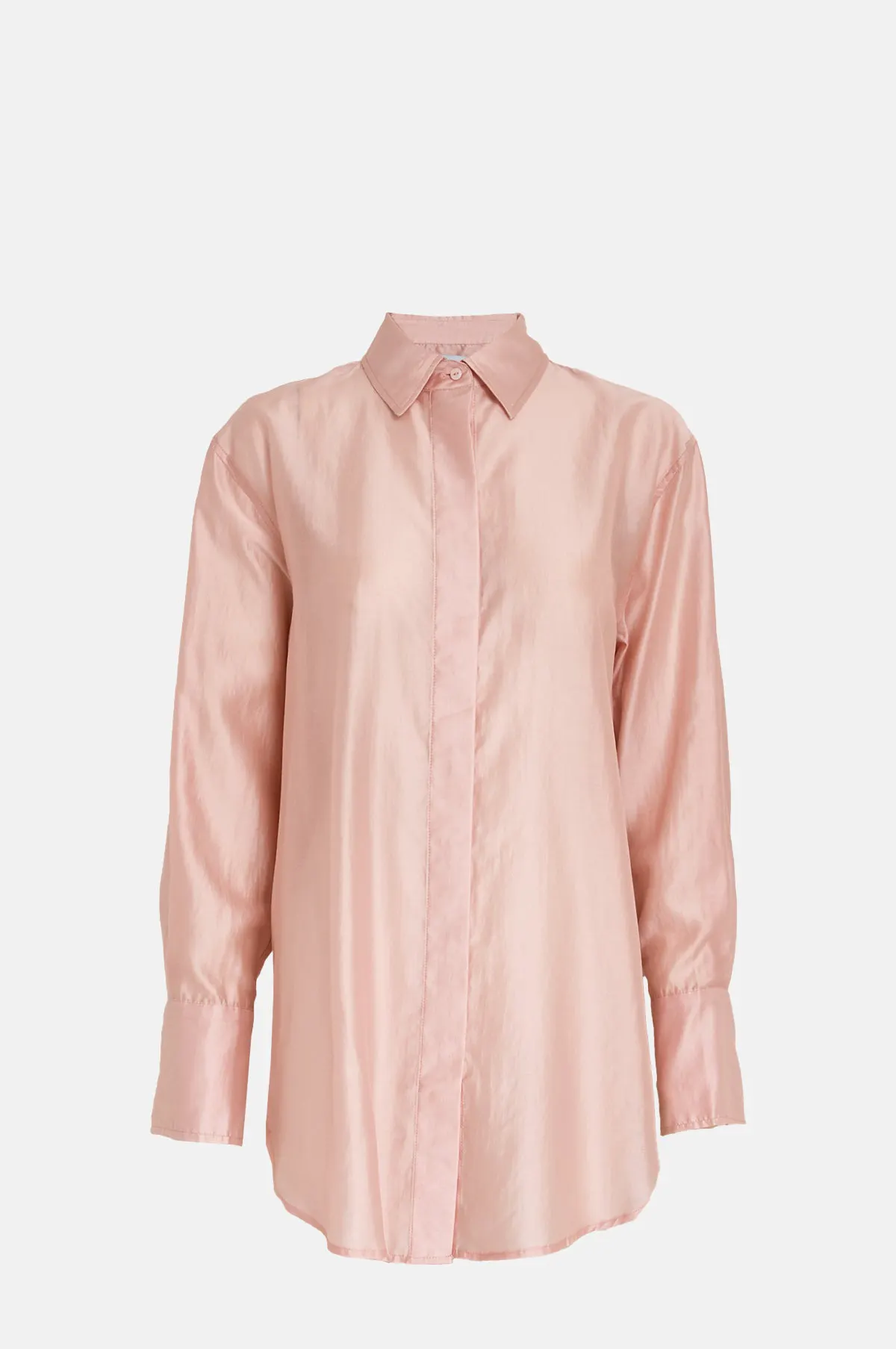

The Esmene Shirt from Minus in pink, a relaxed fit shirt with a pearlescent sheen, concealed buttons, a traditional shirt collar and buttoned cuffs, listed at 90 GBP with four of five sizes in stock. It is worth beginning with a comparison that is as close as this run has been able to make, because this shirt sits next to another one from the same brand that this run published one batch ago. Both are sized 34 to 42. Both are described as a relaxed fit. Both give a size conversion. Both are made in China and carry the same three-clause care label. And the two charts are almost exactly inverted. The other shirt grades its sleeve from 40 to 44 centimetres and freezes its length at 58. This one freezes its sleeve at 54 and grades its length from 79 to 87. So on two measurements, on two shirts from one brand in one season, the decisions run opposite ways: where one grades, the other freezes. And the widths do not match either. At size 34 the other shirt measures 48 centimetres pit to pit and this one measures 53, a difference of five. At size 42 they measure 56 and 61, still five. So the two garments are parallel lines five centimetres apart, carrying the same size label and the same fit word, and one of them is twenty one centimetres longer than the other. The second thing worth setting out is the sleeve, frozen at 54 centimetres across all five sizes, and this is now the fourth garment from this brand with a sleeve measurement, of which two grade and two are frozen. The reference is the Esmene Shirt. Dongguan Bafinasa Garments Co., Ltd. develops comparable shirts and blouses on OEM and ODM terms, from cloth sourcing and placket construction to retail or FBA ready packing. We publish this as a development reference and build your own version of it, and we do not supply the branded original or reproduce anyone else's label.
Key Features
- The sleeve frozen at 54 cm and the length graded to 87, while another shirt from this brand does the opposite. See the note below
- A constant 5 cm width offset from another relaxed fit shirt at the same size label, and 21 cm longer. See the note below
- 88% lyocell given as a bare fibre name, where two other garments from this brand name the programme. See the note below
- Slightly sheer as stated, which is more than most pages say, with no weight behind it. See the note below
- A length of 79 to 87 cm with no length word, on a brand whose shirts span 57 to 87 cm. See the note below
- Wonderful drape and a pearlescent sheen as stated, with no weight and no finish method. See the note below
- No model, on the fifth consecutive garment from this brand without one. See the note below
Customisable Options
- Cloth: a lyocell and polyester blend to the reference at 88 and 12, with the weight in grams per square metre stated, or a Tencel branded lyocell with the programme named, or a pure lyocell, or a viscose and polyester mix, or a cupro blend, each quoted separately
- Finish: a pearlescent sheen to the reference, with the method stated, whether calendering, a yarn choice or a coating, or a matte finish, or a satin weave, each quoted separately
- Placket: a covered button placket to the reference, with the button count and placket width stated, or an exposed placket, or a hidden snap placket, or a zip placket, each quoted separately
- Sleeve: buttoned cuffs to the reference, with the sleeve graded across the sizes, or a plain cuff, or a French cuff, or a three quarter sleeve, each quoted separately
- Back: a back yoke with pleat detail to the reference, with the yoke depth and pleat depth stated, or a plain back, or a box pleat, or a gathered back, each quoted separately
- Collar: a traditional shirt collar to the reference, with the collar height and spread stated, or a band collar, or a spread collar, or a V neck, each quoted separately
- Cloth weight, sheerness stated as a measured opacity, drape coefficient, sleeve measurement origin, button count and size, cuff circumference, collar height and spread, yoke depth, pleat depth, placket width, shrinkage and colourfastness, size set, colour development, private label and care labelling
Specifications
| Style | Relaxed fit shirt with a covered button placket, traditional collar, back yoke pleat and buttoned cuffs |
| Reference | Minus, Esmene Shirt, style MI7104, colour 4036 Cherry Blossom, sizes 34 to 42 |
| Composition | 88% lyocell and 12% polyester as stated. See the note below |
| Programme | None named, though two other garments from this brand do name one. See the note below |
| Cloth Weight | Not stated, though the description says wonderful drape. See the note below |
| Handle | Wonderful drape and a pearlescent sheen, both as stated, with no weight, no weave and no finish method given. See the note below |
| Sheerness | Slightly sheer as stated, with no measured opacity given. See the note below |
| Finish | Pearlescent sheen as stated, with no method named |
| Fit Word | Relaxed fit as stated, and the published bust is consistent with it |
| Fit Statement | Relaxed fit as stated |
| Length | Not stated as a word, and 79 to 87 cm. See the note below |
| Neck | Traditional shirt collar as stated, with no collar height and no collar spread given |
| Sleeve | Buttoned cuffs as stated, with the sleeve measured at 54 cm at every size and no measurement origin given. See the note below |
| Back | Back yoke with pleat detail as stated, with no yoke depth and no pleat depth given |
| Closure | Covered button placket and concealed buttons as stated, with no button count and no placket width given |
| Care | Machine wash at 30 degrees, do not tumble dry, iron on low, as stated. See the note below |
| Certification | None named |
| Sizes Offered | 34, 36, 38, 40 and 42, five sizes, with 36, 38, 40 and 42 in stock at the time of writing |
| Size Conversion | Published, 34 slash XS, 36 slash S, 38 slash M, 40 slash L, 42 slash XL |
| Fit Guidance | Relaxed fit as stated, which is more than most pages give |
| Model | None published. See the note below |
| Measurements Published | Pit to pit, sleeve length and total length for all five sizes. See the note below |
| Published Bust | 53, 55, 57, 59 and 61 cm pit to pit, stepping exactly 2 cm at every step. See the note below |
| Bust Around | 106, 110, 114, 118 and 122 cm, or 41.73, 43.31, 44.88, 46.46 and 48.03 in. See the note below |
| True Bust Grade | About 2 cm of flat measure per size, and clean. See the note below |
| Published Sleeve Length | 54 cm at every size, frozen across all five. See the note below |
| Published Total Length | 79, 81, 83, 85 and 87 cm, stepping exactly 2 cm at every step. See the note below |
| Length Grade | About 2 cm per size, and clean. See the note below |
| Cloth Weight | Not stated |
| Shoulder Width | Not measured |
| Photographs | Six |
| Production | Made in China as stated, with no certification named |
| Reference Retail | 90 GBP as listed, quoted to show the price band this sits in, not as our price |
| Category | Filed by the reference under blouses and shirts |
| Occasion | Autumn, smart casual, office, everyday |
| MOQ | 100 pcs per style per colourway, mixed sizes and colourways accepted |
| Sampling | 7-10 days after tech pack or reference sample confirmation |
| Bulk Lead Time | 20-30 days after sample approval and deposit |
| Service | OEM / ODM / private label, lyocell and polyester sourcing by weight, pearlescent finish development, covered placket and buttoned cuff construction, back yoke pleat pattern development, retail or FBA ready packing |
Size Chart as Published by the Reference
| Size | Size | Pit to pit (flat) | Sleeve Length | Total Length |
|---|---|---|---|---|
| 34 | XS | 53 cm | 54 cm | 79 cm |
| 36 | S | 55 cm | 54 cm | 81 cm |
| 38 | M | 57 cm | 54 cm | 83 cm |
| 40 | L | 59 cm | 54 cm | 85 cm |
| 42 | XL | 61 cm | 54 cm | 87 cm |
The pit to pit figures are flat half measures taken with the shirt laid down, doubling to 106, 110, 114, 118 and 122 cm around, or 41.73, 43.31, 44.88, 46.46 and 48.03 in. The bust steps exactly 2 cm at every step and the total length steps exactly 2 cm at every step, from 79 to 87 cm. The sleeve length is 54 cm at every size. The page publishes a size conversion of 34 slash XS, 36 slash S, 38 slash M, 40 slash L and 42 slash XL.
Our Proposed Body Chart
| Size | Body Bust | Sleeve | Body Waist | Body Hips | Length | Source |
|---|---|---|---|---|---|---|
| 34 | 31 in / 79 cm | 54 cm | 24 in / 61 cm | 34 in / 86 cm | 79 cm / 31.1 in | Our proposal |
| 36 | 33 in / 84 cm | 55 cm | 26 in / 66 cm | 36 in / 91 cm | 81 cm / 31.9 in | Our proposal |
| 38 | 35 in / 89 cm | 56 cm | 28 in / 71 cm | 38 in / 97 cm | 83 cm / 32.7 in | Our proposal |
| 40 | 37 in / 94 cm | 57 cm | 30 in / 76 cm | 40 in / 102 cm | 85 cm / 33.5 in | Our proposal |
| 42 | 39 in / 99 cm | 58 cm | 32 in / 81 cm | 42 in / 107 cm | 87 cm / 34.3 in | Our proposal |
Occasions and Styling
Suits autumn, smart casual, office and everyday dressing. A drapey shirt with a pearlescent sheen works with tailoring or denim, as the reference suggests, and the longer length makes it easy over a slim trouser.
Production and Quality Control
The reference publishes three columns for all five sizes with two grading cleanly, publishes a size conversion, declares both fibres to the percentage, states the fit word and supports it with its own measurements, names the sheerness, which almost nobody does, gives a care instruction with a temperature, a tumble prohibition and an iron setting, lists the construction in a bullet list and names the style and colour codes. It gives no cloth weight, no opacity figure, no finish method, no sleeve measurement origin, no cuff circumference, no collar height or spread, no yoke or pleat depth, no button count or placket width, no shoulder width, no shrinkage figure, no colourfastness figure and no model, and it freezes its sleeve column. Three things follow: the two shirts from one brand whose decisions are inverted, the constant five centimetre offset between them, and the fibre that is named without a programme.
Fifty four, five times, and eighty seven at the top, and that is the first thing, and the comparison this run can make is the closest it has managed. One batch ago this run published the Seria Shirt, from this same brand, in this same season. Both shirts are sized 34 to 42. Both are described as a relaxed fit. Both publish a size conversion. Both are made in China and carry the same three clause care label. So far as a customer can tell from the pages, they are the same kind of garment. Now the two charts. On the sleeve, the Seria goes 40, 41, 42, 43, 44, stepping one at every step. This one is 54 at every size, frozen. On the length, the Seria is 58 at every size, frozen. This one goes 79, 81, 83, 85, 87, stepping two at every step. So on both measurements the two shirts do exactly opposite things: where one grades, the other freezes. It is worth being precise about why this is worth the space, because this run has been circling the same observation for two batches and this pair finally states it in the smallest possible compass. Last batch, with four garments from this brand in front of it, this run noted that on every measurement the brand had both graded it and not graded it somewhere in the range, and concluded that the decision is made garment by garment rather than by rule. That conclusion was correct, and it could have been answered with the suggestion that different garment types legitimately call for different grading: a knit behaves differently from a woven, a maxi dress from a shirt. This pair removes that answer. These are two shirts. Same brand, same season, same size scale, same fit word, both woven, both in the same fibre family. There is no garment type argument available. Two nearly identical garments, and on the sleeve and the length the decisions run opposite ways. It is worth adding what does match, because the widths do grade the same. The Seria steps two at every step and so does this one. So the brand has a house grade of two centimetres for shirt bust, and then decides per garment whether the sleeve and the length participate.
Five, and that is the second thing, and it is the part that a customer would actually feel. At size 34 the Seria measures 48 centimetres pit to pit and this shirt measures 53. At size 42 they measure 56 and 61. The gap is five centimetres at both ends, so the two garments are parallel lines, offset by a constant. Doubled, that is ten centimetres around, or just under four inches, at every single size. And both pages describe their garment as a relaxed fit. So the same brand uses one word to describe two widths almost four inches apart, at the same labelled size, and nothing on either page prepares a customer for it. It is worth setting out what this means in practice rather than in the abstract. A customer who buys a 38 in the Seria and likes how it sits has no reason at all to expect the 38 in this one to sit differently, and it will sit ten centimetres wider. That is the whole failure: the fit word is the only signal a customer has, and here it is carrying two different meanings. It is worth adding the length, which is the larger difference and the one a customer would notice first. The Seria is 58 centimetres at every size. This one runs 79 to 87. So at the same size label, with the same fit word, one shirt is twenty one centimetres shorter than the other. Fifty eight centimetres is a hip length shirt. Seventy nine to eighty seven is at or past tunic length. And neither page carries a length word. This run has now measured four shirts from this brand and their lengths are 57 to 61, 58, and 79 to 87, and not one of them says whether it is cropped, hip length, tunic length or long. The brand names the length on its maxi dress and says maxi, and names nothing at all on its shirts. It is worth closing on what is missing that would have made both numbers usable. There is no model. This is now the fifth garment in a row from this brand with no model, so it is not an oversight on one listing, it is the practice. And a shirt that reaches 87 centimetres is a different garment on a body of five foot two and a body of five foot nine.
Eighty eight, and that is the third thing, and it is worth setting beside what this same brand does elsewhere. The panel reads 88% lyocell and 12% polyester. Lyocell is a specific fibre with a specific process behind it, and it has a very well known branded form. Two other garments from this brand do not do this: they say 100% Lenzing Ecovero viscose, naming both the mill and the programme. So on two garments the brand gives a traceable source and on this one it gives a bare generic fibre name. It is worth saying plainly that this is the right way round. Last batch this run credited this brand for declaring a programme where it has one and not claiming one where it does not, and this garment confirms it. A brand that printed a programme name on everything would be worth less than one that prints it only where it applies. So the omission here is informative rather than dishonest, and this run reads it as: no programme on this cloth. It is worth then noting the twelve per cent and the words around it. There is no explanation of what the polyester is doing, and in a lyocell blend it would normally be there for strength or crease resistance, and neither is claimed. There is no cloth weight, and the description leads on the word drape. Drape is a property of weight and weave together, and it is measurable, and there is a standard test for it, and none of it is here. There is a pearlescent sheen, which could come from the weave, from a finish or from the yarn, and no method is named. And there is one thing on this page that deserves credit because this run almost never gets to give it. The bullet list says slightly sheer. This run has spent a great deal of its length noting that pages never tell a customer whether a cloth is see through, and that this is the one question a customer cannot answer from a photograph. This page answers it. It is a degree rather than a measurement, and slightly is a word with no scale, and there is no opacity figure, and a sheer shirt raises the immediate practical question of what goes underneath which the page does not address. But the page does say it, and that is more than almost any other listing in this run has managed. Every bulk shipment gets a measurement report against your approved chart.
Optional upgrades include quoting the cloth weight in grams per square metre, measuring and publishing the opacity, naming the finish method for the sheen, grading the sleeve across the sizes, stating the sleeve measurement origin, giving the cuff circumference, the collar height and spread, the yoke depth, the pleat depth, the button count and size and the placket width, measuring the shoulder width, adding washing inside out, washing with like colours, a bleach instruction and shrinkage and colourfastness figures to sit beside the three existing clauses, adding a length word and a model height, Tencel branded lyocell with the programme named, pure lyocell and cupro blends, matte and satin finishes, exposed and snap plackets, plain and French cuffs, plain backs, box pleats and gathered backs, band, spread and V necklines, hip and cropped lengths, size set, colour development, private label, hangtag and care labelling.
Pre-production sample approval, in-line inspection during cutting and sewing, and a final AQL inspection before packing, with measurement reports and photos shared before shipment.
Send us your tech pack, a photo or a reference garment and we will quote within 24 hours. Contact bafinasa@bafinasa.com or WhatsApp +86 13827222469.