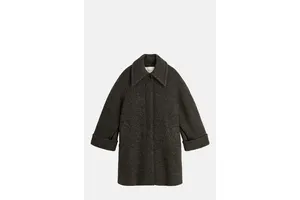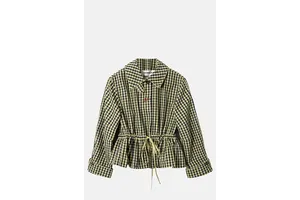
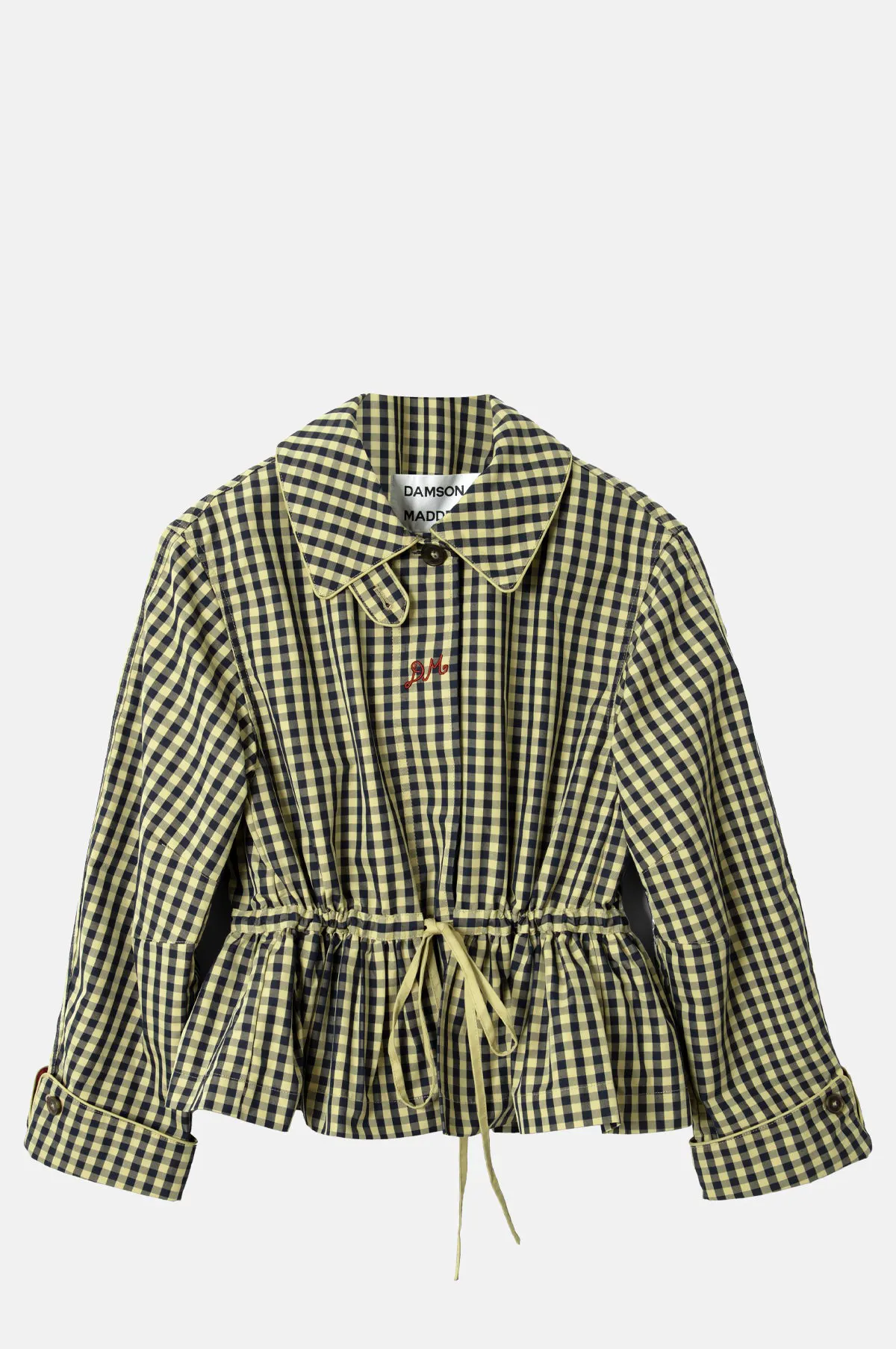

The Myrtle Trench Coat from Damson Madder in navy gingham, cut with an intentionally oversized fit, wearable full length or as a short jacket with the skirt buttoned off, with contrast piping, a button closure, a frill at the waist with an adjustable tie and a water-repellent finish, listed at 180 GBP with all six sizes in stock. It is worth beginning with the chart, because it is the best this run has read from this brand and one of the best in the run. The pit to pit runs 48 to 58 centimetres, stepping exactly two at every step. The sleeve runs 53 to 58, stepping exactly one at every step. The total length runs 118 to 123, stepping exactly one at every step. Three columns, six sizes, fifteen numbers, and every column grades cleanly with no blocks, no wobble and no frozen column. It is worth saying what makes that notable here specifically, because this run has been finding that long garments are where grading tends to give out. At 118 to 123 centimetres this is the second longest garment this run has measured, and it grades. It is worth then turning to the one thing the chart cannot do, which is describe this garment. The headline feature is that it converts: it can be worn full length, or with the skirt buttoned off to make a short jacket. So it has two lengths. The chart publishes one. The full length is there, at 118 to 123 centimetres, and the short jacket length is not given anywhere, and the button-off line that would produce it is not located either. The reference is the Myrtle Trench Coat. Dongguan Bafinasa Garments Co., Ltd. develops comparable outerwear on OEM and ODM terms, from cloth sourcing and functional finishes to retail or FBA ready packing. We publish this as a development reference and build your own version of it, and we do not supply the branded original or reproduce anyone else's label.
Key Features
- Three columns, six sizes, all three grading cleanly at 2, 1 and 1 cm, which is the best chart this run has read from this brand. See the note below
- Wearable as a trench or as a short jacket, and one length published, with no short-jacket length and no button-off line given. See the note below
- Oversized fit as stated, at about 5 to 7 in of ease, against 17 to 19 in on this run's oversized sweatshirt. See the note below
- Water-repellent finish as stated, and breathable fabric as stated, with no rating and no breathability value on either. See the note below
- A frill at the waist with an adjustable tie, and no waist measurement at all. See the note below
- Machine wash at 30 degrees and nothing else, on the most complex garment in this batch. See the note below
- Navy gingham as named, and gingham is a weave, stated in the colour name and nowhere in the specification. See the note below
Customisable Options
- Cloth: a cotton and polyester blend to the reference at 64 and 36, with the weight in grams per square metre stated, or a cotton rich twill, or a recycled polyester blend, or a coated cotton, or a yarn dyed gingham in a heavier weight, each quoted separately
- Finish: a water-repellent finish to the reference, with the spray test rating stated and the durability in washes tested, or a waterproof membrane, or taped seams, or an unfinished cloth, each quoted separately
- Construction: a button-off skirt to the reference, with the jacket length and the button-off line position stated, or a fixed length trench, or a detachable skirt with a zip, or a reversible two-piece, each quoted separately
- Waist: a frill with an adjustable tie to the reference, with the frill depth, the tie length and the waist measured, or a plain waist seam, or a belted waist, or a drawcord waist, each quoted separately
- Fit: an oversized fit to the reference, with the ease agreed at every size and the layering room stated, or a regular fit, or a relaxed fit, each quoted separately
- Detail: contrast piping to the reference, with the piping width and fibre stated, or self piping, or a plain seam, or a bound seam, each quoted separately
- Cloth weight, spray test rating and durability in washes, breathability value, jacket length and button-off line position, button count and size, frill depth and tie length, waist measurement, gingham check size and repeat, piping width and fibre, shrinkage figures, size set, colour development, private label and care labelling
Specifications
| Style | Oversized trench coat with a button-off skirt, contrast piping, a button closure, a frill at the waist with an adjustable tie and a water-repellent finish |
| Reference | Damson Madder, Myrtle Trench Coat, style PF26-DM-3820, colour Navy Gingham, sizes 6 to 16 UK |
| Composition | 64% cotton and 36% polyester as stated |
| Cloth Weight | Not stated, in any form |
| Weave | Gingham, which is both a weave and a check, given in the colour name and nowhere in the specification. See the note below |
| Handle | Breathable as stated, with no breathability value given. See the note below |
| Finish | A water-repellent finish as stated, which is more than most pages name, with no spray test rating, no durability in washes and no reproofing guidance. See the note below |
| Fit Word | Oversized fit as stated, and the ease is about 5 to 7 in. See the note below |
| Fit Statement | Intentionally oversized fit for easy layering, as stated. See the note below |
| Length | Not stated as a word, and 118 to 123 cm full length, with no jacket length published. See the note below |
| Configurations | Two: full length, and a short jacket with the skirt buttoned off, with only one length published. See the note below |
| Button-Off Line | Not located, so the jacket length is not given. See the note below |
| Sleeve | 53 to 58 cm as published, with no measurement origin and no cuff circumference given |
| Waist | A frill and an adjustable tie as stated, with no waist measurement, no frill depth and no tie length given. See the note below |
| Closure | Button closure as stated, with no button count and no button size given. See the note below |
| Detail | Contrast piping as stated, with no piping width and no piping fibre given |
| Branding | DM embroidery as stated, with no size and no placement given |
| Pockets | Not stated |
| Care | Machine wash at 30 degrees as stated, and nothing else. See the note below |
| Certification | None named |
| Sizes Offered | 6, 8, 10, 12, 14 and 16 UK, six sizes, all six in stock at the time of writing |
| Size Conversion | None published, though UK sizes are largely self describing |
| Fit Guidance | Oversized fit, and intentionally oversized for easy layering, both as stated, which is more than most pages give |
| Model | None published, on the second longest garment in this run. See the note below |
| Measurements Published | Pit to pit, sleeve length and total length for all six sizes, all three grading cleanly. See the note below |
| Published Bust | 48, 50, 52, 54, 56 and 58 cm pit to pit, stepping exactly 2 cm at every step |
| Bust Around | 96, 100, 104, 108, 112 and 116 cm, or 37.80, 39.37, 40.94, 42.52, 44.09 and 45.67 in. See the note below |
| True Bust Grade | About 2 cm of flat measure per size, and clean |
| Ease at the Bust | About 6.8 in at a UK 6 falling to about 4.7 in at a UK 16. See the note below |
| Published Sleeve Length | 53, 54, 55, 56, 57 and 58 cm, stepping exactly 1 cm at every step |
| Published Total Length | 118, 119, 120, 121, 122 and 123 cm, stepping exactly 1 cm at every step |
| Jacket Length | Not published. See the note below |
| Cloth Weight | Not stated |
| Photographs | Six |
| Production | Made in China as stated, with no certification named |
| Reference Retail | 180 GBP as listed, quoted to show the price band this sits in, not as our price |
| Category | Filed by the reference under coats and jackets |
| Occasion | Autumn, spring, light rain, outerwear, layering |
| MOQ | 100 pcs per style per colourway, mixed sizes and colourways accepted |
| Sampling | 7-10 days after tech pack or reference sample confirmation |
| Bulk Lead Time | 20-30 days after sample approval and deposit |
| Service | OEM / ODM / private label, cotton and polyester sourcing by weight, water-repellent finish application with the spray rating tested, convertible button-off skirt development with both lengths graded, gingham and check development with the repeat set, retail or FBA ready packing |
Size Chart as Published by the Reference
| Size | Pit to pit (flat) | Sleeve Length | Total Length |
|---|---|---|---|
| 6 | 48 cm | 53 cm | 118 cm |
| 8 | 50 cm | 54 cm | 119 cm |
| 10 | 52 cm | 55 cm | 120 cm |
| 12 | 54 cm | 56 cm | 121 cm |
| 14 | 56 cm | 57 cm | 122 cm |
| 16 | 58 cm | 58 cm | 123 cm |
The pit to pit figures are flat half measures taken with the coat laid down, doubling to 96, 100, 104, 108, 112 and 116 cm around, or 37.80, 39.37, 40.94, 42.52, 44.09 and 45.67 in. Set against bodies of roughly 31 to 41 in across a UK 6 to 16, that is ease of about 6.8 in at the smallest size falling to about 4.7 in at the largest. The bust steps exactly 2 cm, the sleeve exactly 1 cm and the total length exactly 1 cm at every step, so all three columns grade cleanly across all six sizes. The published length is the full length only: the reference states the coat can also be worn as a short jacket with the skirt buttoned off, and no length is given for that configuration.
Our Proposed Body Chart
| Size | Body Bust | Sleeve | Body Waist | Body Hips | Length | Source |
|---|---|---|---|---|---|---|
| 6 | 31 in / 79 cm | 53 cm | 24 in / 61 cm | 34 in / 86 cm | 118 cm / 46.5 in | Our proposal |
| 8 | 33 in / 84 cm | 54 cm | 26 in / 66 cm | 36 in / 91 cm | 120 cm / 47.2 in | Our proposal |
| 10 | 35 in / 89 cm | 55 cm | 28 in / 71 cm | 38 in / 97 cm | 122 cm / 48 in | Our proposal |
| 12 | 37 in / 94 cm | 56 cm | 30 in / 76 cm | 40 in / 102 cm | 124 cm / 48.8 in | Our proposal |
| 14 | 39 in / 99 cm | 57 cm | 32 in / 81 cm | 42 in / 107 cm | 126 cm / 49.6 in | Our proposal |
| 16 | 41 in / 104 cm | 58 cm | 34 in / 86 cm | 44 in / 112 cm | 128 cm / 50.4 in | Our proposal |
Occasions and Styling
Suits autumn, spring and light rain. A convertible trench covers a long dress or a trouser suit, and the button-off skirt makes it two coats in one for travel.
Production and Quality Control
The reference publishes three columns for all six sizes with every column grading cleanly, states the fit word and the reason for it, names the finish, states that the garment converts and how, carries all six sizes in stock, gives a care instruction with a temperature, states the country of manufacture, lists the construction in a bullet list and names the style code. It gives no cloth weight, no spray test rating, no breathability value, no jacket length or button-off line position, no button count or size, no waist measurement, no frill depth, no tie length, no piping width or fibre, no sleeve measurement origin, no pocket statement, no shrinkage figure, no size conversion and no model, and its care label is one clause on the most complex garment in this batch. Three things follow: the chart that grades properly and still cannot describe the garment, the oversized claim that gives less room than a sweatshirt, and the two properties claimed with no number on either.
Two, one, one, and that is the first thing, and it is worth giving the credit plainly because this run does not often get to. The bust goes 48, 50, 52, 54, 56 and 58, stepping exactly two centimetres at every step. The sleeve goes 53 through 58, stepping exactly one. The length goes 118 through 123, stepping exactly one. Three columns, six sizes, fifteen numbers, and there is no block, no wobble, no frozen column and no step that disagrees with its neighbours. It is worth saying why this matters more here than it would on a shorter garment, because this run has been finding the opposite. At 118 to 123 centimetres this is the second longest garment this run has measured, and the run has now watched a coat at 74 to 76 centimetres fail to grade its sleeve, and a dress at 136 to 140 manage it. So the pattern has been that length is where grading gives out. This coat is the longest thing this brand has offered in this run and it grades all three columns properly. It is worth then turning to the thing the chart cannot do, which is the more interesting problem. The headline feature of this garment is that it converts. It can be worn full length, or the skirt buttons off and it becomes a short jacket. So it is two garments and it has two lengths. The chart publishes one: 118 to 123 centimetres, which is the full length. The jacket length is not given, and neither is the position of the button-off line, which is the same thing stated differently, because the line where the skirt comes off is exactly where the jacket ends. It is worth saying that this run has met this before and can now call it a class rather than a one off. Two batches ago it published a sweatshirt with a high low hem, meaning a front and a back of different lengths, and that page published one total length and did not say which of the two it was. That was the same shape of problem in miniature: a garment with two lengths, one number. Here it is the same problem at full size, because the two configurations are not two ends of one garment, they are two different garments, and one of them has no measurements at all. It is worth adding what else the conversion costs, which is the buttons. A skirt that buttons off needs a run of buttons around the waist, and the page says button closure and gives no count and no size, so a customer cannot tell how the two halves join or how secure the join is. It is worth closing on the missing model, because it is the same gap as the length and it compounds it. There is no model, and this is the second longest garment in this run, and the brand published a model height and size on a skirt one batch ago, so it is not a house policy. It is per garment.
Five, and that is the second thing, and it needs the other oversized garments in this run beside it to make sense. The pit to pit runs 48 to 58 centimetres, doubling to 96 to 116 centimetres around, or about 38 to 46 inches, against bodies of roughly 31 to 41. So the ease is about 6.8 inches at a UK 6 and about 4.7 at a UK 16. The word oversized is in the bullets and it is explained in the description, which says intentionally oversized fit for easy layering. It is worth testing both halves of that, because the page gives two claims and they do not fare the same. Is it oversized? At five to seven inches of ease, moderately, yes. It is worth setting that beside the other oversized garments this run has measured, because the spread is now wide enough to be the finding. A sweatshirt from this run was called oversized at seventeen to nineteen inches of ease. A coat from another brand was called oversized at twelve to fifteen. This one is called oversized at five to seven. So one word, in this run, covers nearly four times as much room at one end as at the other, and the garment with the least room in it is the coat, which is the one worn over other clothes. That is worth saying twice: an oversized sweatshirt gives a customer three times as much room as an oversized trench coat. It is worth then taking the second half of the claim, which is the reason given. For easy layering. And 4.7 inches of ease at a UK 16 is about an inch and a half of thickness available around the body for whatever goes underneath. That is a shirt, or a fine knit. It is not a chunky knit, and this is an autumn coat. It is worth noting the direction as well, which is the part the run has learned to look for. The ease falls from about 6.8 inches to about 4.7 across the range, because the coat grades two centimetres flat, or about an inch and a half around, while bodies grow about two inches a size. So the layering room is at its smallest exactly where the body is at its largest. It is worth being fair that a larger body is not a taller body and not necessarily a thicker one, and that five inches of ease is a defensible amount of room. But the page says easy layering and gives no figure, so a customer cannot tell whether the chunky knit she has in mind fits under it, and the number that would tell her is one subtraction away from the numbers on the page.
Water-repellent, and breathable, and that is the third thing, and the page is unusual in one respect and ordinary in another. It is unusual in that it says finish. This run has now read several garments making claims about water: one said water repellent and named nothing, another said relatively waterproof and named nothing, and this one says water-repellent finish, which at least tells a customer that the resistance comes from something applied to the cloth rather than from the cloth itself or a membrane inside it. That is worth crediting and it costs one word. It is worth then noting what is still missing, and it is the same list as before: no spray test rating, no hydrostatic head, no durability in washes, no reproofing guidance, no statement about the seams, and no statement about the chemistry of the finish. It is worth then setting the second claim beside it, because this is where this page differs from the others and the difference matters. The description also says the coat is made from a breathable fabric. So the page claims that water stays out and that vapour gets out, and those two properties work against each other in practice: a finish that stops rain also slows the passage of moisture from inside. There is no number on either. No spray rating, and no breathability value. And this is the exact place where a number is not a nicety but the whole point, because claiming two things that trade off against each other, and quantifying neither, tells a customer nothing she can act on. It is worth closing on the care label, because it is the shortest on the most complicated garment and the run has now seen this at two brands. The label reads machine wash at 30 degrees. One clause. Nothing else. This run published a tee from this same brand in this same batch with two clauses, including do not tumble dry, and a sweatshirt with two as well. So the most complex and most expensive garment in this batch, at 180 pounds with a functional finish and a construction that comes apart into two garments, has the shortest label of the three. And the two things it most needs are the two it does not have. A water-repellent finish is degraded by tumble drying and by heat, and there is no tumble instruction at all. And a finish wears off in washing and has to be renewed, and there is no reproofing guidance. Every bulk shipment gets a measurement report against your approved chart.
Optional upgrades include publishing the jacket length and the position of the button-off line so both configurations are measured, testing and publishing a spray test rating, the durability of the finish in washes and a breathability value, giving reproofing guidance and a tumble instruction, quoting the cloth weight, giving the button count and size, the waist measurement, the frill depth and the tie length, the sleeve measurement origin and the cuff circumference, the gingham check size and repeat and whether the check is matched, the piping width and fibre, adding shrinkage figures to the label and publishing a model height and a size conversion, cotton rich and recycled polyester blends, waterproof membranes, taped seams, fixed length trenches, zip-off and reversible two-piece options, plain waist seams and belted waists, self piping and bound seams, regular and relaxed fits, size set, colour development, private label, hangtag and care labelling.
Pre-production sample approval, in-line inspection during cutting and sewing, and a final AQL inspection before packing, with measurement reports and photos shared before shipment.
Send us your tech pack, a photo or a reference garment and we will quote within 24 hours. Contact bafinasa@bafinasa.com or WhatsApp +86 13827222469.