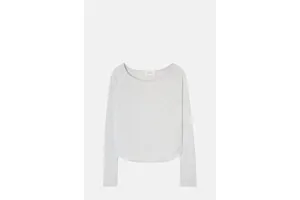
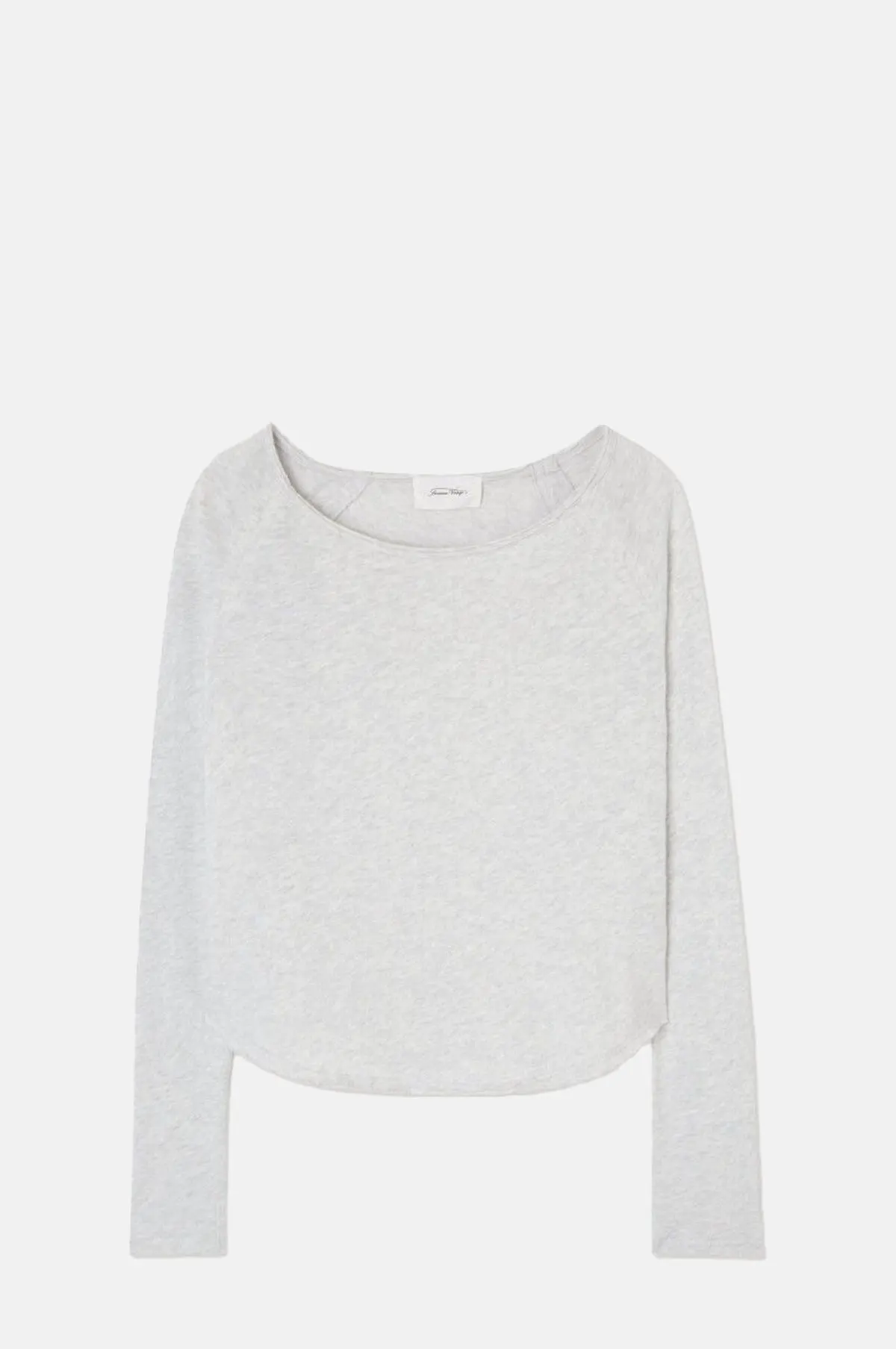

The Sonoma Boat Neck Tee from American Vintage in Arctique Chine, which the page explains is a light grey, slightly thicker than a tee and less so than a sweat, with a flattering boat neckline and long raglan set sleeves, the pure cotton fabric very slightly textured and the edge left raw beyond the hems, listed at 70 GBP with all three sizes in stock. It is worth beginning with the chart, because it fails in three different directions at once and this run has not met that before. The chest runs 48, 52 and 52 centimetres, so it jumps four and then stops: the medium and the large are the same width. The sleeve length runs 74, 76 and 72, so it goes up by two and then down by four: the large sleeve is shorter than the medium sleeve. The total length runs 56, 57 and 62, so it goes up by one and then up by five. Nine numbers, three columns, and no two of them fail in the same way. It is worth being precise about the sleeve, because it is the first time this run has found a measurement that gets smaller as the size gets larger. This run has found grades that slow down and grades that stop entirely, and both of those are decisions a brand can make. A grade that runs backwards is not a decision: a large cannot have less sleeve than a medium. It is worth then working out what the nine numbers do to the wearer, because the chest is the one that bites. Taking the figures as flat half measures, which is the only reading that gives sane circumferences, the chest comes out at about 37.8 inches on a small and about 40.9 on both the medium and the large. Against bodies of roughly 34, 37 and 40 inches, that is about 3.8 inches of ease on the small, about 3.9 on the medium, and about 0.9 on the large. So the largest size is the tightest, by three inches. The reference is the Sonoma Boat Neck Tee. Dongguan Bafinasa Garments Co., Ltd. develops comparable tops on OEM and ODM terms, from cloth sourcing to retail or FBA ready packing. We publish this as a development reference and build your own version of it, and we do not supply the branded original or reproduce anyone else's label.
Key Features
- A chest stepping 4 and then 0, so the medium and the large are the same width and the largest size has the least ease. See the note below
- A sleeve length stepping +2 and then -4, which is the first grade in this run to run backwards. See the note below
- A total length stepping 1 and then 5, so no two columns on the chart fail the same way. See the note below
- Long, raglan set sleeves as stated, and raglan is measured from the neckline, which explains the 74 to 76 cm and is not declared. See the note below
- A boat neckline as stated, with no neck width and no neck depth. See the note below
- A weight given by comparison, slightly thicker than a tee and less so than a sweat, with no figure. See the note below
- 100% cotton as stated, with a raw edge beyond the hems and no width given for it. See the note below
Customisable Options
- Cloth: a cotton jersey to the reference, slightly heavier than a tee, with the weight in grams per square metre stated, or a lighter jersey, or a sweatshirting, or a slub cotton, or an organic cotton, or a cotton and modal mix, each quoted separately
- Neck: a boat neckline to the reference, with the neck width and depth stated, or a crew neck, or a V neck, or a wide scoop, each quoted separately
- Sleeve: raglan set sleeves to the reference, with the sleeve length measured from the neckline and the start point declared and the cuff opening given, or a set-in sleeve, or a dropped shoulder, or a three quarter sleeve, each quoted separately
- Hem: a raw edge beyond the hem to the reference, with the width of the raw edge stated, or a clean hem, or a turned hem, or a rolled hem, each quoted separately
- Sizes: three sizes to the reference, graded evenly across the chest, sleeve and length, or a graded range from XS to XL, or a graded range from S to XXL, each quoted separately
- Texture: a very slightly textured cotton to the reference, with the texture described and the weight stated, or a smooth jersey, or a slub jersey, or a rib, each quoted separately
- Cloth weight, neck width and depth, sleeve measurement start point, cuff opening, raw edge width, shoulder width, hem circumference, shrinkage figures, size set, colour development, private label and care labelling
Specifications
| Style | Long sleeve cotton tee with a boat neckline, raglan set sleeves and a raw edge beyond the hems |
| Reference | American Vintage, Sonoma Boat Neck Tee, style SON31GE26, colour Arctique Chine, which the page explains is a light grey, sizes S to L |
| Composition | 100% cotton, as stated in the panel and as pure cotton in the description |
| Cloth Weight | Not stated as a figure. The description says slightly thicker than a tee and less so than a sweat. See the note below |
| Weave | Not stated |
| Handle | Very slightly textured as stated, with no weight and no finish given. See the note below |
| Fit Word | None stated |
| Fit Statement | None stated, though the description says it drapes as a between season layer |
| Sizes Offered | S, M and L, three sizes, all three in stock at the time of writing |
| Size Conversion | None published |
| Model | None published |
| Length | Not stated as a word, and 56, 57 and 62 cm. See the note below |
| Neck | Boat neckline as stated, and flattering boat neckline in the description, with no neck width and no neck depth given. See the note below |
| Sleeve | Long, raglan set sleeves as stated, measured at 74, 76 and 72 cm, with no cuff opening given and no start point declared. See the note below |
| Hem | Edge left raw beyond the hems as stated, with no width given for the raw edge. See the note below |
| Care | Wash on delicate cycle at 30 degrees and iron at low heat, as stated. See the note below |
| Certification | None named |
| Bullet List | None. See the note below |
| Measurements Published | Chest, sleeve length and total length for all three sizes, all three irregular. See the note below |
| Published Chest | 48, 52 and 52 cm, stepping 4 and then 0, and labelled Chest rather than pit to pit. See the note below |
| Chest Around | 96, 104 and 104 cm, or 37.80, 40.94 and 40.94 in, if the figures are flat halves. See the note below |
| True Chest Grade | About 2 cm of flat measure per size on average, distributed as a jump and then a stop. See the note below |
| Ease at the Chest | About 3.8 in at an S and about 3.9 in at an M, falling to about 0.9 in at an L. See the note below |
| Published Sleeve Length | 74, 76 and 72 cm, stepping +2 and then -4, which runs backwards. See the note below |
| Published Total Length | 56, 57 and 62 cm, stepping 1 and then 5. See the note below |
| Cuff Opening | Not measured |
| Shoulder Width | Not measured |
| Hem Circumference | Not measured |
| Cloth Weight | Not stated |
| Photographs | Six |
| Production | Made in Portugal as stated, with no certification named |
| Reference Retail | 70 GBP as listed, quoted to show the price band this sits in, not as our price |
| Category | Filed by the reference under t-shirts |
| Occasion | Everyday, layering, casual, between season |
| MOQ | 100 pcs per style per colourway, mixed sizes and colourways accepted |
| Sampling | 7-10 days after tech pack or reference sample confirmation |
| Bulk Lead Time | 20-30 days after sample approval and deposit |
| Service | OEM / ODM / private label, cotton jersey sourcing by weight, boat neck and raglan sleeve pattern development with the sleeve start point declared, raw edge hem finishing, grading across a real size range, retail or FBA ready packing |
Size Chart as Published by the Reference
| Size | Chest (cm) | Sleeve Length | Total Length |
|---|---|---|---|
| S | 48 cm | 74 cm | 56 cm |
| M | 52 cm | 76 cm | 57 cm |
| L | 52 cm | 72 cm | 62 cm |
The chest figures are almost certainly flat half measures taken with the top laid down, doubling to 96, 104 and 104 cm around, or 37.80, 40.94 and 40.94 in, though the column is labelled Chest and does not say which. Set against bodies of roughly 34, 37 and 40 in, the ease runs from about 3.8 in at the small and about 3.9 in at the medium down to about 0.9 in at the large, so the largest size is the tightest. The chest steps 4 and then 0. The sleeve length steps +2 and then -4, so it runs backwards at the largest size. The total length steps 1 and then 5. No shoulder width, no hem circumference and no cuff opening is published.
Our Proposed Body Chart
| Size | Body Bust | Sleeve | Body Waist | Body Hips | Length | Source |
|---|---|---|---|---|---|---|
| S | 34 in / 86 cm | 74 cm | 27 in / 69 cm | 37 in / 94 cm | 56 cm / 22 in | Our proposal |
| M | 37 in / 94 cm | 75 cm | 29 in / 74 cm | 39 in / 99 cm | 58 cm / 22.8 in | Our proposal |
| L | 40 in / 102 cm | 76 cm | 31 in / 79 cm | 41 in / 104 cm | 60 cm / 23.6 in | Our proposal |
Occasions and Styling
Suits everyday wear and layering. A long sleeve cotton tee between a tee and a sweat works as a between season layer on its own or under a jacket.
Production and Quality Control
The reference publishes three measurements for all three sizes, names its neckline, its sleeve construction and its hem finish, describes the cloth by comparison with two other garment types so that its weight is at least bounded, explains its own colour name, states its fibre in two places, gives two care clauses including a temperature in figures and an iron instruction, states the country of manufacture and names the style code, and carries all three sizes in stock with six photographs. It gives no cloth weight as a figure, no weave, no fit word, no neck width or depth, no cuff opening, no shoulder width, no hem circumference, no raw edge width, no shrinkage figure, no tumble instruction, no size conversion, no model, no certification and no bullet list, and all three of its measurement columns are irregular. Three things follow: a sleeve length that runs backwards, a chest that stops growing at the largest size, and a weight that is described by comparison instead of measured.
Seventy two, and that is the first thing, and it is worth reading the column in order. The sleeve length runs 74, 76 and 72 centimetres. So from a small to a medium it grows by two, and from a medium to a large it falls by four. The large sleeve is four centimetres shorter than the medium sleeve. It is worth saying what this run has found before, because it makes clear why this one is different. This run has recorded grades that slow down as the sizes grow, on a dress that stepped three, two, one and one and on a cardigan that ran out the same way. Those are decisions: a brand can decide to give the larger sizes less. It has recorded grades that stop, on garments that froze their length across the top three sizes. Those are also decisions, though poorer ones. And it has recorded grades that swing between two and three, which turn out to be a clean grade rounded to whole centimetres and are not decisions at all. All of those are still positive or zero. This is the first measurement in this run that gets smaller as the size gets larger, and a large cannot have less sleeve than a medium. It is worth being fair about what is most likely, because this run should not overclaim. Seventy four, 76 and 78 would be a clean grade of two, so the likeliest explanation is a single figure written down wrong, with a 2 where an 8 should be. But the page publishes 72, and the run can only read what is published, and the point survives either way: a chart with three rows where one row is out of line with the other two cannot be used, because there is not enough here to tell which row is the wrong one. It is worth then taking the other two columns, because together they are the finding. The chest runs 48, 52 and 52, so it jumps four and then stops. The total length runs 56, 57 and 62, so it grows by one and then by five. Nine numbers, three columns, and each column fails differently: one stops, one reverses, one leaps. This run has met bad columns before, but always one at a time and with the other columns sound enough to cross check against. Here there is nothing sound to check anything against.
Fifty two, twice, and that is the second thing, and it is the one that costs the wearer something. The chest measures 48, 52 and 52. It is worth settling how to read it first, because the column is labelled Chest and not pit to pit, and those are different conventions with the same numbers in them. Read as circumferences, 48 centimetres is about 19 inches, which no small size has ever measured in this run, so the figures must be flat half measures, doubling to 96, 104 and 104 centimetres around, or about 37.8, 40.9 and 40.9 inches. It is worth then setting bodies beside them, because that is where it bites. Against bodies of roughly 34, 37 and 40 inches, the ease is about 3.8 inches on the small, about 3.9 on the medium and about 0.9 on the large. So the small and the medium have nearly four inches of room, and the large has under one. The largest size is the tightest, by about three inches. It is worth saying why this is a different version of this run's central finding, because the mechanism is new. Most of the garments in this run get tighter as they get larger because their grade is too slow: they lose a little at every step and end up short. Here the loss is not gradual. It is one frozen cell. The medium and the large are the same width, so everything the body gained between those two sizes, roughly three inches, comes straight out of the ease in a single step. It is worth adding the two things that make it worse. There are only three sizes, so the large is the top of the range and there is nowhere to go. And this garment is described as slightly thicker than a tee and less so than a sweat, made for layering, and a layering piece with one inch of ease at its largest size is not a layering piece at that size. It is worth closing on the label, because this batch makes the point cleanly. This column is headed Chest. The other two garments in this batch head the same measurement Pit to pit and Pit to Pit, and a pair of trousers one batch ago headed it Waist 1/2 while another pair headed it Waist. Five labels in two batches for two conventions, and only one of the five says which convention it is using.
Seventy four, and that is the third thing, and it is worth explaining what it is measuring, because it explains part of this run's sleeve problem. The description says long, raglan set sleeves. Raglan means the sleeve runs in one piece to the neckline rather than joining at the shoulder, so a raglan sleeve is measured from the neckline and not from the shoulder point, and that is worth roughly twenty centimetres. So 74 to 76 centimetres of raglan is broadly the same sleeve as about 53 to 56 measured from the shoulder, which is exactly what a shirt elsewhere in this batch measures. It is worth saying what follows, because it is the sharpest version of this run's sleeve finding. In one batch there are three garments all described as having long sleeves. One measures 28 centimetres, with dropped shoulders. One measures 53 to 56, with no construction note. This one measures 74 to 76, with raglan sleeves. So the same word covers a range of 48 centimetres, and at least two of the three measure from a different place on the body, and not one of the three states where its measurement begins. This garment is the only one of them where a customer could work it out, because raglan is named. It is worth then turning to the things this page gets right, because there are some. The description says slightly thicker than a tee but less so than a sweat. That is not a weight, and this run has been asking for a weight for its whole length, but it is a weight bounded on both sides by two garments a customer owns, and it is more information than lightweight has ever carried. The page also explains that Arctique Chine is a light grey, which almost no brand does with its colour names. And the care label gives thirty degrees, which is a figure, and an iron instruction, which is rare. It is worth then listing what is missing, and two items are specific to this garment. The hem is described as an edge left raw beyond the hems, and no width is given for that raw edge, and a raw edge that extends past the hem is a measurement if ever there was one. The neck is a boat neck, and a boat neck is defined by how wide it is, and there is no neck width and no neck depth. It is worth noting finally that this is the first garment in this run with no bullet list at all: everything is in prose, and the prose is unusually good, but there is no structured list for a customer to scan. Every bulk shipment gets a measurement report against your approved chart.
Optional upgrades include grading all three columns evenly and correcting the sleeve figure, publishing the shoulder width, the hem circumference and the cuff opening, quoting the cloth weight in grams per square metre alongside the comparison, measuring and publishing the neck width and depth, the raw edge width and the sleeve measurement start point, adding a tumble instruction and a shrinkage figure to the label, publishing a model, a size conversion and a fit word, lighter and heavier jerseys, sweatshirting, slub and organic cotton, cotton and modal mixes, crew, V and wide scoop necks, set-in and dropped shoulders, three quarter sleeves, clean, turned and rolled hems, XS to XL and S to XXL ranges, size set, colour development, private label, hangtag and care labelling.
Pre-production sample approval, in-line inspection during cutting and sewing, and a final AQL inspection before packing, with measurement reports and photos shared before shipment.
Send us your tech pack, a photo or a reference garment and we will quote within 24 hours. Contact bafinasa@bafinasa.com or WhatsApp +86 13827222469.