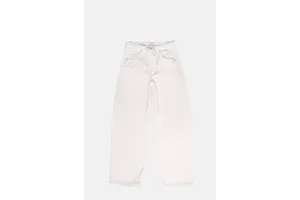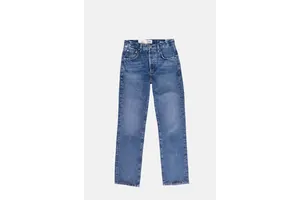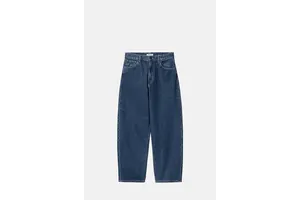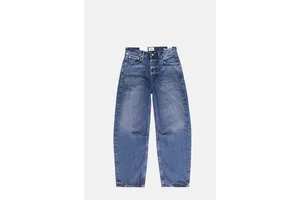
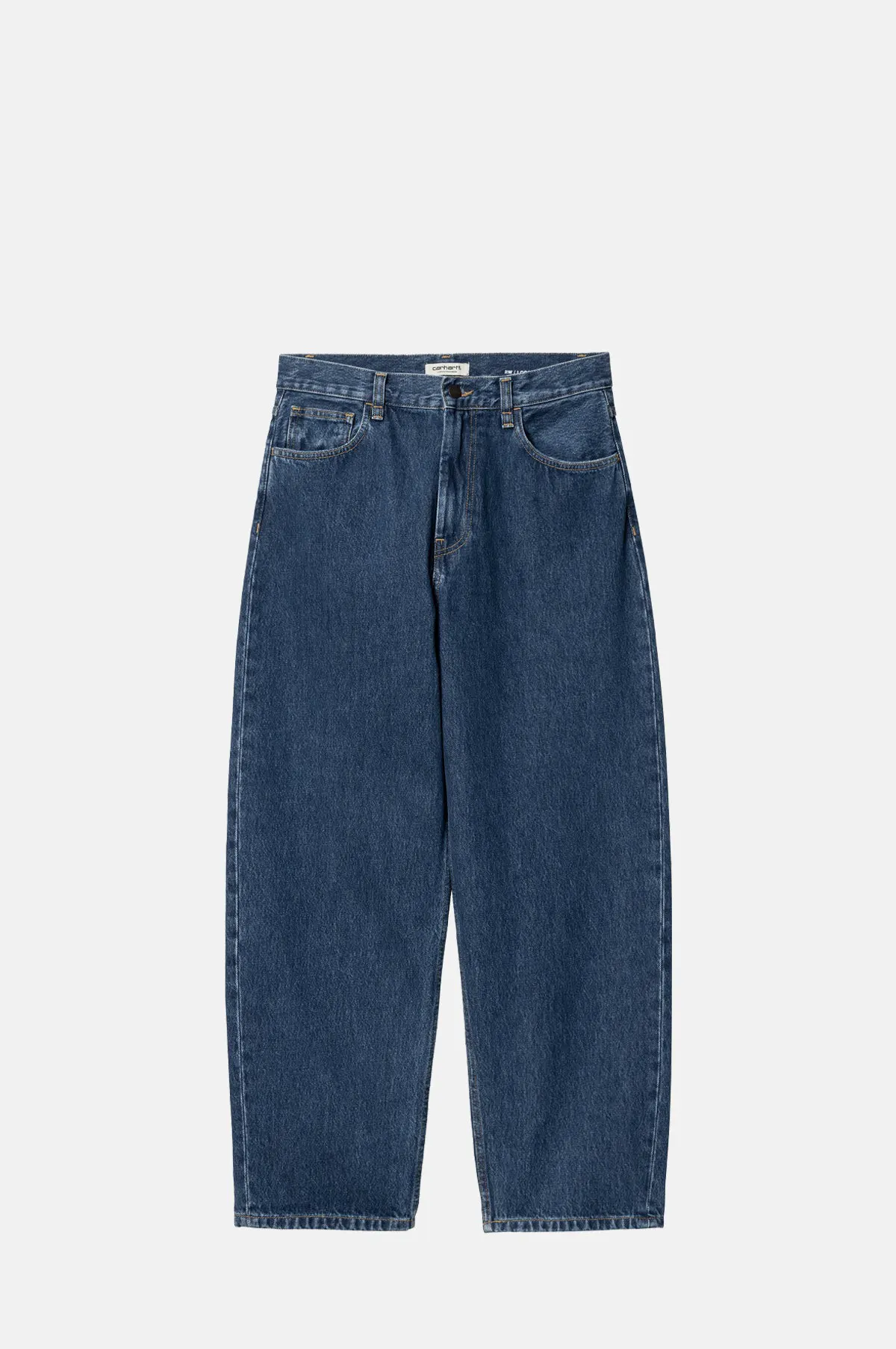

The Brandon Pant from Carhartt WIP in blue stone washed, a loose fitting regular waisted utility style in cotton twill denim with a back yoke, bartack stitching at vital stress points and a zip fly, listed at 105 GBP with all four sizes in stock. It is worth beginning with one bullet, because it contains something this run has been asking for since it started and has never once been given. It reads: 100% Cotton 'Smith' Denim, 13.5 oz. A fibre, a named cloth, and a weight. This run has now read several hundred garment specifications and not one of them has carried a weight in any unit. It has read lightweight, mid-weight, super soft, fine, breathable and heavy, and it has read none of them with a number beside them. Thirteen and a half ounces is about 458 grams per square metre, which is a heavy denim, and it tells a customer in one figure what all of those adjectives have been trying and failing to say. It is worth then setting that beside the price, because the comparison is unflattering to everything else in this run. This is a 105 pound pair of jeans. This run has published dresses at 595 pounds giving a fibre panel and nothing else, and a coat at 540 giving a weave and no weight, and a jacket at 255 whose bullets read lightweight jacket. The cheapest garment here carries the most complete cloth specification in the run, and that is the third time this run has found that price and specification quality are not connected. It is worth then looking at what is missing, because this page is not complete either, and what it leaves out is the measurement jeans are actually bought on. The reference is the Brandon Pant. Dongguan Bafinasa Garments Co., Ltd. develops comparable denim on OEM and ODM terms, from cloth sourcing and wash development to retail or FBA ready packing. We publish this as a development reference and build your own version of it, and we do not supply the branded original or reproduce anyone else's label.
Key Features
- 100% Cotton 'Smith' Denim, 13.5 oz, as stated, which is the first cloth weight in this run and the only complete cloth specification in it. See the note below
- Loose, regular waist as stated, and neither the leg nor the rise is measured. See the note below
- Waist 1/2 (cm), labelled as a flat half measure, which is the correct way to label it and almost nobody does. See the note below
- A waist grading at exactly 2 cm, clean across four sizes, giving away about 1.3 in of ease. See the note below
- Bartack stitching at vital stress points, as stated, which names a construction technique for durability. See the note below
- Wash at 40 degrees, tumble dry on low heat, as stated, which is the most complete care label in this run. See the note below
- A chart of two columns, with no hip, no rise, no thigh and no leg opening. See the note below
Customisable Options
- Denim: 13.5 oz cotton Smith denim to the reference, with the weight stated in both ounces and grams per square metre, or 12 oz, or 14.5 oz, or an 11 oz rigid denim, or a stretch denim at a stated elastane content, or an organic cotton denim, each quoted separately
- Wash: a stone wash to the reference, with the wash recipe and the number of cycles stated, or a raw unwashed denim, or a rinse wash, or an enzyme wash, or a bleach wash, each quoted separately
- Fit: a loose fit with a regular waist to the reference, with the leg opening, thigh and rise measured, or a straight fit, or a tapered fit, or a wide fit, or a relaxed fit, each quoted separately
- Rise: a regular rise to the reference, with the rise measured, or a high rise, or a low rise, or a mid rise, each quoted separately
- Construction: bartack stitching at vital stress points to the reference, with the points enumerated, or plain stitching, or rivets at the pockets, or a double needle seat seam, each quoted separately
- Detail: a back yoke to the reference, with the yoke depth stated, or a plain back, or a split yoke, or no yoke, each quoted separately
- Denim weight in ounces and grams, hip, rise, thigh and leg opening measurements, wash recipe, shrinkage figures, rivet and button specification, zip brand and length, size set, colour development, private label, hangtag and care labelling
Specifications
| Style | Loose fitting regular waisted utility jean in cotton denim with a back yoke, bartack stitching at stress points and a zip fly |
| Reference | Carhartt WIP, Brandon Pant, style I035892, colour Blue Stone Washed, sizes XS to L |
| Composition | 100% cotton, as stated in both the bullet list and the composition panel |
| Denim | 'Smith' Denim, named, which is more than most pages give. See the note below |
| Cloth Weight | 13.5 oz, as stated, which is the first weight figure in this run and is about 458 g/m2. See the note below |
| Weave | Cotton twill, as stated in the description, and denim, as stated in the bullets, which are the same thing |
| Wash | Stone washed, as stated, with no wash recipe, no number of cycles and no enzyme or bleach statement. See the note below |
| Handle | Comfortable as stated, and the weight given implies a substantial cloth, with no finish named |
| Fit Word | Loose, regular waist as stated. See the note below |
| Fit Statement | Loose fitting, regular waisted, as stated in the description, which is more than most pages give |
| Rise | Regular waist as stated, which is a rise word, and no rise measurement published. See the note below |
| Closure | Zip fly as stated, with no zip brand and no zip length given |
| Detail | Back yoke as stated, with no yoke depth given |
| Durability | Bartack stitching at vital stress points as stated, which names the technique, with the points not enumerated. See the note below |
| Branding | WIP script label at inside waistband as stated, which names the placement, with no size given |
| Pockets | Not stated |
| Care | Wash at 40掳C. Tumble dry on low heat, as stated, which is the most complete care label in this run. See the note below |
| Certification | None named |
| Sizes Offered | XS, S, M and L, four sizes, all four in stock at the time of writing |
| Size Conversion | None published |
| Fit Guidance | Loose fitting, regular waisted, as stated |
| Model | None published |
| Measurements Published | Waist 1/2 and inside leg for all four sizes, and nothing else. See the note below |
| Published Waist | 36, 38, 40 and 42 cm, labelled as a flat half measure, stepping exactly 2 cm at every step. See the note below |
| Waist Around | 72, 76, 80 and 84 cm, or 28.35, 29.92, 31.50 and 33.07 in. See the note below |
| True Waist Grade | About 2 cm of flat measure per size, and clean |
| Ease at the Waist | About 3.4 in at an XS falling to about 2.1 in at an L, so about 1.3 in given away across the range. See the note below |
| Published Inside Leg | 75, 76, 77 and 78 cm, stepping exactly 1 cm at every step |
| Hip | Not measured, on a jean. See the note below |
| Rise | Not measured, though regular waist is claimed. See the note below |
| Thigh | Not measured, though loose is claimed |
| Leg Opening | Not measured, though loose is claimed |
| Total Length | Not published |
| Photographs | Six |
| Production | Made in Tunisia as stated, with no certification named |
| Reference Retail | 105 GBP as listed, quoted to show the price band this sits in, not as our price |
| Category | Filed by the reference under jeans |
| Occasion | Everyday, casual, workwear, weekend |
| MOQ | 100 pcs per style per colourway, mixed sizes and colourways accepted |
| Sampling | 7-10 days after tech pack or reference sample confirmation |
| Bulk Lead Time | 20-30 days after sample approval and deposit |
| Service | OEM / ODM / private label, denim sourcing by weight in ounces and grams per square metre, stone wash and enzyme wash development, bartack and rivet construction specification, loose fit block development with the hip, rise, thigh and leg opening measured, retail or FBA ready packing |
Size Chart as Published by the Reference
| Size | Waist 1/2 (flat) | Inside leg |
|---|---|---|
| XS | 36 cm | 75 cm |
| S | 38 cm | 76 cm |
| M | 40 cm | 77 cm |
| L | 42 cm | 78 cm |
The waist figures are labelled Waist 1/2, so they are flat half measures taken with the jeans laid down, doubling to 72, 76, 80 and 84 cm around, or 28.35, 29.92, 31.50 and 33.07 in. Set against bodies of roughly 25 to 31 in across an XS to L, that is ease of about 3.4 in at the smallest size falling to about 2.1 in at the largest. The waist steps exactly 2 cm and the inside leg exactly 1 cm at every step. No hip, no rise, no thigh and no leg opening is published.
Our Proposed Body Chart
| Size | Body Bust | Body Waist | Body Hips | Length | Source |
|---|---|---|---|---|---|
| XS | 31 in / 79 cm | 25 in / 64 cm | 35 in / 89 cm | 75 cm / 29.5 in | Our proposal |
| S | 34 in / 86 cm | 27 in / 69 cm | 37 in / 94 cm | 77 cm / 30.3 in | Our proposal |
| M | 37 in / 94 cm | 29 in / 74 cm | 39 in / 99 cm | 79 cm / 31.1 in | Our proposal |
| L | 40 in / 102 cm | 31 in / 79 cm | 41 in / 104 cm | 81 cm / 31.9 in | Our proposal |
Occasions and Styling
Suits everyday, casual and weekend wear. A loose heavyweight jean works with a baby tee and a flat shoe, and the weight makes it a year-round trouser.
Production and Quality Control
The reference states the fibre in two places, names the denim, states the cloth weight in ounces, states the weave, names the wash, gives two fit words and a fit statement, names the back yoke, the bartack construction, the waistband label and the zip fly, publishes a waist column correctly labelled as a flat half measure, grades both of its columns cleanly, gives the most complete care instruction in this run with a temperature and a qualified tumble instruction, states the country of manufacture, lists the construction in a bullet list, names the style code and carries all four sizes in stock. It gives no hip, no rise, no thigh, no leg opening, no total length, no wash recipe, no shrinkage figure, no zip brand or length, no pocket statement, no size conversion and no model, and it does not enumerate the stress points it claims to reinforce. Three things follow: the weight that nobody else in this run gives, the chart that omits the measurement jeans are bought on, and the care label that is the best in this run and the most likely to shrink the garment.
Thirteen point five, and that is the first thing, and it is worth saying what it is a measurement of and what it is worth. It is ounces per square yard, the denim convention, and it converts to about 458 grams per square metre. That is a heavy denim: eleven to twelve ounces is a standard weight, fourteen and above is rigid. So in one figure a customer knows this is a substantial trouser that will soften slowly and hold its shape. It is worth setting that beside every other cloth description in this run, because the contrast is the finding. This run has read lightweight, mid-weight, super soft, fine, breathable, heavy and textured, on garments from thirty two pounds to five hundred and ninety five, and not one of them carried a number. The adjectives are doing the work of a specification and they cannot do it, because lightweight means one thing on a tee and another on a coat. And this run has been recording the absence of a weight for its entire length without once seeing one. It is worth noting that this page gives more than the weight. The bullet reads 100% Cotton 'Smith' Denim, 13.5 oz. So that is a fibre, a named cloth and a weight in one line, and it is the only complete cloth specification in this run. It is worth then saying who gives it, because that is the part this run keeps finding and keeps being surprised by. This is a hundred and five pound pair of jeans. This run has published a dress at five hundred and ninety five giving three fibre percentages and no weight, and a coat at five hundred and forty giving a weave and no weight, and a jacket at two hundred and fifty five whose entire bullet list ran to a single line about being lightweight. The cheapest garment in this batch has the most complete cloth specification in the run. That is now the third batch in a row in which the cheapest or second cheapest garment has specified itself better than the most expensive one, and it is worth stating what follows from it: specification quality is a decision, and it is not being made on the expensive garments. It is worth adding the wash, which is the other half of a denim specification and is half given here. The colour name says stone washed and the description says stone washed. There is no recipe: no enzyme, no bleach, no number of cycles, no statement of whether it is a real stone wash or an abrasive substitute. And stone washing is what determines how a denim fades over the next two years, so it is the part of the specification a customer will live with longest.
Two, and that is the second thing, and it is the number of columns in the size chart. The page publishes a waist and an inside leg and nothing else. It is worth listing what is not there, because the list is the finding. There is no hip. There is no rise. There is no thigh. There is no leg opening. There is no total length. It is worth saying why the missing hip is the serious one, because jeans are bought on the hip at least as much as the waist. A jean has to pass over the hip to get on at all, and a waist measurement alone cannot tell a customer whether it will. So a customer choosing between sizes here is doing it from a waist circumference and an inside leg, and the measurement that decides whether the trouser fits is not on the page. It is worth then setting the fit words beside the missing measurements, because this is the pattern this run has met most often and it is unusually clear here. The bullets say loose, regular waist. Loose is a word about the leg: how much room there is through the thigh and how wide the hem is. There is no thigh measurement and no leg opening. Regular waist is a word about the rise: where the waistband sits on the body. There is no rise measurement. So both fit words on this page describe dimensions that are not measured, and the only two dimensions that are measured are the ones no adjective on the page is about. It is worth being fair about the waist, because it is done better here than almost anywhere else in this run. The column is labelled Waist 1/2, meaning a flat half measure. This run has spent its entire length reading chest and waist columns that are flat half measures and are labelled as though they were circumferences, and it has read a great many pages where a customer would have to guess. Here is a brand that says so in the header, in two words. And the grade is clean: 36, 38, 40 and 42, exactly two centimetres at every step. It is worth then applying the rule this run worked out, because it holds here too and this is a different measurement on a different brand. To hold ease steady on a scale where bodies grow two inches a size, a flat measurement needs to grow by about 2.54 centimetres. This one grows by two, so it gives away about 0.43 inches a step, and over three steps that is about 1.28 inches. Measured against bodies of roughly 25 to 31 inches, the ease runs from about 3.4 inches down to about 2.1, which is 1.28. The rule now holds on seven garments, four brands and three different size scales.
Forty, and low, and that is the third thing, and it is worth giving the credit because this is the most complete care label in this run. It reads Wash at 40掳C, tumble dry on low heat. Most pages in this run say machine wash at thirty and stop. A good many say do not tumble dry, which is a prohibition and not an instruction. This one gives a temperature and then says what to do in the dryer and how hot, which is three pieces of information where the run is used to one. It is worth then reading it against the garment, because that is where it becomes difficult. The jeans are one hundred per cent cotton at thirteen and a half ounces, and the label instructs a forty degree wash and a tumble dry. Those are the two things that shrink cotton most. And there is no shrinkage figure anywhere on the page. It is worth being precise about why that stings more here than elsewhere, because this page is otherwise unusually exact. The inside leg is published to the centimetre: 75, 76, 77 and 78. So the page is offering a precision that its own care instructions will destroy, and it does not say by how much. It is worth adding what else is missing from the label. There is no instruction to wash inside out, and the denim is stone washed mid blue, and colour loss is what happens to indigo. There is no bleach statement and no iron instruction. It is worth closing on the two construction details, because one of them is the first of its kind in this run. The bullets say bartack stitching at vital stress points. Bartack is a specific reinforcement stitch, and naming it is naming a technique, and no other garment in this run has said how it is made strong. What is missing is the enumeration: which points, and how many. Vital stress points is a phrase and not a list, so a customer is told the strengthening exists and not where to look for it. The other detail is the back yoke, named and not measured. Every bulk shipment gets a measurement report against your approved chart.
Optional upgrades include publishing the hip, rise, thigh and leg opening alongside the waist and inside leg, stating the weight in grams per square metre as well as ounces, measuring and publishing the shrinkage after a 40 degree wash and a tumble, giving the wash recipe including whether it is an enzyme or abrasive stone wash, enumerating the bartacked stress points, adding wash inside out and a bleach statement to the label, publishing a model height and a size conversion, 12, 14.5 and 11 oz denims and stretch and organic options, raw, rinse, enzyme and bleach washes, straight, tapered, wide and relaxed fits, high, mid and low rises, rivets and double needle seat seams, plain and split yokes, size set, colour development, private label, hangtag and care labelling.
Pre-production sample approval, in-line inspection during cutting and sewing, and a final AQL inspection before packing, with measurement reports and photos shared before shipment.
Send us your tech pack, a photo or a reference garment and we will quote within 24 hours. Contact bafinasa@bafinasa.com or WhatsApp +86 13827222469.