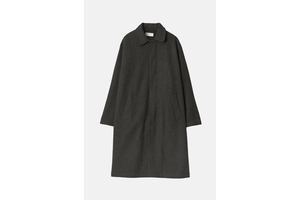
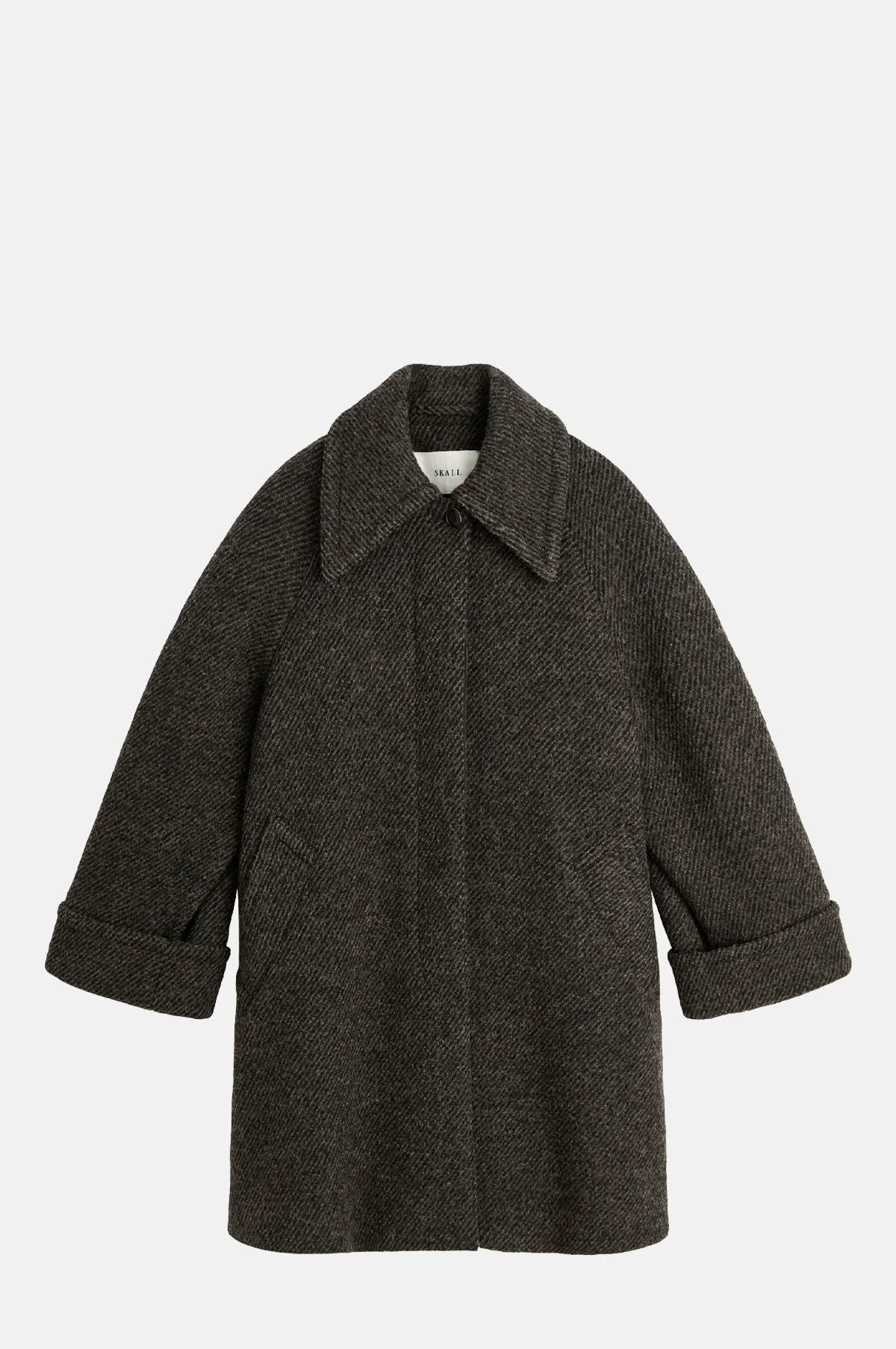

The Beate Coat from Skall Studio in a brown and black twill, an oversized style with a relaxed silhouette, a large pointed collar, wide sleeves and cuffs, in a thick wool fabric, listed at 680 GBP with two of three sizes in stock. It is worth beginning with something no other page in this run has done, because it is the thing this run has been asking for throughout. Above the chart it says: designed to be very oversized, and if you prefer a less oversized fit, we recommend sizing down. That is not a fit word. It is an instruction, and it is the first time a page has told a customer what to do about the fit rather than merely naming it. It is worth then checking whether it works, because the numbers are there to check it against. The chest runs 58, 60 and 62 centimetres, so doubling gives about 45.7, 47.2 and 48.8 inches, and against bodies of roughly 31 to 37 inches the ease runs from about 14.7 inches down to about 11.8. That is genuinely very oversized, and it is the second loosest garment in this run after a hoodie at 17 to 19 inches. But sizing down one size removes the difference between a 60 and a 58, which is four centimetres around, which is about an inch and a half. So a customer who takes the advice and drops a size goes from about 13.2 inches of ease to about 11.7. Both are still very oversized, and there is no size in this range that makes the coat anything else. It is worth then turning to the chart itself, because one of its three columns cannot be used. The sleeve length is given as 93.25, 95 and 95.25 centimetres, and the total length is given as 93, 95 and 95. The two columns are within a quarter of a centimetre of each other at every size. A 93 centimetre raglan sleeve on a knee length coat is not credible, and a sleeve that measures the same as the coat is not a sleeve. The reference is the Beate Coat. Dongguan Bafinasa Garments Co., Ltd. develops comparable coats on OEM and ODM terms, from cloth and lining development to retail or FBA ready packing. We publish this as a development reference and build your own version of it, and we do not supply the branded original or reproduce anyone else's label.
Key Features
- Actionable fit guidance as stated: designed to be very oversized, and sizing down is recommended for a closer fit. See the note below
- An ease of about 14.7 in falling to about 11.8 in, the second loosest in this run, which supports the word. See the note below
- Sizing down removing only about 1.6 in of ease, so no size in the range makes the coat anything but oversized. See the note below
- A size conversion given, 34DK/XS, 36DK/S and 38DK/M, which almost no page in this run supplies. See the note below
- A sleeve length column that tracks the total length column to within a quarter of a centimetre at every size. See the note below
- 100% wool with a 100% organic cotton lining, the only organic claim in this run, and it is on the part you cannot see. See the note below
- Wide raglan sleeves as stated, with no sleeve width and no cuff opening. See the note below
Customisable Options
- Cloth: a thick wool twill to the reference, with the weight in grams per square metre stated, or a wool and cashmere blend, or a wool and alpaca blend, or a merino, or a recycled wool, or a wool and nylon blend, each quoted separately
- Lining: a 100% organic cotton lining to the reference, with the certifier named, or a conventional cotton lining, or a cupro lining, or a viscose lining, or a half lining, or no lining, each quoted separately
- Sleeve: wide raglan sleeves to the reference, with the sleeve length measured from the neckline and the start point declared and the sleeve width and cuff opening given, or a set-in sleeve, or a narrower raglan, or a dropped shoulder, each quoted separately
- Collar: a large pointed collar to the reference, with the collar depth and the collar spread stated, or a smaller collar, or a notch lapel, or a shawl collar, or a hood, each quoted separately
- Closure: a concealed button closure with a visible top button to the reference, with the button count and size stated, or a fully concealed placket, or an exposed button placket, or a double breasted front, each quoted separately
- Length: a knee length to the reference, graded across the sizes, or a midi length, or a shorter jacket length, each quoted separately
- Cloth weight, wool type and micron, lining composition and certifier, sleeve width and cuff opening, collar depth and spread, button count and size, side seam adjustment range, pocket dimensions, hip and hem circumference, size set, colour development, private label and care labelling
Specifications
| Style | Very oversized knee length wool coat with wide raglan sleeves, a large pointed collar and a concealed button closure |
| Reference | Skall Studio, Beate Coat, colour Brown/Black twill, style 10540-26350, sizes 34 to 38 DK |
| Composition | 100% wool, as stated. See the note below |
| Lining | 100% organic cotton, as stated. See the note below |
| Cloth Weight | Thick as stated, with no figure given. See the note below |
| Weave | Twill as stated in the title and the colour name |
| Wool Type | Not stated |
| Micron Count | Not stated |
| Handle | Thick as stated, with no weight given |
| Fit Word | Oversized style with a relaxed silhouette as stated in the description. See the note below |
| Fit Statement | Designed to be very oversized, with sizing down recommended for a less oversized fit, as stated. See the note below |
| Sizes Offered | 34 DK, 36 DK and 38 DK, three sizes, with 34 and 36 in stock at the time of writing |
| Size Conversion | 34DK/XS, 36DK/S and 38DK/M, as stated. See the note below |
| Model | 179 cm tall and wearing a size 36, as stated. See the note below |
| Length | Knee length as stated in the bullets, and 93, 95 and 95 cm. See the note below |
| Sleeve | Wide raglan sleeves as stated in the bullets, and wide sleeves and cuffs in the description, measured at 93.25, 95 and 95.25 cm, with no sleeve width and no cuff opening given. See the note below |
| Collar | Classic collar as stated in the bullets, and a large pointed collar in the description, with no collar depth and no collar spread given. See the note below |
| Closure | Concealed button closure with a visible top button as stated, with no button count and no button size given. See the note below |
| Adjustment | Adjustable button detail in side seam as stated, with no range given for the adjustment. See the note below |
| Pockets | Front and inner pockets as stated, with no count and no dimensions given |
| Care | Dry Clean Only, as stated |
| Certification | None named, though the lining is described as organic. See the note below |
| Measurements Published | Chest pit to pit, length and sleeve length for all three sizes. See the note below |
| Published Bust | 58, 60 and 62 cm pit to pit, stepping exactly 2 cm at every step |
| Bust Around | 116, 120 and 124 cm, or 45.67, 47.24 and 48.82 in. See the note below |
| True Bust Grade | About 2 cm of flat measure per size, against about 3.81 cm needed on an XS to M scale. See the note below |
| Ease at the Bust | About 14.7 in at a 34 falling to about 11.8 in at a 38, so about 2.9 in given away. See the note below |
| Effect of Sizing Down | About 1.6 in of ease removed, from about 13.2 in to about 11.7 in. See the note below |
| Published Length | 93, 95 and 95 cm, stepping 2 and then 0 cm. See the note below |
| Published Sleeve Length | 93.25, 95 and 95.25 cm, which tracks the length column to within a quarter of a centimetre. See the note below |
| Sleeve Width | Not measured |
| Cuff Opening | Not measured |
| Shoulder Width | Not measured |
| Hip | Not measured |
| Hem Circumference | Not measured |
| Cloth Weight | Not stated |
| Photographs | Five |
| Production | Produced in Romania as stated, with no certification named |
| Reference Retail | 680 GBP as listed, quoted to show the price band this sits in, not as our price |
| Category | Filed by the reference under coats and jackets |
| Occasion | Everyday, work, winter, outerwear |
| MOQ | 100 pcs per style per colourway, mixed sizes and colourways accepted |
| Sampling | 7-10 days after tech pack or reference sample confirmation |
| Bulk Lead Time | 20-30 days after sample approval and deposit |
| Service | OEM / ODM / private label, wool twill sourcing by weight and micron, organic cotton and cupro lining sourcing with the certifier named, oversized coat block development with raglan sleeves and the sleeve start point declared, retail or FBA ready packing |
Size Chart as Published by the Reference
| Size | Chest (pit to pit) (cm) | Length (cm) | Sleeve Length (cm) |
|---|---|---|---|
| 34 | 58 cm | 93 cm | 93.25 cm |
| 36 | 60 cm | 95 cm | 95 cm |
| 38 | 62 cm | 95 cm | 95.25 cm |
The chest figures are flat half measures taken with the coat laid down, doubling to 116, 120 and 124 cm around, or 45.67, 47.24 and 48.82 in. Against bodies of roughly 31 to 37 in, the ease runs from about 14.7 in at a 34 down to about 11.8 in at a 38, so the coat is very oversized at every size and sizing down removes only about 1.6 in of that. The chest grades a clean 2 cm at every step. The length steps 2 and then 0, so the 36 and the 38 are the same length. The published sleeve column runs 93.25, 95 and 95.25 cm, which is within a quarter of a centimetre of the length column at every size and cannot be a sleeve measurement, so we do not use it: our proposal below shows a raglan sleeve measured from the neckline at a value we would confirm on the sample. No sleeve width, cuff opening, shoulder width, hip or hem circumference is published.
Our Proposed Body Chart
| Size | Body Bust | Sleeve | Body Waist | Body Hips | Length | Source |
|---|---|---|---|---|---|---|
| 34 (XS) | 31 in / 79 cm | 78 cm | 25 in / 64 cm | 35 in / 89 cm | 93 cm / 36.6 in | Our proposal |
| 36 (S) | 34 in / 86 cm | 79 cm | 27 in / 69 cm | 37 in / 94 cm | 95 cm / 37.4 in | Our proposal |
| 38 (M) | 37 in / 94 cm | 80 cm | 29 in / 74 cm | 39 in / 99 cm | 97 cm / 38.2 in | Our proposal |
Occasions and Styling
Suits everyday, work and winter outerwear. A very oversized knee length wool coat layers over a knit or a blazer and the wool twill goes with almost anything.
Production and Quality Control
The reference publishes three measurements for all three sizes, grades its chest perfectly, gives a size conversion from Danish to letter sizes, gives a model with a height and a size, states its fibre and separately states the composition of its lining, names its collar, its sleeve construction, its closure in unusual detail, its pockets by location, its length as a word, states its care, states the country of manufacture and names the style number, and carries five photographs. It gives no cloth weight, no wool type, no micron count, no sleeve width, no cuff opening, no shoulder width, no hip, no hem circumference, no collar dimensions, no button count or size, no range for the side seam adjustment, no pocket count or dimensions, no certifier for the organic lining and no certification, and two of its three columns cannot be used: one is frozen at the top and the other duplicates the length. Three things follow: the first genuinely useful fit instruction in this run, a sleeve column that is not a sleeve, and an organic claim on the part of the garment nobody sees.
Size down, and that is the first thing, and it is worth saying why it matters more than any single number on this page. Above the chart the page says: designed to be very oversized, and if you prefer a less oversized fit, we recommend sizing down. That is not a fit word, it is an instruction, and it is the first time in this run that a page has told a customer what to do rather than only what to call the garment. It is worth then checking whether the claim is true, because this run now has enough measurements to check it. The chest runs fifty eight, sixty and sixty two flat, so the coat measures a hundred and sixteen, a hundred and twenty and a hundred and twenty four centimetres around, or about forty five point seven, forty seven point two and forty eight point eight inches. Against bodies of roughly thirty one to thirty seven inches, the ease runs about fourteen point seven, thirteen point two and eleven point eight. It is worth setting that beside the rest of this run, because very is a strong word and it is earned here. The oversized garments this run has measured gave seventeen to nineteen inches on a hoodie, twelve to fifteen on another coat, five to seven on a trench, and four to six on a shirt. At eleven point eight to fourteen point seven this is the second loosest garment in the run. It is worth then asking the question the page invites, which is whether the advice works, and the answer is that it barely does. Sizing down moves you from a sixty to a fifty eight, which is four centimetres around, which is about an inch and a half. So a customer who normally takes a small and drops to the thirty four goes from about thirteen point two inches of ease to about eleven point seven. Both are very oversized. There is no size in this range that turns this coat into a coat that fits, and the page is honest enough to imply as much by using the word less rather than the word fitted. It is worth adding the sharpest version of the point, which is the one about the intensifier. Very oversized on a coat means eleven point eight to fourteen point seven inches. Oversized on a hoodie means seventeen to nineteen. So the coat with the stronger word has less ease than the hoodie with the weaker one, and the intensifier does not survive being carried from one garment type to another.
Ninety three point two five, and that is the second thing, and it is worth putting the two columns next to each other before saying what is wrong. The sleeve length is given as ninety three point two five, ninety five and ninety five point two five centimetres. The total length is given as ninety three, ninety five and ninety five. The two columns differ by a quarter of a centimetre, by nothing, and by a quarter of a centimetre. It is worth being careful here, because this run should not claim more than it can show, so let it be said plainly: three sizes, each matching to within a quarter of a centimetre, is not coincidence. And a sleeve that measures the same as the coat is not a sleeve. It is worth then giving the second reason, which is independent of the first. The bullets say wide raglan sleeves, and a raglan sleeve is measured from the neckline rather than the shoulder point, which adds perhaps twenty centimetres to the figure. This run measured a raglan tee two batches ago at seventy four to seventy six centimetres. A knee length coat with wide sleeves might reasonably reach eighty to eighty five from the neckline. Ninety three is beyond that, and it is exactly the length of the coat. It is worth saying what class of error this belongs to, because this run has been collecting them. There was a dress whose chart carried five size headers over four sizes, which was a template problem. There was a tee whose sleeve graded backwards, four centimetres shorter at the largest size. Now there is a coat whose sleeve column is its length column. It is worth adding the detail that makes this one distinctive, which is the precision. Every other garment in this run publishes whole centimetres. This one publishes two decimal places, so the page is offering a quarter of a centimetre of precision while grading by a quarter of a centimetre. The precision on offer is finer than the differences being described, which is the surest sign that nobody checked. It is worth then dealing with the length column itself, which is sound enough to use and still not right. It runs ninety three, ninety five and ninety five, so the thirty six and the thirty eight are the same length. Two of three sizes frozen. And the bullets say knee length, and the model is given as a hundred and seventy nine centimetres, so this run can actually check the word for once: ninety five centimetres on a woman of a hundred and seventy nine puts the hem about fifty centimetres from the floor, which is the knee. So the word is right for her. But the thirty eight is also ninety five centimetres, and a size thirty eight body is taller, so on her the hem sits above the knee. The word holds for the model and not for the range.
Organic, and that is the third thing, and it is worth saying where it appears, because the placement is the finding. The composition panel reads one hundred per cent wool, and then a second line: lining, one hundred per cent organic cotton. That second line is the only organic claim this run has met on any garment, and it is on the lining. It is worth being precise about what that means. The cloth you see, the cloth that makes the coat what it is, the wool, carries no origin claim of any kind. The cloth you cannot see, the cotton inside, is the one described as organic. It is worth adding that no certifier is named, so organic is a word here rather than a standard, which is the same position this run found on a pair of jeans two batches ago that claimed regenerative cotton and eco indigo dyeing with nothing behind either. It is worth then taking the wool itself, which is described as thick and as a twill. Twill is a real weave and this run is glad to have it, because almost no coat in this run names one. Thick is a weight word with no figure behind it, and there is no weight in grams, no wool type and no micron count, and micron is the specification wool is actually bought and sold on. It is worth noting the price, because it is the highest in this run at six hundred and eighty pounds, and the pattern this run has found in five consecutive batches holds again: the more expensive the garment, the less its cloth tends to be specified. It is worth then listing what else this page leaves out, and two items are worth singling out. The bullets say wide raglan sleeves and the description says wide sleeves and cuffs, so wide is claimed twice, and there is no sleeve width and no cuff opening. And there is an adjustable button detail in the side seam, which is an unusual and appealing feature, and no range is given for what it adjusts. It is worth adding the last one, because it is the run's standing rule and this garment obeys it exactly: whenever a garment is adjustable, the adjustable dimension is the one that does not get measured. It is worth closing on the description, which does something no other page in this run has done. After the bullets it carries a paragraph offering a free gift with purchase at three spend thresholds, naming three other products, with a condition about returning the gift. That is shop copy sitting inside the product description, so it travels with the product into every feed, every marketplace listing and every translation, and it will still be there when the offer has expired. Every bulk shipment gets a measurement report against your approved chart.
Optional upgrades include correcting the sleeve column and declaring the measurement start point for a raglan sleeve, grading the length across all three sizes, publishing the sleeve width, cuff opening, shoulder width, hip and hem circumference, quoting the cloth weight in grams per square metre with the wool type and the micron count, naming the certifier for the organic lining, giving the collar depth and spread, the button count and size, the side seam adjustment range and the pocket dimensions, wool and cashmere, wool and alpaca, merino, recycled wool and wool and nylon blends, conventional cotton, cupro and viscose linings and no lining, set-in sleeves, narrower raglan and dropped shoulders, smaller collars, notch and shawl collars and hoods, fully concealed and exposed plackets and double breasted fronts, midi and jacket lengths, size set, colour development, private label, hangtag and care labelling.
Pre-production sample approval, in-line inspection during cutting and sewing, and a final AQL inspection before packing, with measurement reports and photos shared before shipment.
Send us your tech pack, a photo or a reference garment and we will quote within 24 hours. Contact bafinasa@bafinasa.com or WhatsApp +86 13827222469.