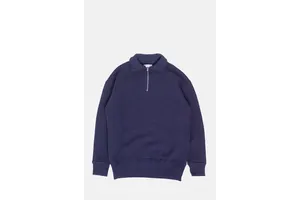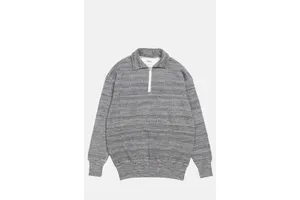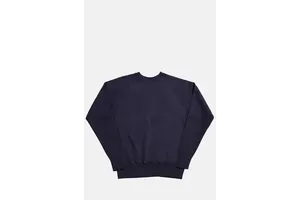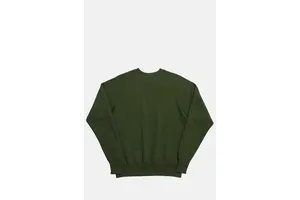
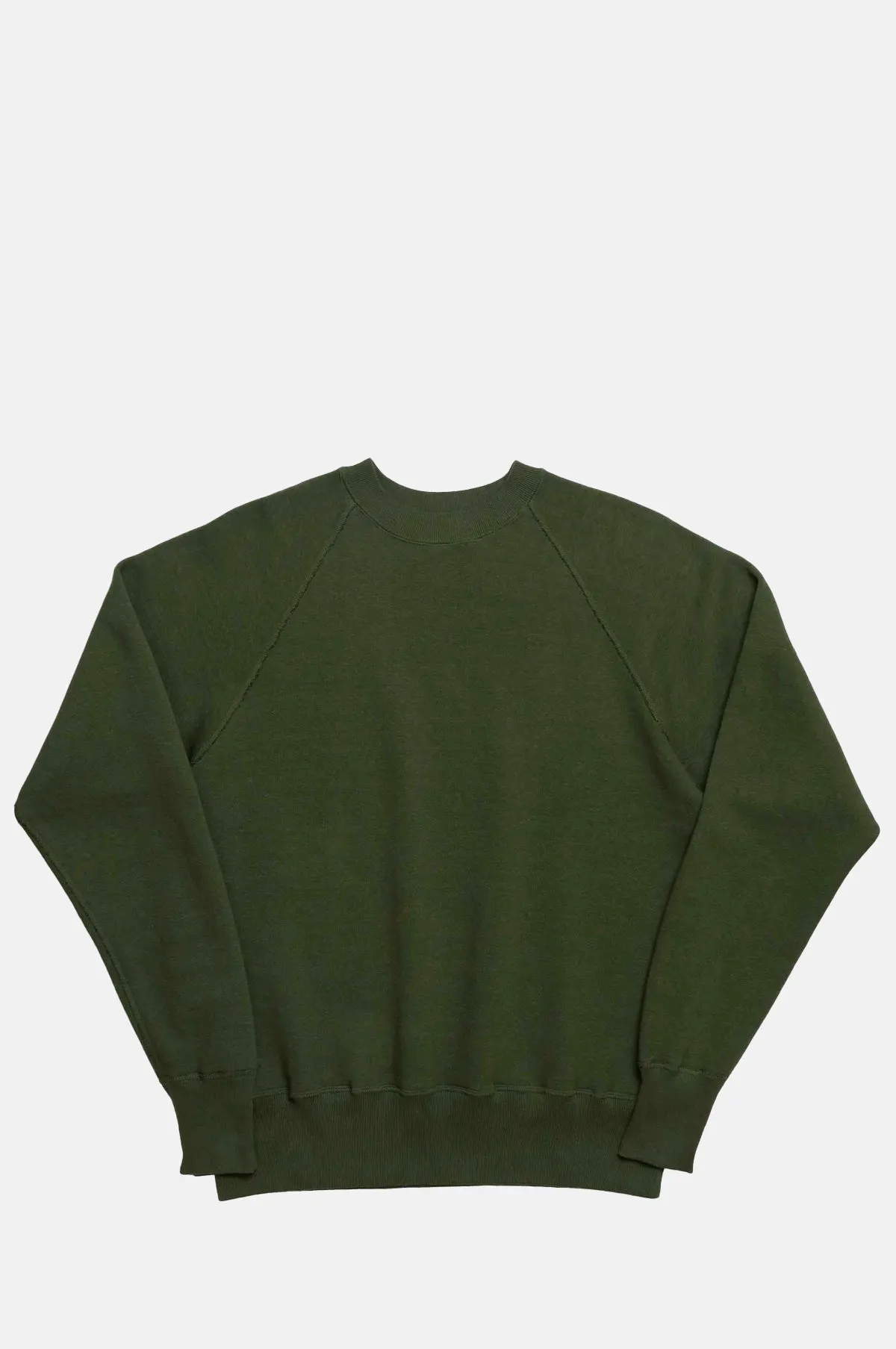

The Loopwheel Easy Sweatshirt in Green from Allevol, and the run should begin with a contradiction, because it is the clearest thing it has found in this run. It is worth then stating what the title says, which is green, and it is worth then stating what the prose says, which is a garment-dyed green finish, and it is worth then stating what the bullet says, which is garment dyed in dark grey. It is worth then stating that all three are on the same page, and it is worth then stating what the run should say about that, which is that this is not a small error but a field that was copied and never updated. It is worth then stating the second thing, which is why this matters more than a typo. It is worth then stating what the run found last batch, which was a composition summing to 60 repeated identically across two colourways, and it is worth then stating what it asked then, which was whether it was a typing error. It is worth then stating what this page proves, which is that the answer is a process and not a typo, because the same kind of copied field has now appeared on a second house in a second batch. It is worth then stating the third thing, which is what the run now knows that it did not know before. It is worth then stating that it had one instrument, which was arithmetic, and it is worth then stating what arithmetic catches: a shared field carrying a wrong VALUE, which is how it found the composition summing to 60. It is worth then stating what arithmetic cannot catch, which is a field that should DIFFER and does not, and it is worth then stating why: a composition should be the same on every colourway, so there is nothing to compare. It is worth then stating the instrument that does catch this one, which is comparison, and it is worth then stating the rule it should now carry: two instruments, and neither catches what the other catches. It is worth then stating the fourth thing, which is an image. It is worth then stating that one of the five files carries a long code in its name where the others do not, and it is worth then stating what that code means, which is that the file was replaced, and it is worth then stating when, which is about 22 days after the rest. It is worth then stating the part the run only found when it checked, which is that the replacement is now a dead link while the file it replaced still works, and it is worth then stating what that makes the green colourway: the only one of the three with a broken image, and broken at exactly the one file that was changed. The reference is the Loopwheel Easy Sweatshirt. Dongguan Bafinasa Garments Co., Ltd. develops comparable knit fleece on OEM and ODM terms, from fabric and trim development to retail or FBA ready packing. We publish this as a development reference and build your own version of it, and we do not supply the branded original or reproduce anyone else's label.
Key Features
- The bullet says garment dyed in dark grey on a green sweatshirt, so a field was copied and never updated. See the note below
- The prose says green and the bullet says dark grey, on the same page, so the run can prove it. See the note below
- One image file carries a replacement code and a timestamp about 22 days after its siblings. See the note below
- Tubular with no side seams, so pit to pit and pit to cuff are the right pair of measurements
- Garment dyed, so the shade will not be flat and no tolerance is given
- 160 GBP, the same as the other two colourways, and no finish difference to explain a difference
- The filename says dark green while the title says green, a second mismatch on one page
Customisable Options
- Fabric: a loopwheel cotton fleece to the reference with the weight in grams per square metre stated, or a conventional circular knit fleece, or a French terry, each quoted separately
- Construction: tubular with no side seams to the reference, or a conventional cut and sew body with side seams, each quoted separately
- Weight: a mid-weight to the reference with the number stated, because the house uses the word and should give the figure
- Dyeing: garment dyed to the reference with the shade tolerance stated and the shade matched to a standard, or yarn dyed, or piece dyed, each quoted separately
- Colour: stated once and checked everywhere it appears, because this reference states it in three places and one is wrong. See the note below
- Sleeve: raglan to the reference with the pit to cuff measured, or set-in with the shoulder and sleeve measured, each quoted separately
- Composition with every share stated and summing to one hundred and published as its own field, the fabric weight in grams per square metre, the yarn count and the knitting machine gauge, the construction stated as tubular or cut and sew, the dyeing method with the shade tolerance and the shade matched to a standard, the colour stated in one place and consistent in every other place it appears, the chest with the flat or round method stated and the measurement point given, the sleeve with the method named as pit to cuff or shoulder to cuff, the back length with the measurement point stated, a stated grade per row, a statement of which sizes share a measurement, the rib depth at the cuff and hem, the neck binding width, an order of preference for cleaning with the washing temperature as a number, a drying method rather than a prohibition, ironing and storage guidance, a stated tolerance on every measurement with rounding that matches it, shrinkage figures for both length and width, a pilling grade tested after a stated number of cycles, colour fastness to washing, rubbing, light and perspiration, a stock line for every size, size set, colour development, private label and care labelling
Specifications
| Style | Loopwheel cotton fleece sweatshirt, tubular with no side seams, raglan sleeves, a bound crew neck and ribbed cuffs and hem, garment dyed |
| Reference | Allevol, Loopwheel Easy Sweatshirt, colour Green, sizes S to XXL |
| Pair | Published beside the Dark Grey and Navy colourways of the same name, so the run can compare |
| Colours Compared | Three, the largest same-name set in this run, and the run broke its own ordering to get them together. See the note below |
| Unit | Inches, stated in every row label, and the centimetre test does not fire |
| Column Count | Three, against five sizes on offer |
| Sizes Offered | S, M, L, XL and XXL, five sizes |
| Stock Compared | Four of five, and S is missing, as it is on the dark grey but not on the navy. See the note below |
| Size Conversion | Not stated, the sizes given as letters only |
| Composition | 100% Cotton, as stated in the bullets and in a tab, the same as the other colourways |
| Composition Sum | One hundred, and it sums correctly |
| Fabric | Loopwheel fleece, as stated in the bullets, and loopwheel is a machine and not a fibre |
| Fabric Weight | Mid-weight, as stated in the bullets, and it is a word and not a number |
| Construction | Tubular with no side seams, as stated in the bullets and the prose |
| Dyeing | Garment dyed, as stated in the prose, and the colour of the dyeing is stated wrongly in the bullets. See the note below |
| Shade Tolerance | Not stated |
| Colour Places | Three: the title, the prose and the bullets, and the third contradicts the first two. See the note below |
| Colour Bullet | Garment dyed in dark grey, on a green garment. See the note below |
| Colour Bullet Compared | Wrong here and wrong on the navy, and right only on the dark grey. See the note below |
| Fit Word | Easy, as stated in the prose, and the run should note the phrase is ungrammatical |
| Neck | Bound crew neck collar, as stated in the bullets, with no binding width given |
| Sleeve | Raglan, as stated in the bullets, for ease of movement |
| Cuffs and Hem | Ribbed, as stated in the bullets, with no rib depth given |
| Chest | Pit to pit 20, 21, 22, 23 and 23.5 in, or 40, 42, 44, 46 and 47 in around |
| Chest Compared | Identical to the other two colourways at every size |
| Chest Grading | 1, 1, 1 and 0.5 in, so not uniform, and the same as the other colourways |
| Sleeve Measurement | Pit to cuff 19, 20.5, 21, 21.5 and 22.5 in, and not shoulder to cuff, which is correct for a raglan |
| Shoulder | Not measured, and on a raglan sleeve with no side seam the run should say this is reasonable |
| Total Length | 22.5, 22.5, 23, 23.5 and 25 in, and sizes S and M share a figure |
| Length Measurement Point | Not stated |
| Ladder Uniformity | None of the three rows is uniform, and the same on all three colourways |
| Care | Machine wash 30, wash inside out, do not tumble dry, iron low, as stated in a tab, the same as the other colourways |
| Washing Temperature | 30, as a number |
| Drying | Do not tumble dry, so a prohibition and not a method. See the note below |
| Ironing | Iron low, a method with a level |
| Storage | Not stated |
| Production | Made in Japan, as stated in a tab, and cut in Wakayama, as stated in the prose |
| Region | Wakayama, and it is the place for loopwheel knitting, so the region carries information |
| Posture | A masterclass in quiet utility, inspired by 1950s U.S. Naval Academy training gear |
| Tags | Sweatshirts and zoom, identical on all three colourways, so no drift here. See the note below |
| Bullet List | Eight, and one of them is wrong. See the note below |
| Colour Dependent Field | A phrase in the prose naming a process as well as a colour, so it should have been easy to check |
| Measurements Published | Pit to pit, pit to cuff and length for all five sizes |
| Photographs | Five files listed, and one carries a replacement code and a later timestamp. See the note below |
| Image Replaced | One file, about 22 days after the other four, and the run detected it from the filename. See the note below |
| Replacement Is Broken | The replaced file returns 404 and the file it replaced still returns 200. See the note below |
| Upload Stamps | Four files within one second, and one about 22 days later |
| Filename Against Title | The files say dark green and the title says green. See the note below |
| Style Number | 500 CTN GRN in the last tab, and it shares its leading part with the other colourways. See the note below |
| Reference Retail | 160 GBP as listed, the same as the other two colourways. See the note below |
| Category | Filed by the reference under sweatshirts, the same tag on all three colourways |
| Occasion | Everyday, weekends, layering over a tee, autumn through spring |
| MOQ | 100 pcs per style per colourway, mixed sizes and colourways accepted |
| Sampling | 7-10 days after tech pack or reference sample confirmation |
| Bulk Lead Time | 20-30 days after sample approval and deposit |
| Service | OEM / DDM / private label, loopwheel and circular knit fleece sourcing with the weight in grams per square metre, the yarn count and the machine gauge stated, tubular and cut and sew construction, raglan and set-in sleeve development with the sleeve measurement method named and matched to the construction, garment dye, yarn dye and piece dye development with the shade tolerance published and the shade matched to a standard, bound crew neck and rib development with the binding width and rib depth stated, colour stated in one place and consistent everywhere it appears, grading with a stated grade per row and a statement of which sizes share a measurement, an order of preference for cleaning with the washing temperature as a number and a drying method rather than a prohibition, ironing and storage guidance, a stated tolerance on every measurement with rounding that matches it, shrinkage figures for both length and width, a pilling grade tested after a stated number of cycles, colour fastness to washing, rubbing, light and perspiration, a stock line for every size, size set, colour development, private label and care labelling, retail or FBA ready packing |
Size Chart as Published by the Reference
| Size | Pit To Pit (inches) | Pit To Cuff (inches) | Length (inches) |
|---|---|---|---|
| S | 20 in | 19 in | 22.5 in |
| M | 21 in | 20.5 in | 22.5 in |
| L | 22 in | 21 in | 23 in |
| XL | 23 in | 21.5 in | 23.5 in |
| XXL | 23.5 in | 22.5 in | 25 in |
The chest figures are flat half measures, doubling to 40, 42, 44, 46 and 47 in around, which is about 3 in more than men's bodies of roughly 37 to 45 in at the chest, and about 2 in on the largest size, and they are identical to the other two colourways. Note that the ease narrows at XXL, and note why: the body table steps by 2 in and the garment steps by only 1 in on that row. Note the sleeve row, which measures pit to cuff and not shoulder to cuff, and note that this is correct here because a raglan sleeve has no shoulder seam. Note the length row, which gives 22.5 in to both S and M, so those two sizes are the same length, and note that this is now the third time in this run that adjacent sizes have shared a measurement. Note that no row is uniform, and note that the run should ask whether a tube knitted on a fixed machine can be graded continuously at all. Note that the run's proposed table below steps length by 2 cm per size because that is what the template does, and note that the run does not endorse that here: the reference steps are 0, 0.5, 0.5 and 1.5 in, and none of them is 2 cm. Our proposal below publishes the fabric weight as a number rather than a word, the yarn count and machine gauge, the construction stated as tubular or cut and sew, the sleeve method named, the back length measurement point, the rib depth and binding width, the shade tolerance, a statement of which sizes share a measurement, and a stated tolerance on every measurement.
Our Proposed Body Chart
| Size | Body Bust | Sleeve | Body Waist | Body Hips | Length | Source |
|---|---|---|---|---|---|---|
| S | 37 in / 94 cm | 48 cm | 31 in / 79 cm | 37 in / 94 cm | 57 cm / 22.4 in | Our proposal |
| M | 39 in / 99 cm | 49 cm | 33 in / 84 cm | 39 in / 99 cm | 59 cm / 23.2 in | Our proposal |
| L | 41 in / 104 cm | 50 cm | 35 in / 89 cm | 41 in / 104 cm | 61 cm / 24 in | Our proposal |
| XL | 43 in / 109 cm | 51 cm | 37 in / 94 cm | 43 in / 109 cm | 63 cm / 24.8 in | Our proposal |
| XXL | 45 in / 114 cm | 52 cm | 39 in / 99 cm | 45 in / 114 cm | 65 cm / 25.6 in | Our proposal |
Occasions and Styling
Suits everyday wear, weekends and layering over a tee, autumn through spring. A garment-dyed green will not be a flat shade and will soften with washing, and the tubular body with no side seams sits flat against the back.
Production and Quality Control
The reference publishes three measurements for all five sizes, chooses a measurement set that matches its construction, states a single fibre that sums to one hundred, names its machine, its construction and its dyeing method, gives four care instructions including a washing temperature as a number, names its country and its region, carries eight bullets and gives a style code. It states its colour in three places and gets one of them wrong, gives no fabric weight as a number although it uses the word mid-weight, no yarn count and no machine gauge, no shoulder measurement, no measurement point for any row, no binding width and no rib depth, no shade tolerance, no tolerance on any measurement, no statement of which sizes share a measurement, no drying method, no model, no size conversion, no shrinkage figure, no pilling grade and no colour fastness figure. Three things follow: a copied field was never updated; the run needed a second instrument to see it; and one image was replaced three weeks after the others.
Dark grey, on a green garment, and that is the first thing, and it is worth saying what the run should do with it. It is worth then stating what the page says in three places: the title says green, the prose says a garment-dyed green finish, and the bullet says garment dyed in dark grey. It is worth then stating that the prose was updated and the bullet was not, and it is worth then stating what that means: the same field lives in two places and only one of them was maintained. It is worth then stating what this settles from last batch, which is the question the run asked when it found a composition summing to 60 on two colourways of one garment. It is worth then stating the question, which was whether that was a typing error, and it is worth then stating the answer this page gives, which is that it is a process: the same failure has now appeared on a second house, in a second batch, in a different field. It is worth then stating the second thing, which is the one the run should carry forward. It is worth then stating the instrument it had, which was arithmetic, and it is worth then stating what arithmetic catches: a shared field carrying a wrong VALUE, which is how it found the composition summing to 60. It is worth then stating what arithmetic cannot catch, which is this, and it is worth then stating why: a composition should be identical on every colourway, so comparison has nothing to see, whereas a colour should differ, so arithmetic has nothing to see. It is worth then stating the rule: two instruments, and neither catches what the other catches. It is worth then stating the third thing, which is an image. It is worth then stating that one of the five files carries a long code in its name and the other four do not, and it is worth then stating what the run has been carrying since batch one hundred and nine, which is that such a code marks a replaced file. It is worth then stating that this is the first time that rule has actually fired, and it is worth then stating what it found: that file was uploaded about 22 days after the other four. It is worth then stating the fourth thing, which is smaller but of the same kind: the files say dark green and the title says green, so the page disagrees with itself about the colour in two separate places.
Twenty two days, and that is the second thing, and it is worth saying what the run should conclude from a replaced image. It is worth then stating what the instrument was, which is to read the filename for a code, and it is worth then stating that the instrument was written three batches ago and had never fired, and it is worth then stating that it has now fired on the first garment where three colourways could be compared. It is worth then stating what the run should ask, which is whether replacements cluster on particular colourways, and it is worth then stating the answer it can already give: the replacement is on the green and not on the dark grey or the navy. It is worth then stating the third thing, which is about the run's own ordering. It is worth then stating what it did this batch, which is to take three colourways out of alphabetical order, and it is worth then stating why: two of its tests need three, and the queue would have split them. It is worth then stating what it should now record, which is that ordering is a choice it makes and not a rule it follows, and it is worth then stating what last batch taught it about that: it had concluded from two colourways that a house does not make a size, and three colourways here show that conclusion was weaker than it was written, because a size missing on two and present on a third is sold out and not unmade.
Optional upgrades include the colour stated in one place and consistent everywhere it appears, the fabric weight in grams per square metre stated as a number rather than the word mid-weight, the yarn count and the knitting machine gauge, the construction stated as tubular or cut and sew, the dyeing method with a shade tolerance and the shade matched to a standard, the sleeve measurement method named and matched to the construction, the back length measurement point, the rib depth at the cuff and hem and the neck binding width, a stated grade per row, a statement of which sizes share a measurement, a drying method rather than a prohibition, a stated tolerance on every measurement with rounding that matches it, shrinkage figures for both length and width, a pilling grade tested after a stated number of cycles, colour fastness to washing, rubbing, light and perspiration, further colourways, size set, private label and care labelling.
Pre-production sample approval, in-line inspection during cutting and sewing, and a final AQL inspection before packing, with measurement reports and photos shared before shipment.
Send us your tech pack, a photo or a reference garment and we will quote within 24 hours. Contact bafinasa@bafinasa.com or WhatsApp +86 13827222469.