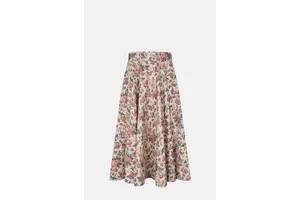
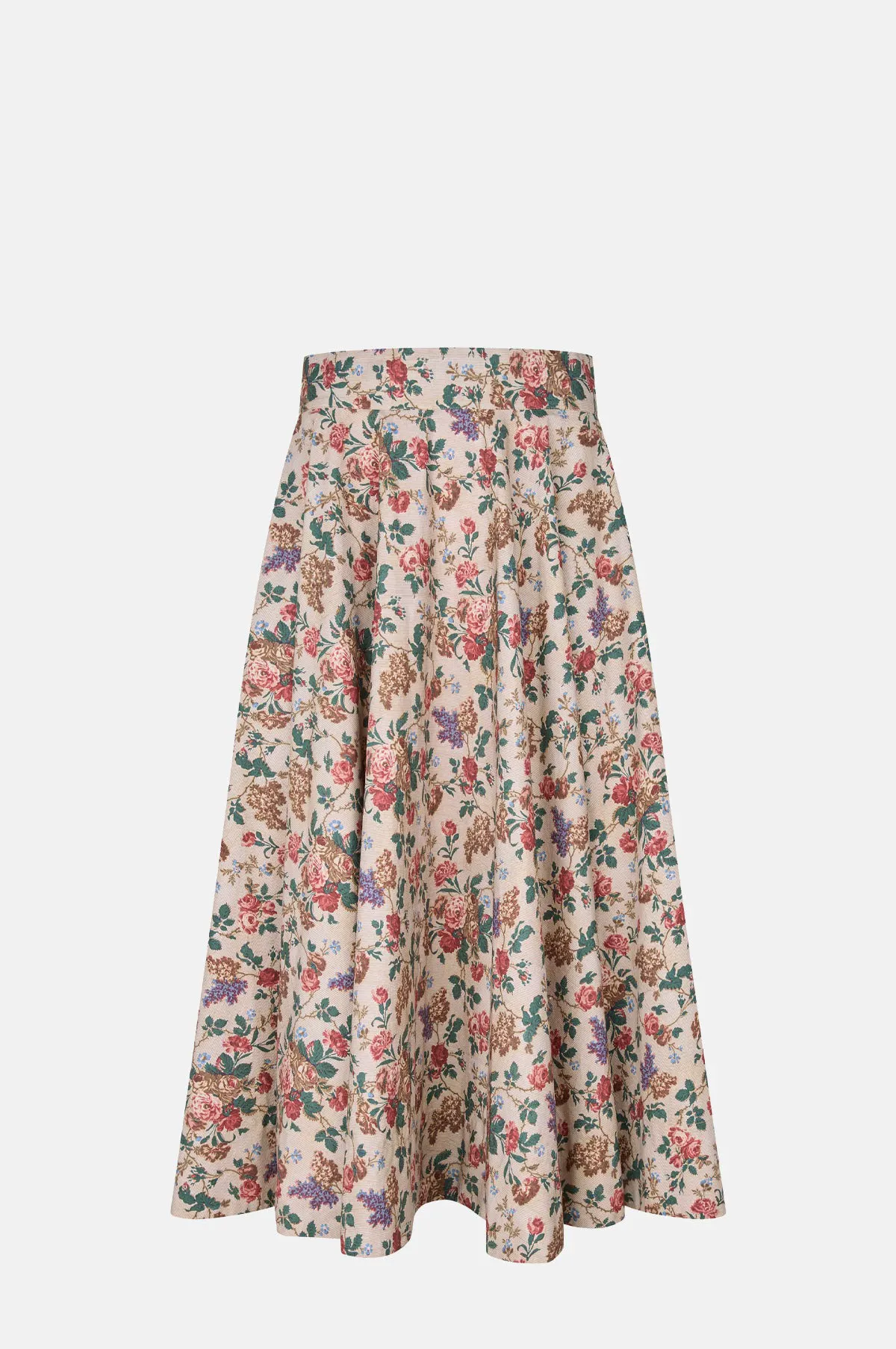

The Farah skirt from Tapis Noir in rose beige, a long skirt in crisp organic cotton carrying a nineteenth century French flower print taken from the maker's archive of antique fabrics, with a full drape, a zip in the waist at the back, side pockets set into the seam and a light cotton poplin lining, listed at 279 GBP with all three sizes in stock. It is worth beginning with the only girth measurement on the page, because this run has read a great many charts and this is the first one whose unit is in doubt. The chart says waist, and it gives 32, 34 and 39 centimetres. It does not say whether that is the skirt laid flat and halved, or the full way round. It is worth then working out why that matters more here than it would on a blouse. Every top in this run has been measured pit to pit, which is flat and which nobody mistakes. A waist is different: 32 centimetres flat is 64 centimetres round, which is a waist of about 25 inches and is wearable, while 32 centimetres round is under 13 inches and is not a waist anybody has. So the reading has to be flat, and the page should have said so instead of leaving a reader to work it out by elimination. It is worth then looking at the grading, because it is the widest single step this run has recorded. The waist steps two centimetres from small to medium, and then five from medium to large. Five centimetres in one step is more than double the run's usual two, and it is the largest jump any garment in this run has made. It is worth then working out what that does, and this run has a formula for it that has now matched eight garments: a grade of g centimetres flat moves the ease by 0.79g minus 2 inches per size. Two centimetres takes away 0.43 inches, and five centimetres adds 1.94. It is worth then following that through, because the consequence is unusual. Doubled, the waist runs about 25.2, 26.8 and 30.7 inches. Against bodies of 26, 28 and 30, that gives minus 0.8 inches at a small, minus 1.2 at a medium and plus 0.7 at a large. It is worth then saying plainly what that means, because the skirt has a zip and no elastic. The two smaller sizes measure tighter than the body they close around, and the largest measures looser. It is worth then closing on the two things the page does that this run rarely sees, because both are worth crediting and one of them is then undone. The bullets count the pockets, which no other garment in this run has done. And the description says the cloth is lined in cotton poplin, while the fibre panel gives one line and does not mention the lining at all. The reference is the Farah skirt. Dongguan Bafinasa Garments Co., Ltd. develops comparable skirts on OEM and ODM terms, from cloth and print development to retail or FBA ready packing. We publish this as a development reference and build your own version of it, and we do not supply the branded original or reproduce anyone else's label.
Key Features
- A waist measured 32 to 39 cm flat, with nothing on the page saying whether that is flat or round. See the note below
- A waist grading 2 cm and then 5 cm, the largest single step this run has recorded. See the note below
- About minus 0.8 in at a small and plus 0.7 at a large, so the fit crosses the body between medium and large. See the note below
- A zip in the waist at the back as stated, on a skirt whose two smaller sizes measure under the body
- Very wide skirt as stated, with no hip and no hem sweep published to support it. See the note below
- 2 side pockets as stated, the only pocket count in this run. See the note below
- 100% organic cotton as stated, with no standard named. See the note below
- Hand wash or dry clean as stated, two different regimes offered and no temperature given. See the note below
Customisable Options
- Cloth: a crisp organic cotton to the reference, with the weight in grams per square metre stated, or a conventional cotton poplin, or a cotton lawn, or a cotton and linen blend, or a recycled cotton, each quoted separately
- Print: a nineteenth century French floral from an archive to the reference, with the repeat, the scale and the ground colour stated, or a larger scale placement print, or a smaller scale engineered print, or a rotary or digital print at a different repeat, or a plain dyed body, each quoted separately
- Volume: a very wide full skirt to the reference, with the hip and the hem sweep published and graded, or a gathered waist, or a pleated waist, or an A line, or a straight skirt, each quoted separately
- Waist: a flat cut waistband with a zip at the back to the reference, with the waist graded evenly and the fit set above the body at every size, or an elasticated back, or a full elastic waist, or a drawstring waist, each quoted separately
- Lining: a light cotton poplin lining to the reference, with the fibre given separately in the composition panel, or a half lining, or a viscose lining, or unlined, each quoted separately
- Pockets: two side pockets set into the seam to the reference, with the opening size and the depth stated, or one pocket, or patch pockets, or no pockets, each quoted separately
- Composition split by component with the lining given its own line, cloth weight in grams per square metre, print scale and repeat, waist, hip and hem measurements all graded evenly, pocket count, opening size and depth, shrinkage figures, size set, colour development, private label and care labelling
Specifications
| Style | Long print organic cotton skirt with a very full drape, a flat cut waist with a zip at the back, two side pockets set into the seam and a light cotton poplin lining |
| Reference | Tapis Noir, Farah cotton skirt, colour Rose Beige, style TN26022403, sizes 0/Small to 2/Large |
| Composition | 100% organic cotton, as stated in the bullets. One line, and it does not cover the lining. See the note below |
| Lining | A light layer of cotton poplin, as stated in the description, with no fibre line of its own in the composition panel. See the note below |
| Certification | None named, despite the cotton being described as organic. See the note below |
| Cloth Type | Crisp organic cotton, as stated, with no weight in grams per square metre given |
| Cloth Weight | Not stated, in any form |
| A 19th century French flower print in shades of pink, purple and brown on an off white ground, taken from the maker's archive of antique fabrics and keeping the old repairs and patches from the original piece, as stated, with no scale and no repeat given | |
| Fit Word | Very wide skirt, as stated in the bullets, describing volume rather than fit |
| Fit Statement | None published |
| Sizes Offered | 0/Small, 1/Medium and 2/Large, three sizes, all three in stock at the time of writing |
| Size Conversion | None published, the sizes are given as a number over a letter |
| Model | 179 cm tall, wearing a size 1/Medium, as stated. Complete, with the height and the size worn |
| Waist | 32 to 39 cm, doubling to 64 to 78 cm around, or about 25.20 to 30.71 in. See the note below |
| Waist Convention | Not stated. The chart says waist and gives no indication whether the figure is flat or round. See the note below |
| Hip | Not measured, despite the garment being described as very wide. See the note below |
| Hem Sweep | Not measured, despite the garment being described as very wide. See the note below |
| Ease at the Waist | About minus 0.8 in at a small, minus 1.2 at a medium and plus 0.7 at a large. See the note below |
| Change in Ease per Size | About minus 0.43 in then plus 1.94 in. See the note below |
| Largest Grade Step | 5 cm, from medium to large, the largest single step this run has recorded. See the note below |
| Pockets | 2 side pockets, as stated, set into the seam, with the count given and no opening size and no depth given. See the note below |
| Closure | Zipper at the back in the waist, as stated, with no zip length given |
| Care | Hand wash or dry clean, as stated, two regimes offered and no temperature given. See the note below |
| Certification | None named |
| Bullet List | Four bullets, the first of which is the fibre |
| Measurements Published | Waist and total length for all three sizes, two columns |
| Published Waist | 32, 34 and 39 cm, stepping 2 cm and then 5 cm. See the note below |
| Waist Around | 64, 68 and 78 cm, or 25.20, 26.77 and 30.71 in. See the note below |
| Published Total Length | 85, 88 and 90 cm, stepping 3 cm and then 2 cm |
| Length as a Share of Height | About 49% on the stated model, being 88 cm on a 179 cm wearer |
| Hip | Not measured |
| Cloth Weight | Not stated |
| Photographs | Four |
| Production | Made in China as stated, with no certification named |
| Reference Retail | 279 GBP as listed, quoted to show the price band this sits in, not as our price |
| Category | Filed by the reference under skirts |
| Occasion | Everyday, weekend, autumn, dressed up or down |
| MOQ | 100 pcs per style per colourway, mixed sizes and colourways accepted |
| Sampling | 7-10 days after tech pack or reference sample confirmation |
| Bulk Lead Time | 20-30 days after sample approval and deposit |
| Service | OEM / ODM / private label, organic, conventional and recycled cotton sourcing with the weight in grams per square metre stated and the certification named where claimed, archive print development with the scale and repeat set, full skirt blocks with the waist, hip and hem sweep all measured and graded evenly, cotton poplin and viscose linings, concealed zip and pocket in seam development, retail or FBA ready packing |
Size Chart as Published by the Reference
| Size | Waist (cm) | Total Length (cm) |
|---|---|---|
| 0/Small | 32 cm | 85 cm |
| 1/Medium | 34 cm | 88 cm |
| 2/Large | 39 cm | 90 cm |
The waist figures are flat half measures taken with the skirt laid down, doubling to 64, 68 and 78 cm around, or 25.20, 26.77 and 30.71 in, and the page does not say which convention it uses, which on a waist matters more than on a chest because the two readings differ by a factor of two. Against bodies of roughly 26, 28 and 30 in, the ease at the waist runs minus 0.8, minus 1.2 and plus 0.7 in, so the fit crosses the body between medium and large and the two smaller sizes close tighter than the body they go round. The waist steps 2 cm and then 5 cm, and this run derives that a grade of g centimetres flat moves the ease by 0.79g minus 2 inches per size, which gives minus 0.43 and then plus 1.94, matching the chart on both steps. No hip and no hem sweep are published despite the skirt being described as very wide. Our proposal below grades the waist evenly, publishes the hip and the hem sweep, and holds the fit above the body at every size.
Our Proposed Body Chart
| Size | Body Waist | Body Hips | Length | Source |
|---|---|---|---|---|
| 0/Small | 26 in / 66 cm | 35 in / 89 cm | 85 cm / 33.5 in | Our proposal |
| 1/Medium | 28 in / 71 cm | 37 in / 94 cm | 87 cm / 34.3 in | Our proposal |
| 2/Large | 30 in / 76 cm | 39 in / 99 cm | 89 cm / 35 in | Our proposal |
Occasions and Styling
Suits everyday and weekend wear. A full printed skirt carries an outfit on its own, so it works with a plain knit or the matching shirt, and the length takes it from daytime into evening.
Production and Quality Control
The reference publishes two measurements for all three sizes, and correctly measures the waist rather than the chest because it is a skirt. It carries all three sizes in stock, gives a complete model reference with the height and the size worn, states its fibre, its lining cloth, its print and its provenance, counts its pockets, names its closure and names its country of manufacture. It gives no cloth weight, no hip, no hem sweep, no certification, no print scale or repeat, no zip length, no pocket opening size or depth, no shrinkage figure and no fibre line for the lining, and it does not say whether its waist figure is flat or round. Three things follow: the only girth measurement on the page is ambiguous in its unit, the largest single grade step this run has recorded, and an organic claim with nothing behind it.
Thirty two, thirty four, thirty nine, and that is the first thing, and it is worth saying what is unusual about it before doing anything with the numbers. This run has read a great many charts, and every top in it has been measured pit to pit, which is unambiguous: it is the garment laid flat and halved, and nobody mistakes it. This chart says waist. It does not say flat, and it does not say round. It is worth then showing why that is not a small thing, because on a waist the two readings are not close. Thirty two centimetres flat is sixty four round, which is about twenty five inches and is a waist. Thirty two centimetres round is under thirteen inches, which is not a waist anybody has. So the reader has to work out which it is by elimination, and a measurement that has to be inferred is a measurement that has failed. It is worth then looking at the grading, because it is the reason the fit behaves oddly. The waist steps two centimetres and then five. Five centimetres in one step is the largest jump this run has recorded, more than double the usual two, and it is worth then following it through with the formula this run has been building, which has now matched eight separate garments. A grade of g centimetres flat moves the ease by 0.79g minus 2 inches per size. Two centimetres takes 0.43 inches away and five centimetres adds 1.94. It is worth then saying what that produces, because it is not the usual shape. The ease runs minus 0.8 at a small, minus 1.2 at a medium and plus 0.7 at a large. So the skirt is tighter than the body on its two smaller sizes and looser on its largest, and it crosses the body somewhere between medium and large. It is worth then adding the one fact that makes that consequential, which is that this waistband has a zip and no elastic. A fixed waist on a woven cotton skirt that measures under the body is a zip that has to be closed against the cloth. It is worth then noting what the page does give, which is the second thing and is to its credit: the bullets read 2 side pockets. Every other garment in this run has written pockets and left it there. This one counted them.
Organic, and that is the third thing, and it is worth setting it beside the garment that did this properly, because they are one batch apart. Last batch, a cotton jersey cardigan from a Danish house named GOTS three times: in its bullets, in its fibre panel and at the end of its style number. It is worth then reading what this page does with the same claim. The bullets say 100 per cent organic cotton. The fibre panel says 100 per cent organic cotton. There is no standard named anywhere. It is worth then being precise about what is missing, because organic is a claim about a supply chain and not about a cloth, and it is proved by a certificate number and a scope, not by an adjective. A reader cannot tell from this page whether the cotton is certified, under which standard, or by whom. It is worth then adding the second omission, which is the same kind of thing and sits in the same panel. The description says the skirt is lined with a light layer of cotton poplin. The fibre panel gives one line and does not mention the lining. So a garment this run knows to be made of two cloths is declared as one. It is worth then closing on the care label, because it is a useful correction to a rule this run has been building. The label reads hand wash or dry clean, with no temperature. The rule so far has been one way and this run should now say so plainly: the presence of animal fibre or applied decoration has always meant no machine temperature, and that has held every time. But the absence of them has never guaranteed a temperature, and this garment is the proof. It is plain organic cotton with no animal fibre and no applied decoration, and the maker still chose hand wash. It is worth then adding the last small thing, which is that the two instructions offered are not equivalent. Hand wash and dry clean are very different regimes, and giving both leaves the customer to choose, and the page gives no help with which to pick.
Optional upgrades include stating whether the waist figure is flat or round on every skirt chart, grading the waist evenly instead of stepping 2 cm and then 5 cm, holding the fit above the body at every size on a fixed waistband, publishing the hip and the hem sweep on a full skirt, giving the lining its own fibre line, naming the organic standard with the certificate number and scope, quoting the cloth weight in grams per square metre and the print scale and repeat, giving the zip length and the pocket opening size and depth, choosing one clear care regime and stating a temperature where the cloth allows it, adding shrinkage figures, conventional cotton poplin, cotton lawn, cotton and linen and recycled cotton cloths, larger and smaller scale prints and plain dyeing, gathered, pleated, A line and straight skirts, elasticated back, full elastic and drawstring waists, half, viscose and unlined options, one pocket, patch pockets and no pockets, size set, colour development, private label, hangtag and care labelling.
Pre-production sample approval, in-line inspection during cutting and sewing, and a final AQL inspection before packing, with measurement reports and photos shared before shipment.
Send us your tech pack, a photo or a reference garment and we will quote within 24 hours. Contact bafinasa@bafinasa.com or WhatsApp +86 13827222469.