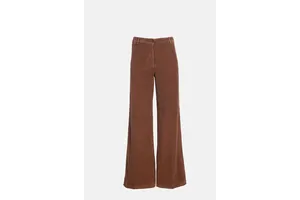
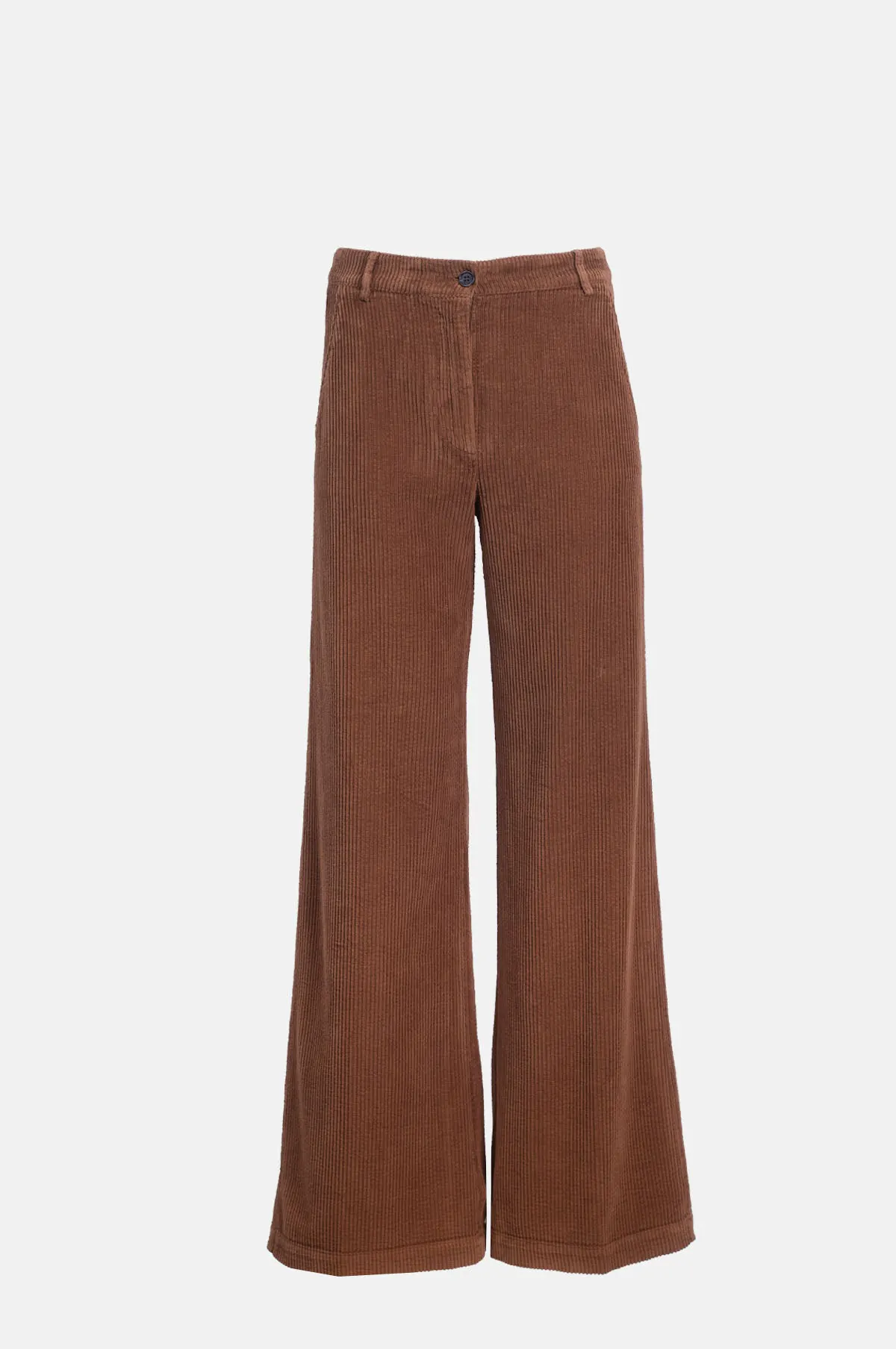

The second colourway of the Hartford Parade Pant, in a rich cognac brown rather than black, sharing a style number with the black and listed at 185 GBP with four of the five sizes left. This run looked at the black one last batch and said that two colourways of one style are the cleanest test there is of whether a brand's measurements are measured or copied, because a chart that is generated from a spec will be identical and a chart that is measured will wander. So it is worth reporting the answer straight, and the answer is that the two tables are identical to the last digit: waist 36, 38, 40, 41 and 43, and inside leg 83, 84, 84, 84 and 84 on both. That settles two questions the black one left open, and it fails to settle a third, and it is worth being precise about which is which, because the third one is the interesting one. What it settles is that the frozen inside leg is the pattern rather than a typo, since a typo does not replicate exactly across two listings, and that the uneven-looking waist step is likewise what the garment does. What it does not settle is whether both colourways were measured or whether one inherited the numbers from the other, and the reason it cannot settle that is the reason this run keeps arriving at: the figures are rounded to whole centimetres, and the rounding erases exactly the difference that would tell you. The reference is the Parade Pant in Cognac. Dongguan Bafinasa Garments Co., Ltd. develops comparable trousers on OEM and ODM terms, from cloth sourcing to retail or FBA ready packing. We publish this as a development reference and build your own version of it, and we do not supply the branded original or reproduce anyone else's label.
Key Features
- Waist 36, 38, 40, 41 and 43 cm and inside leg 83, 84, 84, 84 and 84 cm, identical to the black colourway to the last digit. See the note below
- The colourway test this run proposed last batch, answered: the frozen inside leg and the uneven waist step are both confirmed as the pattern, not as errors. See the note below
- Same style number as the black, BGPC600-27, so these are colourways of one pattern rather than two garments
- A true waist grade of about 1.8 cm per size, of which the published figures are the rounded image, giving ease from about 4.4 in down to about 2.0 in. See the note below
- Medium ribbed corduroy as stated, with no wale count and no weight, and no mention that the cloth has a nap. See the note below
- Two measurements published in total, no hip, no rise, no outside leg and no hem width, on a woven cloth with no stretch
- One photograph again, front only, so the buttoned back pockets named in the description are unshown in either colourway. See the note below
Customisable Options
- Cloth: medium ribbed corduroy to the reference, with the wale count and the weight stated, or a wide wale corduroy, a fine pinwale, or a cotton twill, each quoted separately
- Cutting: one-way cutting as the nap requires, with the cloth allowance quoted, or a non-napped alternative if that is preferred
- Waist: high to the reference, with the hip published, or a mid rise, with the hip published either way
- Leg: wide to the reference, with the hem width published, or a straighter leg, or a tapered leg, each quoted separately
- Inside leg: 84 cm to the reference, held across sizes, or graded at about one centimetre per size, or a shorter or longer leg
- Colourway: cognac to the reference, or black as this run also makes, or any other dyed corduroy, each quoted separately
- Wale count and cloth weight, hip and rise measurements, hem width, inside leg and whether it grades, zip length and button size, pocket dimensions, size set, colour development, private label and care labelling
Specifications
| Style | High-waisted wide leg trouser in cotton corduroy with a zip fly |
| Reference | Hartford, Parade Pant, style BGPC600-27, cognac, sizes 1 to 5 |
| Colourway | The second colourway of the style this run examined in black. See the note below |
| Composition | 100% cotton as stated in the panel |
| Cloth | Medium ribbed corduroy as stated, with no wale count and no weight given. See the note below |
| Nap | Not mentioned, and corduroy has one. See the note below |
| Waist | High waist as stated, with the rise not published. See the note below |
| Leg | Wide leg as stated, with no hem width given. See the note below |
| Closure | Button and zip fly closure as stated, with no zip length and no button size given. See the note below |
| Pockets | Buttoned back pockets and side pockets as stated, with no dimensions and no button size given. See the note below |
| Care | Machine wash at 30 degrees, do not tumble dry, as stated, with no instruction to wash inside out or press on the reverse. See the note below |
| Sizes Offered | 1 to 5, five sizes, with 1, 3, 4 and 5 in stock at the time of writing |
| Size Conversion | Published: 1 is XS, 2 is S, 3 is M, 4 is L and 5 is XL |
| Fit Guidance | None published |
| Model | None published |
| Measurements Published | Waist half and inside leg only, two columns in total, identical to the black colourway. See the note below |
| Published Waist | 36, 38, 40, 41 and 43 cm flat, or 14.2 through 16.9 in. See the note below |
| Waist Around | 72, 76, 80, 82 and 86 cm, or 28.3, 29.9, 31.5, 32.3 and 33.9 in. See the note below |
| True Waist Grade | A uniform 1.8 cm per size, of which the published figures are the rounded image. See the note below |
| Ease Against Body Waist | About 4.3, 3.9, 3.5, 2.3 and 1.9 in as published, but about 4.4, 3.8, 3.2, 2.6 and 2.0 in once the rounding is removed. See the note below |
| Published Inside Leg | 83, 84, 84, 84 and 84 cm, so it is effectively constant across the range, and it is the same on the black. See the note below |
| Hip | None, on a woven cloth with no stretch. See the note below |
| Rise | None, and with only one length column it cannot be derived. See the note below |
| Outside Leg | None. See the note below |
| Hem Width | None, on a garment described as a wide leg. See the note below |
| Wale Count | None. See the note below |
| Cloth Weight | Not stated |
| Photographs | One, and the same single front view as the black. See the note below |
| Production | Made in Morocco as stated, as was the black |
| Reference Retail | 185 GBP as listed, the same as the black, quoted to show the price band this sits in, not as our price |
| Category | Filed by the reference under trousers |
| Occasion | Autumn and winter, everyday, with tailoring or a tee |
| MOQ | 100 pcs per style per colourway, mixed sizes and colourways accepted |
| Sampling | 7-10 days after tech pack or reference sample confirmation |
| Bulk Lead Time | 20-30 days after sample approval and deposit |
| Service | OEM / ODM / private label, corduroy sourcing by wale count and weight, one-way cutting and marker planning, multi-colourway programmes, wide leg trouser development, retail or FBA ready packing |
Size Chart as Published by the Reference
| Size | Waist 1/2 (flat) | Inside Leg |
|---|---|---|
| 1 / XS | 36 cm | 83 cm |
| 2 / S (sold out) | 38 cm | 84 cm |
| 3 / M | 40 cm | 84 cm |
| 4 / L | 41 cm | 84 cm |
| 5 / XL | 43 cm | 84 cm |
The waist figures are flat half measures taken with the trouser laid down, doubling to 72, 76, 80, 82 and 86 cm around, or 28.3, 29.9, 31.5, 32.3 and 33.9 in. They are identical to the black colourway of this same style. The published steps are 2, 2, 1 and 2 cm, but a uniform grade of about 1.8 cm rounds to exactly these figures, so the waist is evenly graded and the true ease falls steadily from about 4.4 in to about 2.0 in across the range. The inside leg is 83 cm on the smallest size and 84 cm on every other size, so it is effectively one length for the whole range, again as on the black. No hip, no rise, no outside leg and no hem width are published.
Our Proposed Body Chart
| Size | Body Bust | Body Waist | Body Hips | Length | Source |
|---|---|---|---|---|---|
| 1 / XS | 31 in / 79 cm | 24 in / 61 cm | 34 in / 86 cm | 83 cm / 32.7 in | Our proposal |
| 2 / S | 33 in / 84 cm | 26 in / 66 cm | 36 in / 91 cm | 85 cm / 33.5 in | Our proposal |
| 3 / M | 35 in / 89 cm | 28 in / 71 cm | 38 in / 97 cm | 87 cm / 34.3 in | Our proposal |
| 4 / L | 37 in / 94 cm | 30 in / 76 cm | 40 in / 102 cm | 89 cm / 35 in | Our proposal |
| 5 / XL | 39 in / 99 cm | 32 in / 81 cm | 42 in / 107 cm | 91 cm / 35.8 in | Our proposal |
Occasions and Styling
Suits autumn and winter and everyday dressing. Cognac is the traditional colour for corduroy and it is the more forgiving of the two colourways of the nap problem this run describes below, since a dark solid shows panel mismatching far more sharply than a mid brown does.
Production and Quality Control
The reference publishes two columns for all five sizes, states a single fibre, names the cloth, describes the leg, the waist, the closure and the pockets, gives a two-clause care instruction, names the country of production, publishes a size conversion, and carries the same style number as the black colourway. It publishes no fit guidance and no model information, and gives no hip, no rise, no outside leg, no hem width, no wale count, no cloth weight and no pocket dimensions, and it never mentions that the cloth has a nap. Three things follow: what the second colourway settles, what it fails to settle, and what it does not add.
The test, and what it answered, and that is the first thing. This run said last batch that two colourways of one style are the cleanest available test of whether a measurement chart is measured or generated, on the reasoning that a chart produced from a graded specification will be identical between colourways while a chart produced by measuring garments will wander by a centimetre here and there. Both colourways of this trouser publish waist 36, 38, 40, 41, 43 and inside leg 83, 84, 84, 84, 84. Identical to the last digit, across five sizes and two columns. That settles two questions the black listing left open, and both were worth settling. The first was whether the frozen inside leg was a mistake. When a single listing shows a dimension held still across a size range, one honest explanation is a clerical error: someone typed the same figure into four cells. A clerical error does not replicate exactly on a second listing, so the replication says the 84 is the pattern. This trouser is one length from the crotch down for every size it is made in, by design. The second question it settles is the same one in reverse, about the waist. The step pattern there is 2, 2, 1, 2, and this run showed last batch that a uniform grade of about 1.8 centimetres rounds to exactly those five numbers, so the apparent stumble is an artifact. Seeing the same stumble on the second colourway confirms that too: it is what the garment does, not a typo in one cell. So the second listing has converted two suspicions into two facts, and this run will take them as settled from here. Now the part the test cannot answer, and this run said it would report the answer straight rather than manufacture a finding, so here it is. The two colourways being identical does not tell you whether both were measured or whether one was measured and the other inherited the numbers, because for two colourways of one pattern in one base cloth those two situations produce the same output. Cognac and black corduroy cut from the same pattern on the same base cloth should measure the same to within a centimetre, and a mill that measured both properly would very likely publish figures that round to the same five numbers. So the honest verdict is that the test as posed is inconclusive, and it is worth saying why, because the reason is the same reason this run has arrived at three times now. The figures are rounded to whole centimetres, and the rounding throws away precisely the variation that would distinguish measured from copied. This run established earlier in this batch set that whole-centimetre rounding can make an even grade look uneven and can make an uneven grade look even. It now establishes that it can make a copied chart look measured and a measured chart look copied. A published chart is a lossy image of the pattern, and what is lost is in exactly the digits a reader would need.
What the second colourway does not add, and that is the second thing, and it is worth saying plainly because a colourway is an opportunity. The black listing omitted the hip, the rise, the outside leg, the hem width, the wale count and the cloth weight, and said nothing about the nap. Every one of those omissions is repeated here, exactly. So the second colourway added no measurement, no fit guidance, no model information and no construction note. It added one photograph. That is worth dwelling on for a moment, because it is not a trivial point about one brand: a customer choosing between these two colourways can compare nothing at all except the colour, since the two listings give her the same two numbers and the same one picture. And it is worth adding the observation that the picture added is another front view. The description on both colourways names buttoned back pockets, so the feature the brand is proudest of is the feature that is not photographed in either. Across this batch that same shape appears twice more: two listings of one trouser with one front view each, and a jumper whose dropped hem at the back is named in the text and not shown in its single photograph. When a page has one image, the question worth asking is which named feature it cannot show, because that is usually the interesting one. Then the nap, which the second colourway does not mention either and which behaves differently in these two colours. Corduroy has raised ribs running down its length and those ribs lie in one direction, so two panels cut in opposite directions read as different shades. That is most visible on a dark solid, which is why black corduroy is the harder of the two to make and why the cognac is the more forgiving colourway for this particular fault. It also means every panel has to be cut the same way up, so the marker cannot be flipped or mirrored to save cloth, and a corduroy trouser costs more in cloth than the same trouser in a plain weave. None of that is on either page. And the wale count, which is corduroy's own specification, is absent on both: medium ribbed is an adjective standing in for how many ribs there are to the inch, and that number decides how the cloth looks, drapes, costs and wears. It is worth adding one practical difference between the two colours while this run has both in front of it. Corduroy wears at the tops of its ribs, which go pale with abrasion at the seat, the inner thigh and the hem. On black that reads as a light patch on a dark ground and is conspicuous. On cognac the abraded area lightens to a paler version of the same tone and is far less obvious. So the two colours have genuinely different wear profiles and the pages say nothing about either.
What is still missing, and that is the third thing, and it is the same list as last batch, which is the point. Two measurements in total, waist and inside leg, is the sparsest trouser chart this run has met, and it is now the sparsest twice over. No hip, on a woven cloth with no stretch, which is the measurement that decides whether the trouser goes on. No rise, and with only one length column there is no outside leg to subtract from it, so there is genuinely no way to recover the rise at all; on the checked trouser this run examined two batches ago there were two length columns and subtracting them exposed a rise held at 27 centimetres across the whole range, and here that arithmetic is simply unavailable. No hem width, which is what wide leg actually means and the one number that would let a customer tell these apart from the straight leg trousers in the same range. And no fit guidance and no model on either colourway, so nothing anywhere in the range tells a customer how the trouser is meant to sit or what height of woman it was measured on. It is worth closing with the one thing the duplication does buy a maker, which is real. Two colourways sharing a style number and a chart is the correct and efficient way to run a programme: one pattern, one graded spec, one fit approval, and only the cloth and the trims change. This run makes multi-colourway programmes the same way. What it does not buy is an excuse to repeat every omission twice. Every bulk shipment gets a measurement report against your approved chart.
Optional upgrades include publishing the wale count and the weight of the corduroy, stating that the cloth is napped and quantifying the extra cloth allowance that one-way cutting requires, grading the inside leg at about one centimetre per size or stating plainly that one length is deliberate, publishing the hip and the rise, publishing the hem width and the outside leg, photographing the back so the buttoned back pockets are visible, specifying the zip by length and the waistband button by size, giving the pocket dimensions, adding wash inside out and press on the reverse to the care label, publishing fit guidance and a model height, a wide wale, pinwale and cotton twill option, mid rise option, straighter and tapered leg options, graded, shorter and longer leg options, plain fly and side zip options, further colourways from one approved pattern, size set, private label, hangtag and care labelling.
Pre-production sample approval, in-line inspection during cutting and sewing, and a final AQL inspection before packing, with measurement reports and photos shared before shipment.
Send us your tech pack, a photo or a reference garment and we will quote within 24 hours. Contact bafinasa@bafinasa.com or WhatsApp +86 13827222469.