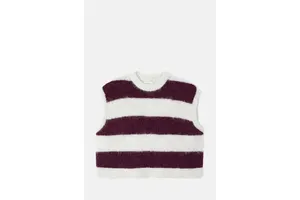
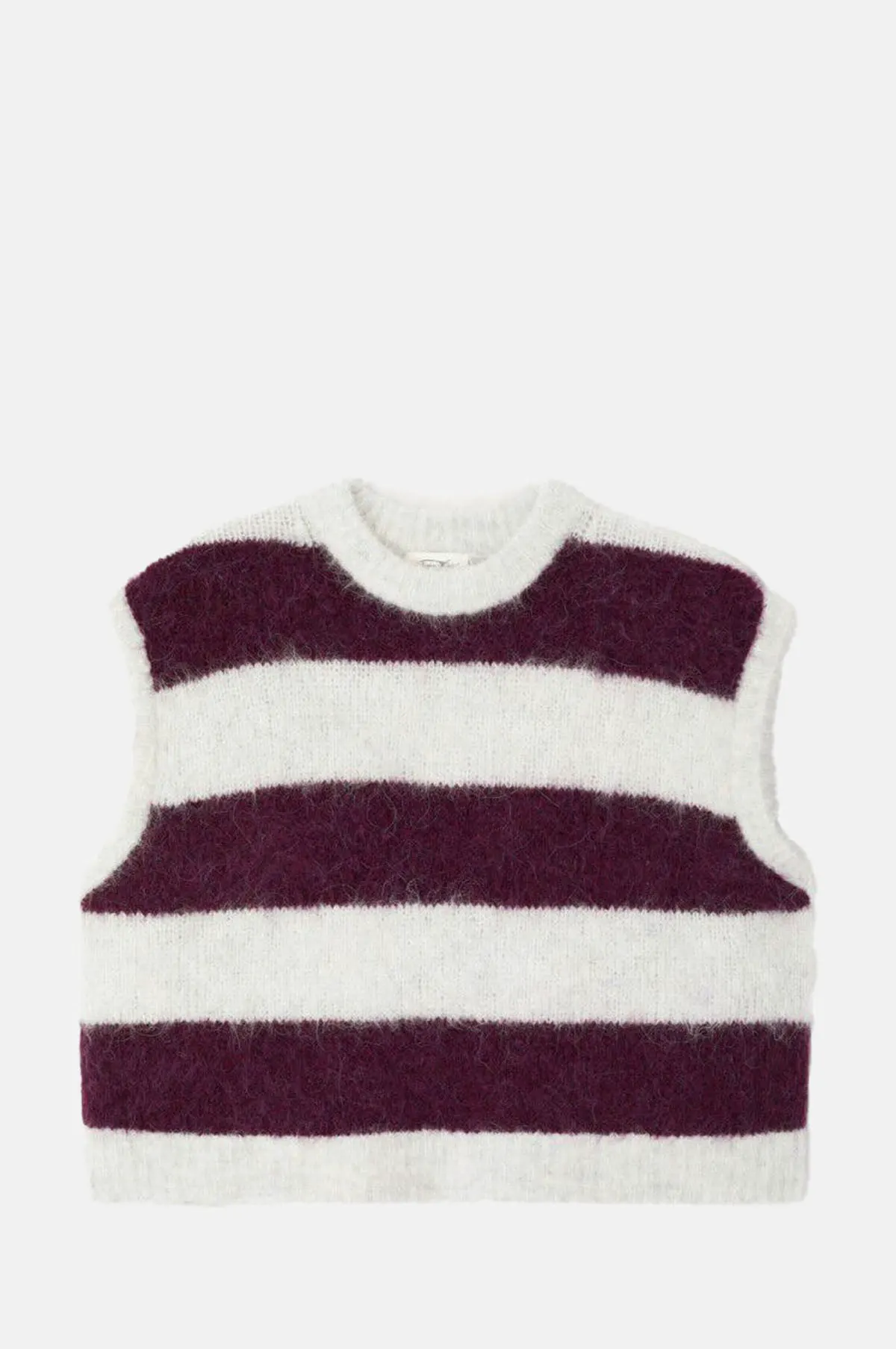

The Niby Vest from American Vintage, sleeveless and patterned in a cranberry red stripe on a grey ground, knitted from a thick and fluffy alpaca blend and listed at 135 GBP in two size bands, both in stock. It is the best-graded garment this run has measured and also the least sized, and those two facts are related, so it is worth setting out both. The grading first: the two bands differ by five centimetres flat, which is ten centimetres of circumference, or 3.94 in, and the bodies they cover differ by four inches. So the garment grades with the body to within about a sixteenth of an inch, and the ease is the same at both ends of the range, at about 15 in measured against the larger body in each band. Nothing else in this run comes close. Then the sizing: there are two bands, XS/S and M/L, and each band has to fit two different bodies, so one band delivers about 17 in of ease to the smaller body in it and about 15 in to the larger. One size, two fits, two inches apart, and the page gives no help at all on which band to choose. And the blend is worth a look, because it is four fibres and the page explains none of them, and because a garment that is 45% synthetic carries the strictest care label in this run while a pure cashmere jumper elsewhere in it is machine washable. The reference is the Niby Vest in Rayures Cranberry. Dongguan Bafinasa Garments Co., Ltd. develops comparable knitwear on OEM and ODM terms, from yarn sourcing by blend, ply, gauge and micron to retail or FBA ready packing. We publish this as a development reference and build your own version of it, and we do not supply the branded original or reproduce anyone else's label.
Key Features
- Two size bands differing by 3.94 in of circumference against a body that differs by four, so the ease is constant at about 15 in. See the note below
- One band, two fits: about 17 in of ease on the smaller body in a band and about 15 in on the larger. See the note below
- 55% alpaca, 24% acrylic, 19% polyamide and 2% elastane as stated, four fibres and not one of them explained. See the note below
- Thick and fluffy as stated, the two qualities acrylic is added to a blend to produce, with no ply, no gauge and no weight to tell them apart. See the note below
- Dry clean only as stated, on a blend that is 45% synthetic, beside a pure cashmere jumper in this run that machine washes. See the note below
- Cranberry stripe on a grey ground as stated, with no stripe width and no repeat given. See the note below
- Two photographs, and a striped garment is one of the few things a customer can partly judge from a picture
Customisable Options
- Blend: 55% alpaca, 24% acrylic, 19% polyamide and 2% elastane to the reference, with the purpose of each fibre stated, or a higher alpaca content, or an alpaca wool blend, or a wool blend, each quoted separately
- Finish: thick and fluffy to the reference, with the weight and the gauge stated, or a smoother felted finish, or a brushed finish, each quoted separately
- Fit: relaxed to the reference, with the ease at every band published, or a neater fit, or a slouchier fit, each quoted separately
- Stripe: cranberry on grey to the reference, with the stripe width and the repeat specified, or a plain ground, or a different stripe width and repeat, each quoted separately
- Neck: round neck to the reference, with the neck width and depth specified, or a V neck, or a higher neck, each quoted separately
- Sizing: two bands to the reference, or four single sizes, or three bands, with the ease published either way
- Alpaca grade and fineness in microns, ply, gauge and garment weight in grams, stripe width and repeat, armhole depth and shoulder width, neck width and depth, rib depth, size set, colour development, private label and care labelling
Specifications
| Style | Relaxed fit sleeveless vest with a round neck and ribbed trims |
| Reference | American Vintage, Niby Vest, style NIB18DH26, rayures cranberry, two size bands |
| Composition | 55% alpaca, 24% acrylic, 19% polyamide and 2% elastane as stated in the panel. See the note below |
| Blend Explained | None of the four fibres is explained. See the note below |
| Alpaca Grade | None, and no fineness in microns. See the note below |
| Yarn Specification | None: no ply, no gauge and no weight. See the note below |
| Finish | Thick and fluffy as stated, with nothing behind it. See the note below |
| Fit Word | Relaxed fit as stated, with a lovely relaxed shape that has just the right amount of slouch. See the note below |
| Neck | Round neck as stated, with no neck width and no neck depth given. See the note below |
| Sleeves | Sleeveless as stated, and no sleeve column is published, which is correct. See the note below |
| Armhole | Not published, and on a sleeveless garment it is the measurement that matters. See the note below |
| Shoulder Width | Not published. See the note below |
| Stripe | Cranberry red on a grey ground as stated, with no stripe width and no repeat given. See the note below |
| Trims | Ribbed trims as stated, with no rib depth and no rib structure given |
| Care | Dry clean only as stated, with no other clause. See the note below |
| Pilling And Shedding | Not mentioned. See the note below |
| Certification | None named. See the note below |
| Sizes Offered | Two bands, XS/S and M/L, both in stock at the time of writing. See the note below |
| Size Conversion | Not given as a conversion, since the bands are named for the sizes they cover |
| Fit Guidance | None published, on a garment whose only question is which band. See the note below |
| Model | None published |
| Measurements Published | Pit to pit and total length for the two bands, two columns in total. See the note below |
| Published Chest | 61 and 66 cm flat, or 24.0 and 26.0 in. See the note below |
| Chest Around | 122 and 132 cm, or 48.0 and 52.0 in. See the note below |
| True Chest Grade | 5 cm flat per band, or 3.94 in of circumference, against a body that grades 4 in per band. See the note below |
| Ease Against Larger Body | About 15.0 in on both bands, so it is constant. See the note below |
| Ease Against Smaller Body | About 17.0 in on both bands. See the note below |
| Published Length | 47 and 52 cm, with only two bands, so no grading pattern can be tested. See the note below |
| Armhole Depth | None. See the note below |
| Stripe Width | None. See the note below |
| Cloth Weight | Not stated. See the note below |
| Photographs | Two. See the note below |
| Production | Made in China as stated, with the alpaca origin not stated. See the note below |
| Reference Retail | 135 GBP as listed, quoted to show the price band this sits in, not as our price |
| Category | Filed by the reference under knitwear |
| Occasion | Autumn and winter, layering, everyday |
| MOQ | 100 pcs per style per colourway, mixed sizes and colourways accepted |
| Sampling | 7-10 days after tech pack or reference sample confirmation |
| Bulk Lead Time | 20-30 days after sample approval and deposit |
| Service | OEM / ODM / private label, alpaca and alpaca blend yarn sourcing with grade, micron, ply and gauge stated, garment weight in grams, stripe development by width and repeat, banded and single size grading, retail or FBA ready packing |
Size Chart as Published by the Reference
| Size | Pit To Pit (flat) | Total Length |
|---|---|---|
| XS / S | 61 cm | 47 cm |
| M / L | 66 cm | 52 cm |
The chest figures are flat half measures taken with the vest laid down, doubling to 122 and 132 cm around, or 48.0 and 52.0 in. The XS/S band covers bodies of about 31 and 33 in and the M/L band about 35 and 37, so measured against the larger body in each band the ease is about 15.0 in on both, and against the smaller body about 17.0 in on both. The two bands differ by 3.94 in of circumference while the bodies they cover differ by 4 in, so the grade follows the body almost exactly.
Our Proposed Body Chart
| Size | Body Bust | Body Waist | Body Hips | Length | Source |
|---|---|---|---|---|---|
| XS / S | 31 in / 79 cm | 24 in / 61 cm | 34 in / 86 cm | 47 cm / 18.5 in | Our proposal |
| M / L | 33 in / 84 cm | 26 in / 66 cm | 36 in / 91 cm | 49 cm / 19.3 in | Our proposal |
Occasions and Styling
Suits autumn and winter and layering. A sleeveless alpaca vest with this much room is made to go over a shirt or a thin knit, and the stripe makes it the piece that carries an otherwise plain outfit.
Production and Quality Control
The reference publishes two columns for both bands, states all four fibres to the percentage, describes the neck, the trims, the stripe and the finish, gives a fit word, gives a care instruction, names the country of production and carries two photographs. It gives no alpaca grade, no fineness, no ply, no gauge, no weight, no armhole, no shoulder width, no neck dimensions, no rib specification, no stripe width and no repeat, and publishes no fit guidance and no model information. Three things follow: the grade that nearly matches the body, the two size bands, and the four fibres that are named but not explained.
Three point nine four against four, and the best match this run has found, and that is the first thing. The smaller band measures 122 cm around and the larger 132, a difference of ten centimetres, or 3.94 in. The bodies the two bands cover are about 33 and 37 in at their upper ends, a difference of exactly four inches. So the garment grades 3.94 in for a body that grades 4, and it is short by about a sixteenth of an inch across the whole range. That is close enough that the ease is effectively constant: measured against the larger body in each band it is about 15.0 in on both, and against the smaller body about 17.0 in on both. This run has been measuring how much the fit changes across a size range for many batches now, and it is worth saying what it has found, because the spread is wide. This brand's roll collar climbs by about 2.7 in of ease from its smallest to its largest. Its two stretch garments swing by more than that and in a non-monotonic way. Its heavyweight cropped jumper, published alongside this one, is the best of that group at about 1.1 in. This vest is within a rounding error of zero. So of everything this run has measured, this is the garment whose fit is most nearly the same fit at every size, and it achieves it by grading almost exactly with the body. That is worth crediting without reservation, and it is worth noting that it was achieved on the garment with the fewest sizes, which is not a coincidence: the fewer sizes a garment has, the more each grade has to carry, and the more reason there is to get it right. It is worth adding the honest limitation, which is that with only two sizes this run cannot test the grading the way it usually does. Its test needs at least three points to ask whether a uniform grade explains the column, and two points can always be joined by a straight line. So the run can say what the two bands differ by, and it cannot say whether the underlying pattern is evenly graded or was simply measured at two points. That is worth stating because it is a real loss of information, and it is the same loss the customer faces: two sizes give a customer the least possible view of how a garment is graded.
One size, two fits, and no help choosing, and that is the second thing. The garment comes in XS/S and M/L, so each band has to fit two different bodies. The smaller band must fit both a 31 in body and a 33 in body, and it delivers about 17 in of ease to the first and about 15 in to the second. The larger band does the same at 35 and 37. So an extra small and a small buy the identical garment and wear it two inches apart in ease, and the same is true of a medium and a large. This is the ordinary consequence of banded sizing and it is not a fault in itself, but it does two things that are worth saying. The first is that it breaks a method this run has been using throughout: every ease figure it has published has assumed one size means one fit, and with a band that is no longer true. A band is a range of fits, and this run has to say so rather than quietly publish a single number as though it were. The second is that it makes the choice of band the only decision a customer has to make, and the page gives her nothing to make it with. No recommendation, no model, no model size, nothing about whether the vest runs large or small. On a four-size garment that is a missed opportunity; on a two-size garment it is the entire question. It is worth connecting this to something this run flagged last batch, because this garment supplies the other half of the comparison. Last batch it noted that a jumper described as hugging the body and, in the next sentence, as a great lightweight layer, is claiming two things that cannot both be true, because a garment that hugs has no room for anything under it. This run now has a number for what it takes to be a layering piece. A vest with 15 to 17 in of ease genuinely layers; it will take a shirt and a thin knit underneath without complaint. A jumper with 2.1 in does not. So the two claims on that other garment are not merely in tension, they are in tension by about thirteen inches, and the run can now say so with a figure. It is worth adding what the chart leaves out on a sleeveless garment in particular. There is no armhole depth and no shoulder width, and on a vest those two are the measurements that decide whether it sits on the shoulder or slides off it. The page publishes two columns and a sleeveless garment needs at least four.
Four fibres, none explained, and the strictest label in the run, and that is the third thing. The panel reads 55% alpaca, 24% acrylic, 19% polyamide and 2% elastane, and the description calls it a thick and fluffy alpaca blend. A blend like that is a set of decisions: alpaca for the handle and the warmth, acrylic for bulk and loft at a lower cost, polyamide for strength, since alpaca fibre has little crimp and poor elasticity and needs a binder, and elastane for recovery. Every one of those is a real reason and not one of them is on the page. It is worth being precise and fair about the acrylic, because it is nearly a quarter of the garment and the description credits the alpaca for exactly the qualities acrylic is there to produce. Alpaca is genuinely lofty and light, so thick and fluffy is not a false claim about it. But acrylic is added to blends of this kind precisely to add bulk and loft cheaply, and with 24% of it in the cloth and no ply, no gauge and no weight published, there is no way for a reader to know how much of the thickness and the fluff comes from the alpaca and how much from the acrylic. That is not an accusation, it is what the missing numbers cost. And the alpaca, like the cashmere in this run's other garments, has no grade and no fineness in microns, and alpaca is graded on exactly that basis. Then the care label, and this is where the run's rule stands up decisively. Dry clean only, on a garment that is 45% synthetic, sitting in the same run as a pure cashmere jumper labelled machine wash at thirty. So the fibre content does not predict the care label, and it does not predict it in either direction: two batches ago this run found two cotton garments from one brand with opposite labels, and here are two knitwear garments from two brands where the more synthetic one is the stricter one. The reason in this case is almost certainly the finish rather than the fibre, because a raised or brushed surface mats and loses its loft in water, and thick and fluffy describes exactly such a surface. So the constraint is the finish, and the page names the finish in adjectives and never mentions the consequence. It is worth saying what the label leaves out, which is everything: no pilling note and no shedding note on a fluffy raised alpaca blend, which are the two things a garment like this does most, and no guidance at all beyond the one instruction. And it is worth closing on the stripe, because it is the one specification on this page a customer could actually check with her eyes. A striped knit is specified by the width of the band and the length of the repeat, and a customer will count both in a photograph. Neither is given. On a brushed fluffy cloth a stripe also softens and blurs with wear and with pilling, so the stripe she counts in the picture is not the stripe she will have in a year, and nothing says so. Every bulk shipment gets a measurement report against your approved chart.
Optional upgrades include stating the alpaca grade and the fineness in microns, stating the ply, the gauge and the garment weight in grams, explaining what each of the four fibres is there for, publishing the stripe width and the repeat and saying how the stripe behaves on a brushed cloth, publishing the armhole depth and the shoulder width, giving the neck width and depth, giving the rib structure and depth, adding a pilling and shedding note, adding fit guidance with a model and her size so the band can be chosen, offering four single sizes instead of two bands, a higher alpaca content, an alpaca wool and a wool blend option, a smoother felted finish, a neater and a slouchier fit, a plain ground and other stripe widths, size set, colour development, private label, hangtag and care labelling.
Pre-production sample approval, in-line inspection during cutting and sewing, and a final AQL inspection before packing, with measurement reports and photos shared before shipment.
Send us your tech pack, a photo or a reference garment and we will quote within 24 hours. Contact bafinasa@bafinasa.com or WhatsApp +86 13827222469.