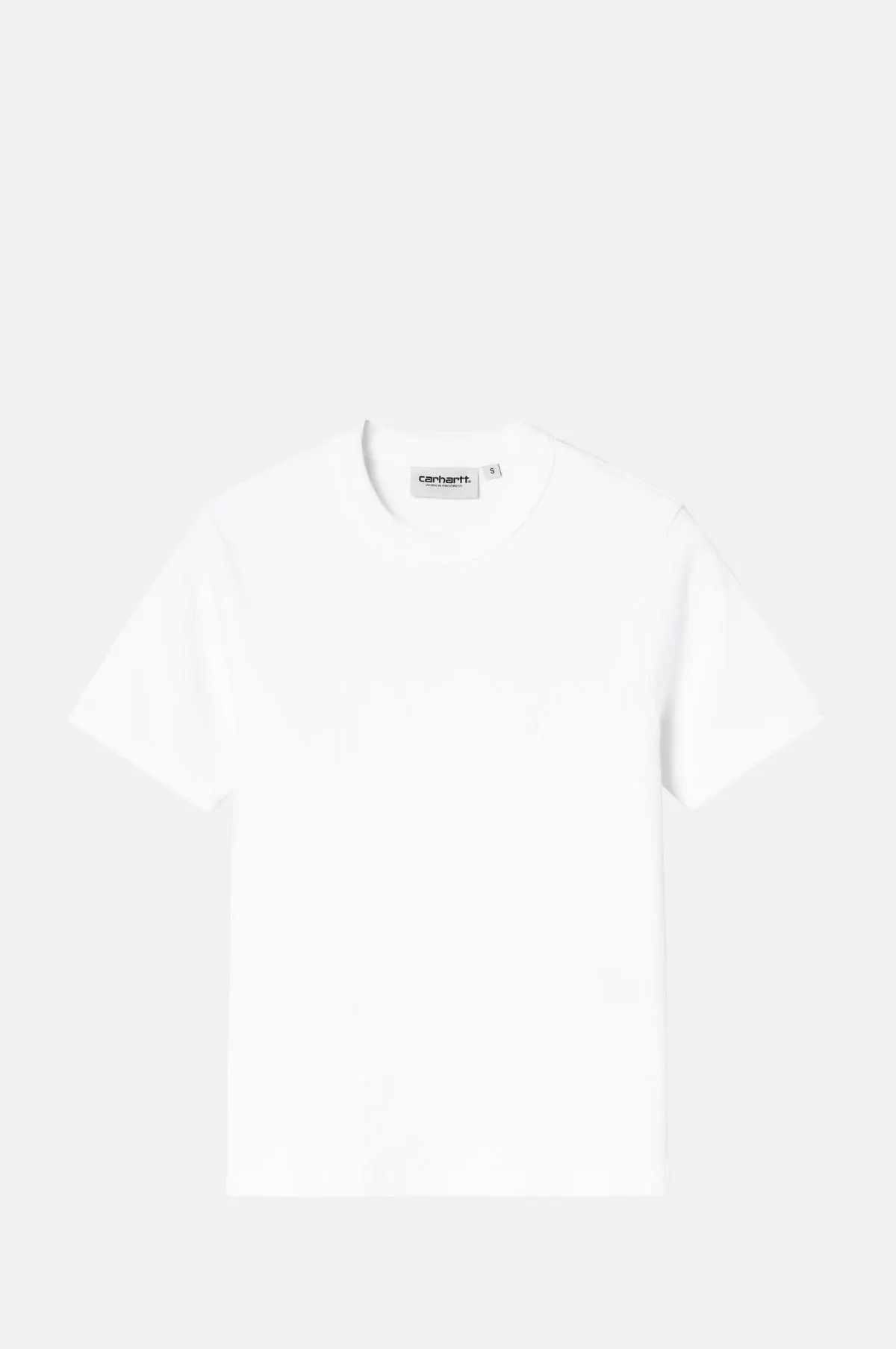

The Philipa T-shirt from Carhartt WIP in white, a ribbed baby tee in a stretch cotton jersey with a slim silhouette, a crew neck and a tonal logo at the chest, listed at 35 GBP with one of four sizes left. It is the first garment in this entire run with negative ease, and that single fact reorganises a lot of what this run has been doing. Measured against the body, its chest comes out at about 2.7 to 3.9 inches SMALLER than the bust it is sized for, at every size. That is not a mistake on the page: it is what a ribbed baby tee with elastane is supposed to do, and the word slim on the label is honest. But it means the vocabulary this run has been building, which sorts fit words by inches of ease, formally does not apply here, and this run will say so rather than quietly filing a negative number into a table built for positive ones. It also means the number a customer actually needs is not the ease but the stretch: how far it goes, whether it comes back, and whether it still comes back after a day. None of that is published. The second thing worth setting out is that two of the three measurement columns fail the run's test, both with the same odd signature, and the third passes cleanly, and the one that passes is the one least affected by how the garment lies. The reference is the S/S Philipa T-Shirt in White. Dongguan Bafinasa Garments Co., Ltd. develops comparable jersey and rib on OEM and ODM terms, from cloth sourcing by weight, rib structure and stretch performance to retail or FBA ready packing. We publish this as a development reference and build your own version of it, and we do not supply the branded original or reproduce anyone else's label.
Key Features
- Negative ease of about 2.7 to 3.9 in at every size, the first in this run, and correct for a ribbed stretch baby tee. See the note below
- Chest 36, 37, 41 and 42 cm, stepping 1, 4 and 1, which no uniform grade produces. See the note below
- Total length 52, 53, 56 and 57 cm, stepping 1, 3 and 1, the same signature as the chest. See the note below
- Sleeve 18, 19, 20 and 21 cm, a clean one centimetre grade, the one column that passes. See the note below
- Ribbed as stated, with the rib being the whole garment, and no rib structure, no gauge and no depth given. See the note below
- 98% cotton and 2% elastane as stated, with no stretch, no recovery and no performance after wear. See the note below
- Machine wash at 30 on a delicate cycle, do not tumble dry, two clauses, and no cloth description anywhere on this page. See the note below
Customisable Options
- Cloth: stretch cotton jersey to the reference, with the weight in grams per square metre and the rib structure stated, or a plain jersey, or a heavier rib, each quoted separately
- Rib: fine rib to the reference, with the structure and gauge specified, or a 2x2 rib, or a wider rib, each quoted separately
- Fit: slim with negative ease to the reference, with the stretch and recovery published, or a neat fit, or a regular fit, each quoted separately
- Stretch: about 2% elastane to the reference, with the stretch percentage and the recovery published, or a higher elastane content for shaping, or no elastane, each quoted separately
- Neck: crew neck to the reference, with the neck width and depth specified, or a scoop neck, or a V neck, each quoted separately
- Logo: tonal embroidered logo at the chest to the reference, with the size and position specified, or a printed logo, or no logo, each quoted separately
- Cloth weight in grams per square metre, rib structure and gauge, stretch percentage and recovery tested over twenty-four hours, neck width and depth, logo size and position, size set, colour development, private label and care labelling
Specifications
| Style | Slim fit ribbed baby tee with a crew neck, short sleeves and a chest logo |
| Reference | Carhartt WIP, S/S Philipa T-Shirt, style 035471, white, sizes XS to L |
| Composition | 98% cotton and 2% elastane as stated in the panel. See the note below |
| Cloth | Stretch cotton jersey, stated on the other colourway of this same garment and not on this one. See the note below |
| Cloth Weight | Not stated, in either unit. See the note below |
| Rib | Ribbed as stated, with no rib structure, no gauge and no rib depth given. See the note below |
| Fit Word | Slim fit as stated, and a slim silhouette in the description, and both are accurate. See the note below |
| Neck | Crew neck as stated, with no neck width, no neck depth and no rib specification given |
| Sleeves | Short sleeves as stated, measured at 18 to 21 cm |
| Logo | Tonal Carhartt C logo on the chest as stated, with no size and no position given. See the note below |
| Stretch | Not quantified: no stretch percentage, no recovery and nothing about performance after wear. See the note below |
| Opacity | Not mentioned, on a white fitted tee. See the note below |
| Care | Machine wash at 30 degrees on a delicate cycle, do not tumble dry, as stated. See the note below |
| Certification | None named |
| Sizes Offered | XS, S, M and L, four sizes, with L in stock at the time of writing |
| Size Conversion | Not applicable, since the sizes are letter sizes |
| Fit Guidance | None published beyond the fit word |
| Model | None published |
| Measurements Published | Pit to pit, sleeve length and total length for all four sizes. See the note below |
| Published Chest | 36, 37, 41 and 42 cm flat, or 14.2 through 16.5 in. See the note below |
| Chest Around | 72, 74, 82 and 84 cm, or 28.35, 29.13, 32.28 and 33.07 in. See the note below |
| True Chest Grade | None: no uniform grade rounds to this column. See the note below |
| Ease Against Body Bust | About minus 2.7, minus 3.9, minus 2.7 and minus 3.9 in, so negative at every size. See the note below |
| Published Sleeve | 18, 19, 20 and 21 cm, a clean one centimetre grade. See the note below |
| Published Length | 52, 53, 56 and 57 cm, stepping 1, 3 and 1. See the note below |
| Cloth Weight | Not stated. See the note below |
| Rib Specification | None. See the note below |
| Photographs | Two |
| Production | Made in Bulgaria as stated, with no certification named |
| Reference Retail | 35 GBP as listed, quoted to show the price band this sits in, not as our price |
| Category | Filed by the reference under T-shirts |
| Occasion | Spring and summer, layering, everyday |
| MOQ | 100 pcs per style per colourway, mixed sizes and colourways accepted |
| Sampling | 7-10 days after tech pack or reference sample confirmation |
| Bulk Lead Time | 20-30 days after sample approval and deposit |
| Service | OEM / ODM / private label, stretch jersey and rib sourcing by weight and gauge, stretch and recovery testing, rib structure development, tonal embroidery, retail or FBA ready packing |
Size Chart as Published by the Reference
| Size | Pit To Pit (flat) | Sleeve Length | Total Length |
|---|---|---|---|
| XS | 36 cm | 18 cm | 52 cm |
| S | 37 cm | 19 cm | 53 cm |
| M | 41 cm | 20 cm | 56 cm |
| L | 42 cm | 21 cm | 57 cm |
The chest figures are flat half measures taken with the shirt laid down, doubling to 72, 74, 82 and 84 cm around, or 28.35, 29.13, 32.28 and 33.07 in. Against a body bust of 31, 33, 35 and 37 in across XS to L, that is about minus 2.7, minus 3.9, minus 2.7 and minus 3.9 in, so the garment is smaller than the body it is sized for at every size, which is what a ribbed stretch baby tee is designed to be. The chest steps 1, 4 and 1 cm and the length steps 1, 3 and 1, and neither is a uniform grade. The sleeve grades a clean one centimetre per size.
Our Proposed Body Chart
| Size | Body Bust | Sleeve | Body Waist | Body Hips | Length | Source |
|---|---|---|---|---|---|---|
| XS | 31 in / 79 cm | 18 cm | 24 in / 61 cm | 34 in / 86 cm | 52 cm / 20.5 in | Our proposal |
| S | 33 in / 84 cm | 19 cm | 26 in / 66 cm | 36 in / 91 cm | 54 cm / 21.3 in | Our proposal |
| M | 35 in / 89 cm | 20 cm | 28 in / 71 cm | 38 in / 97 cm | 56 cm / 22 in | Our proposal |
| L | 37 in / 94 cm | 21 cm | 30 in / 76 cm | 40 in / 102 cm | 58 cm / 22.8 in | Our proposal |
Occasions and Styling
Suits spring and summer and layering. A fitted ribbed tee in white is the piece that goes under everything, and the stretch lets it be worn close or layered beneath a shirt.
Production and Quality Control
The reference publishes three columns for all four sizes, states the fibre to the percentage including the elastane, names the rib, the neck, the sleeves and the logo, gives a fit word, gives a two-clause care instruction with a named cycle, names the country of production and carries two photographs. It gives no cloth weight, no rib specification, no stretch or recovery figure, no neck dimensions, no logo size or position, nothing about opacity and no cloth description at all in the text, and publishes no fit guidance beyond one word and no model information. Three things follow: the negative ease, the two columns that fail with a shared signature, and the rib that is the whole garment and is not specified.
Minus two point seven, minus three point nine, and that is the first thing, and it is a first for this run. Every garment this run has measured has had positive ease: the garment has been larger than the body, by somewhere between two and twenty-one inches depending on the fit word. This one is smaller. Its chest measures about 28.35 to 33.07 inches around against a body bust of 31 to 37, so it is about 2.7 to 3.9 inches tighter than the body at every size. Two things need separating immediately, and both matter. The first is that this is not an error. A ribbed baby tee with elastane is engineered to be worn stretched over the body; the rib and the elastane are doing the work that ease does on a woven shirt. So the page is not lying and the fit word slim is honest, and this run will credit that rather than manufacture a complaint. The second is that this run's own vocabulary formally stops here. It has spent many batches sorting fit words by inches of ease, and it has a working scale for positive ease. A negative number does not go on that scale, and forcing it onto one would be precisely the kind of false precision this run exists to avoid. So it will say plainly: the ease is negative, the vocabulary does not reach, and no fit word can be checked against a number here. What follows from that is the thing worth saying. If the ease is negative, the ease is not the specification that matters. The specification that matters is how much the cloth stretches and whether it comes back, because that is the entire mechanism by which this garment fits. A customer is not asking how much bigger than her this tee is; she is asking whether it will go on, whether it will recover by the afternoon, and whether it will still recover next year. None of those is published. Not the stretch percentage, not the recovery, not anything about performance after a day of wear. And the elastane content that produces all of it is given only as 2%, which is the ordinary comfort amount rather than the twelve percent this run met on another brand's knits, where the elastane was doing shaping work instead of comfort work. So the same fibre appears here at comfort level and there at shaping level, and neither garment says what it does with it. It is worth adding what else the negative ease hides, which is an inconsistency. The ease runs about minus 2.7 on the extra small and the medium, and about minus 3.9 on the small and the large. So the garment does not stretch by the same margin at every size: it has to stretch about 1.2 inches further on the small and the large than on the extra small and the medium. On a garment already working in negative ease, that is the difference between comfortable and strained, and it also means the elastane is being worked harder on two of the four sizes, which is exactly how recovery is lost. Nothing on the page mentions it.
One, four, one, and one, three, one, and that is the second thing. The chest reads 36, 37, 41 and 42 and the length reads 52, 53, 56 and 57. Neither passes the test: no uniform grade rounds to either column. And what makes this worth reporting rather than filing is that the two columns fail with the same signature. Both take a small step from extra small to small, a large step from small to medium, and a small step from medium to large. Two independent dimensions failing in the same shape is not two coincidences; it points to a single systematic cause. The third column is the control that identifies it. The sleeve reads 18, 19, 20 and 21, a clean one centimetre grade, and it is the one dimension measured along the garment rather than across it. So the two dimensions that depend on how this particular garment lies when it is laid flat fail, and the one that does not, passes. And this garment is uniquely sensitive to exactly that, for two compounding reasons: it is ribbed, and rib is far more extensible than jersey, so how much it is allowed to contract before the tape goes down moves the width by centimetres; and it has elastane on top of that. Nothing on the page states the measurement method, and it takes one line to do so: relaxed and unstretched, laid flat, or measured on a mannequin. This run publishes its own tables with that line on them. Now, honesty requires giving the other reading, because this run cannot distinguish them from the outside. The same signature would also be produced by a pattern graded in two blocks, and the page offers nothing to choose between them. But the consequence is the same either way, and it is concrete. The published step from small to medium is 4 centimetres flat, which is 8 centimetres of circumference, or 3.15 inches. The average step across the range is 2 centimetres flat, or 1.57 inches. So depending on which of those is real, a customer moving from a small to a medium gains either 3.15 or 1.57 inches of chest, a difference of about 1.6 inches on the transition more customers make than any other. It is worth putting this in the run's own context, because it sharpens a rule the run has relied on heavily. Until now, nearly every apparently irregular column turned out to be a uniform grade disguised by rounding to whole centimetres, and the run has said so on garment after garment. That explanation fails here and on the padded jacket published alongside this one, and it fails on the same brand's ribbed and padded garments while it succeeds on that brand's plain jersey tee. So the rule has a boundary, and this run can now state it: rounding explains apparent irregularity on cloth that lies still, and it does not explain it on cloth that stretches or compresses, because on those cloths the measurement itself moves more than the rounding does.
Ribbed, and the rib is the whole garment, and that is the third thing. The style is described as a ribbed baby tee, and the rib is not a trim here: it is the cloth from neck to hem. And there is no rib specification of any kind. Not the structure, so nothing tells a reader whether it is a one by one or a two by two; not the gauge; not the depth. Every garment this run has examined with a ribbed trim has omitted the rib specification, and this run has noted it each time as a trim detail. Here it is not a trim, it is the garment, and the omission is proportionally larger. It is worth saying what hangs on it, because these are not connoisseur's details. The rib structure decides how much the garment stretches, how much it recovers, how it clings, and how it behaves at the hem after washing. On a negative ease garment, those are the entire fit. There is also no cloth weight, and it is worth being precise about the state of this page, because it is unusual. The other colourway of this same garment, published alongside it under the same style number, describes the cloth as a midweight stretch cotton jersey. This page does not describe the cloth at all. So the information exists on one colourway of one garment and is missing on the other, and the white version, the one most likely to be bought as a basic, tells a reader nothing about what it is made of beyond the fibre split. That is the clearest instance yet of a pattern this run has been circling for many batches: a second colourway can add information, and sometimes does, and sometimes adds nothing, and there is no rule governing which. Two smaller gaps belong with it. The logo is described as tonal and embroidered, with no size and no position, and on a white ground a tonal embroidery is a decision about visibility that deserves a word. And there is nothing about opacity, which on a white fitted tee worn on its own is the single most common cause of a return, and which is a function of the cloth weight that is not published. It is worth ending on the one thing this page gets right and the category rarely does. The care label carries a named cycle: machine wash at thirty on a delicate cycle, do not tumble dry. That is the second garment in this run to name a cycle, and both of them are the cheapest garments in the run, and this run has already recorded that completeness does not track price. What is missing is the same list as before and it is short: no detergent, no note on washing inside out to protect the embroidery, no ironing instruction, and nothing about drying flat, which on a ribbed garment with elastane is what stops it drying out of shape. Every bulk shipment gets a measurement report against your approved chart.
Optional upgrades include quoting the cloth weight in grams per square metre, specifying the rib structure, gauge and depth, publishing the stretch percentage and the recovery tested after twenty-four hours of wear, publishing the ease at every size and saying plainly that it is negative by design, giving the neck width and depth, giving the logo size and position and saying how a tonal logo reads on a white ground, stating the measurement method as relaxed and unstretched or on a mannequin, stating opacity, adding detergent, wash inside out, ironing and dry flat to the care label, adding fit guidance and a model height, a plain jersey, a 2x2 rib and a heavier rib option, neat and regular fit options, a higher elastane content for shaping and a no elastane option, scoop and V neck options, printed logo and no logo options, size set, colour development, private label, hangtag and care labelling.
Pre-production sample approval, in-line inspection during cutting and sewing, and a final AQL inspection before packing, with measurement reports and photos shared before shipment.
Send us your tech pack, a photo or a reference garment and we will quote within 24 hours. Contact bafinasa@bafinasa.com or WhatsApp +86 13827222469.