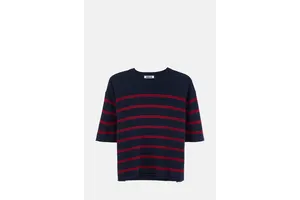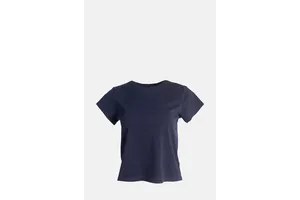
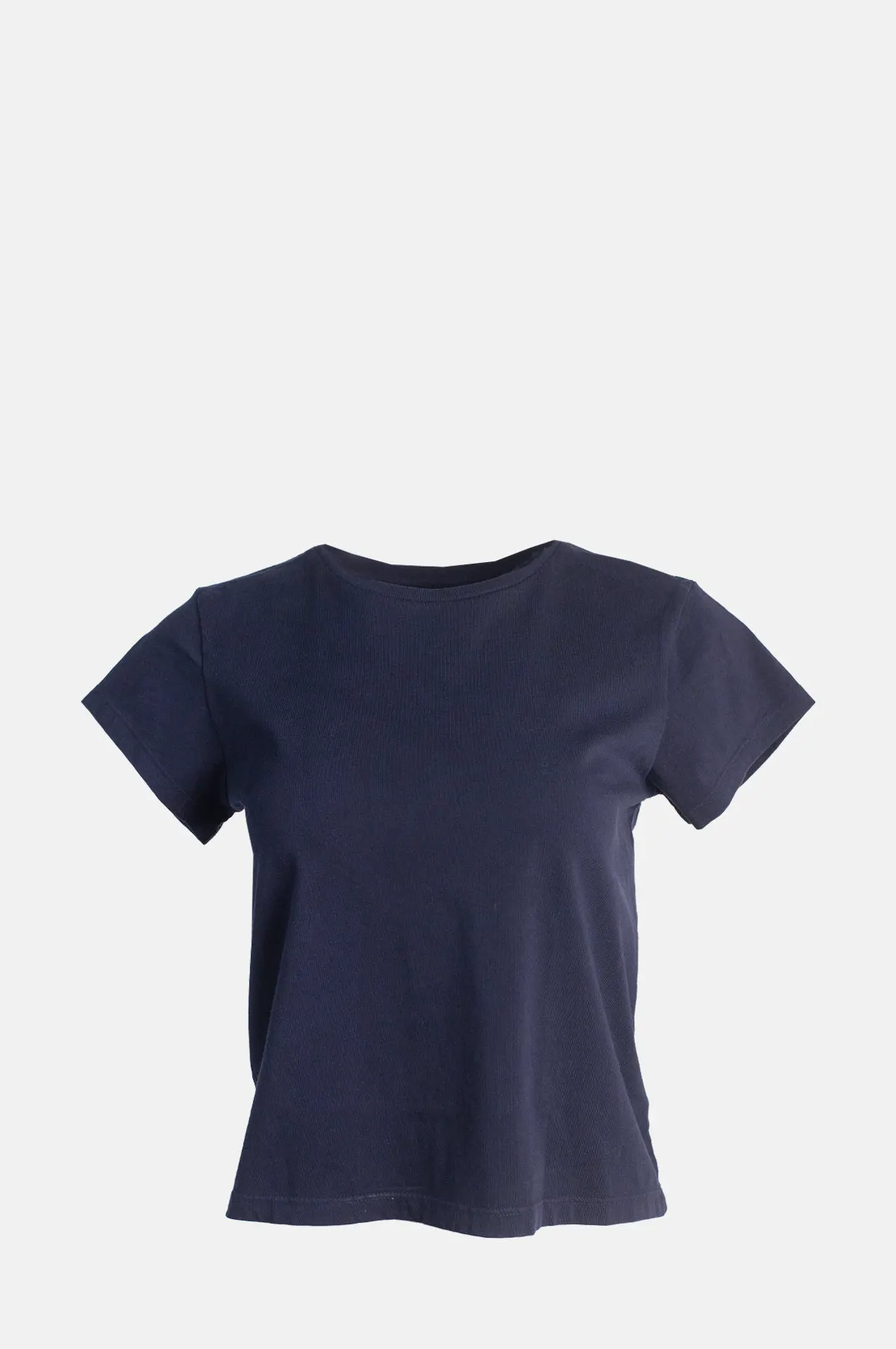

The Kai Baby Tee from Citizens of Humanity in navy, cut from a lightweight super soft jersey cotton with a crew neckline, relaxed sleeves and a slightly structured drape, listed at 90 GBP with two of five sizes left. It is the most useful garment this run has examined for settling a question the run has been carrying for two batches, and the reason is that it is a baby tee, because this run has already published another baby tee from another brand and can now put them side by side. The other one was ribbed and made of 98% cotton with 2% elastane, and its ease was negative at every size, about minus 2.7 to minus 3.9 inches, and this run said then that the negative ease was correct because the rib and the elastane stretch over the body. This one is 100% cotton with no elastane at all, and its ease runs about 1.28, 0.86, 0.43, 0.01 and minus 0.42 inches, so it declines by a precise 0.43 per size, reaches exactly zero at the large, and goes negative at the extra large. Same garment type, same name, two brands, and the negative ease is right in one and wrong in the other. And the only thing that tells you which is the fibre panel, not the fit word and not the price. That is the test this run proposed two batches ago, and this garment is the control that proves it. The other thing worth setting out is that this is only the second garment in the whole run whose three measurement columns all pass, and the first where the word cropped can be checked against a number. The reference is the Kai Baby Tee in Navy. Dongguan Bafinasa Garments Co., Ltd. develops comparable jersey tees on OEM and ODM terms, from cloth sourcing by weight and gauge to retail or FBA ready packing. We publish this as a development reference and build your own version of it, and we do not supply the branded original or reproduce anyone else's label.
Key Features
- Ease of about 1.28, 0.86, 0.43, 0.01 and minus 0.42 in, reaching exactly zero at the large and negative at the extra large. See the note below
- 100% cotton with no elastane, which is what makes the negative ease at the top size a fault rather than a design. See the note below
- Chest 41, 43, 45, 47 and 49 cm, a clean two centimetre grade, and all three columns pass. See the note below
- Total length 42, 44, 46, 48 and 50 cm, a clean two centimetre grade, so cropped is a number this run can check. See the note below
- Sleeve 12, 13, 14, 15 and 16 cm, a clean one centimetre grade, and a 12 cm sleeve on a garment called relaxed sleeves. See the note below
- Machine wash cold and tumble dry low as stated, permitted here for the opposite reason to the other garment in this run that allows it. See the note below
- Lightweight super soft jersey as stated, with no weight, no gauge and no shrinkage figure. See the note below
Customisable Options
- Cloth: lightweight cotton jersey to the reference, with the weight in grams per square metre stated, or a midweight jersey, or a ribbed jersey, or a combed cotton, each quoted separately
- Fit: baby tee fit to the reference, with the ease at every size published and held above zero, or a neat fit, or a regular fit, each quoted separately
- Length: cropped to the reference, with the length graded across every size, or a hip length, or a longer length, each quoted separately
- Sleeves: relaxed cap sleeve to the reference, with the sleeve opening measured, or a longer short sleeve, or a capped sleeve, each quoted separately
- Neck: crew neckline to the reference, with the neck width and depth stated, or a scoop neck, or a wide crew, each quoted separately
- Fibre: 100% cotton to the reference, or cotton with elastane for stretch and recovery, or organic cotton, each quoted separately
- Cloth weight in grams per square metre, gauge, stretch percentage and recovery if elastane is added, shrinkage figure, neck width and depth, sleeve opening measurement, size set, colour development, private label and care labelling
Specifications
| Style | Cropped baby tee with a crew neckline and relaxed sleeves |
| Reference | Citizens of Humanity, Kai Baby Tee, style 9472-3061, colour nvy, sizes XS to XL |
| Composition | 100% cotton as stated in the panel. See the note below |
| Cloth | Lightweight super soft jersey cotton as stated, with no weight and no gauge. See the note below |
| Cloth Weight | Not stated, though the description says lightweight. See the note below |
| Gauge | Not stated |
| Drape | Slightly structured drape that holds its shape as stated, with no weight and no recovery figure behind it. See the note below |
| Fit Word | Easy yet refined as stated, and no fit word in the bullets. See the note below |
| Length Word | Cropped t shirt as stated, and the length is 42 to 50 cm, so it can be checked. See the note below |
| Neck | Classic crew neckline as stated, with no neck width and no neck depth given |
| Sleeves | Relaxed sleeves as stated, measured at 12 to 16 cm, with no sleeve opening measured. See the note below |
| Care | Machine wash cold, tumble dry low, as stated. See the note below |
| Shrinkage | Not stated, on a cotton jersey tee. See the note below |
| Certification | None named |
| Sizes Offered | XS, S, M, L and XL, five sizes, with S and L in stock at the time of writing |
| Size Conversion | Not applicable, since the sizes are letter sizes |
| Fit Guidance | None published beyond the fit word |
| Model | None published |
| Measurements Published | Pit to pit, sleeve length and total length for all five sizes. See the note below |
| Published Chest | 41, 43, 45, 47 and 49 cm flat, a clean two centimetre grade. See the note below |
| Chest Around | 82, 86, 90, 94 and 98 cm, or 32.28, 33.86, 35.43, 37.01 and 38.58 in. See the note below |
| True Chest Grade | A clean two centimetres per size. See the note below |
| Ease Against Body Bust | About 1.28, 0.86, 0.43, 0.01 and minus 0.42 in. See the note below |
| Published Sleeve | 12, 13, 14, 15 and 16 cm, a clean one centimetre grade. See the note below |
| Published Length | 42, 44, 46, 48 and 50 cm, a clean two centimetre grade. See the note below |
| Cloth Weight | Not stated. See the note below |
| Sleeve Opening | Not measured. See the note below |
| Photographs | Six, the most of any garment in this batch. See the note below |
| Production | Made in the USA as stated, with no certification named |
| Reference Retail | 90 GBP as listed, quoted to show the price band this sits in, not as our price |
| Category | Filed by the reference under T-shirts |
| Occasion | Spring and summer, casual, everyday, layering |
| MOQ | 100 pcs per style per colourway, mixed sizes and colourways accepted |
| Sampling | 7-10 days after tech pack or reference sample confirmation |
| Bulk Lead Time | 20-30 days after sample approval and deposit |
| Service | OEM / ODM / private label, cotton jersey sourcing by weight and gauge, US and offshore production options, shrinkage and recovery testing, retail or FBA ready packing |
Size Chart as Published by the Reference
| Size | Pit To Pit (flat) | Sleeve Length | Total Length |
|---|---|---|---|
| XS | 41 cm | 12 cm | 42 cm |
| S | 43 cm | 13 cm | 44 cm |
| M | 45 cm | 14 cm | 46 cm |
| L | 47 cm | 15 cm | 48 cm |
| XL | 49 cm | 16 cm | 50 cm |
The chest figures are flat half measures taken with the tee laid down, doubling to 82, 86, 90, 94 and 98 cm around, or 32.28, 33.86, 35.43, 37.01 and 38.58 in. Against a body bust of 31, 33, 35, 37 and 39 in across XS to XL, the ease is about 1.28, 0.86, 0.43, 0.01 and minus 0.42 in, so it falls by 0.43 in at every size, reaches zero at the large and is negative at the extra large. The chest grades a clean two centimetres per size, the sleeve a clean one and the length a clean two. All three columns pass.
Our Proposed Body Chart
| Size | Body Bust | Sleeve | Body Waist | Body Hips | Length | Source |
|---|---|---|---|---|---|---|
| XS | 31 in / 79 cm | 12 cm | 24 in / 61 cm | 34 in / 86 cm | 42 cm / 16.5 in | Our proposal |
| S | 33 in / 84 cm | 13 cm | 26 in / 66 cm | 36 in / 91 cm | 44 cm / 17.3 in | Our proposal |
| M | 35 in / 89 cm | 14 cm | 28 in / 71 cm | 38 in / 97 cm | 46 cm / 18.1 in | Our proposal |
| L | 37 in / 94 cm | 15 cm | 30 in / 76 cm | 40 in / 102 cm | 48 cm / 18.9 in | Our proposal |
| XL | 39 in / 99 cm | 16 cm | 32 in / 81 cm | 42 in / 107 cm | 50 cm / 19.7 in | Our proposal |
Occasions and Styling
Suits spring and summer and everyday dressing. A cropped baby tee in navy is the piece that goes with high waisted denim, and the shorter length is what makes it work tucked or worn loose.
Production and Quality Control
The reference publishes three columns for all five sizes, states the fibre, describes the cloth, the neck, the sleeves and the drape, gives a fit word and a length word, gives a care instruction with a drying setting, names the country of production and carries six photographs. It gives no cloth weight, no gauge, no shrinkage figure, no neck dimensions, no sleeve opening and no model information, publishes no fit guidance beyond one word, and uses the word relaxed for a sleeve measuring twelve centimetres at the smallest size. Three things follow: the baby tee control that settles the negative ease question, the length word that can be checked, and the care label that permits tumble drying for the opposite reason to the only other garment in this run that does.
One point two eight, then zero point four three, then minus zero point four two, and that is the first thing, and this run has been waiting two batches for the garment that would settle this. It published a baby tee from another brand at 35 GBP. That one was ribbed and made of 98% cotton with 2% elastane, and its ease was negative at every size, about minus 2.7 to minus 3.9 inches. This run said at the time that the negative ease was correct, because a ribbed knit with elastane is engineered to be worn stretched over the body, and it credited the garment rather than complaining about it. But it also said it could not yet tell the difference between negative ease that is designed and negative ease that is a mistake, and it proposed a test: look at whether the cloth can stretch to meet it. This garment is the control. It is also a baby tee. It is 100% cotton. There is no elastane in it. And its ease runs about 1.28, 0.86, 0.43, 0.01 and minus 0.42 inches. It declines by a precise 0.43 per size, which is exactly what this run's arithmetic predicts for a two centimetre grade, because two centimetres of flat measure is 1.57 inches of circumference against a body taking two. It reaches 0.01 inches at the large, which is to say the tee is precisely the same size as the body. And at the extra large it is minus 0.42, which is to say it is smaller than the body. And there is no elastane to bridge that. Cotton jersey has some mechanical give from its loop structure, but it does not have the recovery of an elastic fibre, and a tee that starts out smaller than the person will not be comfortable and will not hold its shape. So the two baby tees settle it, and the answer is clean. The same garment type, the same name, two brands, and in one the negative ease is the design while in the other it is a fault. And the only thing that distinguishes them is the fibre panel. Not the fit word, because neither page uses a word that warns you. Not the price, because the correct one was the cheaper of the two by a factor of two and a half. This run can now state the test with confidence, and it is a single instruction: when a chart shows negative ease, read the fibre panel, and if there is no elastane and no stretch structure named, treat it as a fault. It is worth adding what the fit word is doing while this happens, because the prose says the fit is easy yet refined and that it is perfectly balanced for tucking into denim or wearing loose. Easy is a fair description at the extra small, where there is 1.28 inches of room. It is not a fair description at the large, where there is none, and you cannot wear loose something that is exactly your size. It is worth noting too that the run has now seen this shape on three separate garments in three batches: a dress, a skirt and now a tee, all of which lose ease steadily and cross zero at or near the top of the range, and all of which are made without elastane.
Forty two to fifty, and that is the second thing, and it is a small credit in a run that has had few, so this run will take it. The bullet says cropped t shirt, and the page publishes the length, and the length is 42, 44, 46, 48 and 50 centimetres. So cropped is not an impression here, it is a number, and a customer can check it. And because this run has been recording the published length of every tee it meets, it can now say what cropped means in context rather than in the abstract. A plain jersey tee in this run measured 65 to 71 centimetres. A relaxed graphic tee measured 58 to 62. A ribbed baby tee measured 52 to 57. And this one measures 42 to 50. So there is a working scale, and cropped sits about fifteen centimetres below a baby tee and about twenty-five below a regular tee, and a customer who knows where she likes a hem to fall can now place any of them. That is the value of publishing a measurement, and it is worth saying that the only reason it works is that the number is there, because four garments in this run have held their length frozen across the sizes and their length words cannot be checked at all. It is worth adding that this is only the second garment in the entire run whose three measurement columns all pass, and it is worth being precise about what passes here. The chest grades a clean two centimetres, the sleeve a clean one, the length a clean two. No wobble, no freezing, no irregularity. So the pattern is sound. And that is exactly what makes the ease finding sharper rather than softer: this is not a badly graded garment. It is a well graded garment whose grade is 2.54 short by half a centimetre, and that half centimetre costs 0.43 inches of ease at every size, and over five sizes it takes the tee from having an inch and a quarter of room to being smaller than the body. The arithmetic does this on its own. Nobody has to make a mistake. It is worth closing this on the sleeve, because it is the one place the words and the numbers pull apart. The prose says relaxed sleeves, and the sleeve measures 12 centimetres at the extra small rising to 16 at the extra large. A twelve centimetre sleeve is a cap sleeve. Now, relaxed may mean the sleeve is cut fuller around the arm rather than longer down it, and that is a legitimate use of the word. But the sleeve opening is not measured, so there is no way to check which is meant, and on the smallest size the sleeve is short enough that the word is doing no work a customer can verify. And the sleeve grades one centimetre per size while the chest grades two, so the sleeve grows at half the rate of the body it goes over.
Tumble dry low, and that is the third thing, and the reason it is worth a paragraph is that this is only the second garment in this entire run permitted to tumble dry, and the reason here is the exact opposite of the reason there. The other one was a pair of jeans, and its fibre panel included elastomultiester, which is an elastic fibre that tolerates heat far better than elastane does, and this run argued that the brand had chosen a heat tolerant elastic fibre precisely so that it could write a care label allowing tumble drying. That was a fibre choice made in order to permit the instruction. Here there is no elastic fibre at all and no need for one: the garment is 100% cotton, and there is nothing in it that heat will damage. So the same instruction arises from two opposite situations, and in both cases the label gives the instruction and not the reason. This run is not going to call that a fault on its own, because a care label is not obliged to explain itself. But it is worth recording, because it is the clearest example yet of something this run has been circling for batches: the label tells you what to do and never why, and the why is usually the part that would let a customer make a judgement when the instruction is missing or unclear. And there are things missing here. Cold is given as a word rather than a temperature, and this run has now met cold on three garments in two batches while other garments from the same brands give thirty degrees, so there is no house standard for how a temperature is written. There is no shrinkage figure, and on a cotton jersey tee whose whole design proposition is that it is cropped at 42 to 50 centimetres, two or three centimetres of shrinkage in the first wash changes what the garment is. There is no cycle, no detergent and no ironing instruction. It is worth ending on two absences around the cloth, because they are the ones the description leans on. The prose says lightweight super soft jersey cotton and a slightly structured drape that holds its shape. Lightweight is stated and the weight is not, and this run has now met heavy, midweight and lightweight on garments in three consecutive batches and been given a number for none of them. And holds its shape is a claim about recovery, which is the property a knit either has or does not have, and there is no recovery figure, and given that this is 100% cotton with no elastane, recovery is exactly the property in question. There is no model either. But there are six photographs, which is more than any garment in this batch, and it is worth noting the comparison, because it is stark and it runs the wrong way. The tee at 90 GBP has six photographs. The jumper at 275 and the dress at 345 have one each. Every bulk shipment gets a measurement report against your approved chart.
Optional upgrades include quoting the cloth weight in grams per square metre and the gauge, grading the chest at about 2.54 cm per size so the ease holds steady across the range and publishing the ease at every size, adding elastane or accepting a slightly larger body so the ease stays above zero at every size, giving the stretch percentage and the recovery if elastane is added, giving the shrinkage figure, giving the neck width and depth, measuring the sleeve opening, replacing cold with a temperature in degrees and adding cycle, detergent and ironing to the care label, adding fit guidance and a model height, a midweight jersey and a ribbed jersey and a combed cotton, neat and regular fit options, hip and longer lengths, a longer short sleeve and a capped sleeve, scoop and wide crew neck options, cotton with elastane and organic cotton, size set, colour development, private label, hangtag and care labelling.
Pre-production sample approval, in-line inspection during cutting and sewing, and a final AQL inspection before packing, with measurement reports and photos shared before shipment.
Send us your tech pack, a photo or a reference garment and we will quote within 24 hours. Contact bafinasa@bafinasa.com or WhatsApp +86 13827222469.