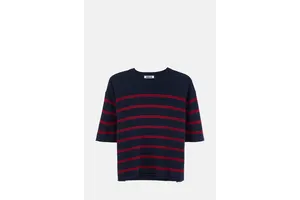
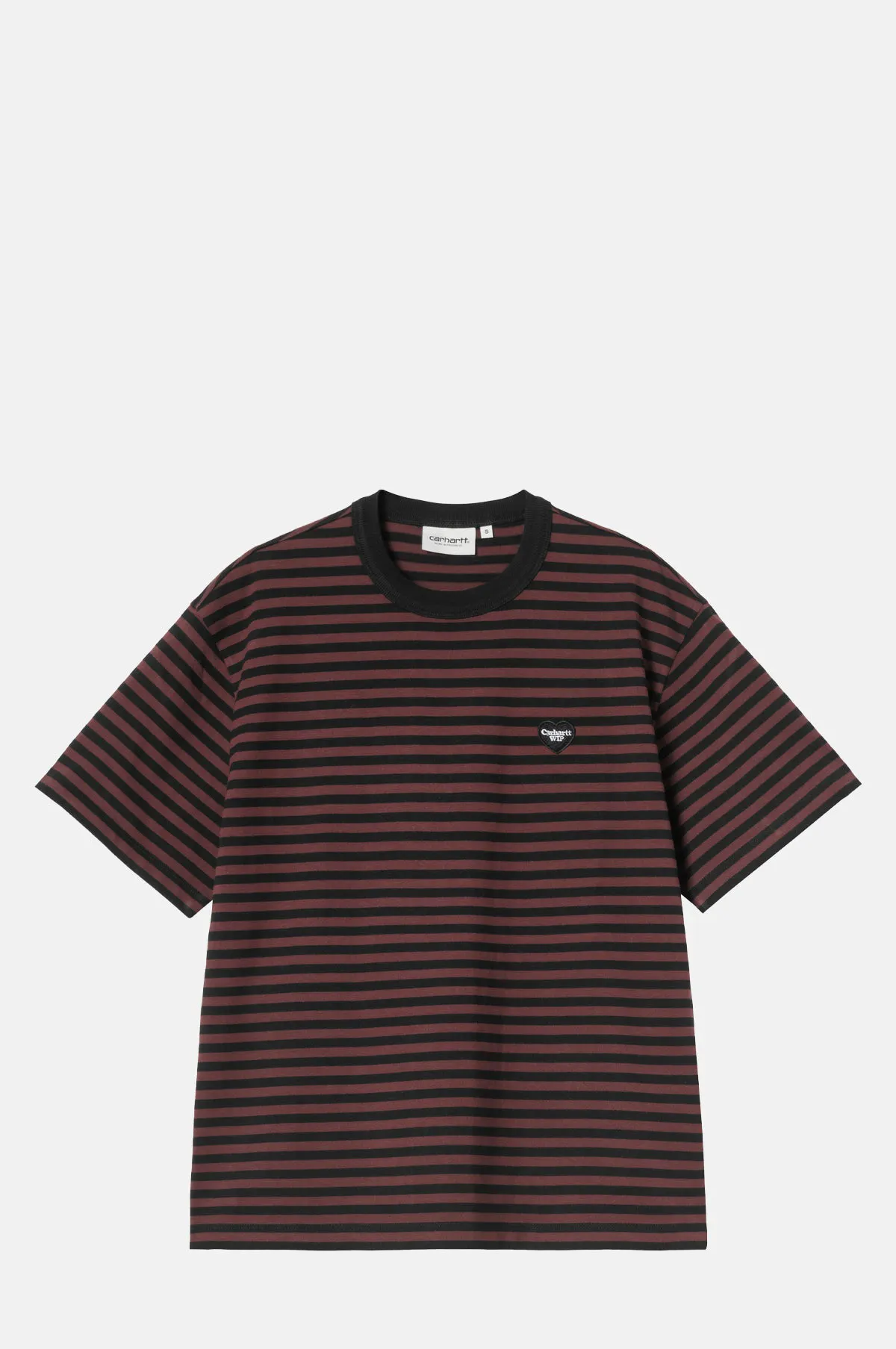

The Essy T-shirt from Carhartt WIP, cut in a generous loose fit from a midweight cotton jersey with an allover black and amarone red stripe and a small embroidered heart at the chest, listed at 35 GBP with two of the four sizes left. It is the cheapest garment this run has examined and in one respect the best documented, and those two facts sitting together are worth thinking about. Its care label is the most complete in the entire run: machine washable up to thirty degrees, on a delicate cycle, do not tumble dry. It is the only garment this run has met that names a wash cycle at all, and it is the only one that gives a maximum temperature and a cycle and a drying prohibition together, and it costs thirty-five pounds. The 299 GBP cashmere jumper managed one clause. The other thing worth setting out is the ease, which the published chart makes look as though it oscillates and which on inspection does not: the chest grades a uniform 2.6 centimetres per size, which is 2.047 inches of circumference against a body that grades two inches, so the ease is steady at about 6.8 to 6.9 inches across all four sizes, and the wobble in the published figures is the rounding. The reference is the S/S Essy T-Shirt in Black Amarone. Dongguan Bafinasa Garments Co., Ltd. develops comparable jersey on OEM and ODM terms, from cloth sourcing by weight in grams per square metre to retail or FBA ready packing. We publish this as a development reference and build your own version of it, and we do not supply the branded original or reproduce anyone else's label.
Key Features
- Care label with a maximum temperature, a named wash cycle and a drying prohibition, the most complete in this run, on the cheapest garment in this run. See the note below
- Chest 48, 51, 53 and 56 cm, a uniform 2.6 cm grade, giving about 6.8 to 6.9 in of ease held steady across the range. See the note below
- Grade within about a twentieth of an inch of the body's own grade, so the fit is nearly identical at every size
- Midweight cotton jersey as stated, with no weight in grams per square metre, the unit the entire trade quotes jersey in. See the note below
- Allover stripe as stated, with no stripe width and no repeat, and nothing to say where the chest logo falls on the stripe. See the note below
- Loose fit as stated, at about 6.8 in, against another house in this run that uses loose for seventeen to twenty-one. See the note below
- Sleeve 20 to 23 cm grading a clean one centimetre per size, and length 65, 65, 68 and 71 cm, the one column that fails the test. See the note below
Customisable Options
- Cloth: midweight cotton jersey to the reference, with the weight quoted in grams per square metre, or a lighter jersey, or a heavier one, or a combed or ring spun jersey, each quoted separately
- Fit: loose to the reference, with the ease at every size published, or a regular fit, or an oversized fit, each quoted separately
- Stripe: allover stripe to the reference, with the width and the repeat specified, or an engineered stripe placed to the panel, or a plain ground, each quoted separately
- Logo: small embroidered heart at the chest to the reference, with the size and the position specified, or a printed logo, or no logo, each quoted separately
- Neck: crew neck to the reference, with the neck width and depth and the rib specified, or a V neck, or a wider neck, each quoted separately
- Length: graded to the reference, or held across the two smaller sizes as the reference does, with the choice stated either way
- Cloth weight in grams per square metre, stripe width and repeat, logo size and position, neck dimensions and rib specification, size set, colour development, private label and care labelling
Specifications
| Style | Loose fit short sleeve T-shirt in striped cotton jersey with a chest logo |
| Reference | Carhartt WIP, S/S Essy T-Shirt, style I037290, black amarone, sizes XS to L |
| Composition | 100% cotton as stated in the panel |
| Cloth | Midweight cotton jersey as stated, with no weight in grams per square metre. See the note below |
| Fit Word | Loose fit as stated, and described in the body of the text as a generous loose fit. See the note below |
| Neck | Crew neck as stated, with no neck width, no neck depth and no rib specification given |
| Sleeves | Short sleeves, as the style name states, with the sleeve measurement published at 20 to 23 cm |
| Stripe | Allover stripe in black and amarone red as stated, with no stripe width and no repeat given. See the note below |
| Logo | Small embroidered heart logo at the chest as stated, with no size, no position and no stitch specification given. See the note below |
| Care | Machine washable up to 30 degrees on a delicate cycle, do not tumble dry, as stated, the most complete label in this run. See the note below |
| Certification | None named. See the note below |
| Sizes Offered | XS, S, M and L, four sizes, with XS and M in stock at the time of writing |
| Size Conversion | Not applicable, since the sizes are letter sizes |
| Fit Guidance | None published beyond the fit word |
| Model | None published |
| Measurements Published | Pit to pit, sleeve length and total length for all four sizes. See the note below |
| Published Chest | 48, 51, 53 and 56 cm flat, or 18.9 through 22.0 in. See the note below |
| Chest Around | 96, 102, 106 and 112 cm, or 37.8, 40.2, 41.7 and 44.1 in. See the note below |
| True Chest Grade | A uniform 2.6 cm per size, of which the published figures are the rounded image. See the note below |
| Grade Against Body | 2.047 in of circumference per size against a body that grades 2 in. See the note below |
| Ease As Published | About 6.8, 7.2, 6.7 and 7.1 in, which appears to oscillate. See the note below |
| Ease In Truth | About 6.8, 6.8, 6.9 and 6.9 in, so it is steady. See the note below |
| Published Sleeve | 20, 21, 22 and 23 cm, a clean one centimetre grade |
| Published Length | 65, 65, 68 and 71 cm, and no uniform grade rounds to this column. See the note below |
| Cloth Weight | Not stated, in the one unit the trade universally uses for jersey. See the note below |
| Stripe Width | None. See the note below |
| Logo Size | None. See the note below |
| Photographs | Five |
| Production | Made in Bangladesh as stated, with no certification named |
| Reference Retail | 35 GBP as listed, the cheapest garment in this run, quoted to show the price band this sits in, not as our price |
| Category | Filed by the reference under T-shirts |
| Occasion | Spring and summer, weekends, casual |
| MOQ | 100 pcs per style per colourway, mixed sizes and colourways accepted |
| Sampling | 7-10 days after tech pack or reference sample confirmation |
| Bulk Lead Time | 20-30 days after sample approval and deposit |
| Service | OEM / ODM / private label, cotton jersey sourcing by weight in grams per square metre, stripe development by width and repeat, embroidery and print, neck rib development, retail or FBA ready packing |
Size Chart as Published by the Reference
| Size | Pit To Pit (flat) | Sleeve Length | Total Length |
|---|---|---|---|
| XS | 48 cm | 20 cm | 65 cm |
| S | 51 cm | 21 cm | 65 cm |
| M | 53 cm | 22 cm | 68 cm |
| L | 56 cm | 23 cm | 71 cm |
The chest figures are flat half measures taken with the shirt laid down, doubling to 96, 102, 106 and 112 cm around, or 37.8, 40.2, 41.7 and 44.1 in. Against a body bust of 31, 33, 35 and 37 in across XS to L, the published figures give an ease of about 6.8, 7.2, 6.7 and 7.1 in, which appears to wobble, but the true grade is a uniform 2.6 cm per size and the true ease is steady at about 6.8 to 6.9 in. The sleeve grades a clean one centimetre per size.
Our Proposed Body Chart
| Size | Body Bust | Sleeve | Body Waist | Body Hips | Length | Source |
|---|---|---|---|---|---|---|
| XS | 31 in / 79 cm | 20 cm | 24 in / 61 cm | 34 in / 86 cm | 65 cm / 25.6 in | Our proposal |
| S | 33 in / 84 cm | 21 cm | 26 in / 66 cm | 36 in / 91 cm | 67 cm / 26.4 in | Our proposal |
| M | 35 in / 89 cm | 22 cm | 28 in / 71 cm | 38 in / 97 cm | 69 cm / 27.2 in | Our proposal |
| L | 37 in / 94 cm | 23 cm | 30 in / 76 cm | 40 in / 102 cm | 71 cm / 28 in | Our proposal |
Occasions and Styling
Suits spring and summer and relaxed weekends. A striped jersey tee with this much room is a weekend piece that goes with denim or shorts, and the stripe carries an otherwise plain outfit.
Production and Quality Control
The reference publishes three columns for all four sizes, states a single fibre, names the cloth, the fit, the neck, the stripe and the logo, gives a three-part care instruction, names the country of production and carries five photographs. It gives no cloth weight, no stripe width or repeat, no logo size or position, no neck dimensions and no rib specification, and publishes no fit guidance beyond one word and no model information. Three things follow: the care label that beats everything else in this run, the ease that looks like it wobbles and does not, and the loose fit that means something different here than elsewhere.
Thirty-five pounds and the best label in the run, and that is the first thing, and it is worth putting the comparison on the table because it is the cleanest evidence this run has gathered on a question it has been asking for a long time. This run has complained repeatedly that care labels are too short to be usable: a pure cashmere jumper at 299 GBP given one clause, cashmere blend knits given one clause, an alpaca blend vest given one clause, a cotton corduroy trouser given two. This T-shirt, at 35 GBP, the cheapest garment in the entire run, is given three: machine washable up to thirty degrees, delicate cycle, do not tumble dry. And it is the only garment in the run that names a cycle at all, which is the single omission this run has flagged most often, because the cycle is what decides whether a delicate fibre survives. So the run has to record that completeness does not track price, and in this case runs the other way: the cheapest item in the run has the most usable care label, and the most expensive is among the least usable. It is worth saying what is still missing even on the best label in the run, because the gap is instructive. No detergent is specified. Nothing about washing inside out, which matters on a garment with an embroidery on the front and a stripe that will abrade. Nothing about ironing, and whether it can be ironed over the embroidery. And nothing about the stripe's colour fastness, which is worth a line because a red stripe next to a black ground is exactly the combination that bleeds in a first wash and ruins the ground. Three clauses is good and four would be better, and the fact that the best label in the run still has gaps is the point: this is not a brand problem, it is a category-wide habit of writing the shortest label the law will allow. Then the construction, where the same pattern holds. The cloth is called midweight cotton jersey, and jersey is quoted by weight in grams per square metre by every mill and every supplier in the world. It is the standard unit, it is universally available, and it is absent. Midweight is an adjective standing in for a number that decides the drape, the opacity, how the garment survives washing, how much it shrinks, and what it costs. It is worth noting how much hangs on it here in particular: a striped jersey needs enough weight to hold the stripe clean and enough opacity that the stripe does not shadow through to the inside, and neither can be judged from the word midweight. And this is the second garment in two consecutive batches in this run with an unspecified stripe, so it is worth saying once plainly that a stripe is the one design feature that has an obvious countable specification. The width of the band and the length of the repeat are the first two things any buyer asks for, and a customer can count both in a photograph. Neither is given on either garment. There is one more detail specific to this garment that the missing numbers hide, and it is worth naming because a maker would catch it immediately: the embroidered heart sits on the chest of a striped fabric, and nothing says where it falls relative to the stripes. Whether the motif lands on a black band or across a red one decides whether it reads cleanly or disappears, and that is a placement decision made at the sampling stage, not an accident. No size and no position are given for the embroidery either.
Six point eight, seven point two, six point seven, seven point one, and none of that is real, and that is the second thing. The published chest gives an ease that appears to wobble: up, down, up. Apply the test this run uses and the wobble evaporates. A uniform grade of 2.6 centimetres per size rounds to exactly 48, 51, 53 and 56, and the true ease is about 6.80, 6.84, 6.89 and 6.94 inches, rising by a twentieth of an inch per size. So the fit is steady and the chart hides it. It is worth saying why the grade is so well chosen, because it is the best match this run has found on a four-size garment. Two point six centimetres flat is 5.2 centimetres of circumference, which is 2.047 inches, against a body that grades two inches. The garment is therefore more generous than the body needs by about a twentieth of an inch per size, and the ease grows by one twentieth of an inch from the smallest size to the largest, which is to say not at all. The run has measured grades from 0.4 centimetres to 3.8 on various garments and most of them let the ease drift; this one does not. It is worth dwelling on the consequence, because it is a different direction for the same rounding rule this run has been applying for many batches. Until now the rule has mostly produced good news: a column that looks uneven turns out to be an even grade in disguise, and the brand is vindicated. Here the rule produces a subtler result, because it is the ease rather than the grade that looks wrong. A customer who reads this chart and computes the ease gets 6.8, 7.2, 6.7 and 7.1 and might reasonably conclude that the medium is cut tighter than the small. It is not. The medium is cut marginally looser, like every other size. So the rounding does not merely disguise the grade here, it manufactures a shape difference that does not exist. There is one column that the test does fail, and it is worth reporting rather than skipping. The length reads 65, 65, 68 and 71, stepping zero, three and three, and no uniform grade produces it. So the extra small and the small share a length of 65 centimetres while the small is three centimetres wider, and then the length jumps by three for each size above. That may well be a deliberate decision to keep the two smallest sizes at one length, and on a T-shirt that is defensible. But it is the only one of three columns that fails, and nothing on the page says whether it is a decision or a slip.
Loose, at six point eight inches, and loose, at seventeen to twenty-one, and that is the third thing, and it is the widest gap this run has found between two houses using the same word. This run has been measuring what fit words mean in inches, and it has enough data now to state the spread. One house uses relaxed for about twelve to thirteen and oversized for about sixteen and a half to eighteen, and loose for about seventeen to twenty-one. This T-shirt is described as a generous loose fit and measures about 6.8 inches of ease. So the same word is being used by two houses for garments roughly three times apart in room. It is worth being fair about why, because there is a real convention difference hiding in there. A T-shirt has its own ease convention: a fitted tee runs at about two to four inches, so 6.8 is genuinely generous for one, and loose is not an unreasonable word for it in that context. The run's vocabulary was built mostly on wovens and knits, where 6.8 would be an ordinary regular fit. But the gap is far too large to be explained by convention alone. Three inches and twenty inches are not two dialects of the same word, they are two different garments, and a customer who has learned one house's vocabulary will be badly wrong at the other. It is worth adding that this run has now found the same kind of mismatch in the other direction too, on a knit called oversized at about ten inches and on another house's oversized at about seventeen, so the problem is general and not specific to this brand. And there is no way for a customer to resolve it, because no brand in this run publishes its ease. It is worth closing on the two things about this page that are visibly unchecked, because they are small and they are diagnostic. The bullet list repeats itself: Loose fit appears as the first bullet and again as the third, in a list of six. And the composition is given as plain cotton while another garment from the same brand in this same batch is labelled organic cotton, so either the tee's cotton is conventional and the brand is quiet about it, or the brand is inconsistent about telling you, and neither reading is flattering. A duplicated bullet is a trivial thing on its own. It matters here because it is the visible sign of a page nobody read back, and this run has learned to look for the invisible signs on the same pages. Every bulk shipment gets a measurement report against your approved chart.
Optional upgrades include quoting the jersey weight in grams per square metre, giving the stripe width and the repeat and saying where the logo falls on the stripe, giving the logo size and its position on the chest, giving the neck width and depth and the rib specification, publishing the ease at every size, stating whether the two smaller sizes share one length by design, adding detergent, wash inside out, ironing and colour fastness guidance to the care label, naming the cotton origin and any standard, adding fit guidance and a model height, a lighter and a heavier jersey, combed and ring spun options, regular and oversized fit options, engineered stripe and plain ground options, printed logo and no logo options, size set, colour development, private label, hangtag and care labelling.
Pre-production sample approval, in-line inspection during cutting and sewing, and a final AQL inspection before packing, with measurement reports and photos shared before shipment.
Send us your tech pack, a photo or a reference garment and we will quote within 24 hours. Contact bafinasa@bafinasa.com or WhatsApp +86 13827222469.