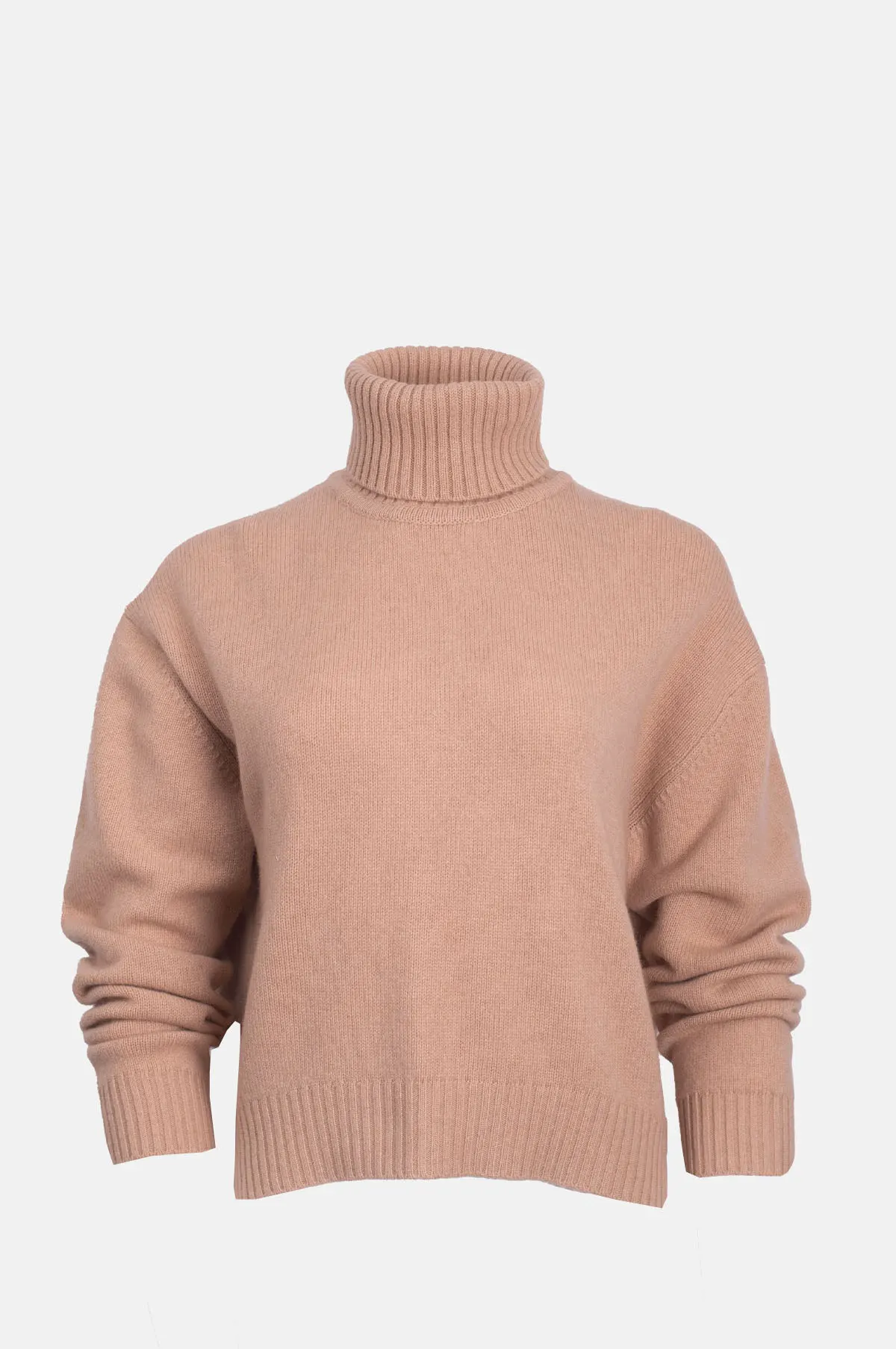

An oversized roll collar jumper from Jumper 1234, spun from heavy weight premium cashmere in a camel brown and finished with a chunky roll collar, thick ribbed trims, dropped shoulders and a dropped hem at the back, listed at 299 GBP with all four sizes in stock. Two things about it are worth a close look, and they pull in opposite directions. The first is that the page gets something right that almost no one in this run gets right: it gives a fit word for the length as well as for the width, calling the fit oversized and the length regular, and when this run measures it, both words turn out to be true and to be measured in different currencies, which is exactly why they need saying separately. The second is that cashmere is the most specification-worthy fibre this run has met and the page gives none of the numbers that specify it: no ply, no gauge, no fibre length, no micron, no grade and no weight in grams, which matters more here than it would anywhere else because cashmere is bought and sold by weight, so the gram weight is the number that would explain the price. And the care label is one clause long, which on cashmere is not enough. The reference is the Oversize Roll Collar in Camel. Dongguan Bafinasa Garments Co., Ltd. develops comparable knitwear on OEM and ODM terms, from yarn sourcing by ply, gauge and micron to retail or FBA ready packing. We publish this as a development reference and build your own version of it, and we do not supply the branded original or reproduce anyone else's label.
Key Features
- Oversized fit and regular length given as two separate fit words, and the measurements bear both out. See the note below
- About 10.7 in of ease at the smallest rising to about 13.4 in at the largest, because the grade is about 3.8 cm flat and the body grades 2 in. See the note below
- Heavy weight premium cashmere as stated, with no ply, no gauge, no fibre length, no micron, no grade and no weight in grams. See the note below
- Machine wash at 30 degrees as the entire care label, with no cycle, no spin limit, no detergent and no drying instruction, on cashmere. See the note below
- 100% cashmere made in Mongolia, with no fibre origin separated from the country of manufacture and no named standard. See the note below
- Dropped hem at the back as stated, with one length published and no drop given. See the note below
- One photograph, front only, so the dropped back hem named in the description is not shown. See the note below
Customisable Options
- Yarn: 100% cashmere to the reference, with the ply, the gauge, the fibre length and the micron stated, or a cashmere wool blend, or a merino, or a lambswool, each quoted separately
- Weight: heavy weight to the reference, with the garment weight in grams stated, or a mid weight, or a lighter weight, each quoted separately
- Fit: oversized in width and regular in length to the reference, with the ease at every size published, or a relaxed fit, or a regular fit, each quoted separately
- Collar: chunky roll collar to the reference, with the collar depth and the construction stated, or a funnel neck, or a full turtleneck, or a crew, each quoted separately
- Hem: dropped at the back to the reference, with the drop stated, or a level hem, or a longer drop
- Care: machine washable to the reference, with the cycle, the spin limit, the detergent and the drying method stated, or a hand wash construction
- Ply, gauge, micron and fibre length, garment weight in grams, cashmere grade, fibre origin and standard, collar depth, rib depth and structure, back hem drop, sleeve measurement origin, size set, colour development, private label and care labelling
Specifications
| Style | Oversized roll collar jumper with ribbed trims, dropped shoulders and a dropped back hem |
| Reference | Jumper 1234, Oversize Roll Collar, style #0921-609, camel, sizes 1 to 4 |
| Composition | 100% cashmere as stated in the panel. See the note below |
| Yarn Specification | Described as heavy weight premium, with no ply, no gauge, no fibre length, no micron and no grade given. See the note below |
| Garment Weight | None, on a fibre that is traded by weight. See the note below |
| Fit Word | Oversized fit as stated. See the note below |
| Length Word | Regular length as stated, separately from the fit word. See the note below |
| Collar | Chunky roll collar as stated, with no collar depth and no construction given. See the note below |
| Sleeve | Dropped sleeves as stated, with the sleeve measurement origin not given. See the note below |
| Trims | Thick ribbed trims as stated, with no rib depth and no rib structure given. See the note below |
| Hem | Dropped hem at the back as stated, with one length published and no drop given. See the note below |
| Care | Machine wash at 30 degrees as stated, with no cycle, spin limit, detergent or drying instruction. See the note below |
| Pilling | Not mentioned. See the note below |
| Certification | None named. See the note below |
| Sizes Offered | 1 to 4, four sizes, all four in stock |
| Size Conversion | Published: 1 is XS, 2 is S, 3 is M and 4 is L |
| Fit Guidance | None published beyond the fit and length words, and no sizing recommendation. See the note below |
| Model | None published |
| Measurements Published | Pit to pit, sleeve length and total length for all four sizes |
| Published Chest | 53, 57, 61 and 64 cm flat, or 20.9 through 25.2 in. See the note below |
| Chest Around | 106, 114, 122 and 128 cm, or 41.7, 44.9, 48.0 and 50.4 in. See the note below |
| True Chest Grade | A uniform 3.8 cm per size, consistent with the house grade this run has recorded on other knits from this brand. See the note below |
| Ease Against Body Bust | About 10.7, 11.9, 13.0 and 13.4 in, so the garment gets more oversized as the sizes go up. See the note below |
| Published Sleeve | 54, 55, 56 and 57 cm, grading one centimetre per size, with the origin not stated on a dropped shoulder |
| Published Length | 62, 63, 63 and 64 cm, which is a uniform grade of about 0.6 cm per size. See the note below |
| Rib Specification | None. See the note below |
| Collar Depth | None. See the note below |
| Back Hem Drop | None. See the note below |
| Cloth Weight | Not stated |
| Photographs | One. See the note below |
| Production | Made in Mongolia as stated, with the fibre origin not separated from it. See the note below |
| Reference Retail | 299 GBP as listed, quoted to show the price band this sits in, not as our price |
| Category | Filed by the reference under knitwear |
| Occasion | Autumn and winter, everyday, with denim or tailoring |
| MOQ | 100 pcs per style per colourway, mixed sizes and colourways accepted |
| Sampling | 7-10 days after tech pack or reference sample confirmation |
| Bulk Lead Time | 20-30 days after sample approval and deposit |
| Service | OEM / ODM / private label, cashmere yarn sourcing by ply, gauge, micron and fibre length, garment weight in grams, Good Cashmere Standard and Sustainable Fibre Alliance sourcing, roll collar and rib development, retail or FBA ready packing |
Size Chart as Published by the Reference
| Size | Pit To Pit (flat) | Sleeve Length | Total Length |
|---|---|---|---|
| 1 / XS | 53 cm | 54 cm | 62 cm |
| 2 / S | 57 cm | 55 cm | 63 cm |
| 3 / M | 61 cm | 56 cm | 63 cm |
| 4 / L | 64 cm | 57 cm | 64 cm |
The chest figures are flat half measures taken with the jumper laid down, doubling to 106, 114, 122 and 128 cm around, or 41.7, 44.9, 48.0 and 50.4 in. Against a body bust of 31, 33, 35 and 37 in across XS to L, the ease is about 10.7, 11.9, 13.0 and 13.4 in, so the garment is more oversized at the largest size than at the smallest by nearly three inches. The chest grades a uniform 3.8 cm per size, and the length grades about 0.6 cm per size, which is why the fit word and the length word point in different directions.
Our Proposed Body Chart
| Size | Body Bust | Sleeve | Body Waist | Body Hips | Length | Source |
|---|---|---|---|---|---|---|
| 1 / XS | 31 in / 79 cm | 54 cm | 24 in / 61 cm | 34 in / 86 cm | 62 cm / 24.4 in | Our proposal |
| 2 / S | 33 in / 84 cm | 55 cm | 26 in / 66 cm | 36 in / 91 cm | 64 cm / 25.2 in | Our proposal |
| 3 / M | 35 in / 89 cm | 56 cm | 28 in / 71 cm | 38 in / 97 cm | 66 cm / 26 in | Our proposal |
| 4 / L | 37 in / 94 cm | 57 cm | 30 in / 76 cm | 40 in / 102 cm | 68 cm / 26.8 in | Our proposal |
Occasions and Styling
Suits autumn and winter and everyday dressing. A heavy weight cashmere roll collar is a cold weather piece that will go to the office as readily as it goes with the slouchy jeans the reference suggests, and the camel makes it easier to wear than black.
Production and Quality Control
The reference publishes three columns for all four sizes, states a single fibre, describes the collar, the shoulders, the trims, the hem and the sleeve, gives a fit word and separately a length word, gives a care instruction, names the country of production and publishes a size conversion. It gives no ply, no gauge, no fibre length, no micron, no cashmere grade and no garment weight, no collar depth, no rib specification, no hem drop, no sleeve measurement origin, no pilling note and no certification, and publishes no fit guidance beyond the two words and no model information. Three things follow: the two fit words, the cashmere that is not specified, and the one-clause care label.
Two words instead of one, and they are doing real work, and that is the first thing. Almost every garment this run has examined offers a single fit word to describe a garment that has two independent dimensions, and this run has complained about it repeatedly. This page gives two: it says the overall style has an oversized fit, and it says the jumper is a regular length. It is worth checking both against the measurements, because the answer is unusually clean. The width: the chest measures 106 to 128 cm around against a body bust of 79 to 94 cm, so the ease runs about 10.7, 11.9, 13.0 and 13.4 inches. That is wide, and oversized is a fair word for it. The length: it reads 62, 63, 63 and 64, which this run's rounding test shows is a uniform grade of about six millimetres per size, so the jumper grows by two centimetres across four sizes while its width grows by fifteen. That is not a long garment, and regular is a fair word for it. So the two words are describing two things that genuinely differ, and the chart confirms both independently. That is the right way to do it and this run will credit it, because it is the first time it has seen it. It is also worth noticing that the chest grade of about 3.8 centimetres per size flat is around 3.15 inches of circumference against a body that grades two inches, which is why the ease grows by more than an inch at every size. This run has recorded a house grade of about four centimetres flat on other knits from this brand, and 3.8 is that same grade with the rounding stripped off, so the house pattern is corroborated. Now the consequence of a grade that wide, which is worth stating plainly because it is the sort of thing a customer cannot see. The garment is nearly three inches more oversized at the largest size than at the smallest. So oversized is not one thing across this range: a woman in the smallest size is wearing about ten and a half inches of ease and a woman in the largest is wearing about thirteen and a half, and the same word is used for both. That is worth connecting to the vocabulary work this run has been doing, because it now has two houses to compare and they do not agree. The other house this run has measured in detail uses relaxed for about twelve to thirteen inches and oversized for about sixteen and a half to eighteen. This jumper sits at about ten and a half to thirteen and a half and is called oversized. So the same garment measurements would attract one word from one house and a different word from the other, and a customer who has learned one house's vocabulary will misread the other's. It is worth adding the honest caveat that knitwear and woven ease are not quite the same currency, since a dropped shoulder and a boxy knit body read differently from a woven shirt at the same figure. But the point stands that the words are not interchangeable between houses. The one thing missing here is sizing advice: another garment in this run told the reader she could size down if she preferred it less loose, and this one says oversized without saying what to do about it.
Heavy weight premium cashmere, and not one number, and that is the second thing. Cashmere is specified the way any fibre is, but it has more numbers than most and they all matter: how many plies the yarn is, what gauge the garment is knitted at, how long the individual fibres are in millimetres, how fine they are in microns, what grade the lot is, and how much the finished garment weighs. The page says heavy weight and premium, and gives none of them. That gap matters more here than it would on any other garment in this run, for one specific reason: cashmere is traded by weight. The raw fibre is bought by the gram, so the weight of the finished garment is not a curiosity, it is the number that explains the price, and it is the number that lets a buyer compare this jumper at one price with another at twice the price. Heavy weight is an adjective standing in for it. It is worth saying plainly that this run has met a cheaper jumper, at well under two thirds of this price, which did publish its ply count, so completeness is not tracking price here in either direction. And premium is a word with no definition attached: cashmere is graded, and premium might mean a long fine grade A fibre or it might mean nothing at all, and there is no way for a reader to tell which. It is also worth noting the one thing premium could usefully mean here, which is fibre length, because length is what governs pilling, and pilling is the single most common complaint about cashmere. Not a word about it. Then the origin, which on this fibre is a question rather than a fact. The jumper is made in Mongolia, which is both a source of the world's cashmere and a place garments are made, and the page does not separate the two. Where the fibre was grown and where the garment was knitted are different facts and only one is given. There are two named standards for exactly this, one concerned with goat welfare and one with the grazing land, and neither is mentioned. This run will not lecture, but it will say that of all the fibres it has examined, cashmere is the one where the sourcing question is environmental as well as animal, and the one where two standards exist and are easy to name. Made in Mongolia is stated, which is more than many pages give, and that is worth crediting.
One clause, on cashmere, and that is the third thing. The entire care label reads machine wash at 30 degrees. It is worth being clear about how much is missing, because on this fibre the missing parts are the difference between a jumper that lasts for years and one that is destroyed in a single wash. No cycle is specified, and machine washing cashmere safely depends almost entirely on the cycle: a wool or delicates cycle agitates gently and a normal one does not, and cashmere felts. No spin limit is given, and spinning cashmere hard is one of the surest ways to felt it. No detergent is specified, and cashmere wants a pH neutral wool detergent rather than a standard one. And no drying instruction is given at all, which on cashmere is the most important omission of the four, because cashmere must be dried flat and will stretch out of shape if it is hung up wet. It is worth putting that beside the trouser this run published in the same batch, and the comparison is uncomfortable. The cotton corduroy trouser gets machine wash at thirty and do not tumble dry, two clauses for a cloth that shrugs off rough treatment. The cashmere jumper gets one clause, for a fibre that does not. So the more delicate garment gets less instruction than the robust one, and the missing clause on the jumper is the one that prevents irreversible damage. It is worth saying what would make the label honest, which is four more words: wool cycle, low spin, wool detergent, dry flat. That is not a long label, and it is the whole difference. Two smaller notes while the garment is on the table. It has a chunky roll collar, and a roll collar is defined by its depth, which is not given; nor is there any note that a collar like this sits against the neck and will pill there first, since that is where the friction is. And it has thick ribbed trims, and a rib is specified by its structure and by how deep it is, and neither is given, which matters because on an oversized knit the depth of the hem rib is what stops the body from collapsing into a sack. Then the hem, which is the detail worth ending on because it is the clearest case in this batch of a page naming something it does not measure and then not photographing it either. The description says the jumper has a dropped hem at the back. The chart publishes one length. So the reader cannot know whether 62 is the front or the back, and there is no figure for how far the back drops, which is the number that defines the feature. And the single photograph is a front view, so the dropped back hem is the one named feature the picture cannot show. That is the same shape this run found twice on the trouser alongside it: one image, and the interesting feature is on the other side of the garment. Every bulk shipment gets a measurement report against your approved chart.
Optional upgrades include stating the ply, the gauge, the fibre length in millimetres and the fineness in microns, stating the garment weight in grams, naming the cashmere grade and separating the fibre origin from the country of manufacture with a named standard, publishing the front and back lengths separately and giving the hem drop, giving the collar depth and the rib structure and depth, naming where the sleeve is measured from on a dropped shoulder, extending the care label to give the cycle, the spin limit, the detergent and the drying method, adding a pilling note, adding a sizing recommendation for an oversized fit, adding a back view photograph, a cashmere wool blend, merino and lambswool option, mid and light weight options, relaxed and regular fit options, funnel neck, turtleneck and crew options, level hem and longer drop options, size set, colour development, private label, hangtag and care labelling.
Pre-production sample approval, in-line inspection during cutting and sewing, and a final AQL inspection before packing, with measurement reports and photos shared before shipment.
Send us your tech pack, a photo or a reference garment and we will quote within 24 hours. Contact bafinasa@bafinasa.com or WhatsApp +86 13827222469.