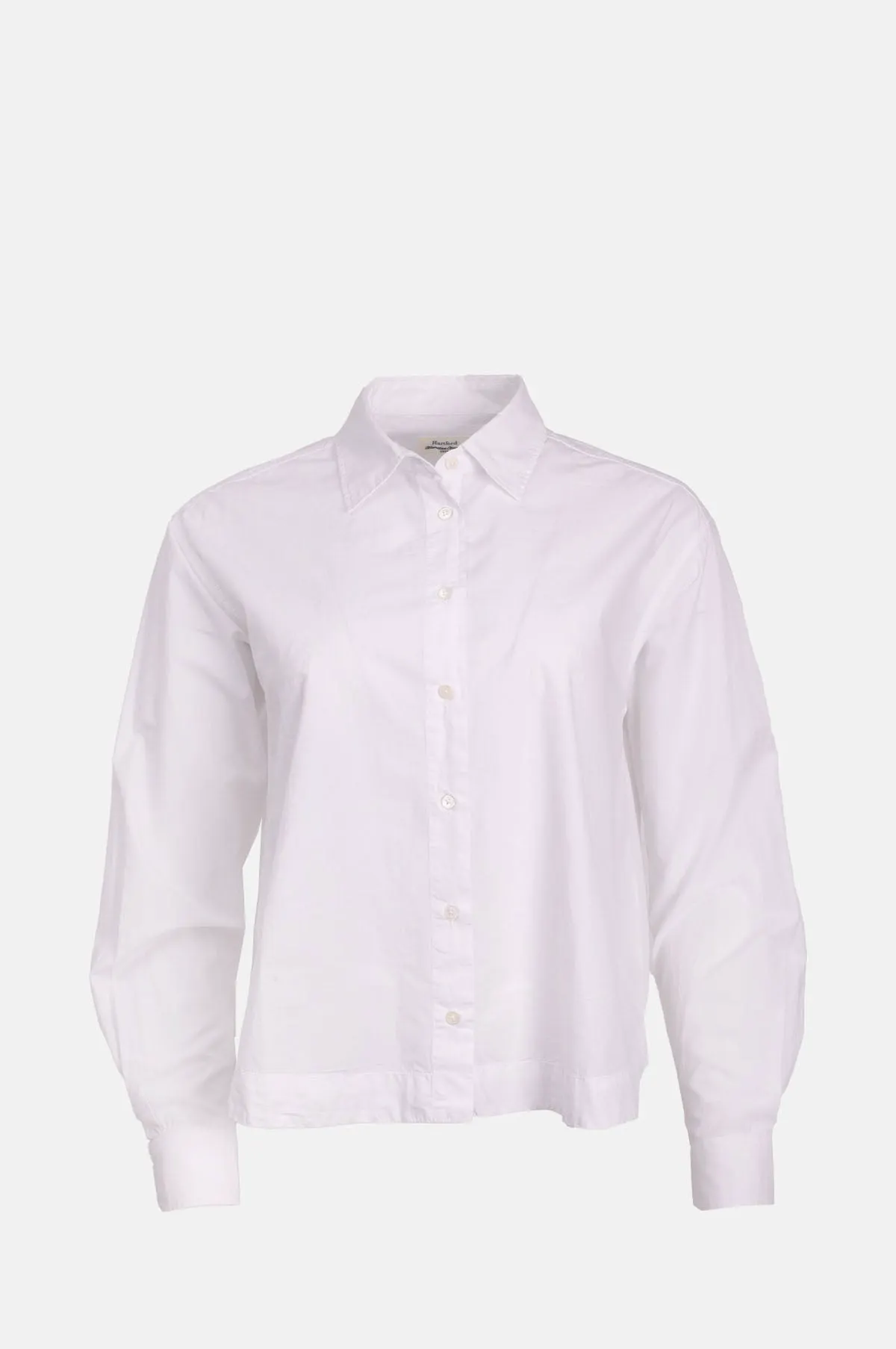

A white shirt from Hartford in an airy cotton poplin, cut with the fuller, looser silhouette of a blouse rather than of shirt, listed at 165 GBP with only two of the five sizes left. Its chart is the best teaching example this run has met, and the reason is that it gets the rounding problem wrong in both directions at once. The chest reads 54, 55, 56, 58 and 61, which steps one, one, two and three, and that widening step is real and it is doing something good, which this run will set out. The sleeve reads 55, 56, 57, 58 and 58, which looks as though it stops growing at the largest size, and it does not: those five numbers are exactly what a uniform grade of about 0.85 centimetres produces once rounded, so the sleeve is evenly graded and the chart hides it. The length reads 60, 60, 61, 61 and 62, which looks as though it grades, and it very nearly does not: those five numbers are what a uniform grade of about four millimetres per size produces, which means the shirt grows by two centimetres from the smallest to the largest. So on one garment, one column is genuinely uneven and the other two are even, and the chart makes one even column look frozen and one nearly frozen column look graded. The other thing worth a hard look is the care label, and it is worth looking at it beside the trouser from the same brand published in the same batch, because together they settle an argument this run has been having for several batches. The reference is the Clove Shirt in White. Dongguan Bafinasa Garments Co., Ltd. develops comparable shirting on OEM and ODM terms, from cloth sourcing to retail or FBA ready packing. We publish this as a development reference and build your own version of it, and we do not supply the branded original or reproduce anyone else's label.
Key Features
- Chest 54, 55, 56, 58 and 61 cm, stepping one, one, two and three, a widening grade which no uniform grade rounds to and which is arresting the ease collapse. See the note below
- Sleeve 55, 56, 57, 58 and 58 cm, which is a uniform 0.85 cm grade rounded, so the sleeve does not freeze at the top. See the note below
- Length 60, 60, 61, 61 and 62 cm, which is a uniform grade of about four millimetres per size, so the shirt grows two centimetres across five sizes. See the note below
- About 8.7 to 11.5 in of ease, held up at the top by the widening grade, against a description that claims fuller and looser than standard shirting. See the note below
- Dry clean only on 100% cotton with no lining, no padding and no trim named, beside a trouser from the same brand in the same fibre that machine washes. See the note below
- Airy cotton poplin as stated, with no weight, no thread count and nothing said about opacity on a white shirt. See the note below
- Six photographs, the most in this run
Customisable Options
- Cloth: airy cotton poplin to the reference, with the weight and the construction stated and the opacity tested, or a heavier poplin, a cotton lawn or a cotton voile, each quoted separately
- Silhouette: fuller and looser than standard shirting to the reference, with the ease at every size published, or a regular shirt silhouette, or a fuller blouse silhouette, each quoted separately
- Care: dry clean only to the reference, or a washable construction with the fusing and the shrinkage specified so the shirt can be machine washed, each quoted separately
- Collar: classic collar to the reference, with the point length and the spread specified, or a band collar, or a camp collar, each quoted separately
- Cuffs: buttoned cuffs to the reference, with the circumference and the button size specified, or a plain cuff, or no cuff
- Length: graded at about one centimetre per size, or held across sizes as the reference does, with the choice stated either way
- Cloth weight and construction, opacity test result, ease at every size, collar dimensions, cuff circumference, button count and size, yoke depth, size set, colour development, private label and care labelling
Specifications
| Style | Loose cut cotton poplin shirt with a classic collar, a back yoke and buttoned cuffs |
| Reference | Hartford, Clove Shirt, style BGCK607-20, white, sizes 1 to 5 |
| Composition | 100% cotton as stated in the panel |
| Cloth | Cotton poplin as stated, described as airy, with no weight, no construction and no opacity statement. See the note below |
| Silhouette | Fuller, looser silhouette than standard shirting, taking inspiration from the volume of a blouse, as stated. See the note below |
| Cut | Straight cut as stated, with a fluid cut as stated in the body of the description. See the note below |
| Collar | Classic collar as stated, with no point length and no spread given. See the note below |
| Cuffs | Buttoned cuffs as stated, with no cuff circumference and no button size given. See the note below |
| Yoke | Back yoke as stated, with no yoke depth given |
| Closure | Not described, with no button count, size or spacing given. See the note below |
| Opacity | Not mentioned, on a white shirt in an airy cloth. See the note below |
| Care | Dry clean only as stated. See the note below |
| Sizes Offered | 1 to 5, five sizes, with 3 and 4 in stock at the time of writing |
| Size Conversion | Published: 1 is XS, 2 is S, 3 is M, 4 is L and 5 is XL |
| Fit Guidance | None published beyond the description of the silhouette |
| Model | None published |
| Measurements Published | Pit to pit, sleeve length and total length for all five sizes. See the note below |
| Published Chest | 54, 55, 56, 58 and 61 cm flat, or 21.3 through 24.0 in. See the note below |
| Chest Around | 108, 110, 112, 116 and 122 cm, or 42.5, 43.3, 44.1, 45.7 and 48.0 in. See the note below |
| True Chest Grade | Not a uniform grade: the steps widen from 1 cm to 3 cm. See the note below |
| Ease Against Body Bust | About 11.5, 10.3, 9.1, 8.7 and 9.0 in. See the note below |
| Published Sleeve | 55, 56, 57, 58 and 58 cm, which is a uniform 0.85 cm grade rounded. See the note below |
| Sleeve Measurement Origin | Not stated |
| Published Length | 60, 60, 61, 61 and 62 cm, which is a uniform grade of about 0.4 cm. See the note below |
| Cloth Weight | Not stated. See the note below |
| Opacity | Not stated. See the note below |
| Photographs | Six, the most in this run |
| Production | Made in Morocco as stated, as was the trouser from this brand |
| Reference Retail | 165 GBP as listed, quoted to show the price band this sits in, not as our price |
| Category | Filed by the reference under blouses and shirts |
| Occasion | All year round, smart casual, to the office or with denim |
| MOQ | 100 pcs per style per colourway, mixed sizes and colourways accepted |
| Sampling | 7-10 days after tech pack or reference sample confirmation |
| Bulk Lead Time | 20-30 days after sample approval and deposit |
| Service | OEM / ODM / private label, cotton poplin sourcing with weight and construction stated, opacity testing, loose silhouette development, washable or dry clean construction, retail or FBA ready packing |
Size Chart as Published by the Reference
| Size | Pit To Pit (flat) | Sleeve Length | Total Length |
|---|---|---|---|
| 1 / XS | 54 cm | 55 cm | 60 cm |
| 2 / S | 55 cm | 56 cm | 60 cm |
| 3 / M | 56 cm | 57 cm | 61 cm |
| 4 / L | 58 cm | 58 cm | 61 cm |
| 5 / XL | 61 cm | 58 cm | 62 cm |
The chest figures are flat half measures taken with the shirt laid down, doubling to 108, 110, 112, 116 and 122 cm around, or 42.5, 43.3, 44.1, 45.7 and 48.0 in. Against a body bust of 31, 33, 35, 37 and 39 in across XS to XL, the ease is about 11.5, 10.3, 9.1, 8.7 and 9.0 in. The sleeve reads 55, 56, 57, 58 and 58 and is a uniform grade of about 0.85 cm rounded, so it does not freeze at the largest size. The length reads 60, 60, 61, 61 and 62 and is a uniform grade of about four millimetres per size, so the shirt grows only about two centimetres across the whole range.
Our Proposed Body Chart
| Size | Body Bust | Sleeve | Body Waist | Body Hips | Length | Source |
|---|---|---|---|---|---|---|
| 1 / XS | 31 in / 79 cm | 55 cm | 24 in / 61 cm | 34 in / 86 cm | 60 cm / 23.6 in | Our proposal |
| 2 / S | 33 in / 84 cm | 56 cm | 26 in / 66 cm | 36 in / 91 cm | 62 cm / 24.4 in | Our proposal |
| 3 / M | 35 in / 89 cm | 57 cm | 28 in / 71 cm | 38 in / 97 cm | 64 cm / 25.2 in | Our proposal |
| 4 / L | 37 in / 94 cm | 58 cm | 30 in / 76 cm | 40 in / 102 cm | 66 cm / 26 in | Our proposal |
| 5 / XL | 39 in / 99 cm | 59 cm | 32 in / 81 cm | 42 in / 107 cm | 68 cm / 26.8 in | Our proposal |
Occasions and Styling
Suits all year round and smart casual dressing. A white poplin shirt cut fuller than standard shirting will go to the office under tailoring as readily as it goes with denim, and the extra volume is what keeps it from reading as formal.
Production and Quality Control
The reference publishes three columns for all five sizes, states a single fibre, names the cloth, describes the silhouette, the cut, the collar, the cuffs and the yoke, gives a care instruction, names the country of production and publishes a size conversion, and it carries six photographs, the most this run has met. It publishes no fit guidance and no model information, and gives no cloth weight, no collar dimensions, no cuff circumference, no yoke depth, no button specification and no opacity statement. Three things follow: the chart that is wrong in both directions at once, the widening grade that is doing good work, and the care label read beside the trouser.
One column genuinely uneven and two that only look it, and that is the first thing. Take the sleeve first, because it is the cleanest case. It reads 55, 56, 57, 58 and 58, so the last step is zero and the sleeve appears to stop growing at the largest size. It does not. The test asks whether any single uniform grade would produce this column once rounded, and working through the four conditions confines the grade to somewhere between about 0.83 and 0.88, and 0.85 sits inside that: 55, 55.85, 56.7, 57.55 and 58.4, which round to 55, 56, 57, 58 and 58, exactly as published. So the sleeve is evenly graded and the apparent freeze is a rounding artifact, which is the same shape of finding this run has made on six columns now. Now the length, which is the interesting one because it runs the other way. It reads 60, 60, 61, 61 and 62, stepping zero, one, zero and one, and it looks like a dimension that is grading in fits and starts. The same test confines the grade to somewhere between about 0.375 and 0.5 centimetres, and 0.45 works: 60, 60.45, 60.9, 61.35 and 61.8, which round to 60, 60, 61, 61 and 62. So the true length grade is about four millimetres per size, and the shirt grows by roughly two centimetres from the smallest size to the largest. A published chart that appears to step zero, one, zero, one is hiding a dimension that barely moves at all. That is worth stating as a general caution, because this run has spent several batches showing that rounding can make an even grade look uneven, and that has mostly been good news for the brands involved. Here it cuts the other way: rounding can also make a nearly frozen dimension look as though it grades. The two halves together mean a chart rounded to whole centimetres cannot be read in either direction, and this garment is the clearest demonstration of it that this run has met, because it does both at once on the same page. It is worth being fair about whether a slow length grade is a fault, because the answer is not obviously yes. Commercial size charts hold a reference height that changes very little across sizes while girth grades two inches per size, so a length that grades slowly is defensible and in many systems correct. What is not defensible is that the published figures give no hint of it, so a customer who is tall and takes a larger size has no way to see that the shirt is barely longer than the one three sizes smaller.
One, one, two, three, and that is the second thing, and it is the first good news in a while. The chest reads 54, 55, 56, 58 and 61, so the steps widen from one centimetre at the bottom to three at the top. This time the rounding test fails properly: to keep the first step at one the grade would have to be under about 1.25, and to reach 61 by the fourth step it would have to be over about 1.6, and those cannot both hold. So this column is genuinely not a uniform grade, which makes it the second provably uneven column this run has found after the white romantic shirt in the previous batch. But it is not the same kind of unevenness, and the difference is the whole point. That shirt's chest stepped one, two and two, which is irregular without a direction. This one steps one, one, two and three, which is regular in its irregularity: the grade widens as the sizes get larger. And it is worth asking what that does, because the effect is visible in the ease. Every other garment this run has examined grades at a flat rate, which means the ease closes by a fixed amount at every size and a loose garment becomes steadily less loose as the sizes go up. Here the opposite happens. The ease runs about 11.5, 10.3, 9.1, 8.7 and 9.0 inches, so it falls for three sizes and then stops falling and turns back up. A flat grade of the size this run usually sees would have taken it below seven by the largest size. Instead it holds at about nine. So the widening grade is arresting the collapse, and that is the correct thing to do if a maker wants a garment to feel the same way on every body rather than only on the smallest one. This run has not seen it before and it is worth crediting: the one column on this chart that is genuinely irregular is the one that is doing the most thoughtful work. It is worth adding the caveat that the largest single step, from 58 to 61, is the one figure on the chart worth double checking, and that if it should have been 60 the story changes slightly though not the direction. Then what the ease means against the words, which this run is now able to calibrate because it has measured enough garments to have a scale. The description says the shirt offers a fuller, looser silhouette than your standard shirting and takes the billowing volume of a blouse. Set against this run's measurements, about 8.7 to 11.5 inches is genuinely looser than a regular shirt, which sits around five to seven, and it is well short of what another house in this run calls relaxed, at about twelve to thirteen, let alone what it calls oversized, at about sixteen and a half to eighteen. So the claim is accurate as a comparative and modest as an absolute, and the reader who expects billowing from the prose will find generous rather than dramatic. It is worth noting two smaller tensions while the words are on the table. The description says billowing and fluid and then lists the cut as straight, and those are not the same idea, though on a shirt with this much ease they can coexist. And it says the shirt keeps its elegance while being less formal, which is a claim about how a garment reads rather than about what it measures, and nothing on the page supports it either way.
Dry clean only, on cotton, with nothing else in the garment, and that is the third thing, and it is worth reading it beside the trouser from the same brand published in the same batch, because together they settle something. The Clove is 100% cotton with a classic collar, buttoned cuffs and a back yoke, no lining, no padding, no trim and no stretch named anywhere, and it is dry clean only. The Parade trouser, same brand, same fibre, same country of production, is machine wash at thirty. Two garments of the same cloth from the same maker with opposite care labels. That is the clean demonstration yet of a thing this run has been circling for several batches: the care label follows the construction, not the fibre. Cotton is washable, so if this shirt cannot be washed the reason must lie in how it is built, and there are two likely candidates and neither is on the page. The first is fusing. A classic collar and buttoned cuffs are held in shape by an interlining, and if that interlining is fused rather than sewn it will bubble, curl or delaminate in a machine wash. That is the single most common reason a plain cotton shirt is labelled dry clean only, and the page names the collar and the cuffs without saying a word about how they are made. The second is shrinkage control on a garment whose whole selling point is a fluid drape, since an uneven wash could change how it hangs. This run has now met this shape of problem four times, on a cotton skirt told to hand wash, a part polyester waistcoat told to dry clean, a padded cotton jacket told to dry clean, and now this. The rule it offered last batch was that when the care label does not follow from the fibre, you should look for a component, and expect the page not to mention it. This one sharpens the rule: here there is no component to find, so the reason has to be invisible construction, which is even harder for a customer to discover than a missing trim would be. And it is worth saying what the label costs in practice, because the description sells the shirt as everyday wear. It says the cloth makes it wonderfully comfortable for every day dressing. An everyday white shirt that must be dry cleaned is not an everyday white shirt in any ordinary sense: it carries a running cost every few wears and it cannot be dealt with at home on a Sunday. Nothing on the page acknowledges that, and the two facts sit a few lines apart. Then two smaller gaps on the cloth. It is an airy cotton poplin, and poplin is specified by its weight and its construction, and neither is given; airy is an adjective, and on an airy white cloth the question a customer will actually ask is whether she can see through it. There is no statement about opacity anywhere on the page, and no note about what to wear underneath. That is the one omission here that will generate returns. Every bulk shipment gets a measurement report against your approved chart.
Optional upgrades include publishing the cloth weight and construction and testing and stating the opacity, publishing the ease at every size and saying whether the widening grade is deliberate, grading the length at about one centimetre per size or stating plainly that it is held, giving the collar point length and spread, the cuff circumference and the button count and size, the yoke depth and the placket, offering a washable construction with the fusing and the shrinkage specified, adding fit guidance and a model height, a heavier poplin, cotton lawn and cotton voile option, regular and fuller blouse silhouette options, band and camp collar options, plain cuff and no cuff options, size set, colour development, private label, hangtag and care labelling.
Pre-production sample approval, in-line inspection during cutting and sewing, and a final AQL inspection before packing, with measurement reports and photos shared before shipment.
Send us your tech pack, a photo or a reference garment and we will quote within 24 hours. Contact bafinasa@bafinasa.com or WhatsApp +86 13827222469.