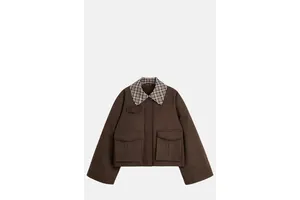
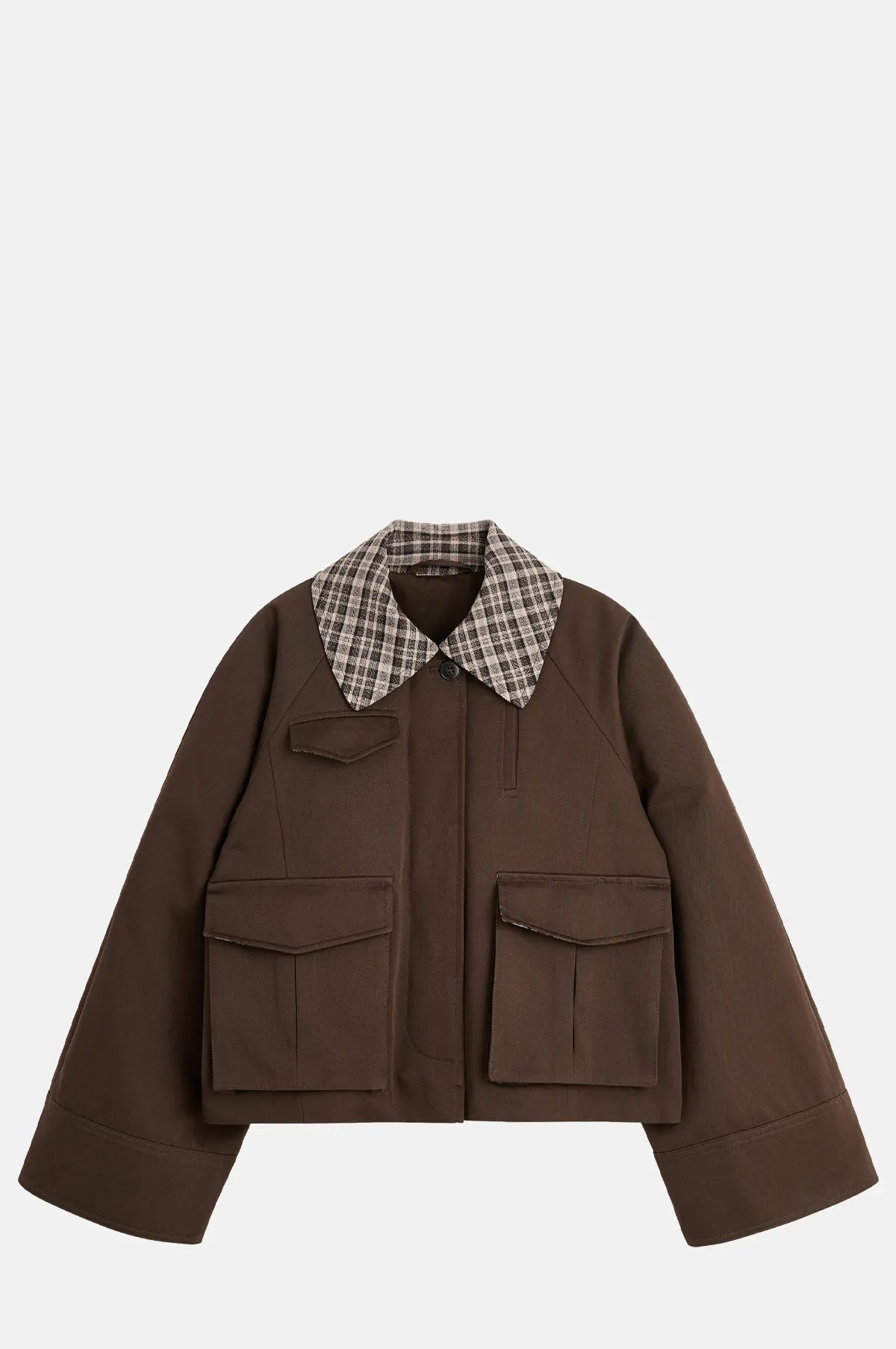

A barn jacket from Skall Studio in chocolate brown, made from organic cotton with a water repellent finish and polyester padding, cut short with a contrast checked collar, a hidden button placket over a zip, wide raglan sleeves with deep cuffs that fold back to show a checked lining, boxy bellows pockets at the front and flap and welt pockets at the chest, listed at 495 GBP in three sizes. It is the most expensive garment this run has examined, and it is also one of the best specified, which is worth saying because this run has spent a good deal of time showing that completeness does not track price in either direction. It declares three components rather than one. It gives fit guidance and a sizing recommendation, which is rare. And it gives a model height, which lets a reader actually check the length claim, and this run will do that below. What is left out is just as instructive, and the most interesting omission is not a measurement but a chemistry: the jacket is water repellent and it is dry clean only, and those two facts are in conflict, because the finish that makes it shed water is the finish that washing maintains and that dry cleaning solvents can strip. The reference is the Gaby City Jacket in Coco Brown. Dongguan Bafinasa Garments Co., Ltd. develops comparable outerwear on OEM and ODM terms, from shell, finish and filling to retail or FBA ready packing. We publish this as a development reference and build your own version of it, and we do not supply the branded original or reproduce anyone else's label.
Key Features
- Water repellent as stated, with no finish type, no test and no durability given, on a garment that is dry clean only. See the note below
- Outer and lining both declared as 100% organic cotton, with the padding declared separately as polyester, three components in one panel. See the note below
- Fit guidance and a sizing recommendation published, which is rare, and a model height of 172 cm, which lets the length claim be checked. See the note below
- About 10.7 to 11.5 in of ease, which on outerwear is about room for a layer rather than a silhouette. See the note below
- All three columns grade two centimetres per size, one of the cleanest charts in this run
- Bellows pockets that open at the top and at the side as stated, the most fully described pockets in this run, with no dimensions. See the note below
- Two closures, a hidden button placket and a zip, with neither specified. See the note below
Customisable Options
- Shell: organic cotton to the reference, with the weight stated, or a conventional cotton, a cotton nylon or a cotton polyester, each quoted separately
- Finish: water repellent to the reference, with the finish type, the test method and the durability stated and its PFAS status declared, or an unfinished shell, or a waxed finish, each quoted separately
- Padding: polyester to the reference, with the weight stated, or a recycled fill, or a heavier fill, or no padding, each quoted separately
- Lining: organic cotton with a check to the reference, with the check repeat published, or a plain lining, or a contrast plain lining, each quoted separately
- Sleeve: wide raglan with a deep turn-back cuff to the reference, with the cuff depth specified and the sleeve measured from a named point, or a set-in sleeve, or a cuff without a turn-back
- Pockets: boxy bellows opening at the top and the side to the reference, with the dimensions and the bellows depth given, or plain patch pockets, or a single entry, each quoted separately
- Shell weight, finish type, test method and durability and PFAS status, padding weight, check repeat, cuff depth, pocket dimensions and bellows depth, zip type and length, button count and size, collar dimensions, size set, colour development, private label and care labelling
Specifications
| Style | Cropped barn jacket with a checked collar, raglan sleeves and bellows pockets |
| Reference | Skall Studio, Gaby City Jacket, style 10018-27014, coco brown, sizes 34 to 38 Danish |
| Composition | Outer and lining 100% organic cotton, as stated in the panel. See the note below |
| Padding | Padding 100% polyester, as stated in the panel, with no weight given. See the note below |
| Finish | Water repellent as stated, with no finish type, no test and no durability given. See the note below |
| Certification | None named, unlike the four other cotton garments from this brand in this run. See the note below |
| Collar | Contrast checked collar as stated, with no collar dimensions and no check repeat given. See the note below |
| Closure | One visible button at the neck with the rest hidden beneath a front placket, which also closes with a zipper, as stated, with no specification for either. See the note below |
| Sleeve | Wide raglan sleeves with deep cuffs which can be folded back to reveal a checked lining, as stated. See the note below |
| Cuffs | Deep cuffs as stated, with no cuff depth given. See the note below |
| Pockets | Two boxy bellows pockets opening at the top and at the side, and flap and welt pockets at the chest, as stated, with no dimensions given. See the note below |
| Fit | Regular fit offering freedom to move effortlessly as stated, with fit guidance published. See the note below |
| Care | Dry clean only as stated. See the note below |
| Sizes Offered | 34 to 38 Danish, three sizes, all three in stock |
| Size Conversion | Published: 34 is XS, 36 is S and 38 is M |
| Fit Guidance | Published: normal fit offering freedom to move effortlessly, choose your normal size |
| Model | Published: 172 cm tall, wearing a size 36. See the note below |
| Measurements Published | Pit to pit, sleeve length and total length for all three sizes |
| Published Chest | 54, 56 and 58 cm flat, or 21.3 through 22.8 in. See the note below |
| Chest Around | 108, 112 and 116 cm, or 42.5, 44.1 and 45.7 in. See the note below |
| Ease Against Body Bust | About 11.5, 11.1 and 10.7 in, which on outerwear is room for a layer. See the note below |
| Published Sleeve | 64, 66 and 68 cm, grading two centimetres per size, with the origin not stated on a raglan |
| Published Length | 56, 58 and 60 cm, grading two centimetres per size. See the note below |
| Padding Weight | None. See the note below |
| Finish Specification | None. See the note below |
| Cuff Depth | None, on a cuff designed to be folded back. See the note below |
| Pocket Specification | None, on the most fully described pockets in this run. See the note below |
| Cloth Weight | Not stated |
| Photographs | Four |
| Production | Made in Bulgaria as stated. See the note below |
| Reference Retail | 495 GBP as listed, the most expensive garment this run has examined, quoted to show the price band this sits in, not as our price |
| Category | Filed by the reference under coats and jackets |
| Occasion | Autumn and winter, everyday outerwear, walking, errands, over a knit |
| MOQ | 100 pcs per style per colourway, mixed sizes and colourways accepted |
| Sampling | 7-10 days after tech pack or reference sample confirmation |
| Bulk Lead Time | 20-30 days after sample approval and deposit |
| Service | OEM / ODM / private label, organic cotton shell sourcing, water repellent finish with test data, padding specification, checked lining development, retail or FBA ready packing |
Size Chart as Published by the Reference
| Size | Pit to Pit (flat) | Sleeve Length | Total Length |
|---|---|---|---|
| 34 / XS | 54 cm | 64 cm | 56 cm |
| 36 / S | 56 cm | 66 cm | 58 cm |
| 38 / M | 58 cm | 68 cm | 60 cm |
The chest figures are flat half measures taken with the jacket laid down, doubling to 108, 112 and 116 cm around, or 42.5, 44.1 and 45.7 in. Against a body bust of 31, 33 and 35 in across XS to M, the ease is about eleven and a half, eleven point one and ten point seven inches, which on outerwear is better read as room for a layer than as a silhouette. All three columns grade two centimetres per size. The model is published at 172 cm wearing a size 36, whose length is 58 cm, so the hem can be placed on a body: it falls at about hip level, which supports the word cropped for a coat without making this a waist length jacket.
Our Proposed Body Chart
| Size | Body Bust | Sleeve | Body Waist | Body Hips | Length | Source |
|---|---|---|---|---|---|---|
| 34 / XS | 31 in / 79 cm | 64 cm | 24 in / 61 cm | 34 in / 86 cm | 56 cm / 22 in | Our proposal |
| 36 / S | 33 in / 84 cm | 65 cm | 26 in / 66 cm | 36 in / 91 cm | 58 cm / 22.8 in | Our proposal |
| 38 / M | 35 in / 89 cm | 66 cm | 28 in / 71 cm | 38 in / 97 cm | 60 cm / 23.6 in | Our proposal |
Occasions and Styling
Suits autumn and winter and everyday outerwear. A short barn jacket is the piece for the errands the reference describes: warm enough for a cold morning, short enough not to get in the way, and tough enough not to mind.
Production and Quality Control
The reference publishes three columns for all three sizes, declares the outer, the lining and the padding separately, describes the finish, the collar, the closure, the sleeve, the cuffs, the pockets and the fit, gives a care instruction, names the country of production, publishes a size conversion, publishes fit guidance with a sizing recommendation, and publishes the model's height and the size she wears. It gives no padding weight, no finish specification, no cuff depth, no pocket dimensions, no collar dimensions, no zip or button specification and no cloth weight, and it names no certification. Three things follow: the water repellent finish on a garment that cannot be washed, the ease that means something different on a coat than on a shirt, and the pockets.
Water repellent, and dry clean only, and that is the first thing. The jacket is described as water repellent, and the care label says dry clean only. Those two statements do not sit comfortably together, and it is worth setting out why, because the conflict is in the chemistry rather than in the paperwork. A water repellent finish is a treatment applied to the cloth so that water beads and runs off rather than soaking in. It is not permanent. It wears off with abrasion and it is degraded by dirt and by washing, and the normal way to restore it is to wash the garment with a reproofing product, or to spray one on and then tumble it on a low heat to cure it. None of those can be done to a garment that is dry clean only. Worse, the solvents used in dry cleaning can strip a finish of this kind, so the very process the page recommends for cleaning the jacket is a process that removes the property it is advertising. It is worth being careful about how far to take this, since finishes vary and a specialist cleaner can reapply some of them, so the honest statement is that the finish has a limited life, that the page gives no way to maintain it, and that the one cleaning method it does name is likely to shorten rather than extend that life. Then what is not said about the finish, which is a good deal. No type is given, and there are several families of water repellent finish with very different profiles: a wax, a durable water repellent of the kind applied in a mill, and a coating all behave differently and cost differently. No test method and no rating are given, and there are standard spray tests that produce a number, and a number is what lets a buyer compare one finish with another. No durability is given, in washes or in seasons. And nothing is said about whether the finish is free of per and polyfluoroalkyl substances, which is now both a regulatory question in Europe and the first question most buyers ask about a water repellent garment. That last one is worth singling out, because it is the one omission here that a brand cannot leave open for much longer. It is also worth asking the same question this run asked about two other care labels in recent batches, which is why a cotton garment is dry clean only. Cotton is washable, so the reason must lie elsewhere, and here there are three candidates: the polyester padding, which shifts and clumps when it is soaked; the checked cotton lining, which will shrink at a different rate from the shell; and the water repellent finish, which washing degrades. All three are plausible and none is stated, and this run has now met this shape of problem three times in three batches, on a cotton skirt told to hand wash, a part polyester waistcoat told to dry clean, and now this. The rule that comes out of it is a useful one: when a care label does not follow from the fibre, look for a component, and expect the page not to mention it. It is worth adding one observation about the certification, offered as a hypothesis rather than a conclusion. Four other cotton garments from this brand carry the GOTS word in their style codes and this one does not, and this is the only one of the five with a chemical finish on it. A fibre standard restricts what can be put onto the cloth, so it is at least possible that the finish and the absence of the standard are connected. Nothing on the page says so, and it may equally be that the code field is simply filled in differently here, since this one ends in a category word rather than a colour name.
Eleven inches of ease, and what it means depends on what the garment is, and that is the second thing. The chest measures 108 to 116 cm around against a body bust of 79 to 89 cm, so the ease is about eleven and a half inches at the smallest and about ten and seven tenths at the largest. If this were a shirt, eleven inches would be at the loose end of relaxed and heading towards oversized, and this run has measured shirts at that number and said so. On a jacket it is a different thing entirely, and the reason is that outerwear has to go over something. A jacket's ease is not a statement about silhouette, it is partly an allowance for the knit or the shirt underneath, and an allowance that is too small makes the garment unwearable for half the year. So eleven inches here is not oversized, it is roughly the right number for a coat worn over a jumper, and the page's fit guidance supports that reading: it says normal fit, that it offers the freedom to move effortlessly, and that the customer should choose her normal size, which is a claim about room rather than about shape. It is worth stating the methodological point that falls out of this, because this run has been comparing ease across garments for many batches and has been treating the numbers as if they were on one scale. They are not. Ease is only comparable within a category, and the same figure means relaxed on a shirt, regular on a coat, and something close to unwearable on a fitted dress. The run will carry that forward. It is also worth crediting the page for the things that let a reader judge the fit at all, of which there are three, and which most pages in this run do not have. There is fit guidance in words. There is a sizing recommendation, which is rarer still. And there is a model height, which is 172 cm wearing a size 36. That last one lets this run do something it could not do on the white shirt published alongside this jacket, which claimed to rest at the waistband and gave no height to check it against. Here it can be done: on a woman of 172 cm the shoulder sits roughly 142 cm above the ground and the natural waist about 107, so a jacket with a length of 58 cm puts its hem somewhere around 84 cm above the ground, which is hip level. So cropped is right for a coat, in the sense that a full length coat would be a hundred centimetres or more, and it is worth saying that cropped here means hip length rather than waist length, because the two are very different garments and the word alone does not distinguish them. All three columns grade two centimetres per size, which is one of the cleanest charts in this run and which makes the ease drift gently and predictably by about two fifths of an inch per size. It is worth noting what is missing from the size set, which is that the jacket stops at a 38, so it is offered in three sizes from XS to M, and the most expensive garment this run has examined is available to the narrowest range of bodies. This run has argued before that a small size set is more honest than a large one with meaningless one centimetre steps, and that argument stands, but it is worth noting who a garment like this is for.
Bellows pockets, and a checked lining you only see when you turn the cuff back, and that is the third thing. The pockets are described as two boxy bellows pockets that sit on the front and open both at the top and at the side, with flap and welt pockets at the chest adding further detail. That is the fullest description of a pocket this run has met, and it deserves the credit: it gives the type, which is a bellows pocket, meaning one with a gusset at the sides that lets it expand; it gives the shape, which is boxy; it gives the position, which is the front; and it gives the entry, which is both the top and the side, so it is a dual entry pocket of the kind you can put your hands into. That is four pieces of information where this run usually gets none beyond the word pocket, and it is worth saying plainly that it is better work than most. What is still missing is every dimension: no pocket width, no depth, no height above the hem, and no bellows depth, which is how far the gusset lets the pocket expand and which is the number that makes a bellows pocket worth making rather than a flat patch. It is also worth noting that the description does not make clear how many pockets there are in total, since flap and welt pockets at the chest could be one of each or two of one kind, and there is no count. Then the cuffs, which are the most interesting detail on the jacket and which are underspecified in a way that matters. They are deep cuffs which can be folded back to reveal a checked lining. A turn-back cuff is a design that depends absolutely on one measurement, which is the depth of the cuff, because a cuff that is too shallow will not stay turned and one that is too deep looks like a mistake when it is not turned. No depth is given. Nor is there any statement of whether the turned-back position is held by anything, since a cuff folded back on a heavy padded sleeve will tend to unfold itself unless it is stitched, snapped or weighted. And the check that is revealed is itself unspecified, since no repeat is given for it, which is the same omission this run has now recorded on every checked and striped garment it has examined. It is worth drawing the components together, because this is where the page does better than most and it is worth saying precisely why. The panel reads outer and lining 100% organic cotton, padding 100% polyester. Three components, each with a fibre, and the lining declared in the panel rather than only in the prose, which is the second time this run has seen a lining declared at all. It is worth noting that the padded jacket this run examined two batches ago also declared three components, so both of the best specified garments in this run have been jackets, and that may not be a coincidence: an outerwear garment has more parts in it and a maker has to account for them. What is missing is the weight of the padding, which as this run said on that other jacket is the number that decides how warm it will be and the one number about it that cannot be inferred. Made in Bulgaria is stated, which completes a sourcing map this run can now read across ten garments from this brand: wool knitwear in Denmark, merino in Italy, printed cotton in Romania, denim in Turkey, romantic and striped shirting in India, and padded outerwear in Bulgaria. The country tracks the product, and it is legible from the pages. Every bulk shipment gets a measurement report against your approved chart.
Optional upgrades include stating the finish type, its test rating and its durability in washes, and declaring whether it is free of per and polyfluoroalkyl substances, stating the padding weight, publishing the cuff depth and saying how the turned-back cuff is held, giving the pocket dimensions and the bellows depth and the pocket count, naming where the raglan sleeve is measured from, giving the collar dimensions and the check repeat for both the collar and the cuff lining, specifying the zip by type and length and the buttons by count and size, stating the cloth weight, naming a certification or saying why there is none, adding a note on how to maintain the water repellent finish, extending the size set beyond a 38, a conventional cotton, cotton nylon and cotton polyester option, unfinished and waxed finish options, recycled, heavier and no padding options, plain and contrast plain lining options, set-in sleeve and plain cuff options, patch and single entry pocket options, size set, colour development, private label, hangtag and care labelling.
Pre-production sample approval, in-line inspection during cutting and sewing, and a final AQL inspection before packing, with measurement reports and photos shared before shipment.
Send us your tech pack, a photo or a reference garment and we will quote within 24 hours. Contact bafinasa@bafinasa.com or WhatsApp +86 13827222469.