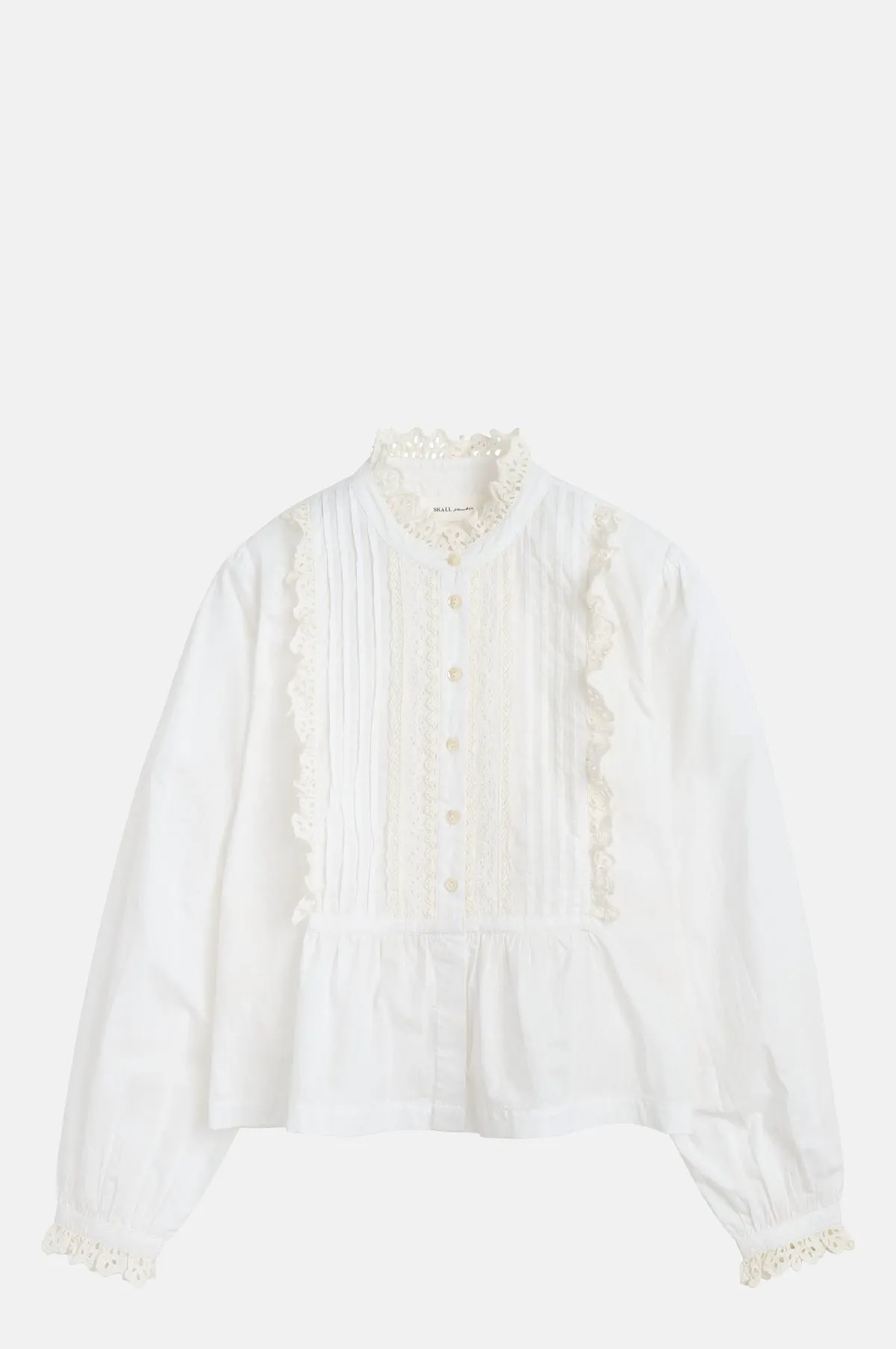

A white shirt from Skall Studio in optic white organic cotton, cut slightly cropped with long voluminous sleeves ruffled at the buttoned cuffs, a double ruffle collar, a front bib with lace inserts and pleats, and gathered detail below the bib, listed at 190 GBP with three of the four sizes left. Its chart is worth examining because the three columns do not agree with each other, and this run can now show which two are right. The sleeve reads 64, 66, 68 and 69, and the total length reads 52, 54, 56 and 57, and both of those are exactly what a uniform grade of about 1.8 centimetres produces once rounded, so both are evenly graded and the chart hides it. The chest reads 49, 50, 52 and 54, and no uniform grade rounds to that, so it is not. That leaves a garment whose sleeve and length march together and whose chest does something else, which is worth knowing on a shirt whose whole shape depends on how those three relate. The other thing worth dwelling on is the description itself, which names feature after feature and gives a measurement for none of them. The reference is the Lesley Shirt in Optic White. Dongguan Bafinasa Garments Co., Ltd. develops comparable shirting on OEM and ODM terms, from cloth and trim sourcing to retail or FBA ready packing. We publish this as a development reference and build your own version of it, and we do not supply the branded original or reproduce anyone else's label.
Key Features
- Sleeve 64, 66, 68 and 69 cm and length 52, 54, 56 and 57 cm, both of which are a uniform 1.8 cm grade rounded. See the note below
- Chest 49, 50, 52 and 54 cm, which no uniform grade rounds to, so the chest is graded differently from the sleeve and the length. See the note below
- About 7.6 in of ease at the smallest falling to about 5.5 in at the largest, and no fit word given anywhere on the page to describe it. See the note below
- Eight features named in the description, including two kinds of trim and two kinds of gather, with not one measurement among them. See the note below
- Front bib with lace inserts as stated, and the lace is the second undeclared trim on a 100% organic cotton claim from this brand. See the note below
- Slightly cropped so the shirt rests at the waistband as stated, against a published length of 52 to 57 cm and no model height to check it. See the note below
- GOTS named as on the three other garments from this brand in this batch, with no certifier and no licence number. See the note below
Customisable Options
- Cloth: organic cotton to the reference, with the weight stated, or a cotton poplin, a cotton lawn or a cotton voile, each quoted separately
- Collar: double ruffle to the reference, with the ruffle depth and the gather ratio specified, or a single ruffle, a plain band collar or a Peter Pan collar, each quoted separately
- Bib: pleated bib with lace inserts to the reference, with the bib width, the pleat count and depth and the lace width and fibre specified, or a plain bib, or no bib
- Trims: lace to the reference, with the fibre named and declared in the composition panel, or broderie anglaise, or a plain frill, or no trim, each quoted separately
- Sleeve: long and voluminous with a ruffled buttoned cuff to the reference, with the upper sleeve width, the cuff circumference and the ruffle depth specified, or a plainer bishop sleeve or a straight sleeve
- Length: slightly cropped to the reference, with the length published and a model height given, or a standard shirt length, or a tunic length
- Cloth weight, ruffle depth and gather ratio, bib width, pleat count and depth, lace fibre and width, cuff circumference, button count and size, yoke depth, certification and licence number, size set, colour development, private label and care labelling
Specifications
| Style | Romantic shirt with a ruffle collar, a pleated lace bib and ruffled cuffs |
| Reference | Skall Studio, Lesley Shirt, style 10207-26532, GOTS, optic white, sizes 34 to 40 Danish |
| Composition | 100% organic cotton as stated in the panel. See the note below |
| Certification | GOTS as stated in the style code line, with no certifier and no licence number. See the note below |
| Collar | Double ruffle collar as stated, with no ruffle depth and no gather ratio given. See the note below |
| Bib | Front bib with lace inserts and pleats as stated, with no bib width, no pleat count, no pleat depth and no lace specification given. See the note below |
| Trims | Lace inserts and a ruffle trim as stated, with no fibre and no width given. See the note below |
| Closure | Button-down closure as stated, with no button count, size or spacing given. See the note below |
| Gathers | Gathered details below the bib as stated, with no gather ratio given. See the note below |
| Sleeve | Long voluminous sleeves, ruffled at the buttoned cuffs, as stated. See the note below |
| Cuffs | Buttoned cuffs with a ruffle edge as stated, with no cuff circumference and no ruffle depth given. See the note below |
| Yoke | Back yoke as stated, with no yoke depth given |
| Length | Designed to be slightly cropped, resting at the waistband, as stated. See the note below |
| Fit Word | None given on the page. See the note below |
| Care | Machine wash at 30 degrees, do not tumble dry, as stated |
| Sizes Offered | 34 to 40 Danish, four sizes, with 34, 38 and 40 in stock at the time of writing |
| Size Conversion | Published: 34 is XS, 36 is S, 38 is M and 40 is L |
| Fit Guidance | None published |
| Model | None published. See the note below |
| Measurements Published | Pit to pit, sleeve length and total length for all four sizes. See the note below |
| Published Chest | 49, 50, 52 and 54 cm flat, or 19.3 through 21.3 in. See the note below |
| Chest Around | 98, 100, 104 and 108 cm, or 38.6, 39.4, 40.9 and 42.5 in. See the note below |
| Ease Against Body Bust | About 7.6, 6.4, 5.9 and 5.5 in, an uneven drift of about two inches. See the note below |
| Published Sleeve | 64, 66, 68 and 69 cm, which is a uniform 1.8 cm grade rounded. See the note below |
| Sleeve Measurement Origin | Not stated |
| Published Length | 52, 54, 56 and 57 cm, which is a uniform 1.8 cm grade rounded. See the note below |
| Ruffle Specification | None. See the note below |
| Pleat Specification | None. See the note below |
| Cuff Specification | None. See the note below |
| Cloth Weight | Not stated |
| Photographs | Two |
| Production | Made in India as stated, as was the striped blouse from this brand |
| Reference Retail | 190 GBP as listed, quoted to show the price band this sits in, not as our price |
| Category | Filed by the reference under blouses and shirts |
| Occasion | Autumn, winter and spring, smart casual, with tailoring or denim |
| MOQ | 100 pcs per style per colourway, mixed sizes and colourways accepted |
| Sampling | 7-10 days after tech pack or reference sample confirmation |
| Bulk Lead Time | 20-30 days after sample approval and deposit |
| Service | OEM / ODM / private label, GOTS certified organic cotton sourcing, lace and ruffle trim development, pleat and gather specification, retail or FBA ready packing |
Size Chart as Published by the Reference
| Size | Pit To Pit (flat) | Sleeve Length | Total Length |
|---|---|---|---|
| 34 / XS | 49 cm | 64 cm | 52 cm |
| 36 / S (sold out) | 50 cm | 66 cm | 54 cm |
| 38 / M | 52 cm | 68 cm | 56 cm |
| 40 / L | 54 cm | 69 cm | 57 cm |
The chest figures are flat half measures taken with the shirt laid down, doubling to 98, 100, 104 and 108 cm around, or 38.6, 39.4, 40.9 and 42.5 in. Against a body bust of 31, 33, 35 and 37 in across XS to L, the ease is about 7.6, 6.4, 5.9 and 5.5 in, and no fit word is given anywhere on the page to describe it. The sleeve reads 64, 66, 68 and 69 cm and the length reads 52, 54, 56 and 57 cm, and both are exactly what a uniform grade of about 1.8 cm per size produces once rounded, so both are evenly graded. The chest steps 1, 2 and 2 cm and no uniform grade rounds to it, so the chest is graded differently from the other two columns.
Our Proposed Body Chart
| Size | Body Bust | Sleeve | Body Waist | Body Hips | Length | Source |
|---|---|---|---|---|---|---|
| 34 / XS | 31 in / 79 cm | 64 cm | 24 in / 61 cm | 34 in / 86 cm | 52 cm / 20.5 in | Our proposal |
| 36 / S | 33 in / 84 cm | 65 cm | 26 in / 66 cm | 36 in / 91 cm | 54 cm / 21.3 in | Our proposal |
| 38 / M | 35 in / 89 cm | 66 cm | 28 in / 71 cm | 38 in / 97 cm | 56 cm / 22 in | Our proposal |
| 40 / L | 37 in / 94 cm | 67 cm | 30 in / 76 cm | 40 in / 102 cm | 58 cm / 22.8 in | Our proposal |
Occasions and Styling
Suits autumn, winter and spring and smart casual dressing. A white shirt with a ruffle collar and a bib is a piece that reads as dressed, so it works under tailoring as readily as with denim, and the volume in the sleeve is what keeps it from looking like office wear.
Production and Quality Control
The reference publishes three columns for all four sizes, states a single fibre, names a certification, describes the collar, the bib, the closure, the gathers, the sleeve, the cuffs, the yoke and the length, gives a two-clause care instruction, names the country of production and publishes a size conversion. It publishes no fit guidance and no model information, and gives no ruffle depth, no pleat specification, no cuff circumference, no bib width, no yoke depth, no cloth weight and no button specification. Three things follow: the two columns that agree and the one that does not, the missing fit word, and the eight features with no measurements between them.
Two columns at one point eight, and one that is not, and that is the first thing. The sleeve reads 64, 66, 68 and 69, and the total length reads 52, 54, 56 and 57. Both step two, two and one, and a step pattern like that is exactly what this run has learned to test rather than accept. The test asks whether any single uniform grade, rounded to whole centimetres, would produce the column. For the sleeve, the grade would have to be large enough to add two at the first step and small enough to add only five by the third, which confines it to somewhere between about 1.75 and 1.83, and 1.8 sits inside that: 64, 65.8, 67.6 and 69.4, which round to 64, 66, 68 and 69, precisely as published. The length works out identically, on the same grade, because 52, 53.8, 55.6 and 57.4 round to 52, 54, 56 and 57. So both columns are evenly graded at about 1.8 centimetres a size, and both are concealed by the same rounding. It is worth noting the detail that makes this more than two coincidences: the two columns have the same grade, and that is why they produce the same apparently irregular step pattern. Identical step patterns across two columns are a tell that the columns share a grade. Now the chest, which reads 49, 50, 52 and 54 and steps one, two and two. That is a different pattern from the other two, and it fails the test: to leave 49 unchanged at the first step the grade would have to be under 1.5, and to reach 54 by the third it would have to be over 1.5, and those two cannot both hold. So no uniform grade rounds to the chest column, and the chest is graded differently from the sleeve and the length. This run has now applied this test to five columns across four garments, and the score is worth stating because it settles an argument the run was having with itself several batches ago. Three columns that looked irregular turned out to be perfectly even once the rounding was removed. Two did not, and are genuinely uneven. So a chart rounded to whole centimetres is a lossy image of the pattern and cannot be used either to convict a brand of bad grading or to acquit it. What it does show here is narrower and more interesting: on one garment, two columns march together and a third does not. It is worth saying what that costs in practice. The chest ease reads about 7.6 inches at the smallest size and about 5.5 at the largest, and the drift is uneven, with more than half of it happening between the first two sizes. A customer who is between sizes, or who compares this shirt with another from the same brand, is reading an artifact rather than a decision.
No fit word at all, and that is the second thing, and it is worth saying because this run has spent several batches praising this brand for its fit vocabulary. Across its garments this run has measured a slim jumper at about two and a half to three and a half inches of ease, a relaxed blouse at about twelve to thirteen, a loose jumper at about seventeen to twenty-one, and an oversized shirt at about sixteen and a half to eighteen. Those are four words in three bands that do not much overlap, which is better than any other house in this run has managed. This shirt has no fit word anywhere on it. The description says the sleeves are voluminous and the length is slightly cropped, and both of those are true statements about parts of the garment, and neither of them tells a customer how the body of it sits. And the body measures about seven and a half inches of ease at the smallest size falling to about five and a half at the largest, which is neither relaxed nor regular by this brand's own scale, and which a customer has to calculate for herself from a flat chest figure. It is worth saying plainly that the fit vocabulary is only useful if it is applied to every garment, and that a brand which uses it well on four garments and not at all on a fifth leaves the reader worse off than a brand that never uses it, because the reader now expects a word and does not get one. Then the cropped length, which is the other claim that cannot be checked. The description says the shirt is designed to be slightly cropped so that it rests at the waistband. The published length is 52 to 57 cm. It is worth doing the arithmetic, because it is quick and the answer is surprising. On a woman of average height the shoulder sits roughly thirty to thirty-five centimetres above her natural waist, which is the distance from the top of the shoulder down to where a waistband sits. So a shirt that genuinely rests at the waistband would measure somewhere in the low thirties from the shoulder. Fifty-two centimetres puts the hem something like twenty centimetres below the waist, which is around the fullest hip, and that is an ordinary shirt length rather than a cropped one. What the word almost certainly means is that this shirt is short in comparison with the brand's own long shirts, since the denim shirt published alongside it measures 77 to 80 cm and is closer to a tunic. That is a fair thing to say and it is worth saying, but it is not what rests at the waistband means, and there is no model height published on this garment for a reader to check either reading against. It is worth setting that beside the jacket published alongside it, which does give a model height and whose length claim this run can therefore test.
Eight features, and not one measurement among them, and that is the third thing. Read the description as a list: a double ruffle collar, a front bib, lace inserts in that bib, pleats in that bib, a button-down closure, gathered details below the bib, buttoned cuffs, and a ruffle edge on those cuffs, plus a back yoke. That is every feature on the garment and it is a long list, and it is unusual in this run for a page to name this much. It then gives a measurement for none of it. No ruffle depth, no gather ratio on either the collar or the gathers below the bib, no bib width, no pleat count, no pleat depth, no lace width, no cuff circumference, no yoke depth, and no button count or size. It is worth saying why each of these is a specification rather than a description, and taking the two that matter most. The pleats in the bib are a measurement twice over: how many there are and how deep each one is, and those two numbers decide how much fullness the bib holds and how it sits. This run has now asked for a pleat specification on a pleated skirt, on a pair of trousers with deep front pleats, on a shirt yoke and now on a bib, and has not had one anywhere. The gathers are the same: a gather is specified by its ratio, which is how much cloth is drawn into how much seam, and that is the number that decides whether a gather reads as soft or as bunched. And the cuff is the same question this run raised on the oversized denim shirt, where it said that on a shirt with volume in the sleeve the cuff is the only thing holding the sleeve on the arm, so its circumference is what governs whether the shirt works. There is no cuff measurement here either. Then the lace, which is the part worth dwelling on because it is not only unmeasured but undeclared. The bib houses lace inserts, and the composition panel reads made from 100% organic cotton and says nothing else. So a garment declared wholly of one fibre carries a trim whose fibre is not stated. This is the second time in two batches this run has found exactly this on this brand: the striped blouse examined last batch had a lace frill at the neck and cuffs, the same 100% organic cotton claim, and the same silence in the panel. Lace is very often nylon, polyester or viscose, any of which would be a reasonable choice for a decorative trim and any of which would make the claim as written wrong. If the lace really is organic cotton, that is worth saying, because it is unusual and because a buyer would pay for it. And it is worth connecting this to the certification, which is the reason the whole question matters. This shirt carries the GOTS word in its style code, as do the three other cotton garments from this brand in this batch. A standard of that kind is not only inspecting the fibre in the field; it covers the accessories and the trims, which is precisely why an undeclared lace insert on a certified garment is a gap rather than a formality. The same two reservations apply here as on the others: the word is in the code line rather than beside the claim, and there is no certifier and no licence number. Every bulk shipment gets a measurement report against your approved chart.
Optional upgrades include grading the chest on the same 1.8 cm step as the sleeve and the length, or publishing the figures unrounded so the true grades are visible, adding a fit word and publishing fit guidance, publishing a model height so the cropped length claim can be checked, specifying the ruffles by depth and the gathers by ratio, specifying the bib by width and its pleats by count and depth, declaring the lace by fibre in the composition panel and giving its width, giving the cuff circumference, the yoke depth and the button count and size, stating the cloth weight, stating the certifier and the licence number beside the claim, a cotton poplin, lawn and voile option, single ruffle, band collar and Peter Pan collar options, plain bib and no bib options, broderie anglaise, plain frill and no trim options, bishop and straight sleeve options, standard and tunic length options, size set, colour development, private label, hangtag and care labelling.
Pre-production sample approval, in-line inspection during cutting and sewing, and a final AQL inspection before packing, with measurement reports and photos shared before shipment.
Send us your tech pack, a photo or a reference garment and we will quote within 24 hours. Contact bafinasa@bafinasa.com or WhatsApp +86 13827222469.