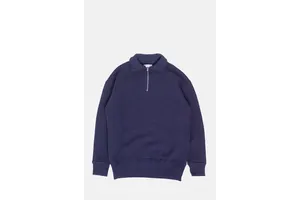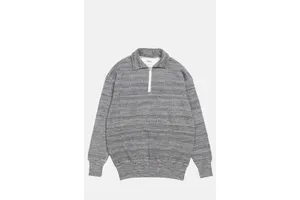
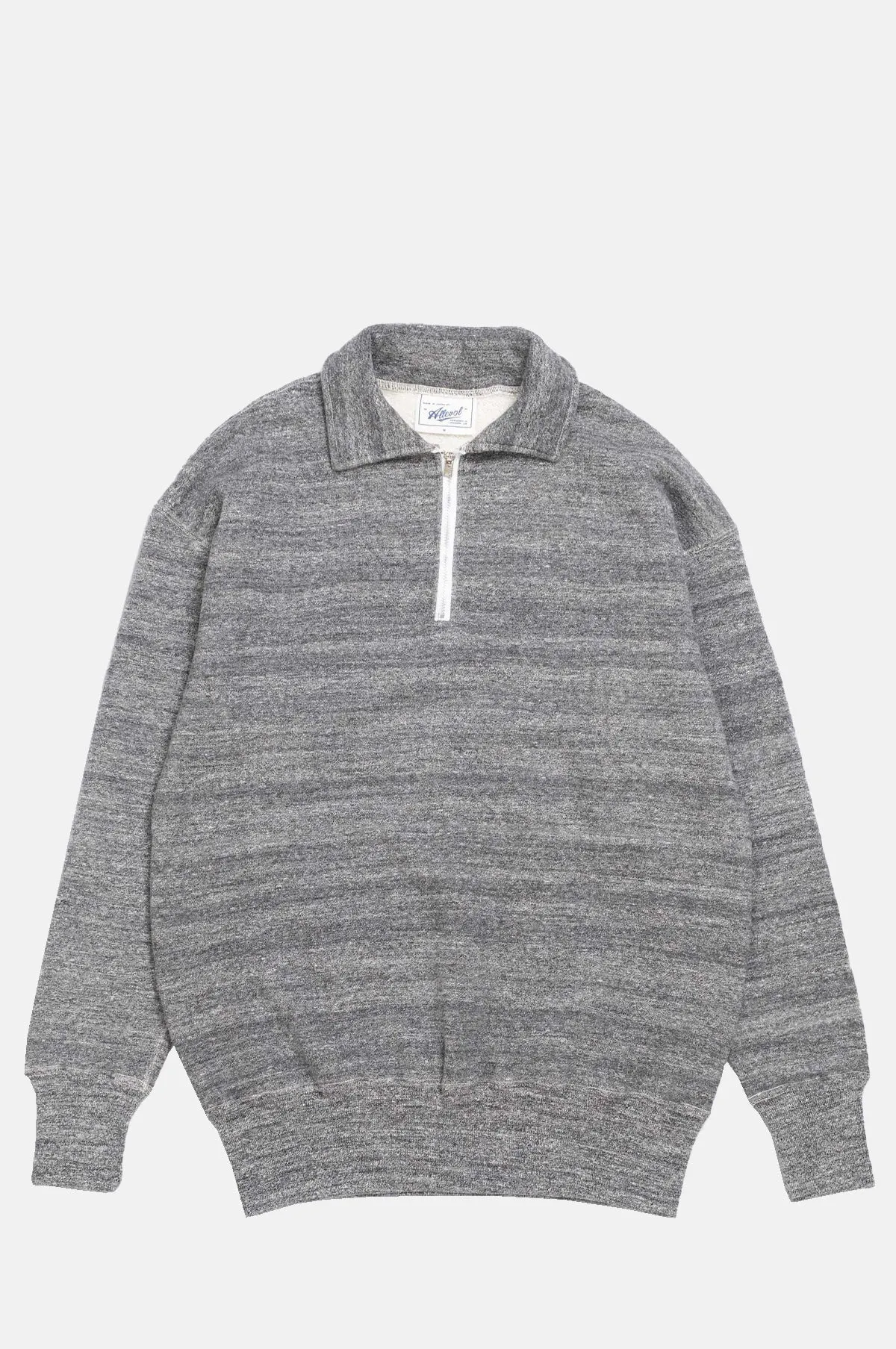

The Loopwheel Quarter Zip Sweatshirt in Dark Grey from Allevol, and the run should begin by saying what makes this one different from everything else it has met, which is that it has a control. It is worth then stating what the control is: the same house published an easy sweatshirt last batch in three colours at 160, and this is the same house, the same fibre, the same machines and the same region, at 195. It is worth then stating the difference, which is 35, and it is worth then stating what the page names as the cause, which is a zipper, and it is worth then stating that it names the make of the zipper, which is Waldes, and the type, which is a half-lock. It is worth then stating what the run should now say: this is the cleanest natural experiment it has had, because everything else is held constant and the only named difference is the hardware. It is worth then stating the second thing, which is a label. It is worth then stating that the easy sweatshirt measured its sleeve as pit to cuff, and it is worth then stating that this one measures it simply as sleeve, and it is worth then stating why: the easy was raglan and this is dropped shoulder, and a raglan has no shoulder seam to measure from. It is worth then stating what that proves, which is that the measurement set tracks the construction within a single house, and it is worth then stating that this is stronger evidence than last batch, because last batch it had only one garment and now it has two. It is worth then stating the third thing, which is the oddest numbers this run has seen. It is worth then stating that the chart gives 19.3, 20.8, 24.4 and 27.3, and it is worth then stating that no one chooses 19.3 inches on purpose, and it is worth then stating what they are, which are conversions from centimetres, and it is worth then stating the proof, which is that 24.4 inches is exactly 62 centimetres. It is worth then stating what the run should now carry: the way to find a house that measures in centimetres is not to look for a centimetre column but to look for decimal inches that are not clean in inches. The reference is the Loopwheel Quarter Zip Sweatshirt. Dongguan Bafinasa Garments Co., Ltd. develops comparable knit fleece on OEM and ODM terms, from fabric and trim development to retail or FBA ready packing. We publish this as a development reference and build your own version of it, and we do not supply the branded original or reproduce anyone else's label.
Key Features
- 195 against 160 for the same house's easy sweatshirt, and the difference is named: a Waldes half-lock zipper. See the note below
- The cleanest natural experiment in this run: same house, same fibre, same machines, same region, and only the hardware differs
- The sleeve is labelled sleeve and not pit to cuff, because this is dropped shoulder and not raglan. See the note below
- Proof that the measurement set tracks the construction within one house, on two garments and not one
- The chart is in decimal inches, which means it was converted from centimetres. See the note below
- Seamless side construction, so no side seams, knitted on loopwheel machines in Wakayama
- Machine wash 30, wash inside out, do not tumble dry, iron low
Customisable Options
- Fabric: a loopwheel cotton fleece to the reference with the weight in grams per square metre stated, or a conventional circular knit fleece, or a French terry, each quoted separately
- Construction: seamless side to the reference, or a conventional cut and sew body with side seams, each quoted separately
- Shoulder: dropped to the reference with the sleeve measured from a stated point, or raglan with the sleeve measured pit to cuff, or set-in with the shoulder measured and the sleeve taken from the shoulder seam, each quoted separately
- Zip: a named half-lock zipper to the reference, or a generic coil zip, or a metal zip, each quoted separately with the make, the type and the gauge named
- Weight: a mid-weight to the reference with the number stated, because the house uses the word on the other garment and should give the figure here
- Units: the chart published in the units it was measured in, and not converted after measuring. See the note below
- Composition with every share stated and summing to one hundred and published as its own field, the fabric weight in grams per square metre, the yarn count and the knitting machine gauge, the construction stated as seamless or cut and sew, the shoulder construction named with the sleeve measurement point stated to match it, the zipper make and type named with the gauge, the collar shape and depth, the chest with the flat or round method stated and the measurement point given, the sleeve with the method named and matched to the shoulder construction, the back length with the measurement point stated, a stated grade per row, a statement of which sizes share a measurement, the rib depth at the cuff and hem, the neck binding width, an order of preference for cleaning with the washing temperature as a number, a drying method rather than a prohibition, ironing and storage guidance, a stated tolerance on every measurement with rounding that matches it, shrinkage figures for both length and width, a pilling grade tested after a stated number of cycles, colour fastness to washing, rubbing, light and perspiration, zipper cycle testing to a stated number of cycles, a stock line for every size, size set, colour development, private label and care labelling
Specifications
| Style | Loopwheel cotton quarter zip sweatshirt, seamless side construction, boxy silhouette with dropped shoulders, a shaped collar, ribbed cuffs and hem |
| Reference | Allevol, Loopwheel Quarter Zip Sweatshirt, colour Dark Grey, sizes S to XXL |
| Pair | Published beside the same house's Easy Sweatshirt, so the run can compare across two names |
| Compared Within House | Two garment names, and this is the first such comparison in this run. See the note below |
| Unit | Inches, stated in every row label, and the figures are decimal |
| Units Compared | Decimal here and whole or half on the easy sweatshirt, so the two garments were measured in different units. See the note below |
| Column Count | Three, against five sizes on offer |
| Sizes Offered | S, M, L, XL and XXL, five sizes |
| Stock Compared | Five of five, and nothing is missing |
| Size Conversion | Not stated, the sizes given as letters only |
| Composition | 100% cotton, as stated in the bullets and in a tab |
| Composition Sum | One hundred, and it sums correctly |
| Fabric | Loopwheel fabric, as stated in the bullets, and loopwheel is a machine and not a fibre |
| Fabric Weight | Not stated, and the run should note the other garment used the word mid-weight and this one says nothing at all. See the note below |
| Knit Tension | Low-tension, as stated in the prose, and the run should note this is a property of the knitting and not of the yarn |
| Texture Word | Exceptionally soft, as stated in the prose, and there is no number behind it |
| Construction | Seamless side construction, as stated in the bullets and the prose, the same as the easy sweatshirt |
| Machine Gauge | Not stated |
| Yarn Count | Not stated |
| Shoulder | Dropped, as stated in the bullets and the prose, and NOT raglan as on the easy sweatshirt. See the note below |
| Shoulder Compared | Dropped here and raglan on the easy, so the two garments are built differently |
| Silhouette Word | Boxy, as stated in the bullets, and the easy sweatshirt said easy. See the note below |
| Period Reference | 1950s-style, as stated in the bullets, and mid-century American sportswear in the prose |
| Zip | A Waldes half-lock zipper, as stated in the bullets and the prose, and it is the only named piece of hardware in this run. See the note below |
| Zip Gauge | Not stated |
| Collar | Elegantly shaped collar, as stated in the prose, with no shape, depth or height given |
| Neck | Not stated, so no binding width and no collar height |
| Cuffs and Hem | Ribbed, as stated in the bullets, with no rib depth given |
| Pockets | None stated |
| Chest | Pit to pit 19.3, 20.8, 22.5, 23 and 25 in, or 38.6, 41.6, 45, 46 and 50 in around |
| Chest Row Label | Pit to pit, and no flat or round method is stated alongside it |
| Chest Grading | 1.5, 1.7, 0.5 and 2 in, so not uniform, and the run should note the last step is four times the one before it. See the note below |
| Ease at the Chest | Plus 1.6 in on the smallest rising to plus 5 in on the largest, so it widens. See the note below |
| Sleeve Measurement | Sleeve 21.3, 22, 22.8, 23.3 and 23.5 in |
| Sleeve Row Label | Sleeve, and not pit to cuff, and the change follows the change of shoulder. See the note below |
| Sleeve Measurement Point | Not stated, and the run should note neither garment gives one |
| Sleeve Grading | 0.7, 0.8, 0.5 and 0.2 in, so not uniform |
| Shoulder Measured | Not measured, and on a dropped shoulder the run should say the shoulder point is not where a set-in one is |
| Total Length | 24.4, 26, 26.8, 27.3 and 28 in, and the steps are 1.6, 0.8, 0.5 and 0.7 in |
| Length Measurement Point | Not stated |
| Ladder Uniformity | None of the three rows is uniform, and the same is true of the easy sweatshirt. See the note below |
| Chart Compared To Easy | Different at every size, so one name one chart does not extend to one house one chart. See the note below |
| Care | Machine wash 30, wash inside out, do not tumble dry, iron low, as stated in a tab |
| Second Cleaning Method | None given |
| Washing Temperature | 30, as a number |
| Drying | Do not tumble dry, so a prohibition and not a method. See the note below |
| Ironing | Iron low, a method with a level |
| Storage | Not stated |
| Production | Made in Japan, as stated in a tab, and Wakayama as stated in the bullets |
| Region | Wakayama, and it is the place for loopwheel knitting, so the region carries information |
| Posture | Mid-century American sportswear, meticulously produced, authentic vintage hardware, relaxed and timeless |
| Tags | Sweatshirts and zoom, the same as the easy sweatshirt, so consistent across two garment names. See the note below |
| Bullet List | Six, against eight on the easy sweatshirt, and there is no colour bullet at all. See the note below |
| Grammar Error | None, and the easy sweatshirt carried one, so the copy is per garment and not per house. See the note below |
| Measurements Published | Pit to pit, sleeve and length for all five sizes |
| Photographs | Four files listed, and the run reports files and not pictures |
| Upload Stamps | A range of one second across four files, and about 37 seconds after the navy of the easy sweatshirt |
| Style Number | 500 CTN GRY in the last tab, and it is the SAME STRING as the easy sweatshirt dark grey. See the note below |
| Style Number Compared | Identical to a different garment, so the shared part is not a style token. See the note below |
| Reference Retail | 195 GBP as listed, against 160 for the easy sweatshirt, quoted to show the price band this sits in, not as our price |
| Category | Filed by the reference under sweatshirts, the same tag on both garment names |
| Occasion | Everyday, weekends, layering over a tee or a shirt, autumn through spring |
| MOQ | 100 pcs per style per colourway, mixed sizes and colourways accepted |
| Sampling | 7-10 days after tech pack or reference sample confirmation |
| Bulk Lead Time | 20-30 days after sample approval and deposit |
| Service | OEM / DDM / private label, loopwheel and circular knit fleece sourcing with the weight in grams per square metre, the yarn count and the machine gauge stated, seamless and cut and sew construction, dropped shoulder, raglan and set-in development with the sleeve measurement method named and matched to the shoulder construction, named zipper sourcing with the make, type and gauge stated and cycle tested, collar shaping with the depth and height given, grading with a stated grade per row and a statement of which sizes share a measurement, charts published in the units they were measured in and not converted after measuring, an order of preference for cleaning with the washing temperature as a number and a drying method rather than a prohibition, ironing and storage guidance, a stated tolerance on every measurement with rounding that matches it, shrinkage figures for both length and width, a pilling grade tested after a stated number of cycles, colour fastness to washing, rubbing, light and perspiration, zipper cycle testing to a stated number of cycles, a stock line for every size, size set, colour development, private label and care labelling, retail or FBA ready packing |
Size Chart as Published by the Reference
| Size | Pit To Pit (inches) | Sleeve (inches) | Length (inches) |
|---|---|---|---|
| S | 19.3 in | 21.3 in | 24.4 in |
| M | 20.8 in | 22 in | 26 in |
| L | 22.5 in | 22.8 in | 26.8 in |
| XL | 23 in | 23.3 in | 27.3 in |
| XXL | 25 in | 23.5 in | 28 in |
The chest figures are flat half measures, doubling to 38.6, 41.6, 45, 46 and 50 in around, against men's bodies of roughly 37 to 45 in at the chest, which is about 1.6 in of ease on the smallest and about 5 in on the largest. Note that the ease WIDENS here where it NARROWED on the easy sweatshirt, and note the reason: the flat step here averages 1.4 in, which is 2.8 in around, against a body step of 2 in, so the ease gains about 0.8 in per size. Note that the run can now state the rule it has been hunting for: the drift per size is twice the flat step minus the body step, and that rule predicts both this garment and the easy sweatshirt exactly. Note the sleeve row, which is labelled simply sleeve and not pit to cuff, and note that this follows the shoulder: a dropped shoulder has a shoulder point to measure from and a raglan does not. Note that no measurement point is given on either garment. Note that no row is uniform, and note that the run's hypothesis from last batch, that a tube knitted on a fixed cylinder cannot be graded continuously, is consistent with a second garment here. Note that the run's proposed table below steps length by 2 cm per size because that is what the template does, and note that the run does not endorse that here: the reference steps are 1.6, 0.8, 0.5 and 0.7 in, and none of them is 2 cm. Our proposal below publishes the fabric weight in grams per square metre, the yarn count and machine gauge, the shoulder construction with the sleeve measurement point matched to it, the zipper make, type and gauge, the collar depth, the back length measurement point, the rib depth and binding width, a stated grade per row, a statement of which sizes share a measurement, and a stated tolerance on every measurement.
Our Proposed Body Chart
| Size | Body Bust | Sleeve | Body Waist | Body Hips | Length | Source |
|---|---|---|---|---|---|---|
| S | 37 in / 94 cm | 54 cm | 31 in / 79 cm | 37 in / 94 cm | 62 cm / 24.4 in | Our proposal |
| M | 39 in / 99 cm | 55 cm | 33 in / 84 cm | 39 in / 99 cm | 64 cm / 25.2 in | Our proposal |
| L | 41 in / 104 cm | 56 cm | 35 in / 89 cm | 41 in / 104 cm | 66 cm / 26 in | Our proposal |
| XL | 43 in / 109 cm | 57 cm | 37 in / 94 cm | 43 in / 109 cm | 68 cm / 26.8 in | Our proposal |
| XXL | 45 in / 114 cm | 58 cm | 39 in / 99 cm | 45 in / 114 cm | 70 cm / 27.6 in | Our proposal |
Occasions and Styling
Suits everyday wear, weekends and layering over a tee or a shirt, autumn through spring. A quarter zip lets the neck open or closed, and the dropped shoulder and boxy body leave room for a shirt underneath.
Production and Quality Control
The reference publishes three measurements for all five sizes, states a single fibre that sums to one hundred, names its machine, its construction, its shoulder, its zipper make and type, its collar and its cuffs and hem, gives four care instructions including a washing temperature as a number, names its country and its region, carries six bullets and gives a code. It gives no fabric weight, no yarn count and no machine gauge, no sleeve measurement point although it changed the sleeve label to match the shoulder, no collar depth or height, no zipper gauge, no measurement point for any row, no rib depth, no tolerance on any measurement, no statement of which sizes share a measurement, no drying method, no model, no size conversion, no shrinkage figure, no pilling grade, no colour fastness figure and no zipper cycle test, and no statement of whether the chest figure is flat or round. Three things follow: the price difference is explained and named; the measurement set tracks the construction within one house; and the chart was converted from centimetres after measuring.
Thirty five, and that is the first thing, and it is worth saying why this number is worth more than any other price difference this run has met. It is worth then stating what the run usually has, which is two prices that differ and nothing held constant, and it is worth then stating what it has here: one house, one fibre, one machine, one region, one construction, and one named piece of hardware different. It is worth then stating the difference, which is 35 against 160, and it is worth then stating what the page names, which is a Waldes half-lock zipper, and it is worth then stating that it names the make and the type and not merely the word zip. It is worth then stating what the run should now record: this is the third time a price difference has come with a named attribute, and the first time the attribute is hardware rather than a finish or a process, and it is worth then stating the cleaner form of the instrument: when everything else is held constant, look for the named difference, because this house gives one every time. It is worth then stating the second thing, which is a label. It is worth then stating that the easy sweatshirt measured pit to cuff and this one measures sleeve, and it is worth then stating what changed between them, which is the shoulder: raglan on one, dropped on the other. It is worth then stating why that decides the label, which is that a raglan sleeve has no shoulder seam and a dropped shoulder does, and it is worth then stating what this proves that last batch could not: the measurement set is chosen per garment from its construction, and it is a practice of this house and not a coincidence of one garment.
Nineteen point three, and that is the second thing, and it is worth saying what a decimal inch tells you. It is worth then stating the figures, which are 19.3, 20.8, 22.5, 23 and 25, and it is worth then stating that every other chart in this run has been in whole or half inches, and it is worth then stating that no one chooses 19.3 inches on purpose. It is worth then stating what they are, which are conversions from centimetres, and it is worth then stating the proof, which is that 24.4 inches is exactly 62 centimetres and 26.8 is 68. It is worth then stating what the run has been looking for, which is a house that measures in centimetres, and it is worth then stating the instrument it should now carry: do not look for a centimetre column, look for decimal inches that are not clean in inches, because a converted chart gives itself away in the digits. It is worth then stating the consequence, which is that this house measured in centimetres and then converted for the shop, and it is worth then stating what that cost: a chart whose steps make no sense in either unit. It is worth then stating the third thing, which is what the run got wrong. It is worth then stating that the last tab here reads 500 CTN GRY, and it is worth then stating that the easy sweatshirt in dark grey reads 500 CTN GRY too, and it is worth then stating that those are two different garments. It is worth then stating what that does to the instrument it built last batch, which read the shared leading part as the style and the differing trailing part as the colourway, and it is worth then stating the verdict: the leading part does not identify the garment at all, and the run cannot say what it does identify. It is worth then stating the rule it should now carry: a token is only shown to be a style token once it has been seen to differ between two garments, and it is worth then stating what follows, which is that every style reading this run made from a shared token is unconfirmed until it differs. It is worth then stating the last thing, which is smaller: last batch this house's easy sweatshirt carried a grammatical error on all three of its colourways and the run wondered whether the boilerplate spanned the house, and this garment carries none of it and is written differently throughout, so the unit of copying is the garment and its colourways and not the house.
Optional upgrades include the fabric weight in grams per square metre, the yarn count and the knitting machine gauge, the shoulder construction named with the sleeve measurement point matched to it, the zipper make, type and gauge with cycle testing to a stated number of cycles, the collar depth and height, the rib depth at the cuff and hem, the chart published in the units it was measured in rather than converted after measuring, a stated grade per row, a statement of which sizes share a measurement, a drying method rather than a prohibition, a stated tolerance on every measurement with rounding that matches it, shrinkage figures for both length and width, a pilling grade tested after a stated number of cycles, colour fastness to washing, rubbing, light and perspiration, further colourways, size set, private label and care labelling.
Pre-production sample approval, in-line inspection during cutting and sewing, and a final AQL inspection before packing, with measurement reports and photos shared before shipment.
Send us your tech pack, a photo or a reference garment and we will quote within 24 hours. Contact bafinasa@bafinasa.com or WhatsApp +86 13827222469.