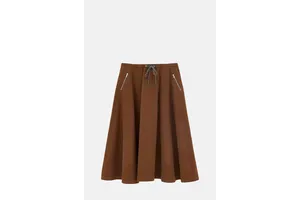
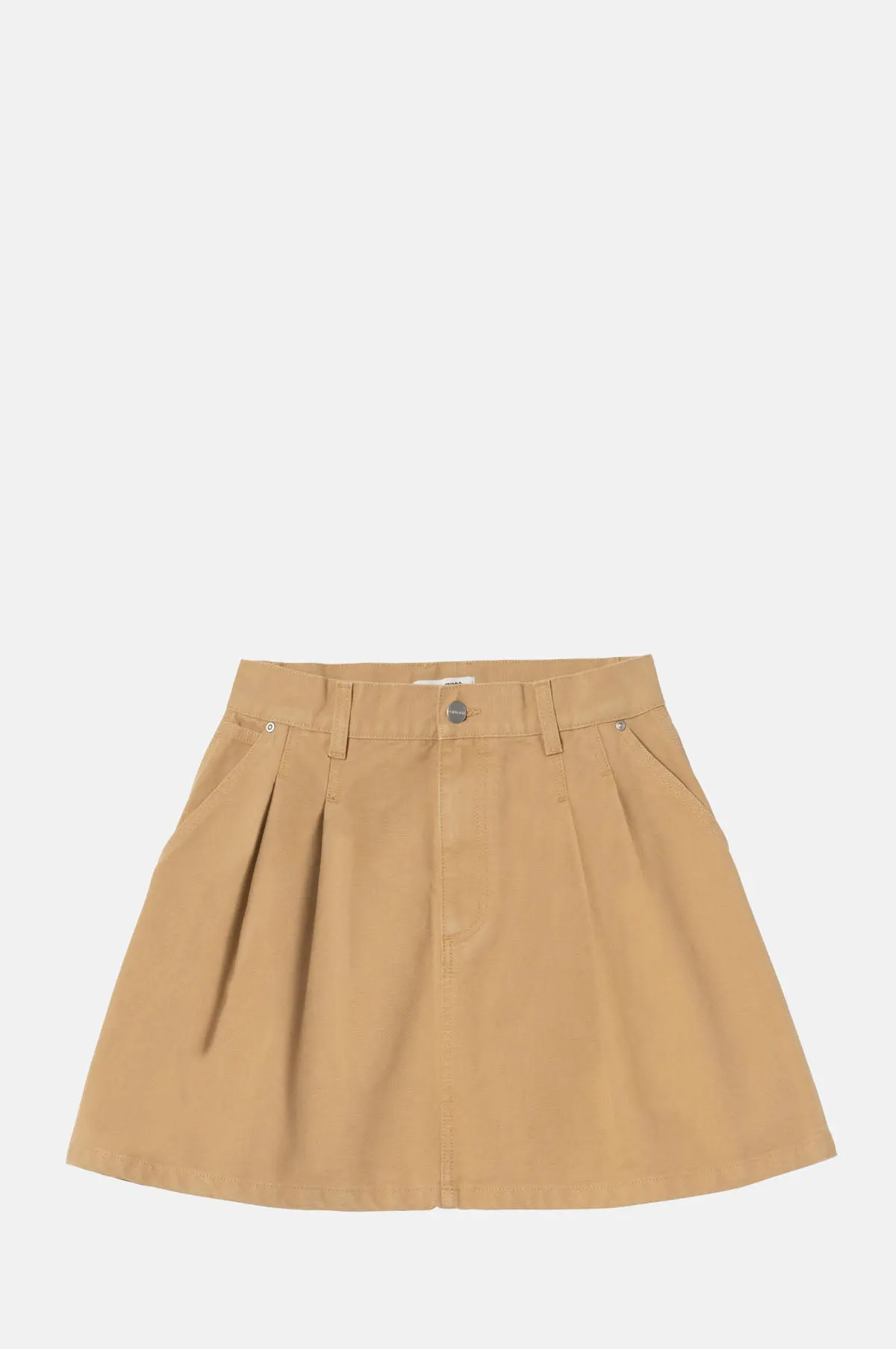

The Women's Billie Single Knee Skirt from Carhartt WIP, a functional interpretation of the brand's classic utility trousers, cut from durable heavyweight Dearborn Canvas in a stonewashed dusty brown, with a high-waist silhouette, structural double front pleats, a hammer loop, reinforced back pockets and bartack stitching at stress points, listed at 85 GBP with two of four sizes in stock. It is worth beginning with the waist, because the run needs to correct something it said two batches ago. The waist runs 34, 36, 40 and 42 centimetres, so the steps are two, four and two: the middle step is twice the size of the two either side of it. And the total length runs 40, 41, 42 and 43, stepping one, one and one, which is perfect. It is worth being explicit about why that matters, because it undoes a conclusion. Two batches ago this run measured a pair of jeans whose waist graded perfectly at two centimetres for seven steps out of seven, while its inseam froze for five sizes, and concluded that the waist is the column brands look after and the lengths are the ones they leave alone. Here it is the other way round, in the same garment family: the length is perfect and the waist is not. So that conclusion was a coincidence of the sample and not a rule, and the run withdraws it. It is worth then saying what the waist figures do get right, which is more interesting than the irregularity. Averaged over the range, the waist grades about 2.67 centimetres per size, and an extra small to large scale needs about 2.54. So the overall span is correct to within about a third of an inch. The total is right and the steps are wrong. It is worth closing on the cloth, because at 85 pounds this is the cheapest garment in several batches and it specifies more than most garments three times its price. The reference is the Billie Single Knee Skirt. Dongguan Bafinasa Garments Co., Ltd. develops comparable skirts on OEM and ODM terms, from canvas and wash development to retail or FBA ready packing. We publish this as a development reference and build your own version of it, and we do not supply the branded original or reproduce anyone else's label.
Key Features
- A total length graded perfectly at 1 cm per size, while the waist steps 2, 4 and 2 cm. See the note below
- A waist span that is correct to within about a third of an inch, with the steps inside it wrong. See the note below
- Heavyweight Dearborn Canvas as stated, a named cloth with a weight word and no figure. See the note below
- Structural double front pleats as stated, with no hip measurement to size them against. See the note below
- A zip-fly and button closure as stated, the most precise closure entry in this run. See the note below
- A two part composition panel covering the shell and the pocket lining separately. See the note below
- Machine washable up to 40 degrees, a number rather than a word. See the note below
Customisable Options
- Cloth: a heavyweight Dearborn Canvas to the reference, with the weight in ounces and grams per square metre stated, or a conventional cotton canvas, or an organic cotton canvas, or a cotton and polyester canvas, or a ripstop, or a twill, each quoted separately
- Finish: a stonewashed finish in the dusty brown shade to the reference, with the recipe and the number of cycles stated, or a garment dyed finish, or a raw unwashed canvas, or an enzyme wash, each quoted separately
- Waist: a high waist with double front pleats to the reference, with the waist and hip both measured and graded, or a mid waist, or a flat front with no pleats, or a single pleat, or box pleats, each quoted separately
- Closure: a zip-fly and button closure to the reference, with the zip length and the button count and size stated, or a button fly, or a side zip, or an exposed button placket, each quoted separately
- Details: a utility hammer loop, reinforced back pockets and bartack stitching at stress points to the reference, with the number and location of the bartacks stated, or without the hammer loop, or with a utility pocket, or with a tool pocket, each quoted separately
- Lining: a polyester and cotton pocket lining to the reference, with the composition and weight stated, or a cotton pocket lining, or a self fabric pocket lining, each quoted separately
- Cloth weight, wash recipe and cycle count, waist and hip measurements, rise, pleat depth and count, zip length, button count and size, bartack count and location, pocket dimensions, shrinkage figures, size set, colour development, private label and care labelling
Specifications
| Style | High waist utility skirt in heavyweight canvas with double front pleats, a zip fly, a hammer loop and bartack stitching |
| Reference | Carhartt WIP, Billie Single Knee Skirt, colour WIP Dusty H, style I037094 - 3TF.06, sizes XS to L |
| Composition | Shell 100% cotton, and pocket lining 65% polyester and 35% cotton, both as stated. See the note below |
| Yarn Count | Not stated |
| Weave | Canvas as implied by the cloth name, with no weave entry given |
| Cloth Weight | Heavyweight as stated, with no figure given. See the note below |
| Cloth Name | Dearborn Canvas as stated, a named house cloth |
| Handle | Durable as stated, with no weight and no finish figure given |
| Finish | Stonewashed as stated, in a warm dusty brown shade, with no recipe and no number of cycles given |
| Fit Word | High-waist silhouette as stated in the description and the bullets |
| Fit Statement | A functional interpretation of the brand's classic utility trousers, as stated |
| Sizes Offered | XS, S, M and L, four sizes, with XS and L in stock at the time of writing |
| Size Conversion | None published |
| Model | None published |
| Length | Not stated as a word, and 40 to 43 cm. See the note below |
| Waist | High waist as stated in the description and the bullets, with double front pleats as stated, measured at 34 to 42 cm. See the note below |
| Pleats | Structural double front pleats as stated, with no pleat depth and no pleat count given. See the note below |
| Closure | Zip-fly and button closure as stated, with no zip length, no button count and no button size given. See the note below |
| Pockets | Front and reinforced back pockets as stated, with no count and no dimensions given. See the note below |
| Details | Utility hammer loop detail and bartack stitching at vital stress points as stated, with no count and no location given for the bartacks. See the note below |
| Label | Woven Carhartt WIP square label at the reverse as stated |
| Hip | Not measured |
| Hem Circumference | Not measured |
| Care | Machine washable up to 40 degrees C, as stated. See the note below |
| Certification | None named |
| Bullet List | Seven bullets |
| Measurements Published | Waist and total length for all four sizes. See the note below |
| Published Waist | 34, 36, 40 and 42 cm, stepping 2, 4 and 2 cm. See the note below |
| Waist Around | 68, 72, 80 and 84 cm, or 26.77, 28.35, 31.50 and 33.07 in. See the note below |
| True Waist Grade | About 2.67 cm of flat measure per size on average, against about 2.54 cm needed on an XS to L scale. See the note below |
| Ease at the Waist | About 1.8 in at an XS, 1.4 in at an S, 2.5 in at an M and 2.1 in at an L. See the note below |
| Published Total Length | 40, 41, 42 and 43 cm, stepping exactly 1 cm at every step. See the note below |
| Hip | Not measured |
| Cloth Weight | Not stated |
| Photographs | Two |
| Production | Made in Tunisia as stated, with no certification named |
| Reference Retail | 85 GBP as listed, quoted to show the price band this sits in, not as our price |
| Category | Filed by the reference under skirts |
| Occasion | Everyday, casual, workwear, weekend |
| MOQ | 100 pcs per style per colourway, mixed sizes and colourways accepted |
| Sampling | 7-10 days after tech pack or reference sample confirmation |
| Bulk Lead Time | 20-30 days after sample approval and deposit |
| Service | OEM / ODM / private label, cotton canvas sourcing by weight in ounces and grams per square metre, stonewash and garment dye development with the recipe set, high waist pleated skirt blocks with the waist and hip both graded, utility detail development with the hammer loop and bartack placement set, retail or FBA ready packing |
Size Chart as Published by the Reference
| Size | Waist (cm) | Total Length (cm) |
|---|---|---|
| XS | 34 cm | 40 cm |
| S | 36 cm | 41 cm |
| M | 40 cm | 42 cm |
| L | 42 cm | 43 cm |
The waist figures are flat half measures taken with the skirt laid down, doubling to 68, 72, 80 and 84 cm around, or 26.77 to 33.07 in. Against bodies of roughly 25 to 31 in, the ease runs about 1.8 in at an XS, 1.4 in at an S, 2.5 in at an M and 2.1 in at an L. The waist steps 2, 4 and 2 cm, so the middle step is twice the size of the two either side of it, but averaged over the range the grade is about 2.67 cm per size against about 2.54 cm needed, so the overall span is right and only the steps are wrong. The total length steps a clean 1 cm at every step. No hip and no hem circumference is published, which matters on a skirt with double front pleats, because the pleats have to cover the hip.
Our Proposed Body Chart
| Size | Body Bust | Body Waist | Body Hips | Length | Source |
|---|---|---|---|---|---|
| XS | 31 in / 79 cm | 25 in / 64 cm | 35 in / 89 cm | 40 cm / 15.7 in | Our proposal |
| S | 34 in / 86 cm | 27 in / 69 cm | 37 in / 94 cm | 42 cm / 16.5 in | Our proposal |
| M | 37 in / 94 cm | 29 in / 74 cm | 39 in / 99 cm | 44 cm / 17.3 in | Our proposal |
| L | 40 in / 102 cm | 31 in / 79 cm | 41 in / 104 cm | 46 cm / 18.1 in | Our proposal |
Occasions and Styling
Suits everyday, casual and weekend wear. A high waist canvas utility skirt works with a tee or a knit from early autumn and takes the same treatment as a workwear trouser.
Production and Quality Control
The reference publishes two measurements for all four sizes, grades its total length perfectly, names its cloth, names its finish, names its waist height and its pleats, gives the most precise closure entry in this run, names and locates its pockets, names two construction details, gives a two part composition panel covering the shell and the pocket lining separately, states its care with a number, states the country of manufacture and names the style number, and carries seven bullets. It gives no cloth weight, no hip, no hem circumference, no pleat depth, no zip length, no button count or size, no pocket count or dimensions, no bartack count or location, no shrinkage figure, no size conversion, no model and no certification, and its waist grading is irregular. Three things follow: a column that is right overall and wrong step by step, a correction to something this run concluded two batches ago, and a garment at 85 pounds that specifies more than most garments at three times the price.
Two, four, two, and that is the first thing, and it is worth saying what it overturns before what it shows. Two batches ago this run measured a pair of jeans from another brand whose waist graded at exactly two centimetres for seven steps out of seven, while the same garment's inseam sat frozen at one figure for five sizes running. From that and from a scattering of similar cases the run concluded that the waist is the measurement brands take care of and the lengths are the ones they leave to look after themselves. This garment says the opposite. Its total length runs forty, forty one, forty two and forty three centimetres, stepping one centimetre at every step, which is as clean as any column this run has measured. And its waist runs thirty four, thirty six, forty and forty two, stepping two, four and two. So on a skirt from the same garment family, the length is perfect and the waist is not, and the run withdraws the earlier claim. It is worth being careful about what that means, because it is not that the earlier observation was wrong. It is that it was one sample, and this run has been treating single samples as house rules all along, and has now been caught doing it twice in three batches: last batch two garments from one brand froze a sleeve while disagreeing about a length, and this batch corrects a rule the run inferred from one pair of jeans. The honest position is that these decisions are made garment by garment and brand by brand in no pattern the run can detect from outside. It is worth then asking what, if anything, the waist gets right, because the answer is more interesting than the irregularity. Averaged across the four sizes the waist grows eight centimetres over three steps, which is about two point six seven centimetres a size, and an extra small to large scale needs about two point five four. So the span from the smallest to the largest is correct to within about a third of an inch, and measured end to end the ease runs from about one point eight inches to about two point one, which is nearly flat. It is worth then saying what that shape costs, because it is a kind of error this run has not named before. The total is right and the steps inside it are wrong. A customer who buys the extra small and a customer who buys the large each get approximately the size they should get. A customer in the middle does not: an even grade would put the small at about thirty six point seven and the medium at about thirty nine point three, so the small is about two thirds of a centimetre tight and the medium about two thirds of a centimetre loose, which is roughly half an inch at the waistband each way and in opposite directions. It is worth adding the practical weight of that, because the cloth is named as heavyweight and the composition is one hundred per cent cotton with no stretch. The smallest ease on this chart is about one point four inches, at the small, and one point four inches of ease at the waistband of a heavy rigid canvas is a snug waistband.
No hip, and that is the second thing, and it is worth saying why it is worse here than on the other garments in this run that have omitted it. The bullets say high waist with double front pleats, and the description calls them structural. Pleats are volume: they exist to let a skirt sit over the hip while the waistband stays close. So the two measurements this skirt needs are the waist, which it gives, and the hip, which it does not. It is worth then setting that beside the pattern this run has been recording for some batches now, because it is the same pattern wearing a different garment each time. A dress has pintucks down the bodice and no measurement at the waist they shape. A dress has a twisted bodice and no circumference at the twist. A dress has an empire seam and underbust seams and no measurement under the bust. Now a skirt has structural pleats and no hip for them to cover. The rule is that the structure gets named and the circumference it exists to accommodate does not. It is worth adding that this batch contains three bottoms and not one of the three measures the hip, which is worth saying as a batch level fact because skirts and trousers are the two garment types where the hip decides whether the thing fits at all. It is worth then giving this page its due on the closure, because it is the best in the run. The bullets say zip-fly and button closure. That is not a closure, it is two, and it says which is which: a zip to do up and a button to hold it. Almost every other garment in this run says button closure or concealed zip and leaves it there. It is worth then noting the two things this page does that are rare and worth naming. The composition panel has two lines: a shell of one hundred per cent cotton, and a pocket lining of sixty five per cent polyester and thirty five per cent cotton. So the pockets are declared, and the garment is not one hundred per cent cotton where the pocket bags sit, and a customer is told. And the care label says machine washable up to forty degrees, which is a number. This run has recorded cold as a word on garment after garment, and thirty degrees on one tee, and forty degrees is the highest figure yet, and it is on the cheapest garment in the batch. It is worth finally noting what is still missing from that label, because it matters on this cloth more than most: there is no shrinkage figure and no drying instruction, and a heavyweight cotton canvas that is stonewashed can still move, and the skirt is only forty to forty three centimetres long, so a few per cent is a visible change at the hem.
Dearborn, and that is the third thing, and it is worth saying what it does and does not do. The bullets say heavyweight Dearborn Canvas. Dearborn Canvas is a named house cloth, which is more than almost any garment in this run offers: this run has read hundreds of pages where the cloth is called a fabric or nothing at all. Heavyweight is a weight word, and it tells you which end of the range the cloth sits at, and it is not a number. It is worth then setting that beside the price, because the comparison is now five batches old and still holds. The cheapest garment in this run to specify its cloth properly was a pair of jeans at a hundred and five pounds whose bullet read one hundred per cent cotton, quote, Smith Denim, unquote, thirteen point five ounces. That is a fibre, a named cloth and a weight, and it remains the only complete cloth specification this run has met. This skirt at eighty five pounds gives a named cloth and a weight word and no number. And in this same batch there is a skirt at two hundred and seventy five pounds whose bullets are four lines long, whose cloth is never named at all, and which carries a single photograph. It is worth adding that Carhartt is now two for two on naming its cloth in this run, and one for two on giving a number, so even the brand that does this best is intermittent about the figure. It is worth then closing on the two smaller things, both of which this page does well and incompletely. The pockets are given as front and reinforced back pockets, which says where they are and that the back ones are strengthened, and gives no count and no dimensions. And the construction claim is bartack stitching at vital stress points for longevity, which is a durability claim that says where in general and not which points or how many. It is worth setting those beside the rest of the batch, because three garments in one batch describe pockets three ways and none completely: this one by location and reinforcement, another by count alone with no location, and a third not at all. Every bulk shipment gets a measurement report against your approved chart.
Optional upgrades include grading the waist evenly and publishing the hip, grading the hip across the sizes, publishing the hem circumference, the pleat depth and count, the zip length, the button count and size, the pocket count and dimensions and the bartack count and location, quoting the cloth weight in ounces and grams per square metre, giving the wash recipe and the number of cycles, adding a shrinkage figure and a drying instruction to the label, conventional, organic and cotton blend canvas, ripstop and twill, garment dyed, raw and enzyme wash finishes, mid waist, flat front, single pleat and box pleat options, button fly, side zip and exposed button plackets, utility and tool pockets, cotton and self fabric pocket linings, size set, colour development, private label, hangtag and care labelling.
Pre-production sample approval, in-line inspection during cutting and sewing, and a final AQL inspection before packing, with measurement reports and photos shared before shipment.
Send us your tech pack, a photo or a reference garment and we will quote within 24 hours. Contact bafinasa@bafinasa.com or WhatsApp +86 13827222469.