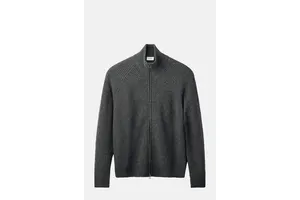
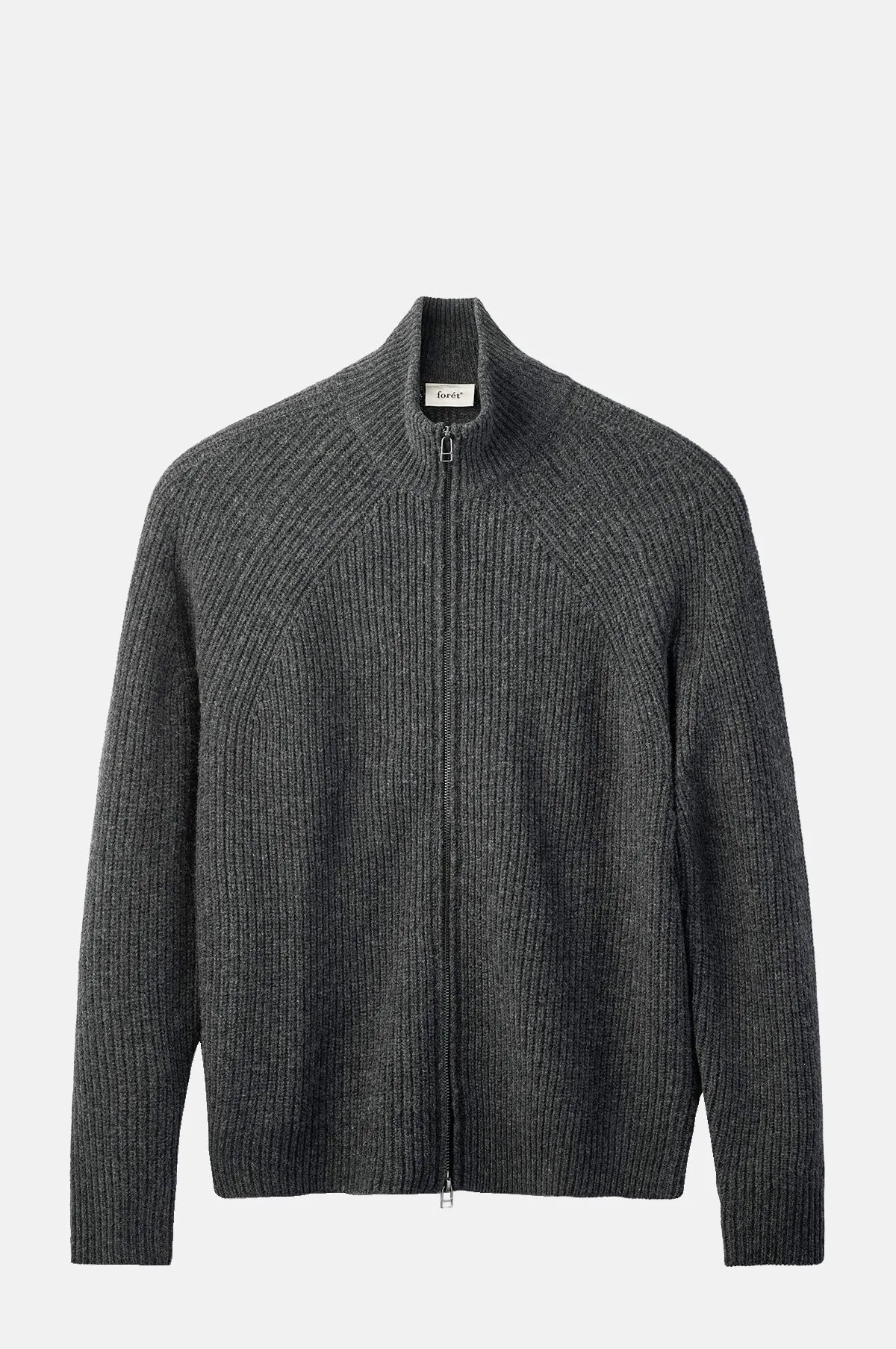

The Delta Wool Zip Jacket in Dark Grey Melange from Foret, a Danish house, crafted from 100% wool with a ribbed texture, a two way zip and a tonal embroidered logo on the cuff, listed at 210 GBP and in stock in all four sizes. It is worth beginning with the figures, because this is the first chart in the run whose unit the run can name. It is worth then reading the chest, which is 20.1, 20.9, 21.7 and 22.4 inches. It is worth then stating what no designer chooses, which is a grade of 0.787 inches. It is worth then stating what a designer does choose, which is two centimetres. It is worth then converting, which gives 51, 53, 55 and 57. It is worth then stating the result, which is a perfect whole-number series. It is worth then stating what the run has been doing with its centimetre test for a hundred batches, which is applying it and reporting that it does not take. It is worth then stating what happens here, which is that it takes, on two rows out of three. It is worth then stating what the third row is, which is a native one inch grade. The reference is the Delta Wool Zip Jacket. Dongguan Bafinasa Garments Co., Ltd. develops comparable knit outerwear on OEM and ODM terms, from fabric and trim development to retail or FBA ready packing. We publish this as a development reference and build your own version of it, and we do not supply the branded original or reproduce anyone else's label.
Key Features
- The first chart in the run whose unit the run can name: the chest and length are 2 cm grades converted to inches. See the note below
- Two units in one table, unreconciled, so a reader comparing the rows is comparing different things. See the note below
- A grade of 0.787 inches is not a grade anyone designs, and a grade of 2 centimetres is. See the note below
- The largest ease drift in the run, 1.4 inches across four sizes, and the run can now say why. See the note below
- The same fit word as garments with three times the ease, so the tag and the word are both choices. See the note below
- One fibre, and the prose agrees with the specification, which is the opposite of the five-fibre garment in this batch. See the note below
- 100% wool with no certifier and no micron count, so the easy number is given and the useful ones are not. See the note below
- A description that is two paragraphs about the house and one about the garment. See the note below
Customisable Options
- Yarn: 100% wool to the reference with the micron count and the yarn count stated, or a wool blend with every share stated and summing to one hundred, or a merino with the micron given, each quoted separately. See the note below
- Wool sourcing: a wool with a responsible standard named and the certifier and licence number given, or a recycled wool with both shares stated, each quoted separately
- Chart: one unit for the whole table, stated in the header, with the grade given as a whole number in that unit, and no row broken mid-way. See the note below
- Fit: a regular fit to the reference with the ease published for every size, or a fit that holds its ease across the range with the chest grade set to the body grade, each quoted separately. See the note below
- Care: an order of preference for cleaning with the temperature as a number, a drying instruction and not only a prohibition, and storage guidance with the reason
- Composition with every share stated and summing to one hundred, the fibre named to match the shares, the micron count and the yarn count for any wool, the knit gauge as stitches per inch, the fabric weight in grams per square metre, chest with the flat or round method stated and the unit stated, sleeve length with the sleeve type named and the measurement point stated, the back length with the measurement point stated, shoulder width, the collar height and rib depth, the cuff opening, the zip length, the pocket count and dimensions, an order of preference for cleaning, the temperature as a number, a drying instruction, shrinkage figures for both length and width, a pilling grade tested after a stated number of cycles, colour fastness to washing, rubbing and light, abrasion resistance, a stock line for every colourway, size set, colour development, private label and care labelling
Specifications
| Style | Regular fit zip jacket in a ribbed 100% wool knit with a two way zip and a tonal embroidered cuff logo |
| Reference | Foret, Delta Wool Zip Jacket, colour Dark Grey Melange, sizes S to XL |
| House Country | Danish, as stated in the prose, the first time a page states one. See the note below |
| Unit | Two units in one table, and the run can name which row is which. See the note below |
| Chest Unit | Centimetres, converted to inches to one decimal, and the test takes. See the note below |
| Sleeve Unit | Inches, native, a clean one inch grade. See the note below |
| Length Unit | Centimetres, converted to inches to one decimal. See the note below |
| Centimetre Test | Takes, for the first time in the run. See the note below |
| Composition | 100% Wool, as stated |
| Composition Places | The prose, the bullets and two tabs, four places, all agreeing. See the note below |
| Prose Against Specification | None, and there is one fibre. See the note below |
| Micron Count | Not stated |
| Yarn Count | Not stated |
| Knit Gauge | Not stated |
| Fabric Weight | Not stated, in any form |
| Certification | None named, and no responsible wool standard named. See the note below |
| Sustainability Claim | None, in the prose or anywhere else |
| Fit Word | Regular, as stated |
| Sizes Offered | S, M, L and XL, four sizes, all four in stock |
| Chart Columns | Four, against four sizes on offer, so the chart and the offer agree |
| Chart Rows | Three filled, and the length row is broken mid-way. See the note below |
| Size Conversion | Not stated, the sizes given as letters only |
| Model | Not given |
| Chest | Pit to pit 20.1, 20.9, 21.7 and 22.4 in, or 40.2 to 44.8 in around |
| Chest In Centimetres | 51, 53, 55 and 57 cm, half measures, a perfect series. See the note below |
| Chest Grade | 2 cm per size, three times, or 0.787 in. See the note below |
| Ease at the Chest | 3.2, 2.8, 2.4 and 1.8 in, and it falls. See the note below |
| Ease Drift | 1.4 in across the range, the largest in the run, and the run can say why. See the note below |
| Waist | Not measured |
| Shoulder | Not measured |
| Sleeve | 20, 21, 22 and 23 in, and the steps are 1 in three times |
| Sleeve Row Label | Sleeve, with no sleeve type and no measurement point stated |
| Total Length | 26, 26.8, 27.6 and 28.3 in |
| Length In Centimetres | 66, 68, 70 and 72 cm, a perfect 2 cm series. See the note below |
| Length Measurement Point | Not stated |
| Collar | Not described, with no collar height and no rib depth given |
| Closure | Two way zip, as stated, with no zip length given |
| Pockets | Not stated |
| Cuffs | Not described, with no cuff opening and no rib depth given |
| Care | Hand wash only, as stated, and it gives no temperature. See the note below |
| Drying | Not stated |
| Storage | Not stated |
| Bullet List | Three, covering the fibre, the fit and the closure |
| Measurements Published | Pit to pit, sleeve and length for all four sizes |
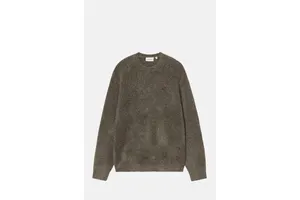
| Photographs | Two, the fewest in this batch, on the most expensive garment in it. See the note below |
| Production | Made in China as stated, and the yarn country is not given |
| Style Number | F7017, as stated, five characters, and no year. See the note below |
| Reference Retail | 210 GBP as listed, the most expensive garment in this batch, quoted to show the price band this sits in, not as our price |
| Category | Filed by the reference under knitwear although it is called a jacket. See the note below |
| Occasion | Everyday, layering, casual and smart casual, autumn and winter |
| MOQ | 100 pcs per style per colourway, mixed sizes and colourways accepted |
| Sampling | 7-10 days after tech pack or reference sample confirmation |
| Bulk Lead Time | 20-30 days after sample approval and deposit |
| Service | OEM / DDM / private label, wool, merino and wool blend sourcing with every share stated and summing to one hundred, the micron count and yarn count given, and a responsible wool standard named with its certifier and licence number, rib, plain and textured knit development with the gauge stated as stitches per inch, zip jacket, cardigan and bomber knit development with the zip length and pocket dimensions published, collar development with the collar height and rib depth given, one unit for a whole chart stated in the header and no row broken mid-way, chest grading set to the body grade if the fit is to hold across the range, an order of preference for cleaning with the temperature as a number, a drying instruction and not only a prohibition, storage guidance with the reason, shrinkage measured in both directions and published, a pilling grade tested after a stated number of cycles, colour fastness to washing, rubbing and light, abrasion resistance tested and published, a stock line for every colourway, size set, colour development, private label and care labelling, retail or FBA ready packing |
Size Chart as Published by the Reference
| Size | Pit to Pit (inches) | Sleeve (inches) | Length (inches) |
|---|---|---|---|
| S | 20.1 in | 20 in | 26 in |
| M | 20.9 in | 21 in | 26.8 in |
| L | 21.7 in | 22 in | 27.6 in |
| XL | 22.4 in | 23 in | 28.3 in |
The pit to pit figures are flat half measures, doubling to 40.2, 41.8, 43.4 and 44.8 in around. Against men's bodies of roughly 37 to 43 in at the chest, the ease falls from 3.2 in at the small to 1.8 in at the extra large. Note what that means, which is that the extra large is a closer-fitting garment than the small, and note what the page says about all four sizes, which is that they are all regular. Note why the ease falls, which the run can now state: the chest grades two centimetres, or 0.79 inches, and the body grades two inches, so the garment cannot keep up. Note what the run has worked out from this, which is that twice the chest grade minus the body grade gives the drift, and here that is minus 0.43 in per size. Note the unit, and note that it is the first time the run has been able to name one: the chest and the length are in centimetres and the sleeve is in inches. Note the length row, which is broken mid-way in the source. Our proposal below publishes one unit for the whole chart, the micron count, the measurement points, and the ease for every size.
Our Proposed Body Chart
| Size | Body Bust | Sleeve | Body Waist | Body Hips | Length | Source |
|---|---|---|---|---|---|---|
| S | 37 in / 94 cm | 51 cm | 31 in / 79 cm | 37 in / 94 cm | 66 cm / 26 in | Our proposal |
| M | 39 in / 99 cm | 52 cm | 33 in / 84 cm | 39 in / 99 cm | 68 cm / 26.8 in | Our proposal |
| L | 41 in / 104 cm | 53 cm | 35 in / 89 cm | 41 in / 104 cm | 70 cm / 27.6 in | Our proposal |
| XL | 43 in / 109 cm | 54 cm | 37 in / 94 cm | 43 in / 109 cm | 72 cm / 28.3 in | Our proposal |
Occasions and Styling
Suits everyday wear, layering, casual and smart casual dressing and autumn and winter. A ribbed wool zip jacket carries a shirt or a knit under it and closes without a lapel, and a two way zip lets it open from the hem when you sit.
Production and Quality Control
The reference publishes three measurements for all four sizes, states its fibre with a share and states it in four places that all agree, gives a fit word, names its closure, names its house country in the prose, gives a cleaning method and its country of manufacture, and carries three bullets and two photographs. It gives no micron count, no yarn count, no gauge, no fabric weight, no responsible wool standard, no certifier, no shoulder width, no waist, no sleeve type, no sleeve or length measurement point, no collar height, no rib depth, no cuff opening, no zip length, no pocket count, no washing temperature although it says hand wash, no drying instruction, no storage guidance, no second cleaning method, no model, no size conversion, no shrinkage figure, no pilling grade and no abrasion grade, no statement of whether any figure is flat or round, no statement of the unit its chart is in, and its length row is broken mid-way. Three things follow: the first chart in the run whose unit the run can name; two units in one table; and the largest ease drift in the run, now explained.
Point one, point nine, point seven, and that is the first thing, and it is worth saying what the run has been doing with its centimetre test. It is worth then stating what it has been doing, which is applying it to every row of every chart, and it is worth then stating the result it has always reported, which is that the test does not take. It is worth then stating what takes here, which is the chest row: 20.1, 20.9, 21.7 and 22.4 inches are 51, 53, 55 and 57 centimetres. It is worth then stating the steps, which are two centimetres, three times, and it is worth then stating the same steps in inches, which are 0.787. It is worth then stating which of those two a designer chooses, and it is worth then stating what that settles: the garment was graded in centimetres and the inches were computed. It is worth then stating the second row that takes, which is the length, at 66, 68, 70 and 72. It is worth then stating the third row, which does not, and it is worth then stating what the sleeve is, which is a native one inch grade. It is worth then stating what that makes this chart, which is a chart with two units in it, and it is worth then stating the consequence: a reader comparing the chest row with the sleeve row is comparing a converted metric grade with a native imperial one, and nothing on the page says so.
One point eight, and that is the second thing, and it is worth saying what the ease does across this range. It is worth then stating what it does, which is fall from 3.2 inches to 1.8, and it is worth then stating what the run has been doing with ease drift for a hundred batches, which is recording it. It is worth then stating what it can now do, which is explain it, and it is worth then stating the explanation: the chest grades 0.79 inches and the body grades 2, so the garment falls behind by about 0.43 inches at every size. It is worth then stating the general form, which is that the change in ease at each step is twice the chest grade minus the body grade, and it is worth then stating what that gives on a garment whose chest grade is one inch, which is zero, and it is worth then stating where the run has seen exactly that, which is the Pittari in the last batch, whose ease held at five inches on every size. It is worth then stating what it gives on a garment whose chest grade is two inches, which is plus two, and it is worth then stating that this run is about to see one. It is worth then stating the last thing, which is the fit word, and it is worth stating what the page calls all four sizes, which is regular. It is worth then stating what the run has measured regular at elsewhere, which is three to seven inches, and it is worth then stating where this sits, which is below that.
Optional upgrades include the micron count and the yarn count for the wool, the knit gauge as stitches per inch, the fabric weight in grams per square metre, a responsible wool standard named with its certifier and licence number, the shoulder width and waist, the sleeve type and measurement point, the length measurement point, the collar height, the rib depth, the cuff opening, the zip length, the pocket count and dimensions, one unit for the whole chart stated in the header, the length row repaired, the washing temperature as a number, an order of preference for cleaning, a drying instruction, storage guidance with the reason, a size conversion, shrinkage figures for both length and width, a pilling grade tested after a stated number of cycles, colour fastness to washing, rubbing and light, abrasion resistance, merino and wool blend options, further colourways, a chest grade set to the body grade if the fit is to hold, size set, private label and care labelling.
Pre-production sample approval, in-line inspection during cutting and sewing, and a final AQL inspection before packing, with measurement reports and photos shared before shipment.
Send us your tech pack, a photo or a reference garment and we will quote within 24 hours. Contact bafinasa@bafinasa.com or WhatsApp +86 13827222469.