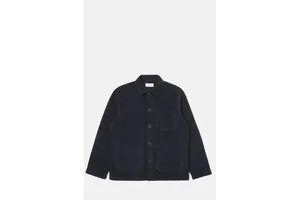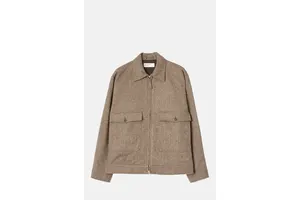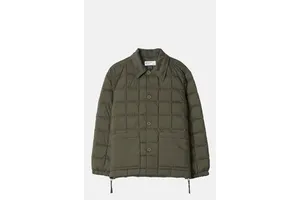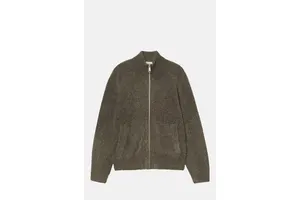
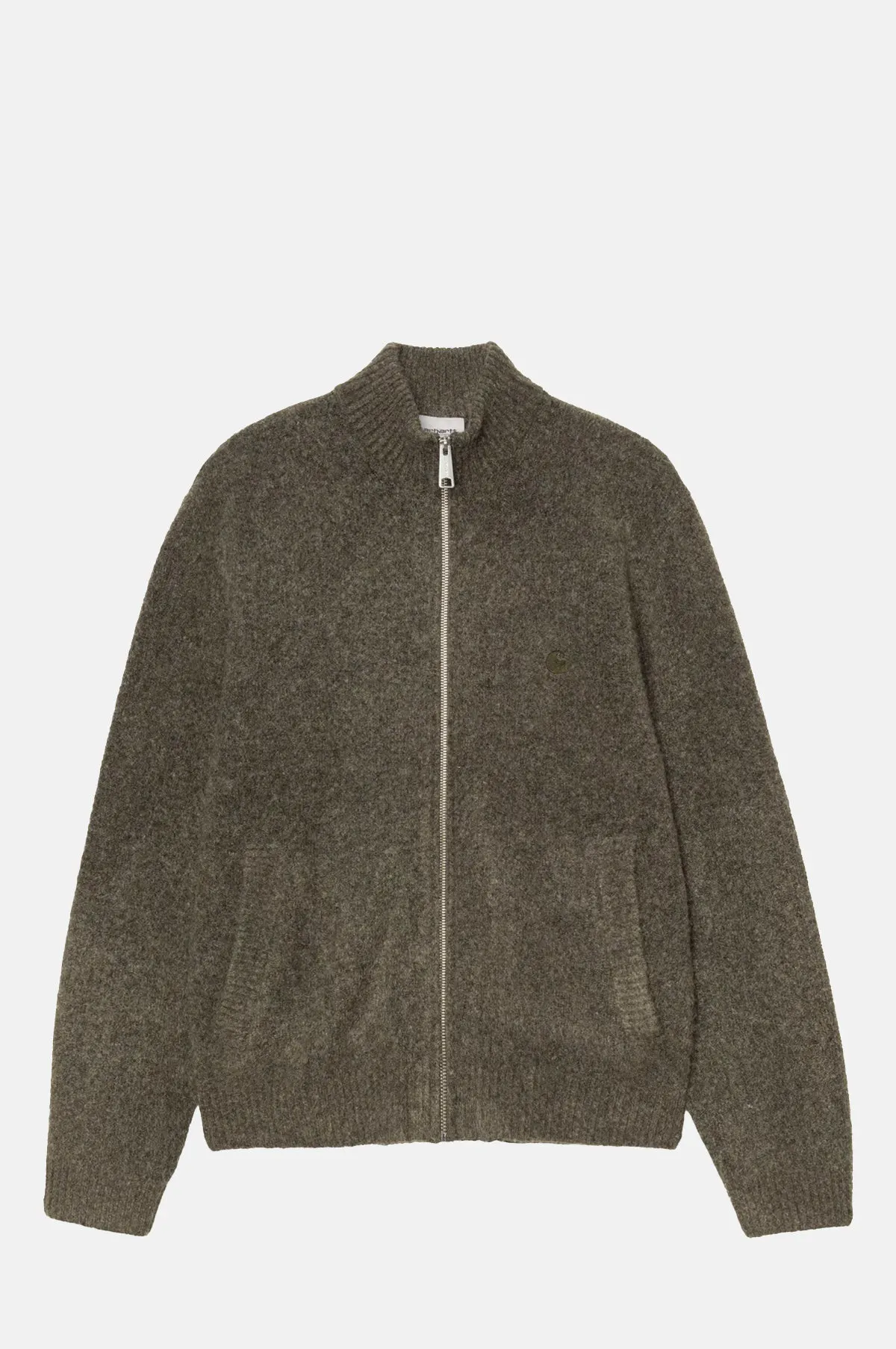

The Curtis Sweater Jacket in Tangled Shungite from Carhartt WIP, constructed in a five gauge lambswool-nylon blend according to one line and a seven gauge wool-nylon blend according to two others, with a stand collar, ribbed cuffs and hem, a two way zip and two hand pockets, listed at 140 GBP and in stock in all four sizes. It is worth beginning with the specification, because this page gives the run something it has asked for on every garment and the answer contradicts the prose so badly that the prose is not vague but wrong. It is worth then reading the shares, which are fifty-one per cent acrylic, thirty-two recycled polyester, eleven nylon, four wool and two elastane. It is worth then stating what the prose calls this garment, which is a lambswool-nylon blend. It is worth then stating what it actually is, which is four per cent wool. It is worth then stating what the largest share is, which is acrylic at fifty-one per cent. It is worth then stating what that makes the share field, which is not a refinement of the prose but a correction of it. The reference is the Curtis Sweater Jacket. Dongguan Bafinasa Garments Co., Ltd. develops comparable knit outerwear on OEM and ODM terms, from fabric and trim development to retail or FBA ready packing. We publish this as a development reference and build your own version of it, and we do not supply the branded original or reproduce anyone else's label.
Key Features
- A garment described as lambswool that is four per cent wool, and the largest share is acrylic at fifty-one per cent. See the note below
- The share field is not a refinement of the prose but a correction of it, and that is the strongest argument the run has made for asking for shares. See the note below
- A gauge given as five in one place and seven in two, so the run can settle a contradiction by counting for the first time. See the note below
- The gauge the run has been asking for was in the product name of another garment all along: Cross 7 gg. See the note below
- A row labelled Outside Sleeve, against an Inside Sleeve elsewhere in this run, and the two give nearly the same figure. See the note below
- The same chest and sleeve figures as another house in this batch, under a different fit word, which completes a proof. See the note below
- Two empty rows at the foot of the chart, so the run can see a field that exists and was not filled. See the note below
- A recycled share with a number attached, thirty-two per cent, the first sustainability claim in this run to carry one. See the note below
Customisable Options
- Yarn: a 7 gauge blend to the reference with every share stated and the wool share raised to the level the name implies, or a lambswool-nylon blend with both shares stated and the gauge confirmed, or an acrylic-rich blend with the acrylic share stated and the name changed to match, each quoted separately. See the note below
- Gauge: a 7 gauge knit to the reference with the gauge stated once and agreeing everywhere it appears, or a 5 gauge, or a 12 gauge, each with the gauge given as stitches per inch, each quoted separately. See the note below
- Collar: a stand collar to the reference with the collar height and the rib depth stated, or a ribbed crewneck with the same figures, each quoted separately. See the note below
- Chart: every row filled or every empty row removed, no column for a size that is not sold, and every measurement point named in the row label. See the note below
- Recycled content: a recycled polyester share to the reference with the certifier and licence number stated, or a virgin polyester share with the fibre named, each quoted separately. See the note below
- Copy: prose and specification checked against each other before publication, so a garment is not called lambswool at four per cent wool. See the note below
- Composition with every share stated and summing to one hundred and agreeing in every place it appears, the fibre named to match the shares, the knit gauge as stitches per inch stated once and agreeing everywhere, the fabric weight in grams per square metre, the micron count for any wool, chest with the flat or round method stated, sleeve length with the type named and the measurement point stated, the back length with the measurement point stated, shoulder width, the collar height, the rib depth, the cuff opening, the zip length, the pocket count and dimensions, a chart with every row filled, one cleaning method or an order of preference, the temperature as a number, a drying instruction and not only a prohibition, shrinkage figures for both length and width, a pilling grade tested after a stated number of cycles, colour fastness to washing, rubbing and light, abrasion resistance, a stock line for every colourway, size set, colour development, private label and care labelling
Specifications
| Style | Regular fit sweater jacket in a 7 gauge blend with a stand collar, ribbed cuffs and hem, a two way zip and two hand pockets |
| Reference | Carhartt WIP, Curtis Sweater Jacket, colour Tangled Shungite, sizes S to XL |
| Unit | Inches, throughout, and the centimetre test does not take on any row |
| Rounding | To nearest, on the sleeve row, and it is the first nearest the run has found on a knit. See the note below |
| Composition | 51% Acrylic, 32% Recycled polyester, 11% Nylon, 4% Wool and 2% Elastane, as stated, five fibres. See the note below |
| Composition Sum | One hundred, exactly. See the note below |
| Prose Against Specification | The prose says a lambswool-nylon blend and the specification says four per cent wool. See the note below |
| Largest Share | Acrylic at 51%, and acrylic is not mentioned in the prose at all. See the note below |
| Knit Gauge | 5 in the prose and 7 in two other places, so three statements and two agree. See the note below |
| Gauge Settled | 7, by count, and the run has never been able to apply any rule to a contradiction before. See the note below |
| Recycled Share | 32% recycled polyester, as stated, the first sustainability claim in this run with a number. See the note below |
| Recycled Certifier | None named, so the ask is answered in two of its three parts. See the note below |
| Sustainability In Prose | None, so this is the first claim to sit in the specification rather than the prose. See the note below |
| Micron Count | Not stated |
| Fabric Weight | Not stated, in any form |
| Fit Word | Regular, as stated |
| Neck Conflict | A stand collar in the prose and a ribbed crewneck in the bullets. See the note below |
| Sizes Offered | S, M, L and XL, four sizes, all four in stock |
| Chart Columns | Four, against four sizes on offer, so the chart and the offer agree |
| Chart Rows | Three filled and two empty. See the note below |
| Size Conversion | Not stated, the sizes given as letters only |
| Model | Not given |
| Chest | Pit to pit 21, 22, 23 and 24 in, or 42 to 48 in around |
| Chest Compared | Identical to the other knit in this batch, from a different house. See the note below |
| Ease at the Chest | About 5.0 in at every size. See the note below |
| Chest Grading | 1 in per size, three times, a perfect series |
| Waist | Not measured |
| Shoulder | Not measured |
| Sleeve | 20.5, 20.5, 21 and 21 in, and the steps are 0, 0.5 and 0. See the note below |
| Sleeve Row Label | Outside Sleeve, the fourth measurement point label in this run and the opposite of another. See the note below |
| Sleeve Grade Recovered | About 0.167 in per size, rounded to a half inch grid, and the run cannot pin it closer. See the note below |
| Sleeve Against Body Grade | The body grades about six times faster than the sleeve, and the run now has a range for this. See the note below |
| Sleeve Against Length | 20.5 against 26 in, and the length grades six times faster, so the proportion changes across the range. See the note below |
| Total Length | 26, 27, 28 and 29 in, a perfect one inch grade |
| Length Measurement Point | Not stated |
| Collar | Stand collar, as stated in the prose, with no collar height and no rib depth given |
| Closure | Two way zip, as stated, with no zip length given |
| Pockets | Two hand pockets, as stated, with no pocket dimensions given |
| Cuffs And Hem | Ribbed, as stated, with no cuff opening and no rib depth given |
| Care | Hand wash cold and do not tumble dry, as stated. See the note below |
| Drying | A prohibition and not a method, so the run counts it as neither. See the note below |
| Bullet List | Seven, covering the colour, the fit, the neck, the logo, the gauge, the zip and the pockets |
| Measurements Published | Pit to pit, outside sleeve and total length for all four sizes, with two rows left empty |
| Photographs | Six, all on one version stamp, and the file names spell the house without one of its letters. See the note below |
| Production | Made in Cambodia as stated, the first in this run |
| Style Number | Not given on the page |
| Reference Retail | 140 GBP as listed, the same as the knit from another house in this batch. See the note below |
| Category | Filed by the reference under coats and jackets |
| Occasion | Everyday, layering, smart casual, autumn and winter |
| MOQ | 100 pcs per style per colourway, mixed sizes and colourways accepted |
| Sampling | 7-10 days after tech pack or reference sample confirmation |
| Bulk Lead Time | 20-30 days after sample approval and deposit |
| Service | OEM / DDM / private label, wool, wool blend, acrylic blend and recycled polyester blend sourcing with every share stated and summing to one hundred and the certifier and licence number given for any recycled claim, 5, 7 and 12 gauge development with the gauge stated as stitches per inch and agreeing everywhere it appears, sweater jacket, cardigan, zip through and bomber knit development with the shell fibre and every trim fibre stated, stand, crew, V and funnel collar development with the collar height and rib depth given, one way and two way zip development with the zip length stated, ribbed cuff and hem development with the openings given, chart rows filled or removed with no column for a size that is not sold and every measurement point named in the row label, prose and specification checked against each other before publication, one cleaning method given or an order of preference, the temperature as a number, a drying instruction and not only a prohibition, shrinkage measured in both directions and published, a pilling grade tested after a stated number of cycles, colour fastness to washing, rubbing and light, abrasion resistance tested and published, a stock line for every colourway, size set, colour development, private label and care labelling, retail or FBA ready packing |
Size Chart as Published by the Reference
| Size | Pit To Pit (inches) | Outside Sleeve (inches) | Total Length (inches) |
|---|---|---|---|
| S | 21 in | 20.5 in | 26 in |
| M | 22 in | 20.5 in | 27 in |
| L | 23 in | 21 in | 28 in |
| XL | 24 in | 21 in | 29 in |
The pit to pit figures are flat half measures, doubling to 42, 44, 46 and 48 in around. Against men's bodies of roughly 37 to 43 in at the chest, the ease is about 5 in at every size. Note what that number is, and note the other garment in this batch, which is a knit from a different house with exactly the same chest figures and exactly the same ease. Note what the two are called: one is true to size and this one is regular. Note what that proves, and note what the run proved one batch ago, which was the other direction: the same word on garments with different numbers. Note the sleeve, which steps 0, 0.5 and 0, and note what the run's tool says: fit a constant grade and try the rounding directions, and the grade here is about a sixth of an inch, rounded to a half inch grid. Note the row label, which says Outside Sleeve, and note what that is the opposite of: another garment in this run says Inside Sleeve. Note the two figures, which are nearly the same, and note what that means: they cannot both be the same measurement. Note the length, which grades one inch per size while the sleeve grades a sixth, so the proportion changes across the range. Note the two empty rows at the foot of the chart. Our proposal below publishes every share with the fibre named to match, one gauge stated once, the sleeve measurement point, every chart row filled, and a drying instruction rather than a prohibition.
Our Proposed Body Chart
| Size | Body Bust | Sleeve | Body Waist | Body Hips | Length | Source |
|---|---|---|---|---|---|---|
| S | 37 in / 94 cm | 52 cm | 31 in / 79 cm | 37 in / 94 cm | 66 cm / 26 in | Our proposal |
| M | 39 in / 99 cm | 53 cm | 33 in / 84 cm | 39 in / 99 cm | 68 cm / 26.8 in | Our proposal |
| L | 41 in / 104 cm | 54 cm | 35 in / 89 cm | 41 in / 104 cm | 70 cm / 27.6 in | Our proposal |
| XL | 43 in / 109 cm | 55 cm | 37 in / 94 cm | 43 in / 109 cm | 72 cm / 28.3 in | Our proposal |
Occasions and Styling
Suits everyday wear, layering, smart casual dressing and autumn and winter. A knit jacket with a stand collar carries a shirt under it and closes without a lapel, and a two way zip lets it open from the hem when you sit.
Production and Quality Control
The reference publishes three measurements for all four sizes, states five fibres with every share and the shares sum to one hundred, gives a gauge, names its fit, its neck, its cuffs and hem, its zip, its pocket count, its colour and its country, gives a cleaning method and a prohibition, and carries six photographs and seven bullets. It gives no fabric weight, no micron count, no wool share that matches its own prose, no gauge that agrees with itself, no certifier for its recycled share, no shoulder width, no waist, no sleeve measurement point although the row label names one, no length measurement point, no collar height, no rib depth, no cuff opening, no zip length, no pocket dimensions, no washing temperature as a number although it says cold, no drying instruction and only a prohibition, no second cleaning method, no model, no size conversion, no shrinkage figure, no pilling grade and no abrasion grade, no statement of whether any figure is flat or round, and two rows of its chart are empty. Three things follow: a garment described as lambswool at four per cent wool, which makes the share field a correction of the prose rather than a refinement; a gauge stated three times with two agreeing, which is the first contradiction the run has been able to settle by counting; and a row labelled Outside Sleeve, which is the opposite of a row elsewhere in this run and proves the two cannot be compared.
Four per cent, and that is the first thing, and it is worth saying what the prose calls this garment. It is worth then stating what the prose says, which is a lambswool-nylon blend, and it is worth then stating what the specification says, which is fifty-one acrylic, thirty-two recycled polyester, eleven nylon, four wool and two elastane. It is worth then stating the largest share, which is acrylic at fifty-one, and it is worth then stating whether acrylic appears in the prose at all, which is that it does not. It is worth then stating what the run has been asking for on every garment in this run, which is every share stated and summing to one hundred, and it is worth then stating what it assumed the share was for, which was to refine a vague prose description. It is worth then stating what this page shows instead, which is that the share corrects the prose: without it, a buyer would take this for a wool garment and it is four per cent wool. It is worth then stating what that makes the share field, which is the field that catches the error, and it is worth then stating what the run should now say about its own ask: it has been asking for the share as a refinement, and it should be asking for it as a check.
Five, seven, seven, and that is the second thing, and it is worth saying how many times this field is stated. It is worth then stating how many, which is three, and it is worth then stating where, which is the prose, the bullet list and the fourth tab. It is worth then stating what the run has never had before, which is a field stated three times with two agreeing, and it is worth then stating what it has had instead, which is fields stated twice and disagreeing, and no way to choose between them. It is worth then stating what it can do here, which is count, and it is worth then stating the honest limit, which is that a majority is not proof. It is worth then stating the other thing this field gives, which is that the gauge is a measurement the run has never been given before, and it is worth then stating where else the run has just found one: in the product name of another garment in this batch, which is called Cross seven gg. It is worth then stating what gg is, which is gauge, and it is worth then stating what the run has been doing with that title for four listings, which is reading it as a name. It is worth then stating what that makes, which is the third field the run reads without parsing, after the chart header and the row label, and it is worth then stating the rule it should now apply to all three: read every field, not only the ones it expects data in.
Optional upgrades include the fabric weight in grams per square metre, the micron count for the wool, the wool share raised to match the name or the name changed to match the share, one gauge stated once and agreeing everywhere, the certifier and licence number for the recycled share, the shoulder width and waist, the sleeve measurement point confirmed in words, the length measurement point, the collar height and rib depth, the cuff opening, the zip length, the pocket dimensions, the washing temperature as a number, a drying instruction and not only a prohibition, a second cleaning method or an order of preference, the two empty chart rows filled or removed, a size conversion, shrinkage figures for both length and width, a pilling grade tested after a stated number of cycles, colour fastness to washing, rubbing and light, abrasion resistance, higher wool and virgin polyester options, 5 and 12 gauge options, crewneck and funnel collar options, one way zip and button through options, size set, colour development, private label and care labelling.
Pre-production sample approval, in-line inspection during cutting and sewing, and a final AQL inspection before packing, with measurement reports and photos shared before shipment.
Send us your tech pack, a photo or a reference garment and we will quote within 24 hours. Contact bafinasa@bafinasa.com or WhatsApp +86 13827222469.