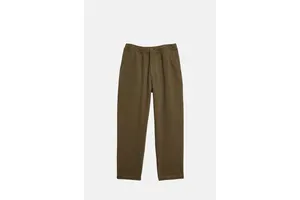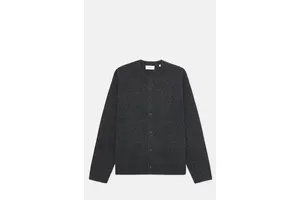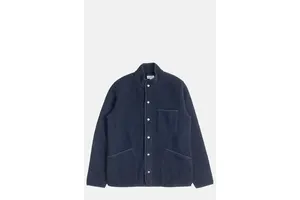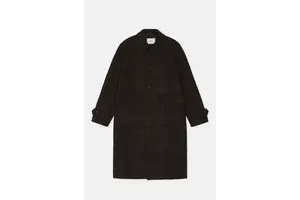
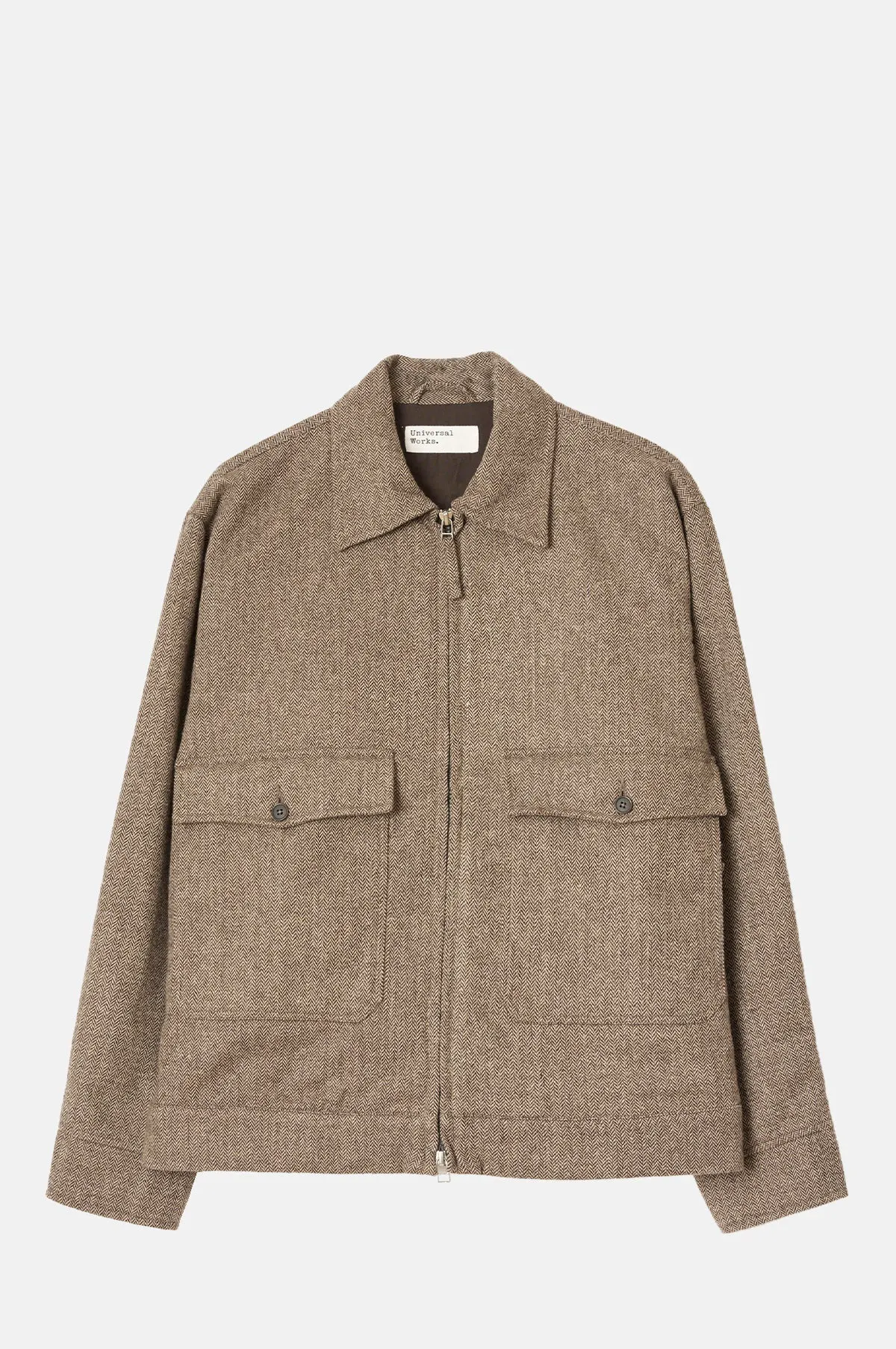

The E130 Jacket in Brown from Universal Works, cut from a durable brown herringbone cloth in a straight, boxy silhouette with a two way zip, two chest pockets with buttoned flaps, a pointed collar and adjustable button tabs at the hem, listed at 215 GBP and in stock in three of four sizes. It is worth beginning with the fibres, because they are not where the run expected to find them. It is worth then stating where the run looked, which is the prose, where it found a durable brown herringbone cloth, and the bullets, where it found a brown herringbone weave. It is worth then stating what neither of those says, which is that the cloth is half wool. It is worth then stating where the shares are, which is the third line of the care block, underneath the country and the washing instruction. It is worth then stating what that makes this garment: the first in this run whose composition is not a field of its own at all. It is worth then stating what the run should say about that, which is that the two statements do not disagree. They are about different things, and neither mentions what the other says. The reference is the E130 Jacket. Dongguan Bafinasa Garments Co., Ltd. develops comparable outerwear on OEM and ODM terms, from fabric and trim development to retail or FBA ready packing. We publish this as a development reference and build your own version of it, and we do not supply the branded original or reproduce anyone else's label.
Key Features
- The composition is not a field on this page: it is the third line of the care block. See the note below
- Half wool, and the headline copy names a weave and not a fibre, so the two statements do not overlap. See the note below
- Thirteen inches of ease, the most in this run, and the word for it is boxy. See the note below
- The top size is extended by half the usual grade, the second time in three batches. See the note below
- The session law gets a mechanism: the same care sentence spelled two ways on two siblings. See the note below
- The decoder fails on one Universal Works garment and works on the other. See the note below
- Same house, two countries of manufacture, 41 minutes apart. See the note below
Customisable Options
- Cloth: a wool blend herringbone to the reference with every share stated and summing to one hundred, or a higher wool share with the micron count given, or a polyester rich twill with the shares stated, each quoted separately. See the note below
- Composition: the fibre shares published as their own field and repeated in the headline copy, so the weave word and the fibre word appear together. See the note below
- Fit: a straight boxy fit to the reference with the ease published for every size, or a fit that holds its ease across the range with the half chest grade set to half the body grade, each quoted separately. See the note below
- Grading: the top size extended by the same step as the rest, or the top size extended deliberately with the smaller step stated. See the note below
- Trims: a two way zip, buttoned chest pockets, a pointed collar and adjustable hem tabs to the reference, with the zip length, pocket dimensions, collar height and point length and the number of buttons all stated
- Composition with every share stated and summing to one hundred and published as its own field, the fibre named in the headline copy as well as the weave, the micron count and a responsible wool standard named with its certifier and licence number, the fabric weight in grams per square metre, chest with the flat or round method stated, sleeve length with the sleeve type and measurement point stated, the back length with the measurement point stated, shoulder width, the collar height and point length, the cuff opening, the pocket count and dimensions, the button count and size, an order of preference for cleaning with the temperature as a number, a drying method and not only a prohibition, storage guidance, shrinkage figures for both length and width, a pilling grade tested after a stated number of cycles, colour fastness to washing, rubbing and light, abrasion resistance tested and published, a stock line for every colourway, size set, colour development, private label and care labelling
Specifications
| Style | Straight boxy fit jacket in brown herringbone wool blend with a two way zip, buttoned chest pockets, a pointed collar and adjustable hem tabs |
| Reference | Universal Works, E130 Jacket, colour Brown, sizes S to XL |
| Sibling | The Down Rams Jacket from the same house, published in the same batch, 41 minutes apart. See the note below |
| Upload Gap | About 41 minutes from the sibling. See the note below |
| Unit | Inches, throughout, and the centimetre test does not take on any row |
| Composition | 50% wool, 36% polyester and 14% acrylic, as stated |
| Composition Where | The third line of the care block, after the country and the washing instruction. See the note below |
| Composition Field | There is no composition field on this page. See the note below |
| Composition Sum | One hundred, exactly |
| Prose Against Specification | They do not overlap: the copy names a weave, the specification names three fibres, and neither mentions the other. See the note below |
| Overlap Class | Not-overlap, which the run now scores separately from disagree. See the note below |
| Largest Share | Wool at 50%, and the word wool appears in the headline copy nowhere at all |
| Polyester Share | 36%, and the prose calls the cloth durable without linking the two. See the note below |
| Micron Count | Not stated |
| Fabric Weight | Not stated, in any form |
| Certification | None named, and no responsible wool standard named |
| Fit Word | Straight, boxy, as stated in the bullets and the prose |
| Fit Word Measured | About 13 in of ease at the chest, the most in this run. See the note below |
| Sizes Offered | S, M, L and XL, four sizes, and three of the four in stock |
| Sizes In Stock | M, L and XL, and the S is sold out |
| Chart Columns | Four, against four sizes on offer, so they match |
| Row Labels | Chest pit to pit, Sleeve length and Total length, and none carries a unit although the header does |
| Size Conversion | Not stated, the sizes given as letters only |
| Model | Not given |
| Chest | Pit to pit 25, 26, 27 and 27.5 in, or 50 to 55 in around |
| Chest Grading | 1, 1 and 0.5 in, and the last step is half the others. See the note below |
| Ease at the Chest | About 13 in at S, M and L, and about 12 in at XL. See the note below |
| Ease Drift | 0, 0 and minus 1 in, exactly as the formula gives. See the note below |
| Waist | Not measured |
| Shoulder | Not measured |
| Sleeve | 23, 24, 24.5 and 25 in, and the steps are 1, 0.5 and 0.5 |
| Sleeve Compared | The sibling's sleeve starts the same two figures and then diverges. See the note below |
| Sleeve Row Label | Sleeve length, with no sleeve type and no measurement point stated |
| Total Length | 24, 25, 26 and 27 in, and the steps are a uniform one inch |
| Total Length Compared | The one row that is uniform on both siblings. See the note below |
| Length Measurement Point | Not stated |
| Ladder Uniformity | Two rows uniform and one broken at the top |
| Collar | Pointed, as stated, with no collar height and no point length given |
| Closure | Two way zip, as stated, with no zip length given |
| Pockets | Two chest patch pockets with buttoned flaps, as stated, with no dimensions and no button count given |
| Cuffs | Single button, as stated, with no opening and no button size given |
| Hem | Adjustable button tabs at the rear, as stated, with no hem width given |
| Care | Machine wash 30 degrees, do not tumbledry, iron on low, as stated |
| Care Compared | The same sentence as the sibling, and spelled differently. See the note below |
| Washing Temperature | 30, as a number |
| Ironing Temperature | Low, as a word, on the same line as a number |
| Drying | A prohibition and not a method, so the run counts it as neither |
| Storage | Not stated |
| Bullet List | Seven, the same count as the sibling, so it is a house habit. See the note below |
| Measurements Published | Chest pit to pit, sleeve length and total length for all four sizes |
| Photographs | Four, two fewer than the sibling |
| Production | Made in India as stated, and the sibling was made in Portugal. See the note below |
| Style Number | 35189 WOOL HERRINGBONE BROWN, as stated, and it ends in a colour. See the note below |
| Style Number Compared | The sibling's ends in a fabric name, so the decoder works on one and not the other. See the note below |
| Reference Retail | 215 GBP as listed, the highest in this batch, quoted to show the price band this sits in, not as our price. See the note below |
| Category | Filed by the reference under coats and jackets |
| Occasion | Everyday, workwear, layering, autumn and winter |
| MOQ | 100 pcs per style per colourway, mixed sizes and colourways accepted |
| Sampling | 7-10 days after tech pack or reference sample confirmation |
| Bulk Lead Time | 20-30 days after sample approval and deposit |
| Service | OEM / DDM / private label, wool blend, herringbone and twill suiting development with every share stated and summing to one hundred and published as its own field and repeated in the headline copy, the micron count and a responsible wool standard named with its certifier and licence number, the fabric weight in grams per square metre stated, workwear, chore coat and overshirt development with the zip length, pocket dimensions, collar height and point length, button count and size and cuff opening published, chest grading set to half the body grade if the fit is to hold across the range, the top size extended by the same step as the rest, composed once and carried so that two siblings uploaded together cannot diverge in spelling, an order of preference for cleaning with the temperature as a number, a drying method and not only a prohibition, storage guidance, shrinkage measured in both directions and published, a pilling grade tested after a stated number of cycles, colour fastness to washing, rubbing and light, abrasion resistance tested and published, a stock line for every colourway, size set, colour development, private label and care labelling, retail or FBA ready packing |
Size Chart as Published by the Reference
| Size | Chest Pit To Pit (inches) | Sleeve Length (inches) | Total Length (inches) |
|---|---|---|---|
| S | 25 in | 23 in | 24 in |
| M | 26 in | 24 in | 25 in |
| L | 27 in | 24.5 in | 26 in |
| XL | 27.5 in | 25 in | 27 in |
The chest figures are flat half measures, doubling to 50, 52, 54 and 55 in around. Against men's bodies of roughly 37 to 43 in at the chest, the ease is about 13 in at the first three sizes and about 12 in at the largest. Note the size of that figure: the run has measured ease from about 1.8 in up to about 10.5 in, and this is outside all of it, and note the word the page uses, which is boxy. Note the drift: the chest grades 1, 1 and 0.5 in against a body grade of 2 in, so the formula gives 0, 0 and minus 1, which is what happens. Note that the top size is extended by half the grade used everywhere else, which is the second garment in three batches to do it. Note the sleeve, which steps 1, 0.5 and 0.5, and note that the sibling from the same house starts with the same two figures and then goes its own way. Our proposal below publishes the fibre shares as their own field and in the headline copy, the micron count, the fabric weight, the measurement points, and a drying method and storage guidance.
Our Proposed Body Chart
| Size | Body Bust | Sleeve | Body Waist | Body Hips | Length | Source |
|---|---|---|---|---|---|---|
| S | 37 in / 94 cm | 58 cm | 31 in / 79 cm | 37 in / 94 cm | 61 cm / 24 in | Our proposal |
| M | 39 in / 99 cm | 59 cm | 33 in / 84 cm | 39 in / 99 cm | 63 cm / 24.8 in | Our proposal |
| L | 41 in / 104 cm | 60 cm | 35 in / 89 cm | 41 in / 104 cm | 65 cm / 25.6 in | Our proposal |
| XL | 43 in / 109 cm | 61 cm | 37 in / 94 cm | 43 in / 109 cm | 67 cm / 26.4 in | Our proposal |
Occasions and Styling
Suits everyday wear, workwear, layering and autumn and winter. A boxy wool blend jacket with chest pockets takes a knit or a sweatshirt underneath, and a pointed collar and a two way zip let it be worn open or shut.
Production and Quality Control
The reference publishes three measurements for all four sizes, states three fibres with every share and the shares sum to one hundred, gives a fit word and a silhouette, names its collar, closure, pockets, cuffs and hem, gives three care instructions including a washing temperature as a number, names its country, carries seven bullets and four photographs, and gives a style number ending in a colour. It gives no micron count, no fabric weight, no responsible wool standard, no certifier, no shoulder width, no waist, no sleeve type, no sleeve or length measurement point, no collar height, no zip length, no pocket dimensions, no button count or size, no cuff opening, no hem width, no drying method and only a prohibition, no storage guidance, no second cleaning method, no model, no size conversion, no shrinkage figure, no pilling grade and no colour fastness figure, no statement of whether any figure is flat or round, and its composition is not a field of its own but a line inside the care block. Three things follow: the composition check has to include where the shares live; the prose and the specification can fail to overlap rather than disagree; and the session law now has a mechanism.
Fifty, thirty-six, fourteen, and that is the first thing, and it is worth saying where the run found them. It is worth then stating where it looked first, which is the prose and the bullets, and it is worth then stating what those say, which is a durable brown herringbone cloth and a brown herringbone weave. It is worth then stating what they do not say, which is wool, or polyester, or acrylic, or any share at all. It is worth then stating where the shares actually are, which is the third line of the care block, after the country and after the washing instruction. It is worth then stating what that makes this garment, which is the first in this run with no composition field. It is worth then stating the general point, which is that a share can be stated and still be buried. It is worth then stating the second thing, which is subtler: the two statements do not contradict each other. It is worth then stating what they are about, which is a weave on one side and three fibres on the other, and it is worth then stating what neither mentions, which is what the other says. It is worth then stating what the run has been recording, which is disagreements, and it is worth then stating what this is instead, which is a failure to overlap. It is worth then stating what the run should do, which is score three outcomes from now on: agree, disagree, and not-overlap. It is worth then closing on the polyester, and it is worth stating that the prose calls the cloth durable and the specification carries thirty-six per cent polyester, and that nobody on the page joins those two facts together.
Tumbledry, and that is the second thing, and it is worth saying what the run is looking at. It is worth then stating what this page says, which is do not tumbledry as one word, and it is worth then stating what its sibling from the same house says, which is do not tumble dry as two. It is worth then stating how far apart the two listings were uploaded, which is about forty-one minutes, and it is worth then stating what the run's session law says about that gap, which is that fields should agree. It is worth then stating what this does to the law, which is refine it, and it is worth then stating how: the two texts are the same sentence and they differ by one space, so they were not copied. It is worth then stating what they were, which is typed twice. It is worth then stating the second mechanism, from the Carhartt pair one batch ago: twenty-nine days apart, bullets identical, prose edited, so those were copied and not updated. It is worth then stating the diagnostic the run now has, which is that byte-identical siblings were copied and siblings differing in trivia were retyped, and that the two fail in different ways. It is worth then stating the other divergences the forty-one minutes produced: a different country of manufacture, a different size run, a different chart width, a different number of photographs, and a style number that ends in a colour on this garment and in a fabric name on the other. It is worth then stating what that does to the decoder, which is that it must be fitted per garment and not per house, because two garments from one house disagree.
Optional upgrades include the fibre shares published as their own field and repeated in the headline copy, the micron count and a responsible wool standard named with its certifier and licence number, the fabric weight in grams per square metre, the shoulder width and waist, the sleeve type and measurement point, the length measurement point, the collar height and point length, the zip length, the pocket dimensions, the button count and size, the cuff opening, the hem width, a drying method and not only a prohibition, storage guidance, the top size extended by the same step as the rest, a size conversion, shrinkage figures for both length and width, a pilling grade tested after a stated number of cycles, colour fastness to washing, rubbing and light, abrasion resistance tested and published, higher wool and recycled polyester options with certification, plain and twill options, further colourways, size set, private label and care labelling.
Pre-production sample approval, in-line inspection during cutting and sewing, and a final AQL inspection before packing, with measurement reports and photos shared before shipment.
Send us your tech pack, a photo or a reference garment and we will quote within 24 hours. Contact bafinasa@bafinasa.com or WhatsApp +86 13827222469.