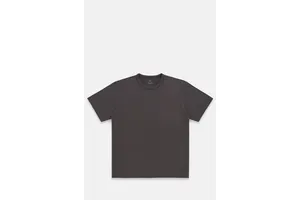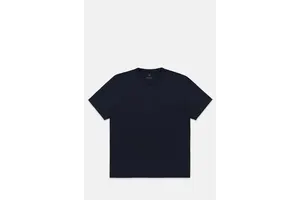
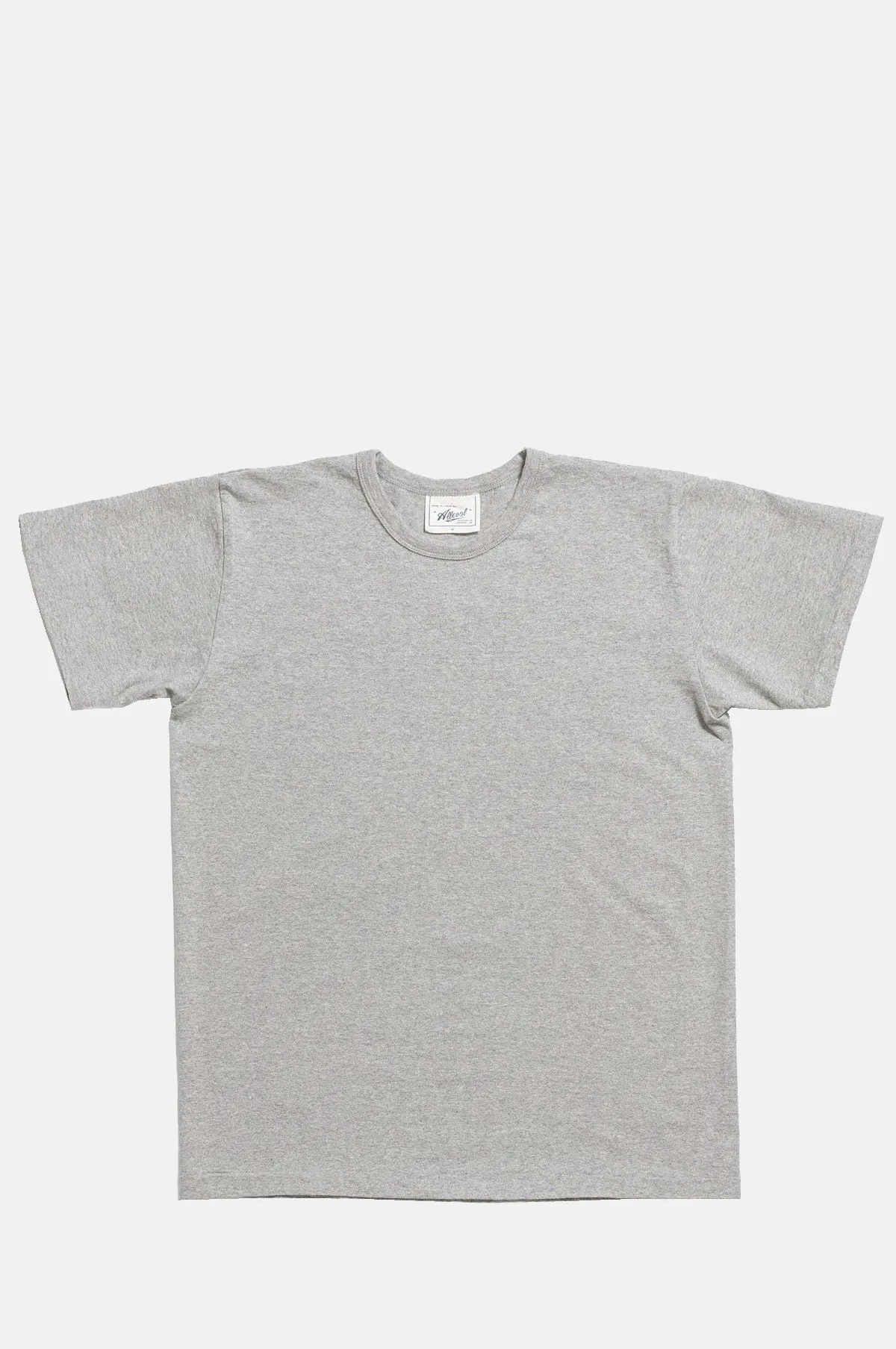

The Heavy Duty Crew Neck T-Shirt in Grey from Allevol, built from 100% US cotton with yarns spun in Japan and knitted on vintage circular machines so that the torso has no side seams, finished with a bound collar and triple stitching in a short boxy mid-century silhouette, listed at 65 GBP and in stock in all five sizes. It is worth beginning with the chart, because it is the least tidy the run has met. It is worth then stating the chest run, which is 18.3, 20.3, 21.5, 23.3 and 23.8 inches. It is worth then stating the steps, which are two inches, then one point two, then one point eight, then half an inch. It is worth then stating what the run has never seen, which is one row varying fourfold. It is worth then stating what that means in a fitting room, which is that the jump from small to medium gives you two inches of chest and the jump from extra large to extra extra large gives you half an inch. It is worth then stating what the run should now do, which is stop saying the grade is irregular and start saying that the largest buyer gets an inch less ease than the one below them. It is worth then stating the second thing, which is that this garment is the run's first case where neither the inch reading nor the centimetre reading is clean, and it is worth then stating why that matters, which is that the run built a detector last batch and it should show where the detector stops. It is worth then stating the last thing, which is a pair of predictions already queued: the navy colourway should carry the code 500 CTN NVY and should carry this same chart. The reference is the Heavy Duty Crew Neck T-Shirt. Dongguan Bafinasa Garments Co., Ltd. develops comparable jersey on OEM and ODM terms, from fabric and trim development to retail or FBA ready packing. We publish this as a development reference and build your own version of it, and we do not supply the branded original or reproduce anyone else's label.
Key Features
- One chest row that varies fourfold: two inches at the bottom and half an inch at the top. See the note below
- The ease rises and then comes back down, which is what a collapse at the top does to a body. See the note below
- The formula holds on all four steps including the negative one, the hardest test it has had
- A yarn count at last: 14 count, and the house calls it thick, and the two agree. See the note below
- Fibre origin given - US cotton - and it is not the country the garment was made in. See the note below
- Seamless, and knitted on a named machine, and the run now has two of these. See the note below
- Care text identical word for word to another house's, and both are made in Japan. See the note below
- The first case where neither the inch nor the centimetre reading is clean. See the note below
Customisable Options
- Fabric: a heavyweight US cotton jersey to the reference with the weight in grams per square metre stated, or a heavyweight jersey from another fibre origin with the origin stated, or a lighter jersey at a published weight, each quoted separately
- Knit: seamless circular knit to the reference with the machine type named, or a side seamed jersey with the reason for the choice stated, each quoted separately. See the note below
- Grade: a stated grade per row, and a grade that does not collapse at the largest size. See the note below
- Chart: five columns matched to five sizes in both directions, with the grade stated and the ease shown to the buyer. See the note below
- Collar: a bound collar to the reference with the neck width and rib depth published, or a rib collar, each quoted separately
- Care: a washing temperature as a number with a second cleaning method named, and an ironing temperature as a number
- Composition with every share stated and summing to one hundred and published as its own field, the fibre origin stated separately from the country of manufacture, the fabric weight in grams per square metre, the yarn count, chest with the flat or round method stated, sleeve length with the sleeve type in the row label, the back length with the measurement point stated, shoulder width, the neck width and rib depth, a stated grade per row with the ease shown to the buyer for every size, the knitting method and machine type, the stitch type and count for any durability claim, an order of preference for cleaning with the washing temperature as a number and a second cleaning method named, an ironing temperature as a number, drying and storage guidance, shrinkage figures for both length and width, a pilling grade tested after a stated number of cycles, colour fastness to washing, rubbing, light and perspiration, any durability claim tested rather than asserted, a stock line for every size, size set, colour development, private label and care labelling
Specifications
| Style | Short boxy crew neck tee in heavyweight US cotton knitted seamless on vintage circular machines with a bound collar and triple stitching |
| Reference | Allevol, Heavy Duty Crew Neck T-Shirt, colour Grey, sizes S to XXL |
| Unit | Inches, stated in every row label, and the centimetre test does not fire on any row. See the note below |
| Column Count | Five, against five sizes on offer, so they match in both directions |
| Sizes Offered | S, M, L, XL and XXL, five sizes, and all five in stock |
| Size Conversion | Not stated, the sizes given as letters only |
| Composition | 100% Cotton, as stated in a tab, and 100% US cotton in the prose and the bullets |
| Fibre Origin | US cotton, as stated, and it is not the country of manufacture. See the note below |
| Prose Against Specification | They agree, and there is one fibre |
| Fabric Weight | Not stated as a number, although the prose says heavy and heavyweight. See the note below |
| Yarn Count | 14 count, as stated in the bullets, the first in this run. See the note below |
| Yarn Claim Checked | 14 is coarse on the cotton count system and the house calls it thick, so they agree. See the note below |
| Yarn Origin | Spun in Japan, as stated |
| Knitting Method | Vintage circular knitting machines, named as Taimaru, as stated |
| Construction | Seamless torso with no side seams, as stated |
| Construction Consequence | A tubular body cannot be tapered, so the waist is fixed by the chest. See the note below |
| Machine Claim | The machine is named and no scarcity claim is made about it. See the note below |
| Durability Claims | Two, in prose and in bullets, and neither is tested. See the note below |
| Stitching | Triple stitched, as stated, with no stitch count and no seams named |
| Collar | Bound crew neck with drop needle stitching, as described, the best neck description in this run |
| Neck Dimensions | Not given |
| Fit Word | None given as a fit word, and the silhouette is described as short and boxy. See the note below |
| Chest | Pit to pit 18.3, 20.3, 21.5, 23.3 and 23.8 in, or 36.6, 40.6, 43, 46.6 and 47.6 in around |
| Chest Grading | 2, then 1.2, then 1.8, then 0.5 in. See the note below |
| Grade Variation | Fourfold across one row, the most in this run. See the note below |
| Ease at the Chest | Minus 0.4, plus 1.6, plus 2, plus 3.6 and plus 2.6 in. See the note below |
| Ease Direction | It rises and then falls, the first in this run. See the note below |
| Ease Drift | Plus 2, plus 0.4, plus 1.6 and minus 1, and the formula gives all four. See the note below |
| Waist | Not measured |
| Shoulder | Not measured |
| Sleeve | 7.5, 7.5, 8, 8.5 and 8.8 in, and the steps are 0, 0.5, 0.5 and 0.3 |
| Sleeve Zero Step | Sizes S and M share a sleeve of 7.5 in. See the note below |
| Zero Steps By Row | Zeroes appear on sleeves and hems and never on a chest. See the note below |
| Sleeve Row Label | Sleeve, with no sleeve type and no measurement point stated |
| Total Length | 25, 25.5, 27, 28 and 29 in, and the steps are 0.5, 1.5, 1 and 1 |
| Length Jump | A one and a half inch step from M to L, the largest length step in this run. See the note below |
| Length Measurement Point | Not stated |
| Shape Ratio | Width to length 0.73. See the note below |
| Ladder Uniformity | No row is uniform, and all three are irregular by the run's test |
| Care | Machine wash 30, wash inside out, do not tumble dry, iron low, as stated |
| Care Compared | Identical, word for word, to another house's care text. See the note below |
| Washing Temperature | 30, as a number, the third in three batches |
| Drying | Do not tumble dry, a prohibition and not a method |
| Drying Compared | Three Japanese made garments in a row all prohibit tumble drying. See the note below |
| Ironing | Low, a temperature word and not a number |
| Storage | Not stated |
| Production | Made in Japan, as stated in a tab and in the bullets |
| Supply Chain Stages | Cotton from the US, yarn spun in Japan, garment made in Japan. See the note below |
| Bullet List | Eight, and four of them are fields |
| Prose | One paragraph, and it carries both durability claims and the whole construction story |
| Measurements Published | Pit to pit, sleeve and length for all five sizes |
| Photographs | Three, all carrying the same upload stamp, so the range is zero |
| Style Number | 500 CTN GRY, as stated, in three tokens with spaces. See the note below |
| Reference Retail | 65 GBP as listed, quoted to show the price band this sits in, not as our price |
| Category | Filed by the reference under t-shirts |
| Occasion | Everyday, work, weekends, layering, spring and summer |
| MOQ | 100 pcs per style per colourway, mixed sizes and colourways accepted |
| Sampling | 7-10 days after tech pack or reference sample confirmation |
| Bulk Lead Time | 20-30 days after sample approval and deposit |
| Service | OEM / DDM / private label, cotton jersey sourcing with the weight in grams per square metre, the yarn count and the fibre origin all stated, seamless circular knitting and conventional side seamed knitting with the consequences of each stated, heavyweight jersey development from 200 to 400 grams per square metre, grading with a stated grade per row that does not collapse at the largest size and with the ease shown to the buyer for every size, bound and rib collar development with the neck width and rib depth published, triple and flat fell seam development with the seams named and the stitch count given, shoulder width, chest, sleeve and length each with a measurement point, an order of preference for cleaning with the washing temperature as a number and a second cleaning method named, an ironing temperature as a number, drying and storage guidance, shrinkage measured in both directions and published, a pilling grade tested after a stated number of cycles, colour fastness to washing, rubbing, light and perspiration, durability claims tested rather than asserted with the cycle count published, a stock line for every size, size set, colour development, private label and care labelling, retail or FBA ready packing |
Size Chart as Published by the Reference
| Size | Pit To Pit (inches) | Sleeve (inches) | Length (inches) |
|---|---|---|---|
| S | 18.3 in | 7.5 in | 25 in |
| M | 20.3 in | 7.5 in | 25.5 in |
| L | 21.5 in | 8 in | 27 in |
| XL | 23.3 in | 8.5 in | 28 in |
| XXL | 23.8 in | 8.8 in | 29 in |
The chest figures are flat half measures, doubling to 36.6, 40.6, 43, 46.6 and 47.6 in around. Against men's bodies of roughly 37 to 45 in at the chest, the ease is minus 0.4, plus 1.6, plus 2, plus 3.6 and plus 2.6 in. Note the shape of that: it rises and then falls, which the run has never seen, and note what causes it, which is the last grade collapsing to half an inch. Note what that means for the largest buyer, which is that the XXL gives about an inch less ease than the XL relative to their bodies, and note that this is the form the run should write its criticisms in from now on. Note the formula, which gives plus 2, plus 0.4, plus 1.6 and minus 1 for these four steps, and note that all four match, including the negative one, which is the hardest test it has had. Note the sleeve, where sizes S and M share 7.5 in, and note the length, which jumps one and a half inches from M to L. Note the ratio, which is 0.73, and note what the run should say about its own ratio metric after this garment, which is that it may be measuring the wrong thing. Our proposal below publishes the fabric weight, the measurement points, a stated grade per row, the ease shown to the buyer, the shoulder width, and the neck width and rib depth.
Our Proposed Body Chart
| Size | Body Bust | Sleeve | Body Waist | Body Hips | Length | Source |
|---|---|---|---|---|---|---|
| S | 37 in / 94 cm | 19 cm | 31 in / 79 cm | 37 in / 94 cm | 64 cm / 25.2 in | Our proposal |
| M | 39 in / 99 cm | 20 cm | 33 in / 84 cm | 39 in / 99 cm | 66 cm / 26 in | Our proposal |
| L | 41 in / 104 cm | 21 cm | 35 in / 89 cm | 41 in / 104 cm | 68 cm / 26.8 in | Our proposal |
| XL | 43 in / 109 cm | 22 cm | 37 in / 94 cm | 43 in / 109 cm | 70 cm / 27.6 in | Our proposal |
| XXL | 45 in / 114 cm | 23 cm | 39 in / 99 cm | 45 in / 114 cm | 72 cm / 28.3 in | Our proposal |
Occasions and Styling
Suits everyday wear, work, weekends, layering and spring and summer. A seamless heavyweight tee has no side seam to twist, and a short boxy body sits over a trouser without tucking.
Production and Quality Control
The reference publishes three measurements for all five sizes, states one fibre with a share, gives the fibre's country of origin, gives a yarn count, names the spinning country, the knitting machine and the construction, gives a bound collar with its stitch type, gives triple stitching, describes its silhouette, gives four care instructions including a washing temperature as a number, names its country, carries eight bullets and three photographs, and gives a style number. It gives no fabric weight as a number although it says heavy and heavyweight, no shoulder width, no waist, no sleeve measurement point, no length measurement point, no neck width, no rib depth, no measurement of the boxy silhouette it claims, no stitch count, no seams named for the triple stitching, no second cleaning method, no ironing temperature as a number, no storage guidance, no model, no size conversion, no shrinkage figure, no pilling grade and no colour fastness figure, no statement of whether any figure is flat or round, no test behind either durability claim, and no explanation of why it asks the buyer to wash inside out. Three things follow: the run should restate every grade criticism in the buyer's terms; the ratio metric may be under specified; and the run can now name a garment type it has two members of.
Two, then one point two, then one point eight, then half an inch, and that is the first thing, and it is worth saying what the run has been writing. It is worth then stating what it has been writing, which is that a grade is irregular, and it is worth then stating what that means to nobody in particular. It is worth then stating what it should write instead, which is this: going from small to medium buys you two inches of chest, and going from extra large to extra extra large buys you half an inch. It is worth then stating what the run computed to check that, which is the ease, and it is worth then stating what the ease does, which is rise to three point six and then fall to two point six. It is worth then stating what that is, which is the largest size wearing an inch tighter than the one below it, relative to their bodies, and it is worth then stating that this is the first time in the run the ease has gone up and then come back down. It is worth then stating what the run should now do, which is go back and restate every broken grade it has criticised in these terms, because this is the form a buyer can act on. It is worth then stating the second thing, which is the harder one. It is worth then stating that the run built a centimetre detector last batch and it fired on two Wax garments, and it is worth then stating what it does here, which is nothing. It is worth then stating why: in centimetres these steps are about five, three, four point five and one point two five, and that is not a grade rule either. It is worth then stating what the run should conclude, which is that this is its first garment where neither reading is clean, and it is worth then stating why it should say so, which is that it has just built an instrument and it should show where the instrument stops. It is worth then stating the count so far, which is one clean positive and three negatives.
Fourteen, and that is the second thing, and it is worth saying what the run asked for last batch. It is worth then stating what it asked for, which is a yarn count, and it is worth then stating why, which is so that the Sunray's softness claim could be checked. It is worth then stating what the run has now, which is one house that makes a softness claim and gives no count, and another that gives a count and makes no claim. It is worth then stating what that means, which is that neither can be checked, and it is worth then stating that this is the state of it and the run should not pretend otherwise. It is worth then stating what it can check here, which is the count itself: fourteen is coarse on the cotton count system, where a higher number is a finer yarn, and the house calls it thick, and those agree. It is worth then stating that this is the first yarn claim the run has been able to check, and it is worth then stating that one case is one case. It is worth then stating the third thing, which is the care. It is worth then stating what it is, which is machine wash thirty, wash inside out, do not tumble dry, iron low, and it is worth then stating that this is identical, word for word, to the Sunray's care from last batch. It is worth then stating what the run concluded last batch, which is that care travels with the supplier, and it is worth then stating what this does to that, which is complicate it, because these are two different houses. It is worth then stating the two candidates, which are a shared care label template and a shared country, and it is worth then stating why the run cannot choose, which is that both houses are Japanese and the two explanations are confounded. It is worth then stating what would settle it: a third unrelated Japanese house with the same text points to the country, and a non Japanese house with the same text points to a template.
Optional upgrades include the fabric weight in grams per square metre, the shoulder width and waist, the sleeve measurement point, the length measurement point, the neck width and rib depth, a measurement of the boxy silhouette, the stitch count and the seams named for the triple stitching, a stated grade per row that does not collapse at the largest size, the ease shown to the buyer for every size, a second cleaning method, an ironing temperature as a number, storage guidance, an explanation of why the garment should be washed inside out, shrinkage figures for both length and width, a pilling grade tested after a stated number of cycles, colour fastness to washing, rubbing, light and perspiration, both durability claims tested with the cycle count published, further colourways, long sleeve and pocket options, size set, private label and care labelling.
Pre-production sample approval, in-line inspection during cutting and sewing, and a final AQL inspection before packing, with measurement reports and photos shared before shipment.
Send us your tech pack, a photo or a reference garment and we will quote within 24 hours. Contact bafinasa@bafinasa.com or WhatsApp +86 13827222469.