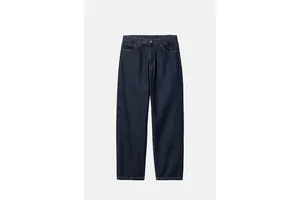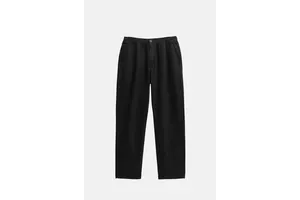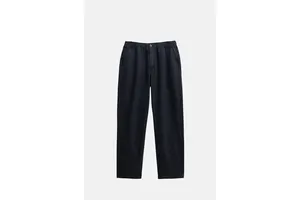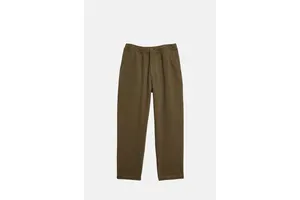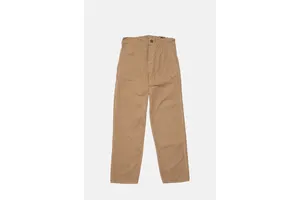
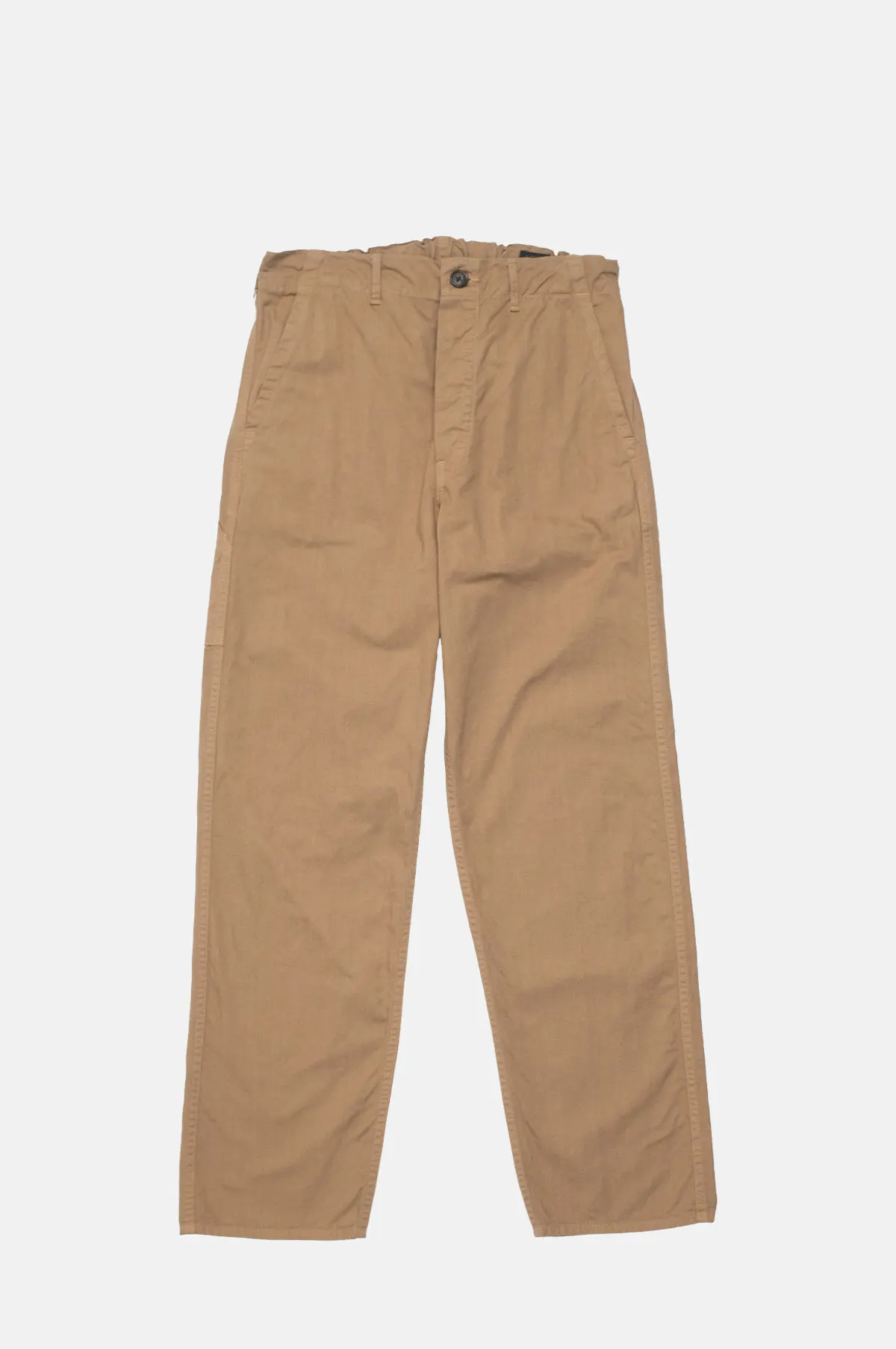

The French Work Pants in Khaki from orSlow, a Japanese house that makes interpretations of Americana classics with a focus on fabrication, cut from a garment dyed Japanese herringbone cotton with an elasticated waist, a button fly, two front slant pockets, two rear patch pockets and a utility pocket, listed at 185 GBP and in stock in one size of four. It is worth beginning with the size labels, because the run has been asking for a size conversion on every garment for a hundred batches and has almost never found one. It is worth then stating where it is here, which is in the column header, and it is worth then stating what each header reads, which is 2 slash 30, 3 slash 32, 4 slash 34 and 5 slash 36. It is worth then stating what the run should notice next, which is that 30, 32, 34 and 36 are the waist row underneath. It is worth then stating what that makes it, which is not a conversion at all but the garment's own waist restated in the header. It is worth then stating what the run asked for and what it got, which are different things, and it is worth then stating which is better, which is the one it got. It is worth then stating the second thing, which is the waist row's own label, and it is worth stating what it says, which is relaxed. It is worth then stating why it says that, which is that the waist is elasticated, and it is worth then stating what the run should conclude, which is that the fields a house fills in are the ones its construction forces it to. The reference is the French Work Pants. Dongguan Bafinasa Garments Co., Ltd. develops comparable woven trousers on OEM and ODM terms, from fabric and trim development to retail or FBA ready packing. We publish this as a development reference and build your own version of it, and we do not supply the branded original or reproduce anyone else's label.
Key Features
- The size conversion is in the column header, and it turns out to be the waist restated. See the note below
- Waist Relaxed: a measuring state, and it follows from the elasticated waistband. See the note below
- A quarter inch on the hem row, the finest grid in the run, and a zero step beside it. See the note below
- 30 degree wash: a washing temperature as a number, after a hundred garments without one
- Wash like colours together, which is the garment dye showing up in the care text. See the note below
- Eight bullets, and four of them are fields and four are prose. See the note below
- The bullets say right leg and the prose says left leg. See the note below
- Carry over: a season flag the run's own script has been throwing away. See the note below
Customisable Options
- Fabric: a garment dyed Japanese herringbone cotton to the reference with the weight in grams per square metre stated, or a piece dyed herringbone with the difference in handle and shrinkage stated, or a yarn dyed herringbone, each quoted separately. See the note below
- Waist: an elasticated waist to the reference with both the relaxed and the stretched measurement published, or a fixed waist with the measurement published once, each quoted separately. See the note below
- Chart: waist, inseam and hem as published here, plus the hip, the front and back rise and the thigh, each stated with its measurement point. See the note below
- Grade: a stated grade per row, so that a tapered grade is a choice on the record and not a thing a buyer has to infer. See the note below
- Care: a washing temperature as a number with a second cleaning method named, and an ironing temperature as a number
- Season: whether a style is new for the season or carried over, published as its own field. See the note below
- Composition with every share stated and summing to one hundred and published as its own field, the fabric weight in grams per square metre, the yarn count, the waist with its measuring state and both relaxed and stretched figures, the hip, the front and back rise, the thigh, the knee, the inseam, the hem, and the leg opening, each with its measurement point, a stated grade per row, the pocket count and placement with the leg named for any asymmetric pocket, the fly type, the waistband construction, a size conversion that says whether it maps to a body measurement or to a garment measurement, whether the style is new or carried over, an order of preference for cleaning with the washing temperature as a number and a second cleaning method named, an ironing temperature as a number, drying and storage guidance, shrinkage figures for both length and width, a pilling grade tested after a stated number of cycles, colour fastness to washing, rubbing, light and perspiration, and to any dye process used after making, a stock line for every size, size set, colour development, private label and care labelling
Specifications
| Style | Vintage French workwear trouser in garment dyed Japanese herringbone cotton with an elasticated waist and button fly |
| Reference | orSlow, French Work Pants, colour Khaki, sizes 2 to 5 |
| House | A Japanese house working on Americana classics, and the run should note three nationalities on one garment |
| Unit | Inches, stated in every row label, and the centimetre test does not take on any row |
| Column Count | Four, against four sizes on offer, so they match in both directions |
| Size Labels | 2, 3, 4 and 5, numeric and not lettered |
| Size Conversion | Given, as 2 / 30, 3 / 32, 4 / 34 and 5 / 36, and it is in the column header. See the note below |
| Conversion Meaning | It restates the waist row underneath, so it is a garment measurement and not a body scale. See the note below |
| Sizes Offered | 2, 3, 4 and 5, four sizes, and one of the four in stock |
| Sizes In Stock | Size 5 only, which is the largest. See the note below |
| Composition | 100% Cotton, as stated in a tab and in the bullets |
| Prose Against Specification | They agree, and there is one fibre |
| Fabric | Japanese herringbone cotton, garment dyed, as stated in the prose |
| Fabric Weight | Not stated as a number |
| Yarn Count | Not stated |
| Certification | None named |
| Fit Word | None given, and the run should note that a trouser with no fit word is unusual |
| Waist | Relaxed 30, 32, 34 and 36 in, and the steps are a uniform two inches |
| Waist Measuring State | Relaxed, as stated in the row label, the second measuring state in the run. See the note below |
| Waist Elastic | Elasticated, as stated in the bullets, so the stretched figure is missing. See the note below |
| Ease at the Waist | Minus 1 in at every size, and perfectly constant. See the note below |
| Hip | Not measured |
| Rise | Not measured |
| Thigh | Not measured |
| Inseam | 30.5, 31, 31.5 and 32 in, and the steps are a uniform half inch |
| Inseam Compared | A half inch grade against a two inch grade on the waist, on the same garment. See the note below |
| Ease on the Inseam | Not computable, because the run has no body inseam in its table. See the note below |
| Hem | 8, 8, 8.25 and 8.5 in, and the steps are 0, a quarter and a quarter |
| Hem Compared | The finest grid in the run, and the first quarter inch. See the note below |
| Hem Zero Step | Sizes 2 and 3 share an 8 in hem, the run's first plausible case of two sizes sharing a piece. See the note below |
| Ladder Uniformity | Waist uniform, inseam uniform, hem tapered with a zero step |
| Pockets | Two front slant, two rear patch with one buttoned, and one utility pocket, as stated |
| Pocket Contradiction | The bullets say right leg and the prose says left leg. See the note below |
| Fly | Button fly, as stated in the prose only and not in the bullets. See the note below |
| Waistband | Elasticated, as stated in the bullets |
| Care | 30 degree wash, do not bleach, do not tumble dry, cool iron, wash like colours together, as stated |
| Washing Temperature | 30 degrees, as a number, one of very few in this run. See the note below |
| Drying | Do not tumble dry, a prohibition and not a method. See the note below |
| Drying Compared | Both garments in this batch made in Japan prohibit tumble drying. See the note below |
| Ironing | Cool iron, a temperature word and not a number |
| Care From Construction | Wash like colours together follows from the garment dye. See the note below |
| Storage | Not stated |
| Production | Made in Japan, as stated in the prose, the bullets and the care tab |
| Country Names | Japanese craftsmanship, Americana classics, French workwear, three on one garment. See the note below |
| Season | Carry over, as stated in a tag the run's own script strips. See the note below |
| Bullet List | Eight, and four are fields and four are features. See the note below |
| Prose | Three sentences, and it styles the house name in lower case in one of them. See the note below |
| Measurements Published | Waist relaxed, inseam and hem for all four sizes |
| Photographs | One, and its upload stamp is far older than this batch's. See the note below |
| Style Number | 03-5000-02 40, as stated, and the run normalised the spacing. See the note below |
| Reference Retail | 185 GBP as listed, quoted to show the price band this sits in, not as our price |
| Category | Filed by the reference under trousers |
| Occasion | Everyday, work, weekends, spring and autumn |
| MOQ | 100 pcs per style per colourway, mixed sizes and colourways accepted |
| Sampling | 7-10 days after tech pack or reference sample confirmation |
| Bulk Lead Time | 20-30 days after sample approval and deposit |
| Service | OEM / DDM / private label, woven trouser sourcing with the fabric weight in grams per square metre and the yarn count stated, herringbone, twill, canvas and denim options, garment dye, piece dye and yarn dye development with the shrinkage and handle consequences of each stated and the colour fastness to the dye process tested and published, elasticated and fixed waistband development with both relaxed and stretched measurements published, button and zip fly development, pocket development with the leg named for any asymmetric pocket, trouser grading with a stated grade per row and the hip, front and back rise and thigh published, waist, hip, rise, thigh, inseam, hem and leg opening each with its measurement point, a size conversion that says whether it maps to a body measurement or to a garment measurement, whether the style is new or carried over published as a field, an order of preference for cleaning with the washing temperature as a number and a second cleaning method named, an ironing temperature as a number, drying and storage guidance, shrinkage measured in both directions and published, a pilling grade tested after a stated number of cycles, colour fastness to washing, rubbing, light and perspiration, a stock line for every size, size set, colour development, private label and care labelling, retail or FBA ready packing |
Size Chart as Published by the Reference
| Size | Waist Relaxed (inches) | Inseam (inches) | Hem (inches) |
|---|---|---|---|
| 2 / 30 | 30 in | 30.5 in | 8 in |
| 3 / 32 | 32 in | 31 in | 8 in |
| 4 / 34 | 34 in | 31.5 in | 8.25 in |
| 5 / 36 | 36 in | 32 in | 8.5 in |
The waist is given as a relaxed measurement, so it is an around figure and not a flat one, reading 30, 32, 34 and 36 in. Against men's bodies of roughly 31 to 37 in at the waist, the ease is minus 1 in at every size and does not drift. Note what that does to the run's formula: the garment grades two inches around and the body grades two, so the drift is zero, and observed drift is zero. Note that this is the same rule the run has been applying to chests, and it holds here, and it is the first time the run has applied it to a waist. Note what the run nearly wrote, which is that the formula had failed, and note why it had not: on a chest the run doubles a flat measurement, which doubles the grade, and here the measurement is already around. Note that this is the answer to a question the run asked early and never answered: the flat or round method matters because it scales the grade. Note the inseam, which grades half an inch while the waist grades two, and note what that shows: a grade is a property of the dimension and not of the garment, and the run has been loose about comparing grades between rows. Note the run has no body inseam in its table, so it cannot compute an inseam ease at all, and it should say so. Our proposal below publishes the hip, both rises, the thigh, the stretched waist, a stated grade per row and every measurement point.
Our Proposed Body Chart
| Size | Body Waist | Body Hips | Length | Source |
|---|---|---|---|---|
| 2 | 31 in / 79 cm | 37 in / 94 cm | 77 cm / 30.3 in | Our proposal |
| 3 | 33 in / 84 cm | 39 in / 99 cm | 79 cm / 31.1 in | Our proposal |
| 4 | 35 in / 89 cm | 41 in / 104 cm | 81 cm / 31.9 in | Our proposal |
| 5 | 37 in / 94 cm | 43 in / 109 cm | 83 cm / 32.7 in | Our proposal |
Occasions and Styling
Suits everyday wear, work, weekends and spring and autumn. A herringbone work trouser with an elasticated waist takes a boot or a shoe, and a utility pocket carries a phone without a bag.
Production and Quality Control
The reference publishes three measurements for all four sizes, gives a size conversion, states one fibre with a share and states it in two places, names its fabric and its dye process, describes its waistband, fly and every pocket, gives five care instructions including a washing temperature as a number and a prohibition on tumble drying, names its country, carries eight bullets and one photograph, and gives a style number. It gives no fabric weight as a number, no yarn count, no certification, no fit word, no hip, no rise, no thigh, no stretched waist figure, no leg opening, no measurement point on any row, no second cleaning method, no ironing temperature as a number, no storage guidance, no model, no shrinkage figure, no pilling grade and no colour fastness figure, no statement of whether any figure is flat or round, and no wash fastness for the dye process it names. Three things follow: what the run found is better than what it asked for; the fields a house fills in are the ones its construction forces; and the run has been discarding a season flag.
Thirty-two-thirty-four-thirty-six, and that is the first thing, and it is worth saying what the run has been asking for. It is worth then stating what it has been asking for, which is a size conversion, and it is worth then stating how often it has found one, which is almost never in a hundred garments. It is worth then stating where this one is, which is in the column header, and it is worth then stating what the run should learn from that, which is to look in the header and not only in a field. It is worth then stating what the run noticed next, which is that 30, 32, 34 and 36 are also the waist row. It is worth then stating what that makes this, which is not a conversion but the waist restated. It is worth then stating what the run asked for and what it got, which are two different things, and it is worth then stating which is more useful, which is the one it got: a buyer who knows their waist can read the size directly. It is worth then stating what the second garment in this batch gives, which is a conversion to 40, 42, 44, 46 and 48, and it is worth then stating what those are, which is twice the pit to pit, so a derived garment measurement. It is worth then stating what that settles: size conversion is at least two different things, and the run has been asking for it as though it were one. It is worth then stating which is useful to a buyer who does not know their number, which is only the first kind. It is worth then stating the second thing, which is the waist label. It is worth then stating what it says, which is relaxed, and it is worth then stating why, which is that the waistband is elasticated. It is worth then stating what is missing, which is the stretched figure, and it is worth then stating what an elasticated waist needs, which is both, because the gap between them is the whole of what a buyer is choosing. It is worth then stating the generalisation, which is that the fields a house fills in are the ones its construction forces it to, and it is worth then stating the test, which is that a garment without elastic should not say relaxed, and it is worth then stating that the run has several such garments and none of them do.
Right and left, and that is the second thing, and it is worth saying what the run found. It is worth then stating what the bullets say, which is a right leg utility pocket, and it is worth then stating what the prose says, which is a single utility pocket on the left leg. It is worth then stating what that is, which is a contradiction on one page, and it is worth then stating what kind of error it is, which is the kind no spelling check catches and the kind a buyer acts on. It is worth then stating what the run should say about which is right, which is that it does not know. It is worth then stating what the run should add, which is that this is the second prose conflict it has found after the heavyweight light grey one, and it is worth then stating how they differ, which is that the first was ambiguous and correct and this one is an error. It is worth then stating the third thing, which is the season flag. It is worth then stating what the tag says, which is carry over, and it is worth then stating what the run's own script does with it, which is strip it, because the script strips any tag beginning with two underscores. It is worth then stating what that assumption is worth, which is wrong: carry over is a season flag about the garment and not a platform flag, and it is worth then stating how many garments in this batch carry it, which is two of three. It is worth then stating what the run has been throwing away, which is whether a style is new for the season or carried over, and it is worth then stating that this is commercial information it has never once recorded. It is worth then stating the fix, which is to strip zoom by name and keep carry over, and it is worth then stating that the run should also stop assuming the underscore prefix means anything at all.
Optional upgrades include the fabric weight in grams per square metre, the yarn count, the hip, the front and back rise, the thigh, the knee, the leg opening, the stretched waist figure, a measurement point on every row, a stated grade per row, a second cleaning method, an ironing temperature as a number, storage guidance, shrinkage figures for both length and width, a pilling grade tested after a stated number of cycles, colour fastness to washing, rubbing, light and perspiration, wash fastness for the garment dye process, piece dyed and yarn dyed options, fixed waistband and zip fly options, further colourways, size set, private label and care labelling.
Pre-production sample approval, in-line inspection during cutting and sewing, and a final AQL inspection before packing, with measurement reports and photos shared before shipment.
Send us your tech pack, a photo or a reference garment and we will quote within 24 hours. Contact bafinasa@bafinasa.com or WhatsApp +86 13827222469.