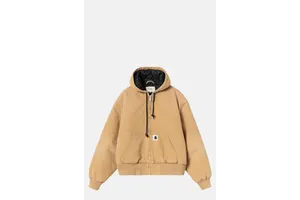
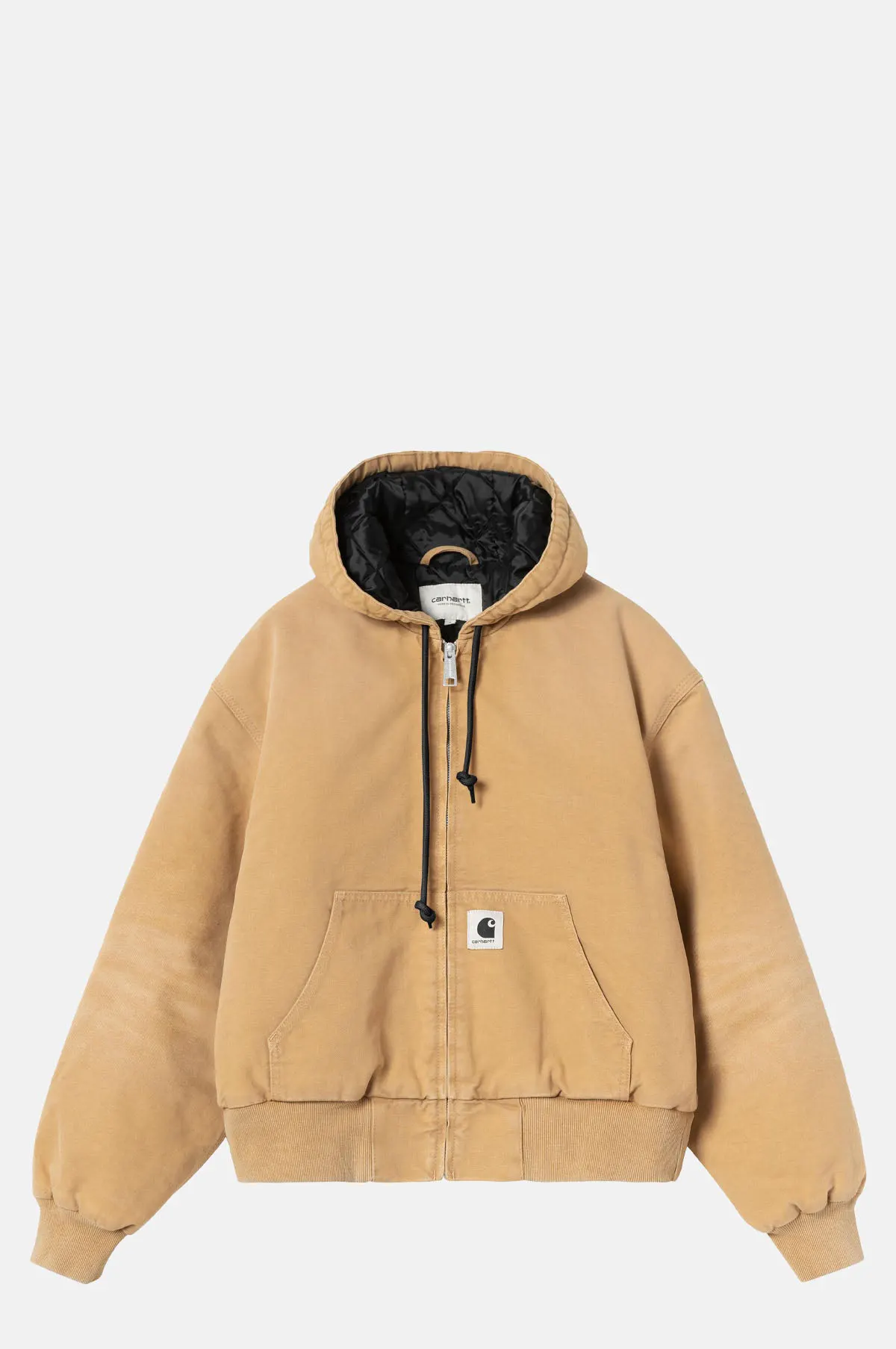

The OG Active Jacket from Carhartt WIP in a soft honey brown, cut in an original loose fit from heavyweight 13.5 oz cotton denim with a diamond quilted lining and warm padding, triple stitch detailing, rib knit cuffs and an adjustable hood, listed at 225 GBP with all four sizes in stock. It is the most complex garment this run has examined and it carries the shortest care label, and that inversion is the sharpest one the run has found. Three fibre systems, a quilt, a wadding, a rib, a zip, a drawcord and two pockets, and one line of care: machine washable up to forty degrees. The 35 GBP T-shirt published alongside it has three, including a named wash cycle. Six times the price, a third of the information, on the garment most likely to be ruined by being washed wrong. It is also only the second garment in this run to state a fabric weight, and the number is the same 13.5 oz the brand puts on its denim jeans, which tells a reader that the brand has a house denim weight and simply declines to print it on one product in three. And its three measurement columns all fail the run's test, all with the same signature, which is worth setting out because this run has rarely met a garment where the columns fail rather than the cloth. The reference is the OG Active Jacket in Dusty H. Dongguan Bafinasa Garments Co., Ltd. develops comparable outerwear on OEM and ODM terms, from shell, lining and wadding sourcing to retail or FBA ready packing. We publish this as a development reference and build your own version of it, and we do not supply the branded original or reproduce anyone else's label.
Key Features
- 13.5 oz cotton denim as stated, the second fabric weight in a proper unit in this run and the same figure the brand uses on its jeans
- Diamond quilted lining with warm padding as stated, and substantial insulation, with no wadding weight, no loft and no temperature rating. See the note below
- Shell in 100% cotton, lining in 100% nylon and padding in 100% polyester, all stated, with the rib knit trims absent from the panel. See the note below
- Triple stitch detailing as stated, a genuine construction specification, with no location, no stitch density and no thread given. See the note below
- Machine washable up to 40 degrees as the entire care label, one clause on a three layer padded jacket. See the note below
- Chest 53, 54, 60 and 61 cm, sleeve 57, 58, 60 and 61 and length 56, 57, 60 and 61, and all three columns fail the test with the same signature. See the note below
- Ease about 10.7, 9.5, 12.2 and 11.0 in, so the small is the least loose in the range and the medium the most. See the note below
Customisable Options
- Shell: 13.5 oz cotton denim to the reference, with the finish stated, or a 12 oz denim, or a lighter 10 oz, or a cotton canvas, each quoted separately
- Insulation: quilted wadding to the reference, with the wadding weight and the diamond size stated, or a heavier fill, or a lighter fill, or a down fill, each quoted separately
- Lining: quilted nylon to the reference, with the denier and the weave stated, or a taffeta lining, or a brushed lining, each quoted separately
- Fit: loose to the reference, with the ease at every size published, or a regular fit, or a boxier fit, each quoted separately
- Trims: rib knit cuffs and bottom band to the reference, with the rib composition, depth and structure stated, or a plain hem, or an elasticated hem, each quoted separately
- Hardware: full length zip to the reference, with the brand, the type and the length stated, or a zip with a storm flap, or a button placket, each quoted separately
- Wadding weight in grams per square metre, shell weight in ounces, lining denier and weave, quilt diamond size, rib composition and depth, zip brand and type, hood dimensions and drawcord specification, pocket dimensions, size set, colour development, private label and care labelling
Specifications
| Style | Loose fit padded jacket with a quilted lining, an adjustable hood and rib knit trims |
| Reference | Carhartt WIP, OG Active Jacket, style I035673, dusty H, sizes XS to L |
| Shell Composition | 100% cotton as stated in the panel, described as 13.5 oz denim. See the note below |
| Shell Weight | 13.5 oz as stated, the second fabric weight in a proper unit in this run. See the note below |
| Lining Composition | 100% nylon as stated in the panel, with no denier and no weave given. See the note below |
| Quilt | Diamond quilted as stated, with no diamond size and no quilt spacing given. See the note below |
| Padding Composition | 100% polyester as stated in the panel, with no weight, no loft and no thermal rating given. See the note below |
| Insulation | Warm padding providing substantial insulation as stated, with nothing quantified. See the note below |
| Rib | Rib knit cuffs and bottom band as stated, with no rib composition, no depth and no structure, and the rib absent from the composition panel. See the note below |
| Fit Word | Original loose fit as stated, with no explanation of what original denotes. See the note below |
| Hood | Adjustable hood with drawcord as stated, with no hood dimensions, no drawcord specification and nothing about whether the hood is lined. See the note below |
| Closure | Full length zip fastening as stated, with no zip brand, no zip type, no length and nothing about a storm flap. See the note below |
| Pockets | Kangaroo pocket and internal chest pocket as stated, with no dimensions and no pocket bag composition given. See the note below |
| Construction | Triple stitch detailing for durability as stated, with no location, no stitch density and no thread given. See the note below |
| Trims | Woven Carhartt WIP square label as stated, with no size and no position given |
| Finish | Faded and lived in as stated, with no explanation of how the fade is produced. See the note below |
| Care | Machine washable up to 40 degrees as stated, and nothing else. See the note below |
| Certification | None named, and no recycled content claimed for the polyester padding |
| Sizes Offered | XS, S, M and L, four sizes, all four in stock at the time of writing |
| Size Conversion | Not applicable, since the sizes are letter sizes |
| Fit Guidance | None published beyond the fit word |
| Model | None published, unlike the same brand's jeans |
| Measurements Published | Pit to pit, sleeve length and total length for all four sizes. See the note below |
| Published Chest | 53, 54, 60 and 61 cm flat. See the note below |
| Chest Around | 106, 108, 120 and 122 cm, or 41.73, 42.52, 47.24 and 48.03 in. See the note below |
| True Chest Grade | None: no uniform grade rounds to this column. See the note below |
| Ease Against Body Bust | About 10.7, 9.5, 12.2 and 11.0 in, so it is not steady. See the note below |
| Published Sleeve | 57, 58, 60 and 61 cm, stepping 1, 2 and 1. See the note below |
| Published Length | 56, 57, 60 and 61 cm, stepping 1, 3 and 1. See the note below |
| Wadding Weight | Not stated. See the note below |
| Lining Denier | Not stated. See the note below |
| Rib Specification | None. See the note below |
| Photographs | Three, and none shows the quilted lining. See the note below |
| Production | Made in Tunisia as stated, with no certification named |
| Reference Retail | 225 GBP as listed, quoted to show the price band this sits in, not as our price |
| Category | Filed by the reference under coats and jackets |
| Occasion | Autumn and winter, outerwear, workwear |
| MOQ | 100 pcs per style per colourway, mixed sizes and colourways accepted |
| Sampling | 7-10 days after tech pack or reference sample confirmation |
| Bulk Lead Time | 20-30 days after sample approval and deposit |
| Service | OEM / ODM / private label, denim and canvas shell sourcing by weight in ounces, wadding sourcing by weight in grams per square metre, quilt development, rib trim development, hardware sourcing, wash testing and shrinkage control, retail or FBA ready packing |
Size Chart as Published by the Reference
| Size | Pit To Pit (flat) | Sleeve Length | Total Length |
|---|---|---|---|
| XS | 53 cm | 57 cm | 56 cm |
| S | 54 cm | 58 cm | 57 cm |
| M | 60 cm | 60 cm | 60 cm |
| L | 61 cm | 61 cm | 61 cm |
The chest figures are flat half measures taken with the jacket laid down, doubling to 106, 108, 120 and 122 cm around, or 41.73, 42.52, 47.24 and 48.03 in. Against a body bust of 31, 33, 35 and 37 in across XS to L, the ease is about 10.7, 9.5, 12.2 and 11.0 in, so it is not steady across the range. All three columns step small, large, small and none of them is a uniform grade.
Our Proposed Body Chart
| Size | Body Bust | Sleeve | Body Waist | Body Hips | Length | Source |
|---|---|---|---|---|---|---|
| XS | 31 in / 79 cm | 57 cm | 24 in / 61 cm | 34 in / 86 cm | 56 cm / 22 in | Our proposal |
| S | 33 in / 84 cm | 58 cm | 26 in / 66 cm | 36 in / 91 cm | 58 cm / 22.8 in | Our proposal |
| M | 35 in / 89 cm | 59 cm | 28 in / 71 cm | 38 in / 97 cm | 60 cm / 23.6 in | Our proposal |
| L | 37 in / 94 cm | 60 cm | 30 in / 76 cm | 40 in / 102 cm | 62 cm / 24.4 in | Our proposal |
Occasions and Styling
Suits autumn and winter and outerwear. A padded denim jacket in a faded brown is a workwear piece for cold days, and the loose fit leaves room for a knit underneath.
Production and Quality Control
The reference publishes three columns for all four sizes, states the shell, the lining and the padding separately, states the shell weight in ounces, names the quilt, the insulation, the rib, the hood, the closure, the pockets, the triple stitch construction and the trims, describes the finish, gives a care instruction, names the country of production and carries three photographs. It gives no wadding weight, no thermal rating, no lining denier or weave, no quilt dimensions, no rib composition or specification, no zip specification, no hood or drawcord specification, no pocket dimensions and no stitch density, and publishes no fit guidance beyond one word and no model information. Three things follow: the specification that is given and the specification that matters, the care label on the most complex garment in the run, and the three columns that fail together.
Thirteen point five ounces on the outside and nothing at all on the inside, and that is the first thing, and the inversion is worth stating slowly because it is the clearest example this run has found of specification being aimed at the wrong target. The shell is 100% cotton denim and the brand states its weight: 13.5 oz. That deserves real credit. It is only the second garment in this entire run to publish a fabric weight in a proper unit, and both of them are this brand, and both are 13.5 oz, which means the brand has a house denim weight and uses it on its jeans and on this jacket. It also retroactively sharpens a criticism this run made last batch: the Jane jean was called heavyweight with no number, and the run inferred the number from the neighbouring product. Now there is a third product confirming 13.5 oz, so the inference was sound and the omission on that one product is harder to excuse. But here is the inversion. On a padded winter jacket, the shell is the layer that contributes least to the thing the garment is for. It keeps the wind off and it takes the abuse, and that is worth something, but the warmth comes from the wadding. And the wadding has no number. Not its weight in grams per square metre, which is how wadding is bought and specified worldwide. Not its loft. Not a thermal rating, not a temperature range, nothing. The page calls it warm padding and substantial insulation, which are two words doing the work of a number, and this run has now met that shape on cashmere, on alpaca, on corduroy and on jersey. It is the brand's habit rather than this page's slip. It is worth adding what is missing one layer down, because the lining is specified no better. It is 100% nylon and quilted, and nylon lining is specified by denier and by weave, and neither is given, and neither is the size of the diamond in the quilting, which sets both the warmth and the hand. So the layer the garment is named and priced for is the one layer with nothing behind it. It is worth closing this on the rib, because it is the sharpest single gap on the page. The jacket has rib knit cuffs and a bottom band, and the composition panel lists three things: shell, lining and padding. The rib is not among them. So the fibre content of the trims is simply absent, and on a jacket the cuffs are what touch the wrists all day and what wear out first. Rib on a workwear garment of this kind almost always carries elastane for recovery, and a reader cannot know whether it does. It is worth putting one more credit on the table while the construction is open, because this page does something almost no page in this run does. It states triple stitch detailing. That is a real construction specification, not a marketing word, and on a workwear jacket it is exactly the right thing to say. It is not located, the stitch density is not given and the thread is not named, so it is a specification without the numbers that would let anyone compare it, but the run will credit the intent.
One clause, on three fibre systems, and that is the second thing, and it is the sharpest price inversion in this run. The care label reads machine washable up to forty degrees. That is all. This is a garment with a 13.5 oz cotton denim shell, a quilted nylon lining, a polyester wadding, rib knit trims, a zip, a drawcord and two pockets, and it is told to wash at forty with no further instruction. Set that beside the 35 GBP T-shirt published in the same batch, which gets a maximum temperature, a named delicate cycle and a prohibition on tumble drying. Six times the price and a third of the information, on the garment far more likely to be damaged. And it is worth being specific about why one clause is not nearly enough here, because the risks are concrete and none of them is fanciful. A quilted padded garment can have its wadding shift or clump in a washing machine, and there is no instruction about the cycle that would prevent it, no instruction to wash inside out, and no instruction about spin speed. Nylon, polyester and cotton shrink at different rates and the garment is built from all three, and there is no shrinkage figure and nothing about whether the shell was sanforized. There is no drying instruction at all, and a padded jacket is the garment that takes longest to dry and most needs to be dried thoroughly, since wadding left damp will mildew. There is no ironing instruction, and a denim shell with a nylon lining has two different tolerances for heat. And there is nothing about the colour: the jacket is described as faded and lived in, which is a finish, and washing at forty will advance it, and a customer who likes the fade as it is should be told that. It is worth adding the control that makes this harder to excuse, which is the same brand's own jeans. Those say wash inside out, and give a tumble drying setting and an ironing setting. So the brand writes four part care labels when it chooses to, on a simple garment, and writes one clause on its most complex one. It is worth ending this on the photographs, which are the same story. Three of them, for a jacket at 225 GBP with a hood, a kangaroo pocket, an internal chest pocket and a diamond quilted lining. The quilt is named in the description and in the first bullet, and no photograph shows the inside of the garment. This run has now met that shape repeatedly: a feature named in the copy and absent from the pictures, because the pictures are of the outside.
Small, large, small, three times over, and that is the third thing. The chest reads 53, 54, 60 and 61. The sleeve reads 57, 58, 60 and 61. The length reads 56, 57, 60 and 61. All three step by one from extra small to small, then by a large amount from small to medium, then by one again from medium to large. And none of the three passes the test: no uniform grade rounds to any of them. That all three fail in the same shape is what makes this worth reporting rather than shrugging at, because three independent dimensions do not stumble in lockstep by accident. There is a systematic cause, and the run can offer the two candidates and cannot choose between them from the outside. The first is the pattern itself: a garment graded in two blocks, with the small step inside each block and the larger step between them, would produce exactly this signature, and this run has met the same signature on the ribbed tee published alongside this one, which is a different garment in a different cloth from the same brand. The second is the cloth: this is a padded, quilted, lined jacket, and it does not lie flat. How far a thick springy garment is pressed down before the tape goes across it moves every laid flat dimension on it, and no page says how firmly. The run has a strong reason to take the second seriously, because it has just watched the same thing happen on a ribbed stretch tee from this same brand, and because the one garment from this brand whose columns came out clean is the plain jersey tee, which lies flatter than either. Whichever it is, the consequence is the same and it is not small. The published step from small to medium is 6 centimetres flat, which is 12 centimetres of circumference, or 4.72 inches. The average step across the range is about 2.7 centimetres flat, or 2.09 inches. So a customer moving from a small to a medium is told she gains 4.72 inches of chest and may in truth gain about half that, on the transition more customers make than any other. It is worth adding what the ease does, because on this garment it matters more than on most. The ease works out at about 10.7, 9.5, 12.2 and 11.0 inches, and it is not steady. It falls from extra small to small, jumps by nearly three inches to medium, then falls again to large. So the small is the least generous jacket in the range at about 9.5 inches and the medium is the most generous at about 12.2. And this is a winter jacket, which is the garment type where the ease is not a matter of silhouette but of what fits underneath. The difference between 9.5 and 12.2 inches is the difference between a jacket that takes a jumper and one that takes a shirt. The size in the range least likely to fit over a knit is the small, and nothing on the page warns about it. Every bulk shipment gets a measurement report against your approved chart.
Optional upgrades include quoting the wadding weight in grams per square metre and the loft, adding a thermal rating or a temperature range, giving the lining denier and weave, giving the quilt diamond size and spacing, stating the rib composition, depth and structure, giving the zip brand, type and length and saying whether there is a storm flap, giving the hood dimensions and the drawcord specification, giving the pocket dimensions and the pocket bag composition, giving the stitch density and the thread, extending the care label to cover the cycle, spin speed, drying, ironing, shrinkage and colour behaviour, adding fit guidance and a model height, photographing the quilted lining, a 12 oz and a 10 oz shell, a canvas shell, heavier and lighter fills, a down fill, taffeta and brushed linings, plain hem and elasticated hem options, a zip with a storm flap and a button placket, regular and boxier fit options, size set, colour development, private label, hangtag and care labelling.
Pre-production sample approval, in-line inspection during cutting and sewing, and a final AQL inspection before packing, with measurement reports and photos shared before shipment.
Send us your tech pack, a photo or a reference garment and we will quote within 24 hours. Contact bafinasa@bafinasa.com or WhatsApp +86 13827222469.