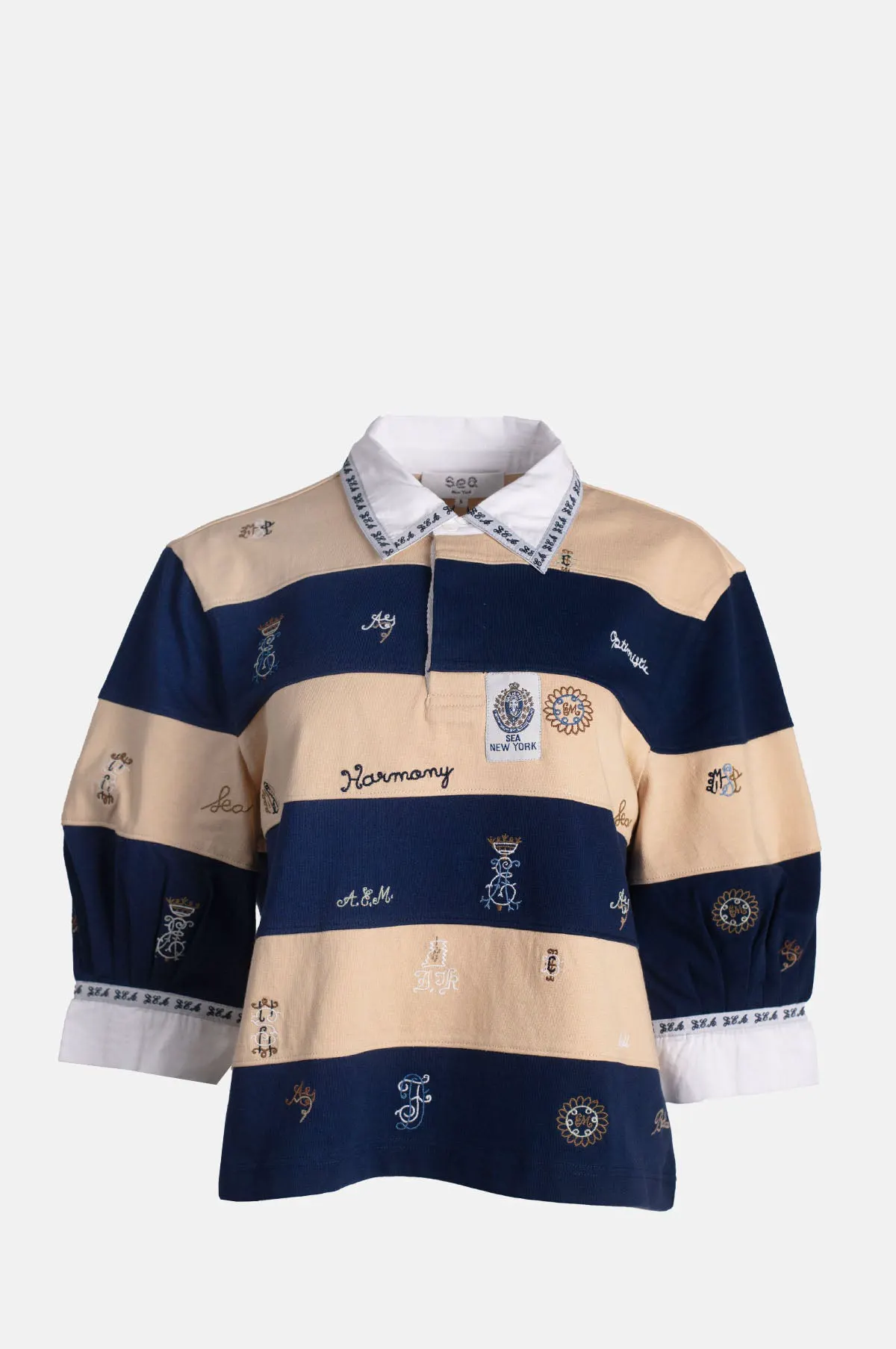

The Juliet from Sea New York, a rugby shirt in a navy and butterscotch stripe with short puff sleeves, embroidered detailing, a button placket and a ribbon trim collar, listed at 355 GBP with all four sizes in stock. It is worth beginning with the chart, and specifically with the contrast it makes, because this brand published a garment in the batch immediately before this one whose chart was the cleanest this run has yet found. That one stepped two, two and two across the bust, one, one and one down the sleeve and one, one and one down the length, every column perfectly regular. This one goes 51, 54, 55 and 58 centimetres across the pit to pit. That is a step of three, then a step of one, then a step of two. No uniform grade produces it. And it is worth saying plainly what that means, because it is the useful part: the brand is not unable to grade. It demonstrated, one garment ago, that it grades properly and publishes exactly what it drew. So this is not a house without a standard. It is a house that applies one sometimes. A customer comparing two garments on the same page of the same brand is entitled to assume the numbers mean the same thing, and here they do not even step evenly within themselves. The sleeve is the second thing worth setting out, and it is worse than a matter of grading. The sleeve reads 39, 40, 41 and 42 centimetres, which is clean, and the bullet says short puff sleeves. On the garment this brand published alongside it, the sleeve reads 28 to 31 centimetres and the bullet says short puffed sleeves. Same brand, same sleeve description, eleven centimetres apart. Two garments called short, and one of them is nearly forty per cent longer than the other. The reference is the Juliet Rugby Top. Dongguan Bafinasa Garments Co., Ltd. develops comparable tops and shirts on OEM and ODM terms, from cloth sourcing and embroidery development to retail or FBA ready packing. We publish this as a development reference and build your own version of it, and we do not supply the branded original or reproduce anyone else's label.
Key Features
- Pit to pit stepping 3, 1 and 2 cm, from the same brand that published a perfectly graded chart one garment earlier. See the note below
- A sleeve of 39 to 42 cm called short puff, against 28 to 31 cm called short puffed on another garment from this brand. See the note below
- Total length frozen at 60 cm across all four sizes while the bust grows by 7 cm. See the note below
- 100% cotton with a dry clean only label, on a rugby shirt. See the note below
- A separate composition line for the embroidery, 100% polyester, the second from this brand. See the note below
- Navy and butterscotch, navy and brown, and multi, three colour names on one page. See the note below
- Designed for a relaxed fit as stated, on a chart whose bust does not grade. See the note below
Customisable Options
- Cloth: cotton to the reference, with the weight in grams per square metre stated, or a cotton jersey, or a cotton pique, or a cotton and linen mix, each quoted separately
- Embroidery: embroidered detailing to the reference, with the motif count, size and placement stated, or a crest embroidery, or a logo embroidery, or no embroidery, each quoted separately
- Embroidery Thread: polyester to the reference, with the thread type stated, or cotton thread, or viscose thread, each quoted separately
- Sleeve: short puff sleeves to the reference, with the sleeve opening and the puff volume stated, or a plain short sleeve, or a long sleeve, or a raglan sleeve, each quoted separately
- Collar: ribbon trim collar to the reference, with the ribbon width stated, or a plain rugby collar, or a contrast collar, each quoted separately
- Length: cropped to the reference, with the length graded across the sizes and the target length agreed, or a regular length, or a longline, each quoted separately
- Care: a washable construction with the embroidery and trims wash tested, or dry clean only to the reference, each quoted separately. See the note below
- Cloth weight, embroidery motif count, size and placement, stripe width and repeat, collar ribbon width, sleeve opening and puff volume, placket button count and size, label size and placement, wash testing on the embroidery and trims, size set, colour development, private label and care labelling
Specifications
| Style | Cropped rugby shirt with a button placket, short puff sleeves and a ribbon trim collar |
| Reference | Sea New York, Juliet Rugby Top, style PF26-127, colour multi, sizes XS to L |
| Composition | Self 100% cotton, and embroidery 100% polyester, both stated. See the note below |
| Embroidery Fibre | Declared separately as 100% polyester, the second garment from this brand to do so. See the note below |
| Cloth Weight | Not stated |
| Handle | Not stated |
| Fit Word | Relaxed fit, stated as designed for a relaxed fit. See the note below |
| Fit Statement | Designed for a relaxed fit as stated. See the note below |
| Length | Cropped as stated, and 60 cm at every size. See the note below |
| Neck | Rugby collar with ribbon trim as stated, with no collar measurement and no ribbon width given |
| Sleeve | Short puff sleeves as stated, measured at 39 to 42 cm, with no sleeve opening and no puff volume given. See the note below |
| Placket | Button front closure and button placket as stated, with no button count and no button size given |
| Embroidery | Intricate embroidered detailing as stated, with no motif count, no size and no placement given. See the note below |
| Labels | Custom Sea labels as stated, with no size, no placement and no material given |
| Pattern | Navy and butterscotch stripe as stated, with no stripe width and no repeat given. See the note below |
| Colour | Multi in the title, navy and brown in the bullets, navy and butterscotch in the description. See the note below |
| Care | Dry clean only as stated, on 100% cotton. See the note below |
| Certification | None named |
| Sizes Offered | XS, S, M and L, four sizes, all four in stock at the time of writing |
| Size Conversion | None published |
| Fit Guidance | Designed for a relaxed fit as stated, which is more than most pages give. See the note below |
| Model | None published |
| Measurements Published | Pit to pit, sleeve length and total length for all four sizes. See the note below |
| Published Bust | 51, 54, 55 and 58 cm pit to pit, stepping 3, 1 and 2. See the note below |
| Bust Around | 102, 108, 110 and 116 cm, or 40.16, 42.52, 43.31 and 45.67 in. See the note below |
| Published Sleeve Length | 39, 40, 41 and 42 cm, stepping exactly 1 cm at every step, so the sleeve grades. See the note below |
| Published Total Length | 60 cm at every size, frozen across all four. See the note below |
| Sleeve Grade | About 1 cm per size, and clean. See the note below |
| Cloth Weight | Not stated |
| Photographs | Six |
| Production | Made in India as stated, with no certification named |
| Reference Retail | 355 GBP as listed, quoted to show the price band this sits in, not as our price |
| Category | Filed by the reference under tops |
| Occasion | Autumn and winter, everyday, smart casual |
| MOQ | 100 pcs per style per colourway, mixed sizes and colourways accepted |
| Sampling | 7-10 days after tech pack or reference sample confirmation |
| Bulk Lead Time | 20-30 days after sample approval and deposit |
| Service | OEM / ODM / private label, cotton sourcing by weight, stripe development with the repeat set, embroidery development with motif and stitch specification, puffed sleeve and rugby collar pattern development, retail or FBA ready packing |
Size Chart as Published by the Reference
| Size | Pit to pit (flat) | Sleeve Length | Total Length |
|---|---|---|---|
| XS | 51 cm | 39 cm | 60 cm |
| S | 54 cm | 40 cm | 60 cm |
| M | 55 cm | 41 cm | 60 cm |
| L | 58 cm | 42 cm | 60 cm |
The pit to pit figures are flat half measures taken with the top laid down, doubling to 102, 108, 110 and 116 cm around, or 40.16, 42.52, 43.31 and 45.67 in. The bust steps 3, 1 and 2 cm, which no uniform grade produces. The sleeve length runs 39 to 42 cm and the total length is 60 cm at all four sizes. No size conversion is published for XS to L.
Our Proposed Body Chart
| Size | Body Bust | Sleeve | Body Waist | Body Hips | Length | Source |
|---|---|---|---|---|---|---|
| XS | 31 in / 79 cm | 39 cm | 24 in / 61 cm | 34 in / 86 cm | 60 cm / 23.6 in | Our proposal |
| S | 33 in / 84 cm | 40 cm | 26 in / 66 cm | 36 in / 91 cm | 62 cm / 24.4 in | Our proposal |
| M | 35 in / 89 cm | 41 cm | 28 in / 71 cm | 38 in / 97 cm | 64 cm / 25.2 in | Our proposal |
| L | 37 in / 94 cm | 42 cm | 30 in / 76 cm | 40 in / 102 cm | 66 cm / 26 in | Our proposal |
Occasions and Styling
Suits autumn and winter and everyday dressing. A striped rugby top with puff sleeves reads more considered than a sweatshirt and works with a wide trouser or a straight jean.
Production and Quality Control
The reference publishes three columns for all four sizes, has all four sizes in stock, gives two separate composition lines including one for the embroidery, states the fit, describes the collar, the placket, the sleeves, the labels and the embroidery, names the country of production and carries six photographs. It gives no cloth weight, no embroidery motif count, size or placement, no stripe width or repeat, no collar measurement or ribbon width, no sleeve opening, no button count or size, no label specification, no size conversion, no model and no wash testing, and its chart does not grade. Three things follow: the grade that broke one garment after the same brand published a perfect one, the sleeve that contradicts the brand's own other sleeve, and the care label on the most washable fibre there is.
Three, one, two, and that is the first thing, and it is worth setting out because of what it sits next to. The pit to pit across XS, S, M and L is 51, 54, 55 and 58 centimetres. That is a step of three, then one, then two. This run tests every chart it meets against a single uniform grade, and the test is a narrow one: does any one number, added repeatedly and rounded to the nearest centimetre, reproduce the published column. Here the first two steps alone rule it out, because a step of three at the first size wants a grade of at least 2.5, and a step of one at the second wants at most 2.25. No single number satisfies both. Now, on its own that would be an unremarkable finding, because this run has failed a great many charts on exactly this test. What makes it worth writing about is the garment next to it. One garment earlier in this same run, from this same brand, in this same size range, the chart was 47, 49, 51, 53 across the pit to pit, 28, 29, 30, 31 down the sleeve and 46, 47, 48, 49 down the length. Nine steps, every one of them regular. It was the first entirely clean chart this run had found in dozens of garments, and this run credited the brand for it without hedging. So the conclusion here is not that this brand cannot grade. It plainly can, and it published proof of it. The conclusion is that it does not always, and that a customer has no way of knowing which garment she is looking at. And this run wants to be precise about why that matters more than a rounding error would. A column that steps three, one, two is not a column that is slightly imprecise. It is a column whose increments are larger than the gaps between some of the sizes, so the garment gets wider by three centimetres between two sizes and then by one between the next two. Two customers one size apart can end up with garments two centimetres different, and two customers one size apart elsewhere end up with garments one centimetre different. That is not a grade. It is four numbers. It is worth adding what is frozen, because it compounds. The total length is 60 centimetres at every size. So the top gets seven centimetres wider from XS to L and not one millimetre longer. The proportion changes systematically across the range, and a size L customer is wearing a garment cut to the same length as the XS with fourteen centimetres more cloth in the body. And there is no model, so nobody can see where 60 centimetres falls on anybody.
Thirty nine and twenty eight, and that is the second thing, and it is the sharpest contradiction in this batch. The sleeve on this garment reads 39, 40, 41 and 42 centimetres, and the bullet says short puff sleeves. The garment this brand published alongside it reads 28, 29, 30 and 31 centimetres down the sleeve, and its bullet says short puffed sleeves. Same brand, same size set, same sleeve construction described in almost the same words, and eleven centimetres between them. The one called short is longer than the other by more than a third. Now this run wants to be careful, because there is a benign explanation and it should be stated. A sleeve can be measured from the shoulder seam or from the centre back neck, and the difference between those two origins on a garment with a wide neckline can be several centimetres. But that is precisely the problem rather than a defence of it: the page never says which one it uses. So two garments on one brand's site carry sleeve numbers that cannot be compared with each other, and neither says where the tape starts. And it is worth widening this, because this batch makes the point very cleanly. Across the three garments in this batch there are three sleeve descriptions and three sleeve numbers. A short puff sleeve at 39 to 42 centimetres. An elbow length sleeve at 20 to 23 centimetres. An elbow length sleeve at 29 centimetres. So the word short describes a sleeve nearly twice as long as the one called elbow length, and the word elbow describes two sleeves six centimetres apart. The vocabulary has come loose from the measurements entirely. This run has spent this run finding individual words that disagree with individual numbers: a rise called mid that measures high, an inseam called ankle that measures cropped, a fit claim of true to size on a garment three inches over its label. This is the same failure, but it is worse, because it is not one word failing once. It is a whole category of measurement that has no fixed meaning from one page to the next.
Dry clean only, and that is the third thing, and this run has to say that this is the most pointed instance of it yet. The self is 100% cotton. Cotton is the most washable cloth in this run, and it is the fibre this run has used throughout as the benchmark for what does not need special handling. And the label says dry clean only. It is worth placing it, because the tally now matters: this run has met dry clean only on silk, on wool, on viscose, on linen, on polyester, on a linen and cotton mix, and now on pure cotton. It has been applied to the most delicate fibre this run has looked at and to the least, with equal confidence, which means the instruction carries no information whatsoever about the cloth. And here is the part that sharpens it: the garment is a rugby shirt. The description calls it a collegiate classic and says it looks like it could have been pulled straight from an Old Rugbeians yearbook. A rugby shirt is a garment whose entire heritage is being worn on a pitch, getting muddy, and being put in a washing machine. And this one cannot be washed. Now, there are plausible reasons, and the page supplies them without stating them. There is 100% polyester embroidery, custom labels, and a ribbon trim on the collar, and any of those can be the reason a cotton garment is restricted. But the label does not say which, and it does not say that a gentler wash would be acceptable, and there is no evidence the garment was ever wash tested. It is worth adding what else is missing from the care instruction, because it is two words. No temperature, since there is no water. No cycle, no detergent, no bleaching, no drying, no ironing, no shrinkage figure and no colourfastness figure, on a striped cotton garment where a colourfastness number is exactly what a customer wants before she commits. It is worth closing on what the page does get right, because this run has been hard on it and there is real credit here. The composition panel gives the embroidery its own line, at 100% polyester, and this brand did the same thing on the garment it published immediately before this one. So it is a house practice rather than a one off, and that makes it worth more, because declaring a trim separately is not standard and it is the right thing to do. There is a fit statement, which is more than most pages in this run give. The sleeve column grades cleanly at one centimetre a step. And all four sizes are in stock, which this run has noted repeatedly is rarer than it should be. A page can declare its trim fibre properly, state its fit, grade one column cleanly and stock every size, and still ship a rugby shirt that cannot be washed. Every bulk shipment gets a measurement report against your approved chart.
Optional upgrades include grading the bust on a uniform grade and publishing the sleeve and length grades alongside it, grading the length across the sizes, publishing the sleeve measurement origin so two garments can be compared, quoting the cloth weight in grams per square metre, giving the embroidery motif count, size and placement, giving the stripe width and repeat, the collar measurement and ribbon width, the sleeve opening and puff volume, the button count and size and the label size and placement, wash testing the embroidery and trims so the care label can be relaxed, replacing dry clean only with a temperature, cycle and drying instruction, adding shrinkage and colourfastness figures, a size conversion, a model height and fit guidance, cotton jersey, cotton pique and cotton linen, crest and logo embroidery, plain short, long and raglan sleeves, plain and contrast collars, regular and longline lengths, size set, colour development, private label, hangtag and care labelling.
Pre-production sample approval, in-line inspection during cutting and sewing, and a final AQL inspection before packing, with measurement reports and photos shared before shipment.
Send us your tech pack, a photo or a reference garment and we will quote within 24 hours. Contact bafinasa@bafinasa.com or WhatsApp +86 13827222469.