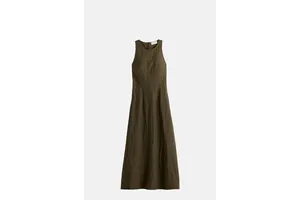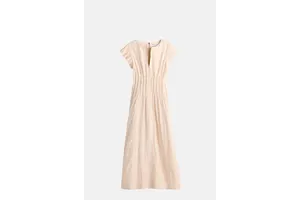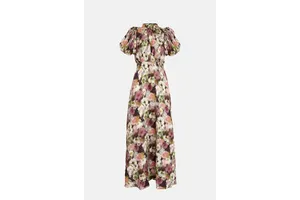
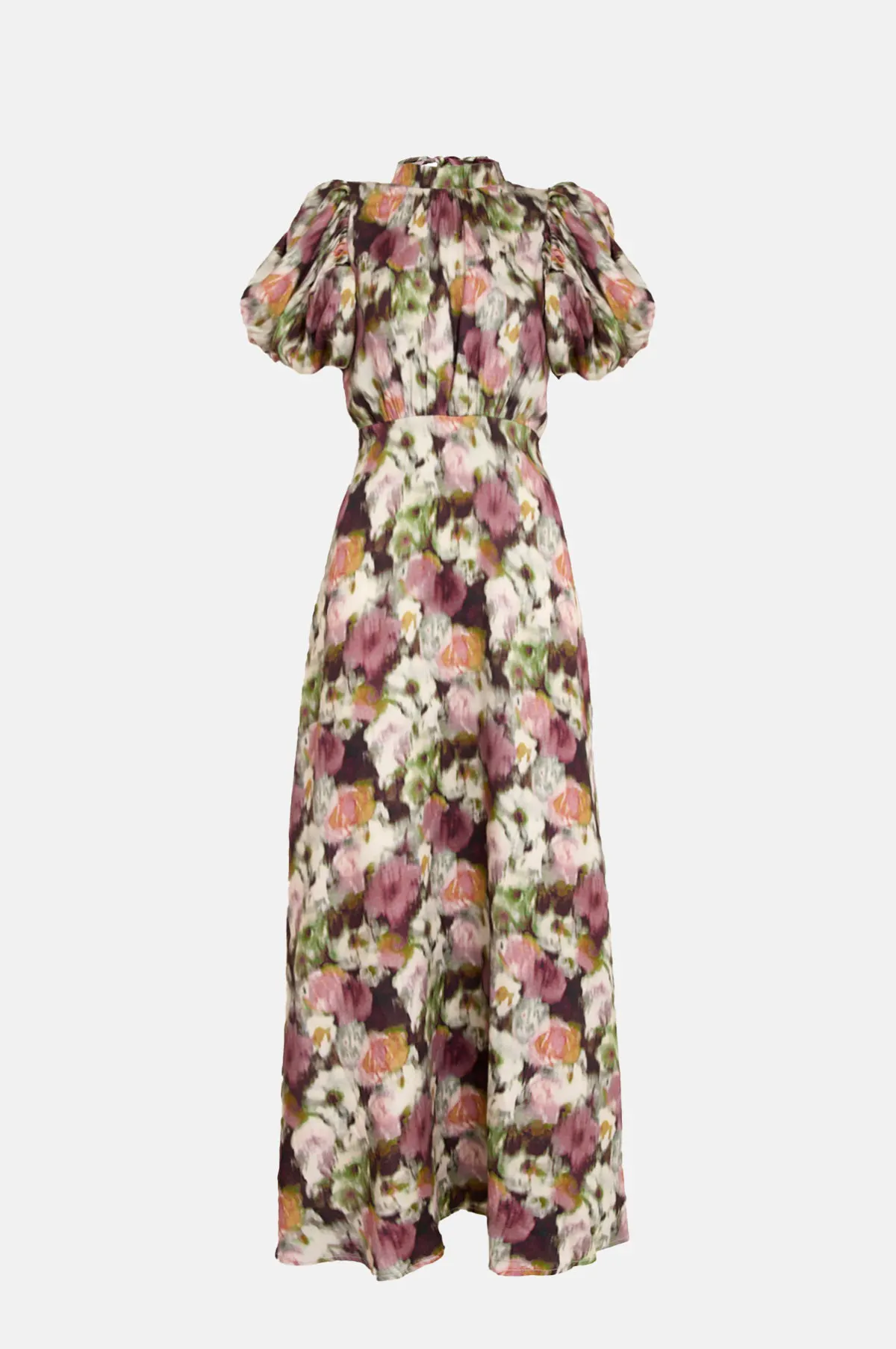

The Nadia dress from Minus in a bold floral print, cut from a lightweight viscose with a flowing silhouette, short puffed sleeves, an open back with ties, a high neck and a maxi length, listed at 160 GBP with three of five sizes in stock. It is worth beginning with the bust column, because this dress shares its name, its print, its size range, its fibre and its care label with a shirt this run published one batch ago, and that makes the comparison exact. The shirt's pit to pit went 46, 49, 52, 55 and 58 centimetres, stepping three at every step, cleanly. This dress goes 47, 50, 52, 53 and 54. That is a step of three, then two, then one, then one. No uniform grade produces it, and the shape is worth naming: the steps get smaller as the sizes get larger, so the garment gains three centimetres between the first two sizes and one between the last two. Set beside the shirt and the consequence is plain. At size 34 the two garments are one centimetre apart. At size 38 they are identical. At size 42 the shirt is four centimetres wider than the dress. So a customer buying the shirt and the dress in the same size, from the same range, in the same print, gets two bodices four centimetres apart at the top of the range. The second thing worth setting out is the sleeve, and it belongs to something this run has been building for several batches. The sleeve is 15 to 19 centimetres and the bullet says puffed short sleeves. Fifteen centimetres is about six inches. This run has now measured a short puff sleeve at 39 to 42 centimetres and another at 28 to 31, and an elbow length sleeve at 20 to 23 and another at 29. So the word short now covers 15 to 42 centimetres, and within this one brand the sleeve numbers in a single batch run from 15 to 52. The reference is the Nadia Maxi Dress in Andorra Red Print. Dongguan Bafinasa Garments Co., Ltd. develops comparable dresses on OEM and ODM terms, from cloth sourcing and print development to retail or FBA ready packing. We publish this as a development reference and build your own version of it, and we do not supply the branded original or reproduce anyone else's label.
Key Features
- Pit to pit stepping 3, 2, 1 and 1, against 3, 3, 3, 3 on the shirt of the same name and print. See the note below
- Two garments with the same name, print and size label differing by 4 cm at size 42. See the note below
- A sleeve of 15 to 19 cm called puffed short, on a run where short has covered 15 to 42 cm. See the note below
- Total length of 136 to 140 cm called maxi, and the word is right. See the note below
- 100% Lenzing Ecovero viscose, and a size conversion, both house practice at this brand. See the note below
- Open back with ties as stated, on a garment whose bust is measured pit to pit. See the note below
- No model, on the longest garment in this run. See the note below
Customisable Options
- Cloth: Lenzing Ecovero viscose to the reference, with the weight in grams per square metre stated, or a conventional viscose, or a viscose and linen mix, or a cotton lawn, or a recycled polyester, each quoted separately
- Print: a bold floral print to the reference, with the repeat size stated, or a smaller floral, or a plain dyed cloth, or a solid colour matched to the shirt, each quoted separately
- Back: an open back with ties to the reference, with the opening depth and the tie length stated, or a closed back, or a low back with a fixed band, or a back zip, each quoted separately
- Sleeve: puffed short sleeves to the reference, with the sleeve measurement origin stated, or a cap sleeve, or a long sleeve, or a sleeveless bodice, each quoted separately
- Grade: the bust graded to your own chart, with the grade stated, or a 3 cm flat grade matched to the shirt, or the reference grading, each quoted separately
- Length: a maxi length to the reference, with the length graded and the target agreed, or a midi length, or a floor length, each quoted separately
- Cloth weight, print repeat size, sleeve measurement origin, back opening depth and tie length, neck depth, shoulder width, bust grade stated, shrinkage and colourfastness, size set, colour development, private label and care labelling
Specifications
| Style | Maxi dress with a high neck, puffed short sleeves and an open back with ties |
| Reference | Minus, Nadia dress, style MI7134, colour 4009P Andorra Red Print, sizes 34 to 42 |
| Composition | 100% Lenzing Ecovero viscose as stated. See the note below |
| Programme | Ecovero, a named and traceable programme, as on the shirt of the same name. See the note below |
| Cloth Weight | Not stated, though the description says lightweight. See the note below |
| Handle | Flowing and lightweight as stated, with no weight and no finish named |
| Finish | None named, and no crease guidance on viscose |
| Fit Word | None published. See the note below |
| Fit Statement | None published |
| Length | Maxi length as stated, and 136 to 140 cm, which is right. See the note below |
| Neck | High neck as stated, with no neck depth and no neck opening given |
| Sleeve | Puffed short sleeves as stated, measured at 15 to 19 cm, with no measurement origin and no sleeve opening given. See the note below |
| Back | Open back design with ties as stated, with no opening depth and no tie length given. See the note below |
| Bold floral print as stated, with no repeat size and no motif scale given | |
| Care | Machine wash at 30 degrees, do not tumble dry, iron on low, as stated. See the note below |
| Certification | Ecovero named, which is traceable. See the note below |
| Sizes Offered | 34, 36, 38, 40 and 42, five sizes, with 34, 40 and 42 in stock at the time of writing |
| Size Conversion | Published, 34 slash XS, 36 slash S, 38 slash M, 40 slash L, 42 slash XL, as on the shirt. See the note below |
| Fit Guidance | None published, beyond the word maxi |
| Model | None published, on this run's longest garment. See the note below |
| Measurements Published | Pit to pit, sleeve length and total length for all five sizes. See the note below |
| Published Bust | 47, 50, 52, 53 and 54 cm pit to pit, stepping 3, 2, 1 and 1. See the note below |
| Bust Around | 94, 100, 104, 106 and 108 cm, or 37.01, 39.37, 40.94, 41.73 and 42.52 in. See the note below |
| True Bust Grade | None: no uniform grade rounds to this column, and the steps shrink as the size rises. See the note below |
| Published Sleeve Length | 15, 16, 17, 18 and 19 cm, stepping exactly 1 cm at every step. See the note below |
| Published Total Length | 136, 137, 138, 139 and 140 cm, stepping exactly 1 cm at every step. See the note below |
| Length Grade | About 1 cm per size, and clean. See the note below |
| Cloth Weight | Not stated |
| Shoulder Width | Not measured. See the note below |
| Photographs | Five |
| Production | Made in China as stated, with no certification named |
| Reference Retail | 160 GBP as listed, quoted to show the price band this sits in, not as our price |
| Category | Filed by the reference under print and floral dresses |
| Occasion | Autumn and winter, party, occasion |
| MOQ | 100 pcs per style per colourway, mixed sizes and colourways accepted |
| Sampling | 7-10 days after tech pack or reference sample confirmation |
| Bulk Lead Time | 20-30 days after sample approval and deposit |
| Service | OEM / ODM / private label, Lenzing Ecovero viscose sourcing with traceability, print development with the repeat set, puffed sleeve and open back tie pattern development, retail or FBA ready packing |
Size Chart as Published by the Reference
| Size | Size | Pit to pit (flat) | Sleeve Length | Total Length |
|---|---|---|---|---|
| 34 | XS | 47 cm | 15 cm | 136 cm |
| 36 | S | 50 cm | 16 cm | 137 cm |
| 38 | M | 52 cm | 17 cm | 138 cm |
| 40 | L | 53 cm | 18 cm | 139 cm |
| 42 | XL | 54 cm | 19 cm | 140 cm |
The pit to pit figures are flat half measures taken with the dress laid down, doubling to 94, 100, 104, 106 and 108 cm around, or 37.01, 39.37, 40.94, 41.73 and 42.52 in. The bust steps 3, 2, 1 and 1 cm, so the steps shrink as the size rises and no uniform grade produces it. The sleeve length runs 15 to 19 cm and the total length runs 136 to 140 cm, both stepping exactly 1 cm at every step. The page publishes a size conversion of 34 slash XS, 36 slash S, 38 slash M, 40 slash L and 42 slash XL.
Our Proposed Body Chart
| Size | Body Bust | Sleeve | Body Waist | Body Hips | Length | Source |
|---|---|---|---|---|---|---|
| 34 | 31 in / 79 cm | 15 cm | 24 in / 61 cm | 34 in / 86 cm | 136 cm / 53.5 in | Our proposal |
| 36 | 33 in / 84 cm | 16 cm | 26 in / 66 cm | 36 in / 91 cm | 138 cm / 54.3 in | Our proposal |
| 38 | 35 in / 89 cm | 17 cm | 28 in / 71 cm | 38 in / 97 cm | 140 cm / 55.1 in | Our proposal |
| 40 | 37 in / 94 cm | 18 cm | 30 in / 76 cm | 40 in / 102 cm | 142 cm / 55.9 in | Our proposal |
| 42 | 39 in / 99 cm | 19 cm | 32 in / 81 cm | 42 in / 107 cm | 144 cm / 56.7 in | Our proposal |
Occasions and Styling
Suits autumn, winter, party and occasion dressing. A printed maxi with an open back carries itself without much help, and the high neck balances the open back.
Production and Quality Control
The reference publishes three columns for all five sizes with two of them grading cleanly, publishes a size conversion, declares a viscose with a named and traceable programme behind it, gives a care instruction with a temperature, a tumble prohibition and an iron setting, gets its length word right, lists the construction in a bullet list, and names the style and colour codes. It gives no cloth weight, no print repeat size, no sleeve measurement origin, no sleeve opening, no back opening depth or tie length, no neck depth, no shoulder width, no shrinkage figure, no colourfastness figure, no fit word, no fit statement and no model, and its bust column steps three, two, one, one. Three things follow: the bust that contradicts the shirt of the same name, the sleeve that stretches this run's vocabulary to its widest, and the length word that is finally right.
Three, two, one, one, and that is the first thing, and the comparison available here is the closest this run has had. One batch ago this run published the Nadia Shirt, from this same brand, in this same print, in this same size range, in this same fibre, with this same care label. Its pit to pit went 46, 49, 52, 55 and 58. Every step three. Clean. This dress goes 47, 50, 52, 53 and 54. The steps are three, then two, then one, then one. This run tests every chart it meets against a single uniform grade, and the test fails here in the first three sizes: a step of three at the start wants a grade of at least two and a half, and a step of one by the third size wants at most about two and a fifth. No single number satisfies both. But the interesting part is not that it fails. It is the shape. The steps get smaller as the sizes get larger. This run has met a great many broken charts and most of them wobble: a two here, a three there, a two again. This one does not wobble, it declines. The garment gains three centimetres between the first two sizes and one between the last two, steadily. That is what a chart looks like when the bigger sizes were not graded so much as nudged. And the consequence against the shirt can be stated exactly, which is what makes this pair worth the space. At size 34 the shirt is 46 and the dress is 47, one centimetre apart. At size 38 both are 52, identical. At size 42 the shirt is 58 and the dress is 54, four centimetres apart. So two garments sharing a name, a print, a size scale, a season and a fibre, sold as a set, are four centimetres apart in the bodice at the top of the range and identical in the middle. A customer who buys both in a 42 gets two different garments. A customer who buys both in a 38 gets the same one. It is worth adding what the two clean columns do, because they show the brand can do this. The sleeve steps one, one, one and one. The length steps one, one, one and one, from 136 to 140. Both perfectly regular. So the pattern room graded two of the three measurements correctly on this dress and produced a declining series on the third, while grading all the shirt's measurements correctly. That is not a capability problem. It is worth saying what is missing that would have let a reader notice: there is no fit word and no fit statement on this dress, and none on the shirt either, so nothing tells a customer how either is meant to sit.
Fifteen, and that is the second thing, and it takes this run's sleeve findings to their widest point yet. The sleeve is 15 to 19 centimetres and the bullet says puffed short sleeves, and the description says short puffed sleeves. Fifteen centimetres is about six inches. This run has been measuring sleeves throughout and has found that the words do not mean anything comparable, and the list is now long enough to set out. A short puffed sleeve at 28 to 31 centimetres. A short puff sleeve at 39 to 42. An elbow length sleeve at 29. An elbow length sleeve at 20 to 23, published twice by the same brand so not a slip. And now a short puffed sleeve at 15 to 19. So the word short covers 15 to 42 centimetres, a range of twenty seven, and the shortest garment called short is a third the length of the longest. It is worth adding the second half of the point, which is sharper. Within this one brand, in this one batch, the sleeve numbers are 15 to 19 on this dress, 40 to 44 on another shirt, and 52 on a cardigan. A single brand's sleeve measurements span 15 to 52 centimetres, a range of thirty seven, with no measurement origin stated on any of them. And this run can now say why that matters, because one batch ago it finally met a brand that states its origin. American Vintage published 72 centimetres with the words sleeve length measured from cuff to collar. That told a reader the tape ran from the neck edge, across the shoulder and down the arm. Under that method a 15 centimetre sleeve is not possible on an adult garment. So either this brand uses a different origin on each garment, or some of these numbers are wrong. Neither is stated, and a customer has no way to choose between them. It is worth being fair about what 15 centimetres probably is. Measured from the shoulder seam, 15 to 19 centimetres is a cap sleeve or a very short puff, which is a coherent garment and not a fault in itself. The fault is that the number cannot be checked, and cannot be compared with the 40 to 44 centimetre sleeve on the shirt hanging next to it. It is worth noting what the description claims for the sleeve and what the chart measures. The description says the short puffed sleeves add a sense of drama. The chart measures the length. There is no sleeve opening, no puff volume and no gather measurement, so the drama is in the prose and not in the specification.
One hundred and thirty six, and maxi, and that is the third thing, and this run wants to credit it because it has spent several batches finding length words that do not match their measurements. The dress says maxi length and measures 136 to 140 centimetres, which is a maxi. That is right, and it is worth saying plainly after this run spent a whole batch on a dress called a midi at 73 to 106 centimetres. A brand can get this right, and this one did. It is worth setting out why the contrast matters rather than just noting it. Length words are the easiest words on a page to check, because the measurement is sitting in the same chart, four rows down. There is no ambiguity about what a maxi is when the number is 136 and no ambiguity about what a midi is when the number is 73. So getting it right costs nothing except reading your own chart, and getting it wrong is not a copy problem, it is a failure to look. It is also worth adding that the length grades, which the midi dress at 106 centimetres did not do. This one goes 136, 137, 138, 139, 140, stepping one at every step. So this brand graded the length of its longest garment and froze the length of its shortest one. It is worth closing on the two things that would have made this number usable, because a maxi is the garment type where they matter most. There is no model. A 140 centimetre dress on a body of five foot four reaches the floor, and the same dress on a body of five foot ten reaches the ankle, and those are two different garments for two different customers. This is the longest garment this run has measured and there is no model height anywhere on the page. And there is no fit word or fit statement, so nothing says how it is meant to sit, which on a flowing silhouette is the one thing a customer cannot work out from the numbers. It is worth noting the open back, because it interacts with the chart. The back is open and closes with ties, so the bodice can be drawn in or let out at the back, and the pit to pit measurement describes a garment whose back opening is adjustable. That adjustability is creditable and worth naming. But there is no opening depth and no tie length, so the one adjustable element on the garment is unmeasured, and the bust measurement sits next to an adjustment nobody has quantified. Every bulk shipment gets a measurement report against your approved chart.
Optional upgrades include grading the bust on a uniform grade and matching it to the shirt across the shared size range, publishing the sleeve measurement origin so the number can be compared with the other garments in the range, quoting the cloth weight in grams per square metre, giving the print repeat size, the back opening depth and the tie length, the neck depth, the shoulder width and the sleeve opening and puff volume, adding washing inside out, washing with like colours, a bleach instruction and shrinkage and colourfastness figures to sit beside the three existing clauses, adding a fit word, a fit statement and a model height, conventional viscose, viscose linen, cotton lawn and recycled polyester, smaller florals and plain cloths, a closed back, a low back with a fixed band and a back zip, cap, long and sleeveless options, midi and floor lengths, size set, colour development, private label, hangtag and care labelling.
Pre-production sample approval, in-line inspection during cutting and sewing, and a final AQL inspection before packing, with measurement reports and photos shared before shipment.
Send us your tech pack, a photo or a reference garment and we will quote within 24 hours. Contact bafinasa@bafinasa.com or WhatsApp +86 13827222469.