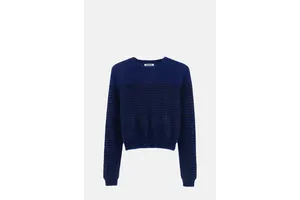
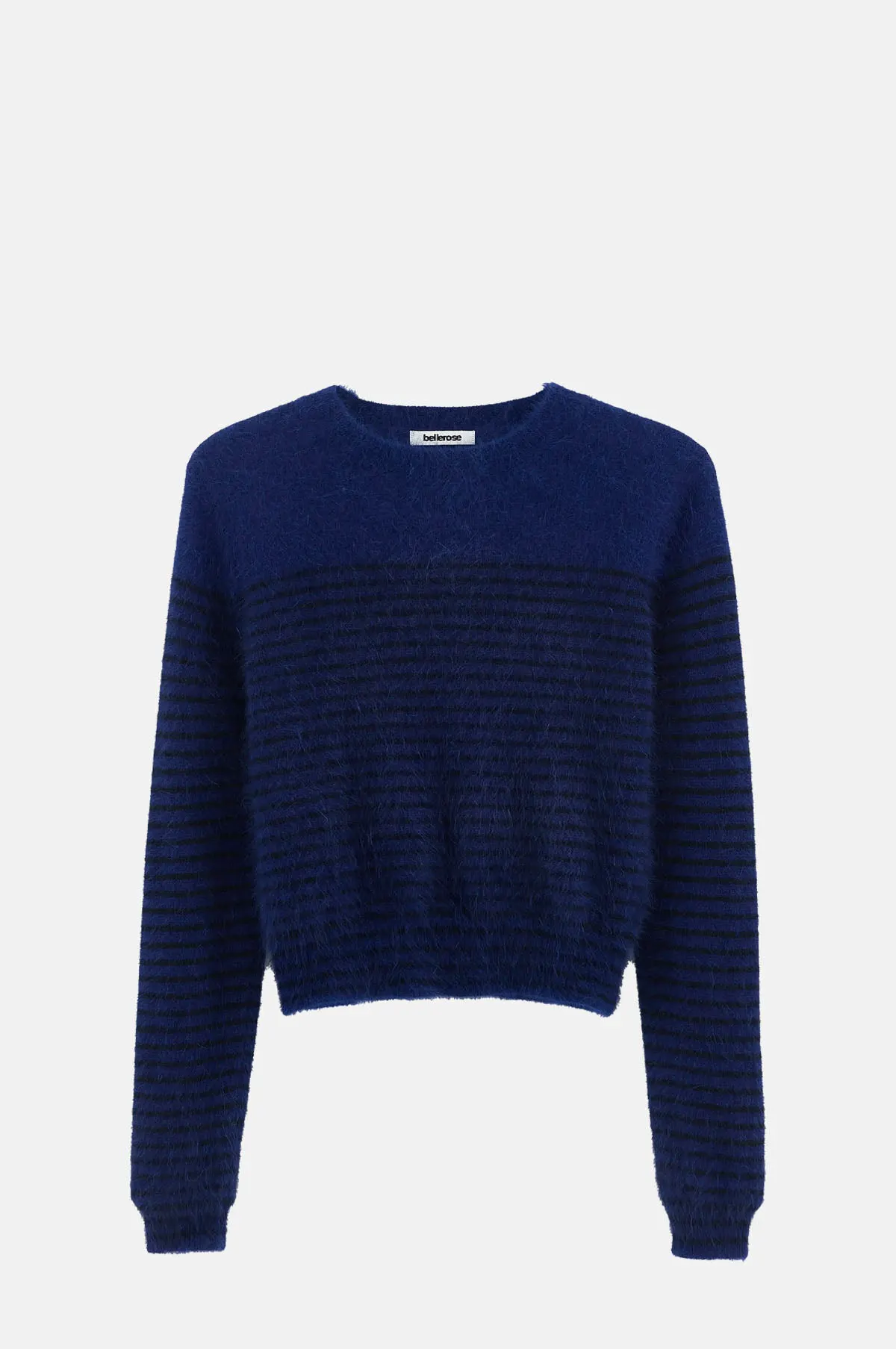

The Datir Knit from Bellerose in navy, a neat fit jumper in a fluffy angora blend with a tonal stripe, a crew neck, long sleeves and ribbed trims, listed at 165 GBP with three of five sizes in stock. It is worth beginning with the bust column, because it is the cleanest and the largest this run has measured. The pit to pit goes 44, 48, 52, 56 and 60 centimetres, stepping four at every step, which is the largest uniform grade in this run and it is perfectly regular. And it sits in the same batch as another garment from the same brand whose bust grade is one. So one brand, one season, two clean charts, and the grades differ by a factor of four. The second thing follows directly, and it is what the grade does to the fit word. The description says neat fit. At the smallest size, 44 centimetres flat is about thirty five inches around, on a body of roughly thirty two, which is about three inches of ease and genuinely neat. At the largest, 60 centimetres flat is about forty seven inches around, on a body of roughly forty, which is about seven inches of ease, and that is not neat. So the grade is large enough that the fit word is true at one end of the range and false at the other, and this run can now say which end: neat fit describes the small sizes. And it runs opposite to the other garment from this brand in this same batch, which is oversized with a width grade of one, so its ease shrinks as the sizes rise while this one grows. The reference is the Datir Knit. Dongguan Bafinasa Garments Co., Ltd. develops comparable knitwear on OEM and ODM terms, from yarn sourcing by count and gauge to retail or FBA ready packing. We publish this as a development reference and build your own version of it, and we do not supply the branded original or reproduce anyone else's label.
Key Features
- A bust grade of 4 cm, the largest uniform grade in this run, against 1 cm on another garment from this brand in this same batch. See the note below
- Neat fit as stated, and the ease runs from about 3 in at XS to about 7 in at XL, so the word fits one end. See the note below
- A sleeve frozen at 63 cm across all five sizes, on a garment whose bullets say long sleeves. See the note below
- 65% angora, the highest animal fibre content in a knit this run has seen, with no welfare or sourcing statement. See the note below
- Hand wash or dry clean only as stated, which is self contradictory, with no temperature and no drying instruction. See the note below
- Mid-weight and fluffy as stated, with no gauge, no yarn count and no weight. See the note below
- Named Stripe A, with no stripe width and no repeat size anywhere. See the note below
Customisable Options
- Yarn: an angora and polyamide blend to the reference at 65 and 35, with the angora grade and the sourcing stated, or an angora and wool blend, or a wool and alpaca blend, or a mohair blend, or a synthetic fluffy yarn, each quoted separately
- Stripe: a tonal stripe to the reference, with the stripe width and the repeat size stated, or a contrast stripe, or a wider stripe, or a plain knit, each quoted separately
- Gauge: a mid weight gauge to the reference, with the gauge number and the weight in grams per square metre stated, or a fine gauge, or a chunky gauge, each quoted separately
- Sleeve: long sleeves to the reference, with the length graded across the sizes, or a three quarter sleeve, or a raglan sleeve, or a balloon sleeve, each quoted separately
- Neck: a crew neck to the reference, with the neck depth and opening width stated, or a V neck, or a roll neck, or a boat neck, each quoted separately
- Fit: a neat fit to the reference, with the ease agreed at every size, or a relaxed fit, or a slightly neat fit, each quoted separately
- Angora grade and sourcing statement, gauge number, yarn count and ply, weight in grams per square metre, stripe width and repeat size, neck depth and opening width, rib width, shedding and pilling test results, sleeve measurement origin, size set, colour development, private label and care labelling
Specifications
| Style | Neat fit jumper with a tonal stripe, crew neck, long sleeves and ribbed trims |
| Reference | Bellerose, Datir Knit, style BW262919, colour K1014S-STA Stripe A, sizes XS to XL |
| Composition | 65% angora and 35% polyamide as stated. See the note below |
| Angora Grade | Not stated, and no sourcing or welfare statement given. See the note below |
| Animal Fibre Content | 65%, the highest in a knit this run has seen, and no welfare statement. See the note below |
| Gauge | Not stated, in any form. See the note below |
| Yarn Count | Not stated |
| Ply | Not stated |
| Cloth Weight | Mid-weight as stated, with no number and no unit. See the note below |
| Handle | Fluffy angora blend as stated, with no halo rating and no shedding guidance. See the note below |
| Fit Word | Neat fit as stated, and the published bust is consistent with it at the small end. See the note below |
| Fit Statement | Neat fit as stated |
| Length | Not stated as a word, and 47 to 55 cm. See the note below |
| Neck | Crew neck as stated, with no neck depth and no opening width given |
| Sleeve | Long sleeves as stated, measured at 63 cm at every size, with no measurement origin given. See the note below |
| Trim | Ribbed trims as stated, with no rib width given |
| Pattern | Tonal stripe as stated, and the garment is named for it, with no stripe width and no repeat size given. See the note below |
| Care | Hand wash or dry clean only as stated, which is self contradictory, with no temperature, no drying instruction and no iron instruction. See the note below |
| Certification | None named |
| Sizes Offered | XS, S, M, L and XL, five sizes, with S, M and L in stock at the time of writing |
| Size Conversion | None published |
| Fit Guidance | Neat fit as stated, which is more than most pages give |
| Model | None published |
| Measurements Published | Pit to pit, sleeve length and total length for all five sizes. See the note below |
| Published Bust | 44, 48, 52, 56 and 60 cm pit to pit, stepping exactly 4 cm at every step. See the note below |
| Bust Around | 88, 96, 104, 112 and 120 cm, or 34.65, 37.80, 40.94, 44.09 and 47.24 in. See the note below |
| True Bust Grade | About 4 cm of flat measure per size, and clean, and the largest uniform grade in this run. See the note below |
| Published Sleeve Length | 63 cm at every size, frozen across all five. See the note below |
| Published Total Length | 47, 49, 51, 53 and 55 cm, stepping exactly 2 cm at every step. See the note below |
| Length Grade | About 2 cm per size, and clean. See the note below |
| Photographs | Five |
| Production | Made in China as stated, with no certification named |
| Reference Retail | 165 GBP as listed, quoted to show the price band this sits in, not as our price |
| Category | Filed by the reference under knitwear |
| Occasion | Autumn and winter, everyday, layering |
| MOQ | 100 pcs per style per colourway, mixed sizes and colourways accepted |
| Sampling | 7-10 days after tech pack or reference sample confirmation |
| Bulk Lead Time | 20-30 days after sample approval and deposit |
| Service | OEM / ODM / private label, angora blend yarn sourcing with the grade and sourcing confirmed, stripe development with the repeat set, gauge and weight development, rib trim development, retail or FBA ready packing |
Size Chart as Published by the Reference
| Size | Pit to pit (flat) | Sleeve Length | Total Length |
|---|---|---|---|
| XS | 44 cm | 63 cm | 47 cm |
| S | 48 cm | 63 cm | 49 cm |
| M | 52 cm | 63 cm | 51 cm |
| L | 56 cm | 63 cm | 53 cm |
| XL | 60 cm | 63 cm | 55 cm |
The pit to pit figures are flat half measures taken with the jumper laid down, doubling to 88, 96, 104, 112 and 120 cm around, or 34.65, 37.80, 40.94, 44.09 and 47.24 in. The bust steps exactly 4 cm at every step, the largest uniform grade this run has measured, and the total length steps exactly 2 cm at every step, from 47 to 55 cm. The sleeve length is 63 cm at every size. No size conversion is published.
Our Proposed Body Chart
| Size | Body Bust | Sleeve | Body Waist | Body Hips | Length | Source |
|---|---|---|---|---|---|---|
| XS | 31 in / 79 cm | 63 cm | 24 in / 61 cm | 34 in / 86 cm | 47 cm / 18.5 in | Our proposal |
| S | 33 in / 84 cm | 64 cm | 26 in / 66 cm | 36 in / 91 cm | 49 cm / 19.3 in | Our proposal |
| M | 35 in / 89 cm | 65 cm | 28 in / 71 cm | 38 in / 97 cm | 51 cm / 20.1 in | Our proposal |
| L | 37 in / 94 cm | 66 cm | 30 in / 76 cm | 40 in / 102 cm | 53 cm / 20.9 in | Our proposal |
| XL | 39 in / 99 cm | 67 cm | 32 in / 81 cm | 42 in / 107 cm | 55 cm / 21.7 in | Our proposal |
Occasions and Styling
Suits autumn, winter and everyday layering. A neat tonal stripe jumper in navy anchors a wardrobe, as the reference says, and the shorter length works well over a high waisted trouser or skirt.
Production and Quality Control
The reference publishes three columns for all five sizes with two grading cleanly, declares both fibres to the percentage, states the fit word, gives a relative weight word in its bullets rather than only in its prose, matches its sleeve length to its long sleeve claim, lists the construction in a bullet list and names the style and colour codes. It gives no angora grade, no sourcing or welfare statement, no gauge, no yarn count, no ply, no weight in grams per square metre, no stripe width or repeat size, no neck depth or opening width, no rib width, no sleeve measurement origin, no shedding or pilling guidance, no drying instruction, no shrinkage figure, no size conversion and no model, and it freezes its sleeve column. Three things follow: the grade that is four times the one on another garment from this brand in this same batch, the fit word that only fits one end of the range, and the fibre that carries the heaviest sourcing question in this run.
Four, and that is the first thing, and it is worth stating where it sits. The bust goes 44, 48, 52, 56 and 60, stepping four at every step. That is perfectly uniform, and it is the largest uniform grade this run has measured. This run has now recorded bust grades of one, two, two, two, two, three, three and four, all of them clean, on garments in the same size ranges from several brands. And the two extremes in this run are both from this brand, in this batch. The other garment, published alongside this one, steps one. This one steps four. Same brand, same season, both perfectly regular, and one is four times the other. It is worth saying what this does to the whole idea of a clean chart, because this run has been building towards it for some time and this pair states it as plainly as it can be stated. Several batches ago this run said that clean grading is a premise rather than a conclusion, after finding two garments with clean but different grades from one brand, and it looked for a pattern in those grades and thought it had found one. There is no pattern to find here. One and four, from one brand, in one batch, on garments at similar prices, is not a system with an exception, it is two separate decisions. And the consequence is the one that matters to a customer: a size chart on one garment from a brand teaches you nothing you can carry to the next garment from that brand, because the next one may have been graded at four times the rate. It is worth adding the arithmetic of what a four centimetre grade does, because it is not a small number. Four centimetres flat is eight centimetres around per size, so over four size steps the garment grows thirty two centimetres in circumference. Bodies grow roughly twenty over the same span. So the garment outpaces the body by about twelve centimetres across the range, and all of that has to go somewhere, and it goes into ease.
Neat, and that is the second thing, and it is the direct consequence of the grade. The description says neat fit. At XS, 88 centimetres around is about thirty five inches, on a body of roughly thirty two, which is about three inches of ease. That is neat, and the word is earned. At XL, 120 centimetres around is about forty seven inches, on a body of roughly forty, which is about seven inches of ease. That is not neat, that is a relaxed jumper. So the same word, on the same page, describes three inches of ease at one end and seven at the other, and a customer reading neat fit and buying an XL is being told something that her own chart contradicts. It is worth setting this beside the other garment from this brand in this same batch, because the two are exact opposites and the pairing is unusually clean. That one is a coat, described as oversized, with a width grade of one centimetre. Its ease therefore shrinks as the sizes rise: it is most oversized at the smallest size and least at the largest. This one is described as neat fit, with a width grade of four. Its ease therefore grows: it is neatest at the smallest size and loosest at the largest. Same brand, same season, opposite directions, one fit word each, and in both cases the word is true at one end of the range and not the other. It is worth adding that this run has now seen this split at more than one brand. Two batches ago it found a jeans brand with two garments at the same size range and the same true to size claim, one of which got looser as the sizes rose and one of which got tighter. Now this. So the finding is not that a fit word is vaguely wrong. It is that within a single brand, fit words describe a direction, and the direction is not the same on any two garments. It is worth closing on the sleeve, which is the third column and does the simpler thing. It is 63 centimetres at every size, frozen across five. This run has said on every frozen sleeve that a sleeve repeated across sizes will be short on everyone above the smallest, and it is worth adding the specific here, because the width grade is four. So this garment hands an XL customer sixteen more centimetres of body and not one more millimetre of sleeve. The body and the arms are being graded at different rates in the same chart, which is a decision, and there is nothing on the page that explains it. It is worth crediting one thing: the bullets say long sleeves and 63 centimetres is a long sleeve, so the word and the number agree, which this run does not always get to say.
Sixty five, and that is the third thing, and it carries the heaviest sourcing question this run has encountered. The panel reads 65% angora and 35% polyamide. Angora at sixty five per cent is the highest animal fibre content in a knit this run has measured, higher than the wool and cashmere blends and higher than the alpaca blends it has recorded elsewhere. And there is no sourcing statement and no welfare certification of any kind. It is worth being precise rather than rhetorical about why that matters, because angora is not like wool in this respect. Angora production has a specific and well documented animal welfare problem, and it is the reason the fibre has a dedicated standard of its own, and the reason a number of large retailers stopped carrying it altogether for a period. A brand using angora at sixty five per cent is making a choice that most of its peers have had to think about carefully, and the page does not mention it. No grade for the angora, no origin, no certification, nothing. It is worth setting that beside what the run has found on every other animal fibre, because it is the same gap each time and it is now long enough to state as a rule. Wool with no type and no micron. Cashmere with no grade and no fibre length. Alpaca with no grade. And now angora at sixty five per cent with no sourcing statement. Every animal fibre in this run has arrived without the one piece of information that distinguishes good from bad, which is grade, and the higher the percentage the more the absence matters. It is worth adding the practical side of angora, which the page also does not address. Angora sheds, and it mats, and it felts. There is no shedding guidance and no pilling guidance on a garment that is two thirds angora. And there is no gauge, no yarn count, no ply and no weight in grams per square metre, despite the bullets saying mid weight, which is one of the few times this run has seen a weight word promoted into a bullet list rather than left in the prose. It is worth closing on the care label, which is where this garment is at its weakest. It reads hand wash or dry clean only. That is self contradictory: only means one option, and this gives two. And there is no temperature for the hand wash, when nearly every other garment in this run states thirty degrees. And there is no drying instruction at all, which on a two thirds angora knit is the single most important clause on the label, because a wet angora knit hung up will stretch under its own weight and the correction is to dry it flat. And there is no iron instruction. It is worth noting the pattern in the run's dry clean labels, which now covers silk, wool, viscose, linen, cotton, polyester and angora, and is as confident on the most delicate fibre as on the least, so it carries no information about the garment. It is worth ending on the name, because it is the cleanest instance of something this run keeps finding. The garment is called Stripe A. Its colour code contains the stripe reference. The description says it is patterned in a tonal stripe. And there is no stripe width and no repeat size anywhere on the page. A stripe is the single most measurable element in all of knit design, because it is a width and a spacing and nothing else, and the garment named after it does not say how wide it is. Every bulk shipment gets a measurement report against your approved chart.
Optional upgrades include naming the angora grade and giving a sourcing or welfare statement, quoting the gauge number and the weight in grams per square metre, giving the yarn count and ply, measuring and publishing the stripe width and repeat size, grading the sleeve across the sizes, stating the sleeve measurement origin, giving the neck depth and opening width and the rib width, adding a drying instruction, a wash temperature and an iron instruction to the label and resolving whether it is hand wash or dry clean, adding shedding and pilling test results and a shrinkage figure, publishing a size conversion and a model height, angora and wool, wool and alpaca, mohair and synthetic fluffy yarns, contrast and wider stripes and plain knits, fine and chunky gauges, three quarter, raglan and balloon sleeves, V, roll and boat necks, relaxed and slightly neat fits, longer lengths, size set, colour development, private label, hangtag and care labelling.
Pre-production sample approval, in-line inspection during cutting and sewing, and a final AQL inspection before packing, with measurement reports and photos shared before shipment.
Send us your tech pack, a photo or a reference garment and we will quote within 24 hours. Contact bafinasa@bafinasa.com or WhatsApp +86 13827222469.