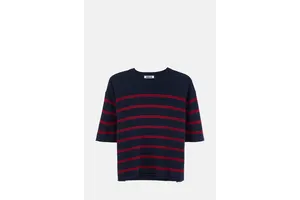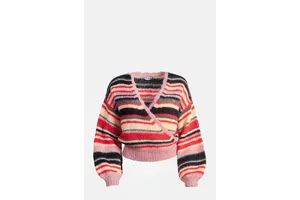
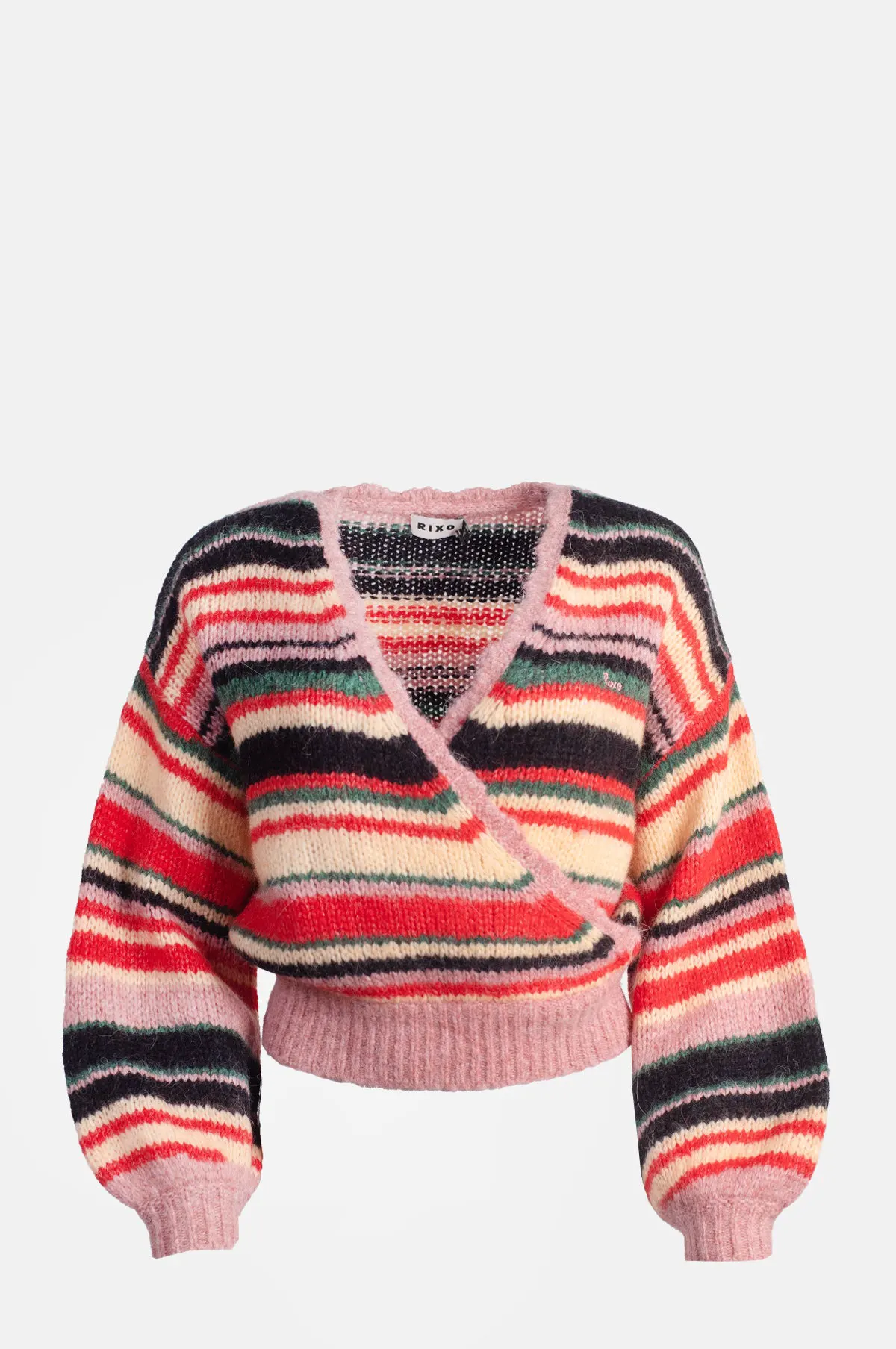

The Cari Jumper from Rixo, striped in a palette of vibrant colours and made from a mid weight knit in a cosy wool and alpaca blend, with a crossover V neck, dropped shoulders and ribbed trims, listed at 275 GBP with two of four sizes left. It is worth setting out the good part first, because it is genuinely good and this run has been waiting several batches for it. Its chest grades a clean 2.6 centimetres per size. That is almost exactly the 2.54 centimetres that this run worked out is needed for a garment to hold its fit steady across the sizes, and so its ease does hold steady: about 9.94, 10.31, 9.88 and 10.24 inches, barely moving across four sizes. This is now the fourth garment in a row where that arithmetic has predicted the behaviour correctly, and this run is satisfied it is a rule and not a coincidence. The other half of the chart is the problem. The sleeve is 48 centimetres at all four sizes and the total length is 50 centimetres at all four sizes. Both frozen. So the jumper grows by 16 centimetres around the chest and stays exactly the same length and exactly the same sleeve length, and nothing on the page says so. And the care label is one clause long, on a wool and alpaca knit, which is the fibre combination that most needs instructions and gets the fewest. Hand wash only. No temperature, no detergent, nothing about wringing, and nothing about drying flat, which is the single instruction that prevents irreversible damage to a wet knit. The reference is the Cari Jumper in Kelly Stripe Multi. Dongguan Bafinasa Garments Co., Ltd. develops comparable knitwear on OEM and ODM terms, from yarn sourcing by micron and blend to retail or FBA ready packing. We publish this as a development reference and build your own version of it, and we do not supply the branded original or reproduce anyone else's label.
Key Features
- Chest 52, 55, 57 and 60 cm, a clean uniform grade of about 2.6 cm, close to the rate that holds the ease steady
- Ease of about 9.94, 10.31, 9.88 and 10.24 in, so it holds steady across the range. See the note below
- Sleeve 48 cm and total length 50 cm, both frozen at all four sizes while the chest grows 16 cm. See the note below
- 53% wool, 30% polyamide and 17% alpaca as stated, while the description says a wool and alpaca blend and omits the third fibre. See the note below
- Hand wash only as the entire care label, with no temperature, no detergent, nothing about wringing and nothing about drying flat. See the note below
- A crossover V neck as stated, with nothing to say how it stays closed. See the note below
- Ribbed trims as stated, with no rib composition, no depth and no structure, and the rib absent from the fibre panel. See the note below
Customisable Options
- Yarn: wool, polyamide and alpaca blend to the reference, with the micron and the blend stated, or a merino blend, or a lambswool blend, or a higher alpaca content, each quoted separately
- Fit: relaxed to the reference, with the ease at every size published, or a regular fit, or an oversized fit, each quoted separately
- Neck: crossover V to the reference, with the overlap and the closure stated, or a plain V neck, or a crew neck, or a polo neck, each quoted separately
- Stripe: multi colour stripe to the reference, with the stripe width and the repeat stated, or a two colour stripe, or a plain colour, each quoted separately
- Trims: ribbed to the reference, with the rib composition, depth and structure stated, or a plain hem, or a rolled edge, each quoted separately
- Shoulders: dropped to the reference, with the drop measurement stated, or a set in shoulder, or a raglan, each quoted separately
- Yarn count and gauge, cloth weight in grams per square metre, wool micron and certification, alpaca grade and micron, rib composition and depth, stripe width and repeat, crossover overlap and closure, shoulder drop, size set, colour development, private label and care labelling
Specifications
| Style | Relaxed fit jumper with a crossover V neck, dropped shoulders and ribbed trims |
| Reference | Rixo, Cari Jumper, style 105.06303.326.08711, Kelly Stripe Multi, sizes 8 to 14 |
| Composition | 53% wool, 30% polyamide and 17% alpaca as stated in the panel. See the note below |
| Blend As Described | A cosy wool and alpaca blend, which omits the polyamide. See the note below |
| Cloth Weight | Not stated, though the description says mid weight. See the note below |
| Gauge | Not stated |
| Yarn Count | Not stated |
| Wool Specification | Not specified: no micron, no wool type and no certification. See the note below |
| Alpaca Specification | Not specified: no grade, no micron and no fibre length. See the note below |
| Fit Word | Loose and relaxed fit as stated, so two words for one garment. See the note below |
| Neck | V neck that overlaps to create a crossover style as stated, with no overlap width, no depth and nothing about how it closes. See the note below |
| Shoulders | Dropped shoulders as stated, with no shoulder width and no drop measurement. See the note below |
| Trims | Ribbed trims as stated, with no rib composition, no depth and no structure, and the rib absent from the fibre panel. See the note below |
| Stripe | Joyfully striped in a palette of vibrant colours as stated, with no stripe width and no repeat. See the note below |
| Care | Hand wash only as stated, and nothing else. See the note below |
| Certification | None named, and no responsible wool standard despite a wool claim |
| Sizes Offered | 8, 10, 12 and 14, four sizes, with 10 and 14 in stock at the time of writing |
| Size Conversion | None published |
| Fit Guidance | None published beyond the fit words |
| Model | None published |
| Measurements Published | Pit to pit, sleeve length and total length for all four sizes. See the note below |
| Published Chest | 52, 55, 57 and 60 cm flat. See the note below |
| Chest Around | 104, 110, 114 and 120 cm, or 40.94, 43.31, 44.88 and 47.24 in. See the note below |
| True Chest Grade | A clean uniform grade of about 2.6 cm per size, close to the rate that holds the ease steady. See the note below |
| Ease Against Body Bust | About 9.94, 10.31, 9.88 and 10.24 in, so it holds steady. See the note below |
| Grade Needed To Hold Ease | About 2.54 cm of flat measure per size. See the note below |
| Published Sleeve | 48 cm at all four sizes, frozen. See the note below |
| Published Length | 50 cm at all four sizes, frozen. See the note below |
| Cloth Weight | Not stated. See the note below |
| Rib Specification | None. See the note below |
| Photographs | One, for a garment whose defining feature is a stripe. See the note below |
| Production | Made in China as stated, with no certification named |
| Reference Retail | 275 GBP as listed, quoted to show the price band this sits in, not as our price |
| Category | Filed by the reference under knitwear |
| Occasion | Autumn and winter, everyday, casual |
| MOQ | 100 pcs per style per colourway, mixed sizes and colourways accepted |
| Sampling | 7-10 days after tech pack or reference sample confirmation |
| Bulk Lead Time | 20-30 days after sample approval and deposit |
| Service | OEM / ODM / private label, wool and alpaca yarn sourcing by micron and grade, knit development by gauge and weight, stripe and intarsia development, rib trim development, retail or FBA ready packing |
Size Chart as Published by the Reference
| Size | Pit To Pit (flat) | Sleeve Length | Total Length |
|---|---|---|---|
| 8 | 52 cm | 48 cm | 50 cm |
| 10 | 55 cm | 48 cm | 50 cm |
| 12 | 57 cm | 48 cm | 50 cm |
| 14 | 60 cm | 48 cm | 50 cm |
The chest figures are flat half measures taken with the jumper laid down, doubling to 104, 110, 114 and 120 cm around, or 40.94, 43.31, 44.88 and 47.24 in. Against a body bust of 31, 33, 35 and 37 in across sizes 8 to 14, the ease is about 9.94, 10.31, 9.88 and 10.24 in, so it holds steady. The chest grades a clean uniform 2.6 cm per size, close to the 2.54 cm that holds the ease steady. The sleeve is 48 cm and the total length is 50 cm at all four sizes.
Our Proposed Body Chart
| Size | Body Bust | Sleeve | Body Waist | Body Hips | Length | Source |
|---|---|---|---|---|---|---|
| 8 | 31 in / 79 cm | 48 cm | 24 in / 61 cm | 34 in / 86 cm | 50 cm / 19.7 in | Our proposal |
| 10 | 33 in / 84 cm | 49 cm | 26 in / 66 cm | 36 in / 91 cm | 52 cm / 20.5 in | Our proposal |
| 12 | 35 in / 89 cm | 50 cm | 28 in / 71 cm | 38 in / 97 cm | 54 cm / 21.3 in | Our proposal |
| 14 | 37 in / 94 cm | 51 cm | 30 in / 76 cm | 40 in / 102 cm | 56 cm / 22 in | Our proposal |
Occasions and Styling
Suits autumn and winter and everyday dressing. A striped wool and alpaca jumper with a crossover neck is a piece that lifts an ordinary outfit, and the relaxed shape makes it easy over a shirt or on its own.
Production and Quality Control
The reference publishes three columns for all four sizes, states three fibres to the percentage, describes the knit weight, the neck, the shoulders and the trims, gives a fit word, gives a care instruction, names the country of production and names a full style code. It gives no cloth weight, no gauge, no yarn count, no wool or alpaca specification, no neck depth or overlap, no shoulder drop, no rib specification, no stripe specification and no size conversion or model, publishes no fit guidance beyond one word and carries one photograph, and its description names two of its three fibres. Three things follow: the grade that is right, the two columns that do not move, and the care label that is one clause long on wool and alpaca.
Two point six, and that is the first thing, and this run will take it slowly because it is the fourth time and the rule is now solid. The chest reads 52, 55, 57 and 60, and a single uniform grade reproduces every figure: start at 52 and add 2.6 centimetres at each size and you get 54.6, 57.2 and 59.8, which round to 55, 57 and 60. So the column is clean. And 2.6 centimetres is almost exactly the figure this run worked out two batches ago is needed to hold a fit steady. The reasoning, briefly: a body gains two inches of bust per size, two inches of circumference is 5.08 centimetres, and on a flat half measure that is 2.54 centimetres. Grade at 2.54 and the garment gives back exactly what the body took, and the ease does not move. Grade at less and the ease falls at every size. Grade at more and it climbs. And this jumper grades 2.6, which is 2.54 to within a rounding error, and its ease does not move: about 9.94, 10.31, 9.88 and 10.24 inches across four sizes. It is worth putting the run's scorecard on the table, because this is the fourth garment and the pattern is now unmistakable. A dress at 410 GBP graded two, two, one and one centimetres and its ease fell by more than an inch per size and went negative. A skirt at 385 GBP graded one centimetre, the arithmetic predicted a loss of 1.21 inches per size, and it lost 1.21. A jacket at 178 GBP graded a clean two centimetres, the arithmetic predicted 0.43, and it lost 0.43. A pair of jeans at 320 GBP graded one centimetre and then two, and the arithmetic predicted a fall of 0.21 and then a rise of 0.57, and it did both. And now this. Every single time, the prediction has been right to within a hundredth of an inch. This run is now confident enough to say what it means in practice, and it is worth saying plainly: the reason so many garments in this run have fit that gets tighter as the size goes up is not sloppiness at any one brand. It is that the industry grades in centimetres and bodies grade in inches, and two centimetres is not two inches. It is worth adding the one thing that getting the grade right does not fix. Holding the ease steady means holding it steady at whatever it was. This jumper holds about 10 inches, and the page calls it loose and relaxed. On the scale this run has built, relaxed sits around twelve to thirteen inches. So the grade is right and the word is still generous by about two inches. Grading is not fitting.
Forty eight, and fifty, and that is the second thing, and it is the run's eighth and ninth frozen dimensions. The sleeve is 48 centimetres at all four sizes. The total length is 50 centimetres at all four sizes. And the chest, over those same four sizes, goes from 104 to 120 centimetres around, which is 16 centimetres, or about six and a half inches. So the jumper gets wider and wider and does not get longer by anything at all and does not get a longer sleeve by anything at all. This run has found frozen figures on six garments now and has said each time that a number repeated across sizes is a fact about the pattern rather than a slip of the pen, and four sizes at exactly 48 and exactly 50 settles this one. And the consequence is a shape that changes across the range whether or not anyone intended it. A jumper that is 104 centimetres around and 50 centimetres long is one shape. A jumper that is 120 centimetres around and 50 centimetres long is a quite different shape: proportionally much wider and boxier, and the sleeve is proportionally much shorter on the larger size because the arm it goes over is bigger and the sleeve is not. Nothing on the page says any of this, and there is no model to let a customer work it out. It is worth adding what 50 centimetres means, because the number is short. On a jumper, 50 centimetres is a cropped to high hip length. And the page calls this loose and relaxed and describes dropped shoulders, which are the words of a big slouchy knit, and then publishes a length that is short. The fit words here describe the width. They do not describe the length, and the length is the half of the shape nobody mentions. It is worth putting the shoulder question alongside it, because dropped shoulders are named and not measured, and there is a specific reason to measure them here. If the shoulder point moves down the arm as the size grows, then a sleeve measured from that point changes even when the sleeve itself does not. And here the sleeve is frozen, which is consistent either with the drop not changing or with the sleeve being measured from somewhere it does not change. There is no shoulder width and no drop measurement, so a customer cannot tell which, and a maker should not leave it ambiguous. It is worth ending on the trims, which are the same gap this run has recorded on every ribbed garment it has met. Ribbed trims are named, and there is no rib composition, no rib depth and no rib structure. And the fibre panel reads 53% wool, 30% polyamide and 17% alpaca and does not mention the rib at all, so the trims are not accounted for. Rib on a knit of this kind almost always carries something for recovery, because a rib that does not snap back is a rib that goes baggy at the cuff and the hem within a season, and a reader cannot know whether it does.
Wool and alpaca, and thirty per cent of something else, and that is the third thing, and the third fibre is the interesting part. The panel reads 53% wool, 30% polyamide and 17% alpaca. The description says a cosy wool and alpaca blend. So the prose names two of the three fibres and skips the third, and the third is 30% of the garment. That is nearly twice the alpaca and more than half the wool. It is worth saying what the polyamide is almost certainly doing there, because it is not filler. Alpaca is a low crimp fibre with poor elasticity, and a high alpaca knit is prone to shedding and to losing its shape. Polyamide is added for strength and to hold the yarn together. So the fibre that makes this jumper durable is the one the description leaves out. And a customer who avoids synthetics, or who is choosing between this and a pure wool knit, is not told. This run has met the inverse of this before, on a cashmere blend where the prose said midweight and named the cloth and the panel told a different story, and it is the same habit: the copy describes the fibres that sound expensive and the panel is where you find out. It is worth adding what is missing from the fibres that are named, which is the same list this run has given on every animal fibre it has met. The wool has no micron, no type and no certification. Wool has a responsible standard that is widely used across the trade and it is not named. The alpaca has no grade, no micron and no fibre length, and alpaca is graded, and the grade is what decides whether it is soft or scratchy. And the knit itself has no weight in grams per square metre, no gauge and no yarn count, despite the description calling it mid weight. So the one word the page gives for how heavy this jumper is is the one word with nothing behind it. It is worth closing on the care label, because this is the worst match between a garment and its instructions in this run. The label says hand wash only. That is all. Not a temperature, not a detergent, nothing about wringing, nothing about drying. Now consider what this garment is: a wool and alpaca knit. Wool felts in warm water and the temperature is the single most important thing to tell someone. Wool and alpaca both need a pH neutral detergent and ordinary detergent damages them. Both distort if wrung. And both must be dried flat, because a wet knit hung on a line or over a rail stretches under its own weight and does not come back, and alpaca in particular will grow because it has so little elasticity to begin with. Drying flat is not one useful instruction among several here. It is the one that prevents irreversible damage, and it is the one that is missing. It is worth setting the scale of this beside the rest of the run, because the run has been tracking it. A 35 GBP cotton T-shirt got a temperature, a named cycle and a drying prohibition. A 225 GBP padded jacket got one clause. This, at 275 GBP, in the fibre combination that most needs instructions, gets one clause. And it has one photograph, of a garment whose defining feature is a stripe, with no stripe width, no repeat and no colour count. Every bulk shipment gets a measurement report against your approved chart.
Optional upgrades include quoting the cloth weight in grams per square metre, the gauge and the yarn count, giving the wool micron, type and certification and the alpaca grade and micron, grading the sleeve and the length across the sizes instead of holding them at 48 and 50, giving the shoulder width and the drop measurement, giving the rib composition, depth and structure and accounting for the rib in the fibre panel, giving the crossover overlap and saying how the neck closes, giving the stripe width, the repeat and the colour count, naming the polyamide in the description as well as the panel, extending the care label to cover temperature, detergent, do not wring and dry flat, adding a size conversion, fit guidance and a model height, a merino blend, a lambswool blend and a higher alpaca content, plain V, crew and polo neck options, a plain hem and a rolled edge, a set in shoulder and a raglan, a two colour stripe and a plain colour, regular and oversized fit options, size set, colour development, private label, hangtag and care labelling.
Pre-production sample approval, in-line inspection during cutting and sewing, and a final AQL inspection before packing, with measurement reports and photos shared before shipment.
Send us your tech pack, a photo or a reference garment and we will quote within 24 hours. Contact bafinasa@bafinasa.com or WhatsApp +86 13827222469.