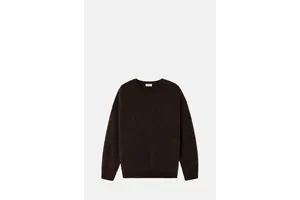
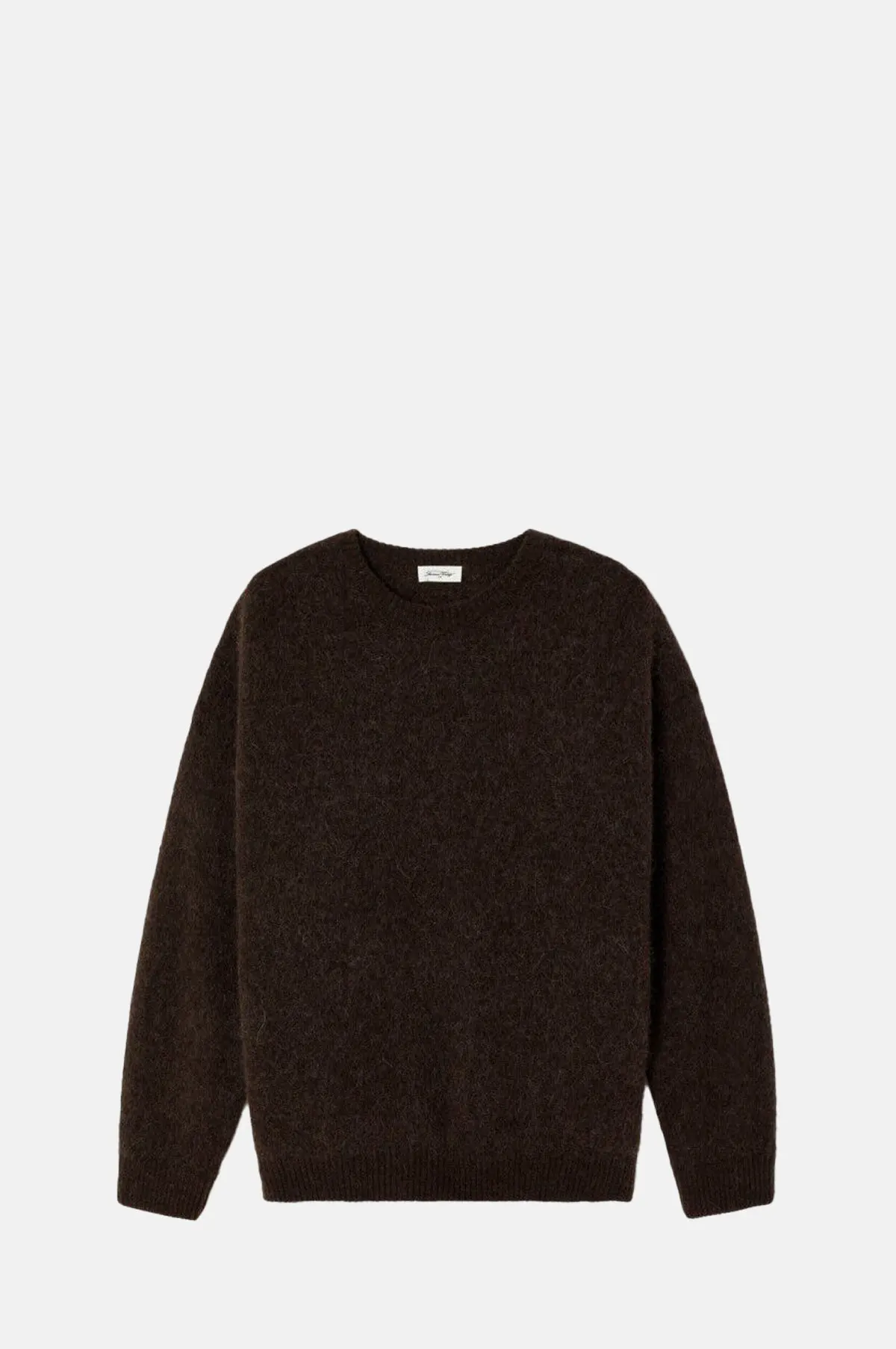

The Vitow Oversize Knit from American Vintage in dark brown, oversized and in a longer length, listed at 180 GBP in a single size with two photographs on the page. It is worth beginning with something this run has been asking for on every garment with sleeves and has never once received until now. Above the chart, in plain text, the page says: sleeve length measured from cuff to collar. That is the measurement origin. This run has spent several batches establishing that sleeve numbers cannot be compared between garments, because a short sleeve has measured anywhere from 28 to 42 centimetres and an elbow length sleeve anywhere from 20 to 29, and it concluded that the vocabulary had come loose from the measurements. The remedy it kept proposing was not a better word but a stated origin, and here is a brand that states it. So this run will credit it plainly: this is how it is done, it costs one line, and it makes the number checkable. It also explains the confusion elsewhere, because a cuff to collar measurement is a much longer number than a shoulder to cuff one, and a brand measuring the short way and a brand measuring the long way will publish numbers that differ by tens of centimetres for the same sleeve. The second thing worth setting out is what one size costs. The pit to pit is 72 centimetres, which doubles to 144, which is about 56.7 inches around. That is consistent with oversized. But the sleeve is 72 centimetres and the length is 68, and those are fixed, because there is only one size. So the width is forgiving and the length is not, and length is the dimension that varies most between bodies of the same size, because height varies independently of size. And there is no model. On a garment with one size and no chart, a model height is the only way a customer can tell where 68 centimetres falls on anybody. The reference is the Vitow Oversize Knit. Dongguan Bafinasa Garments Co., Ltd. develops comparable knitwear on OEM and ODM terms, from yarn sourcing by count and gauge to retail or FBA ready packing. We publish this as a development reference and build your own version of it, and we do not supply the branded original or reproduce anyone else's label.
Key Features
- Sleeve length measured from cuff to collar, the first stated measurement origin in this run. See the note below
- One size, so no grade, no size chart and no fit test is possible. See the note below
- A bust of about 56.7 in around, consistent with oversized, with a fixed sleeve and a fixed length. See the note below
- No model, on the one garment type where a model is most necessary. See the note below
- 34% alpaca, 34% wool, 29% polyamide and 3% elastane, all declared, with no alpaca grade, no wool type and no gauge. See the note below
- Hand wash max 40 degrees, with no dry flat instruction on a fibre blend that is 68% animal. See the note below
- Two photographs, and no bullet list. See the note below
Customisable Options
- Yarn: an alpaca, wool and polyamide blend to the reference at 34, 34, 29 and 3, with the alpaca grade and wool type stated, or baby alpaca, or merino wool, or a wool and cashmere blend, or a wool and cotton blend, each quoted separately
- Gauge: the gauge set to the reference handle, with the number stated, or a fine 14 gauge, or a mid 12 gauge, or a chunky 7 gauge, each quoted separately
- Sizing: one size to the reference, or two sizes, or a full size set from XS to L, or a size set from 6 to 16, each quoted separately
- Fit: oversized to the reference, with the finished bust, sleeve and length published, or a relaxed fit, or a regular fit, each quoted separately
- Length: a longer length to the reference, with the target length agreed, or a regular length, or a cropped length, each quoted separately
- Care: hand wash at up to 40 degrees to the reference, with a dry flat instruction added, or machine washable on a wool cycle, or dry clean only, each quoted separately
- Alpaca grade and wool type, micron count, gauge number, yarn count and ply, grams per square metre, stretch percentage and recovery, shoulder width and sleeve measurement origin stated, shrinkage and pilling test results, additional size development, size set, colour development, private label and care labelling
Specifications
| Style | Oversized long length jumper |
| Reference | American Vintage, Vitow Oversize Knit, style VITO18QH26CCI, colour cafe chine, one size |
| Composition | 34% alpaca, 34% wool, 29% polyamide, 3% elastane, all stated. See the note below |
| Alpaca Grade | Not stated. See the note below |
| Wool Type | Not stated, and no micron count given. See the note below |
| Gauge | Not stated, in any form. See the note below |
| Yarn Count | Not stated |
| Ply | Not stated |
| Cloth Weight | Not stated, in either unit |
| Handle | Super soft as stated, with no grade or micron to support it. See the note below |
| Fit Word | Oversized as stated, and the published bust is consistent with it. See the note below |
| Fit Statement | None published beyond the word oversized |
| Length | A longer length as stated, and 68 cm, which is consistent with it |
| Sizing | One size, so no grade and no size chart. See the note below |
| Sleeve | 72 cm, with the measurement origin stated as cuff to collar. See the note below |
| Sleeve Measurement Origin | Stated as cuff to collar, the first in this run. See the note below |
| Care | Hand wash, max 40 degrees, as stated. See the note below |
| Drying | Not stated, on a blend that is 68% animal fibre. See the note below |
| Certification | None named |
| Sizes Offered | One size, in stock at the time of writing |
| Size Conversion | None published, and none possible with one size |
| Fit Guidance | Oversized and a longer length as stated, and nothing else. See the note below |
| Model | None published, on a one size garment. See the note below |
| Measurements Published | Pit to pit, sleeve length and total length, for one size. See the note below |
| Published Bust | 72 cm pit to pit. See the note below |
| Bust Around | 144 cm, or about 56.7 in. See the note below |
| Published Sleeve Length | 72 cm, measured cuff to collar. See the note below |
| Published Total Length | 68 cm. See the note below |
| Cloth Weight | Not stated |
| Shoulder | Not measured |
| Photographs | Two. See the note below |
| Bullets | None published. See the note below |
| Production | Made in Bulgaria as stated, with no certification named |
| Reference Retail | 180 GBP as listed, quoted to show the price band this sits in, not as our price |
| Category | Filed by the reference under knitwear |
| Occasion | Autumn and winter, everyday, relaxed |
| MOQ | 100 pcs per style per colourway, mixed sizes and colourways accepted |
| Sampling | 7-10 days after tech pack or reference sample confirmation |
| Bulk Lead Time | 20-30 days after sample approval and deposit |
| Service | OEM / ODM / private label, alpaca and wool yarn sourcing by grade and micron, gauge development, oversized pattern development with additional sizes if required, retail or FBA ready packing |
Size Chart as Published by the Reference
| Size | Pit to pit (flat) | Sleeve Length | Total Length |
|---|---|---|---|
| One size | |||
| 72 cm | |||
| 72 cm | |||
| 68 cm |
The pit to pit figure is a flat half measure taken with the jumper laid down, doubling to 144 cm around, or about 56.7 in. The sleeve length is 72 cm and the page states that it is measured from cuff to collar. The total length is 68 cm. There is one size, so there is no grade and no size chart.
Our Proposed Body Chart
| Size | Body Bust | Sleeve | Body Waist | Body Hips | Length | Source |
|---|---|---|---|---|---|---|
| One size | 31 in / 79 cm | 72 cm | 24 in / 61 cm | 34 in / 86 cm | 68 cm / 26.8 in | Our proposal |
Occasions and Styling
Suits autumn, winter and relaxed everyday dressing. An oversized long jumper in dark brown works over a shirt or on its own, and the length makes it easy to wear over leggings or a slim trouser.
Production and Quality Control
The reference states the origin of its sleeve measurement, publishes three measurements for its one size, gives a composition with all four fibres to the percentage, states that it is oversized and a longer length and supports both with its own numbers, gives a care instruction with a temperature, names the style code and names the country of production. It gives no alpaca grade, no wool type, no micron, no gauge, no yarn count, no ply, no cloth weight, no shoulder width, no drying instruction, no pilling guidance, no shrinkage figure, no model, no bullet list and no size set, and it carries two photographs. Three things follow: the measurement origin that finally appears, the one size that removes every tool this run has, and the animal fibre blend with no dry flat instruction.
Cuff to collar, and that is the first thing, and it is worth saying plainly that this is the answer to something this run has been asking for across several batches. Above the chart, in a line of plain text, the page states that the sleeve length is measured from cuff to collar. That is the measurement origin. This run has been measuring sleeves throughout and has found that the numbers do not mean anything comparable. A sleeve called short puff measured 28 to 31 centimetres on one garment and 39 to 42 on another. A sleeve called elbow length measured 29 on one and 20 to 23 on another, and this run saw that second pairing published twice by the same brand, which ruled out a typo. So the conclusion this run reached was that the sleeve vocabulary had come loose from the measurements, and that the remedy was not a better adjective but a stated origin. Here is a brand that states it. Credit, without hedging: this is how it is done, it costs one line of text, and it turns an uncheckable number into a checkable one. And it explains the mess elsewhere rather well. A cuff to collar measurement runs from the neck edge, across the shoulder, and down the arm to the cuff. A shoulder to cuff measurement does not include the shoulder at all. The same sleeve measured both ways differs by the width of the shoulder, which on an oversized garment with a dropped shoulder is a great deal. So two honest brands measuring the same sleeve honestly can publish numbers twenty or thirty centimetres apart, and both are right. It is worth applying that to this garment, because the number looks odd until you do. The sleeve here is 72 centimetres, and the pit to pit is also 72. On a jumper whose shoulder is dropped and whose body is 144 centimetres around, a cuff to collar measurement of 72 is a full length sleeve and not an extraordinary one. Read as a shoulder to cuff measurement it would be a sleeve down to the knee. So the stated origin is not a nicety here, it is the difference between a sensible number and an absurd one. It is worth adding that this brand publishes no sleeve adjective at all. There is no long sleeve, no elbow length, nothing. Just 72, and where it starts from. That is the right way round, and it is worth setting against the rest of this run.
Fifty six point seven, and that is the second thing, and it is worth being clear about what one size removes. The pit to pit is 72 centimetres, which doubles to 144 around, which is about 56.7 inches. The sleeve is 72 and the length is 68, and all three are single numbers, because there is one size. So there is no grade to test, no size chart to read, no ease to work out against a label, and no way to compare this garment with anything else. Every method this run has used on every other garment is unavailable here, and this run should say so rather than stretch one to fit. What is left is three fixed numbers and the word oversized. And the word holds up, which is worth crediting: 56.7 inches around is a great deal of jumper, and this run has measured fitted garments in this run at 24 inches, so oversized is doing real work and the published number supports it. The length is 68 centimetres and the description says a longer length, and 68 is a long jumper, so that agrees too. Two words, two numbers, both consistent. Credit where it is due. But here is what one size costs, and it is a specific cost rather than a general complaint. The width is forgiving, because an oversized garment has room in it and a wide range of bodies can wear 56.7 inches. The sleeve and the length are not forgiving at all. They are fixed at 72 and 68. And of the three dimensions on this chart, the two that are fixed are the two that vary most between bodies of the same size, because height varies independently of size. A customer who is five foot two and a customer who is five foot eleven can both wear 56.7 inches of bust. They cannot both wear a 68 centimetre body and a 72 centimetre sleeve and get the same jumper. And there is no model. This run has noted the absence of a model on a great many garments and has usually treated it as one omission among several. Here it is the whole problem. On a garment with a single size and three fixed numbers, a model height is the only information that could tell a customer where 68 centimetres falls on a body, and it is the one thing a photograph could convey that a chart cannot. There are two photographs and neither has a model height attached. It is worth adding that this garment belongs to a family: the description says the Vitow Knit now meets its more slouchy counterpart, so there is another Vitow in the range and the page does not say how this one differs from it beyond being oversized and longer.
Thirty four and thirty four, and that is the third thing, and the fibre panel is better than most and still missing the number this garment most needs. The composition is 34% alpaca, 34% wool, 29% polyamide and 3% elastane. Four fibres, all to the percentage, which is more than most panels in this run have given, and it is worth crediting. It is also worth noting what the panel tells a reader that the description does not: the jumper is 29% polyamide, which is nearly a third synthetic, and 3% elastane, and neither appears anywhere in the prose, which talks about luxurious and soft. So the hand of this cloth owes a good deal to nylon, and the page does not mention it. Now the gaps. There is no alpaca grade. Alpaca is graded, and the grades differ sharply in softness and in price, with baby alpaca at one end and coarse grades at the other. The description says super soft, which is precisely the claim a grade exists to specify, and there is no grade. There is no wool type and no micron count. There is no gauge, no yarn count and no ply, and this run has noted on several knits that gauge is the single most informative number on a knitwear page and costs nothing to publish. And there is no weight in grams per square metre on a garment described as oversized and long, which is a great deal of cloth to have no weight for. It is worth closing on the care label, because it has a temperature and misses the instruction that matters most. The label says hand wash, max 40 degrees. A temperature, and the first hand wash temperature this run has met, so credit for that. But 40 degrees is at the upper limit for animal fibre, and this garment is 68% alpaca and wool, both of which felt and shrink with heat and agitation. And there is no drying instruction at all. A wet alpaca and wool jumper hung up will stretch out of shape under its own weight, and the correct instruction is to dry it flat. This run has now noted the absence of that instruction on two garments at 70% wool with 30% cashmere and now on one at 68% alpaca and wool. The instruction that matters most on animal fibre is the one never given. There is no detergent type, no ironing instruction, no pilling guidance on a blend containing alpaca, which is a fibre that pills, and no shrinkage figure. And there is no recovery figure for the 3% elastane. Every bulk shipment gets a measurement report against your approved chart.
Optional upgrades include naming the alpaca grade and the wool type and giving the micron count, publishing the gauge number, the yarn count, the ply and the weight in grams per square metre, developing a size set with the sleeve and length graded across it and the oversized fit held, stating the shoulder width and keeping the sleeve measurement origin published, adding a dry flat instruction, a detergent type, an ironing instruction and pilling and shrinkage test results to sit beside the temperature, adding a model height and further photographs, a bullet list, baby alpaca, merino wool, wool and cashmere and wool and cotton blends, fine, mid and chunky gauges, regular and cropped lengths, relaxed and regular fits, size set, colour development, private label, hangtag and care labelling.
Pre-production sample approval, in-line inspection during cutting and sewing, and a final AQL inspection before packing, with measurement reports and photos shared before shipment.
Send us your tech pack, a photo or a reference garment and we will quote within 24 hours. Contact bafinasa@bafinasa.com or WhatsApp +86 13827222469.