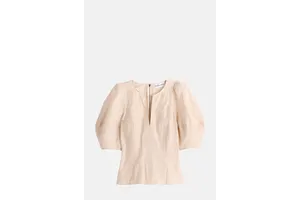
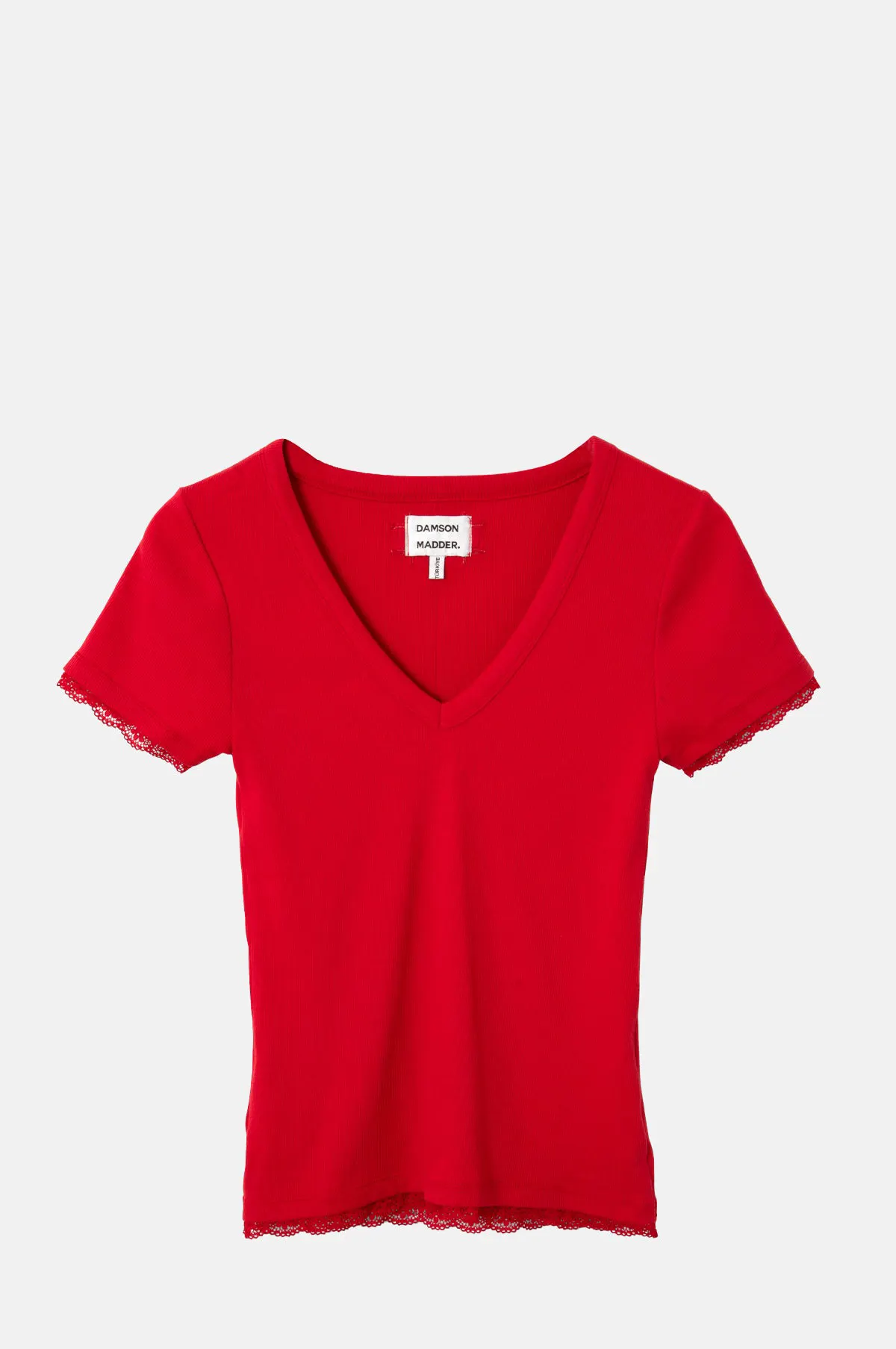

The Paige V-neck tee from Damson Madder in red, with a low V-neck, a fitted silhouette and delicate lace trims at the hem and cuffs, listed at 32 GBP with two of six sizes in stock. It is worth beginning with the numbers, because they look wrong and they are not, and the reason they are not is the most useful thing on this page. The pit to pit runs 30 to 40 centimetres, which doubles to 60 to 80 centimetres around, or about 24 to 31 inches. A UK 6 body measures roughly 31 inches at the bust. So at the smallest size this tee measures about seven inches less around than the body that wears it, and at the largest size about nine inches less. Negative ease, in other words, which is impossible in a woven cloth and meaningless in a jersey unless the jersey stretches. And the composition panel says 95% cotton and 5% elastane. It says so in four words, and those four words are what make the chart readable. A cotton and elastane jersey stretched from 60 centimetres to fit a 79 centimetre body needs about a third again in stretch, which is well within what five percent elastane gives. So the chart and the fibre panel agree with each other, and this is the first time in this run that the one has been usable to check the other. It is worth setting that beside another garment from this brand in this same batch, where the same arithmetic fails, and where the same four words are the reason. The reference is the Paige V-neck Tee. Dongguan Bafinasa Garments Co., Ltd. develops comparable jersey tops on OEM and ODM terms, from cloth and trim sourcing to retail or FBA ready packing. We publish this as a development reference and build your own version of it, and we do not supply the branded original or reproduce anyone else's label.
Key Features
- A bust of 60 to 80 cm around on bodies of 79 to 104 cm, so the ease is negative, and the declared 5% elastane is what makes that possible. See the note below
- 95% cotton and 5% elastane as stated, which is the panel that lets the chart be read at all. See the note below
- A bust grade of exactly 2 cm, clean across six sizes, against a sleeve and a length that each grade in two blocks of three. See the note below
- A low V-neck as stated, and no depth anywhere on the page. See the note below
- Lace trims at the hem and cuffs, with no lace width and no lace fibre, and the panel does not say whether the trim is included. See the note below
- A raw seam down the centre back and grosgrain branding at the back neck, both named. See the note below
- The most specific construction bullets in this run, on the cheapest garment in this run. See the note below
Customisable Options
- Jersey: a cotton and elastane jersey to the reference at 95 and 5, with the weight in grams per square metre and the stretch percentage stated, or a 100% cotton jersey, or a heavier cotton elastane, or an organic cotton jersey, or a rib jersey, each quoted separately
- Neck: a low V-neck to the reference, with the depth and the width of the opening stated, or a standard V-neck, or a crew neck, or a scoop neck, or a square neck, each quoted separately
- Trim: lace trims at the hem and cuffs to the reference, with the lace width, fibre and colour stated, or a plain hem, or a scalloped edge, or a picot edge, or a satin binding, each quoted separately
- Back: a raw seam detail down the centre back to the reference, or a plain back, or a centre back pleat, or a yoke seam, each quoted separately
- Branding: grosgrain branding at the back neck to the reference, with the width stated, or a printed back neck label, or a woven label, or an unbranded neck, each quoted separately
- Fit: a fitted style to the reference, with the negative ease and the stretch measured and stated at every size, or a regular fit, or a relaxed fit, each quoted separately
- Jersey weight and stretch percentage, bust measured relaxed and stretched, V-neck depth and width, lace width and fibre, grosgrain width, cuff circumference, shrinkage figures, size set, colour development, private label and care labelling
Specifications
| Style | Fitted tee with a V-neck, lace trims at the hem and cuffs, a raw seam down the centre back and grosgrain branding at the back neck |
| Reference | Damson Madder, Paige V-neck Tee, style PF26-DM-3904, colour Red, sizes 6 to 16 UK |
| Composition | 95% cotton and 5% elastane as stated. See the note below |
| Cloth Weight | Not stated, in any form |
| Jersey Type | Not stated, beyond the fibre panel implying a stretch jersey |
| Stretch Percentage | Not stated. See the note below |
| Handle | Comfortable as stated, with no weight and no finish named |
| Fit Word | Fitted style as stated, and the published bust supports it. See the note below |
| Fit Statement | Fitted style as stated, which is more than most pages give |
| Length | Not stated as a word, and 56 and 58 cm. See the note below |
| Neck | Low V-neck as stated, and V-neck in the bullets, with no depth and no opening width given. See the note below |
| Sleeve | Short sleeves implied, measured at 16 and 18 cm, with no measurement origin and no cuff circumference given. See the note below |
| Trim | Delicate lace trims at the hem and cuffs as stated, with no lace width and no lace fibre given, and no statement of whether the panel covers the trim. See the note below |
| Back Detail | Raw seam detail down centre back as stated. See the note below |
| Branding | Grosgrain branding at back neck as stated, with no width given. See the note below |
| Care | Machine wash at 30 degrees, do not tumble dry, as stated. See the note below |
| Certification | None named |
| Sizes Offered | 6, 8, 10, 12, 14 and 16 UK, six sizes, with 12 and 16 in stock at the time of writing |
| Size Conversion | None published, though UK sizes are largely self describing |
| Fit Guidance | Fitted style as stated |
| Model | None published |
| Measurements Published | Pit to pit, sleeve length and total length for all six sizes. See the note below |
| Published Bust | 30, 32, 34, 36, 38 and 40 cm pit to pit, stepping exactly 2 cm at every step |
| Bust Around | 60, 64, 68, 72, 76 and 80 cm, or 23.62, 25.20, 26.77, 28.35, 29.92 and 31.50 in. See the note below |
| True Bust Grade | About 2 cm of flat measure per size, and clean |
| Ease at the Bust | Negative at every size, from about -7 in at a UK 6 to about -9 in at a UK 16, which the declared elastane accounts for. See the note below |
| Published Sleeve Length | 16, 16, 16, 18, 18 and 18 cm, stepping 0, 0, 2, 0 and 0. See the note below |
| Published Total Length | 56, 56, 56, 58, 58 and 58 cm, stepping 0, 0, 2, 0 and 0. See the note below |
| Stretched Bust | Not measured. See the note below |
| Cloth Weight | Not stated |
| Photographs | Six |
| Production | Made in Turkey as stated, with no certification named |
| Reference Retail | 32 GBP as listed, the lowest in this run, quoted to show the price band this sits in, not as our price |
| Category | Filed by the reference under t-shirts |
| Occasion | All season, layering, casual, smart casual |
| MOQ | 100 pcs per style per colourway, mixed sizes and colourways accepted |
| Sampling | 7-10 days after tech pack or reference sample confirmation |
| Bulk Lead Time | 20-30 days after sample approval and deposit |
| Service | OEM / ODM / private label, cotton elastane jersey sourcing by weight with the stretch percentage measured, lace trim and grosgrain sourcing, V-neck depth development, retail or FBA ready packing |
Size Chart as Published by the Reference
| Size | Pit to pit (flat) | Sleeve Length | Total Length |
|---|---|---|---|
| 6 | 30 cm | 16 cm | 56 cm |
| 8 | 32 cm | 16 cm | 56 cm |
| 10 | 34 cm | 16 cm | 56 cm |
| 12 | 36 cm | 18 cm | 58 cm |
| 14 | 38 cm | 18 cm | 58 cm |
| 16 | 40 cm | 18 cm | 58 cm |
The pit to pit figures are flat half measures taken with the tee laid down, doubling to 60, 64, 68, 72, 76 and 80 cm around, or 23.62, 25.20, 26.77, 28.35, 29.92 and 31.50 in. Set against bodies of roughly 31 to 41 in across a UK 6 to 16, that is negative ease of about 7 in at the smallest size and about 9 in at the largest, which the declared 5% elastane is what makes wearable. No stretched measurement is published. The bust steps exactly 2 cm at every step. The sleeve runs 16 cm for sizes 6 to 10 and 18 cm for sizes 12 to 16, and the length runs 56 and 58 the same way, so both grade in two blocks of three rather than across six steps.
Our Proposed Body Chart
| Size | Body Bust | Sleeve | Body Waist | Body Hips | Length | Source |
|---|---|---|---|---|---|---|
| 6 | 31 in / 79 cm | 16 cm | 24 in / 61 cm | 34 in / 86 cm | 56 cm / 22 in | Our proposal |
| 8 | 33 in / 84 cm | 17 cm | 26 in / 66 cm | 36 in / 91 cm | 58 cm / 22.8 in | Our proposal |
| 10 | 35 in / 89 cm | 18 cm | 28 in / 71 cm | 38 in / 97 cm | 60 cm / 23.6 in | Our proposal |
| 12 | 37 in / 94 cm | 19 cm | 30 in / 76 cm | 40 in / 102 cm | 62 cm / 24.4 in | Our proposal |
| 14 | 39 in / 99 cm | 20 cm | 32 in / 81 cm | 42 in / 107 cm | 64 cm / 25.2 in | Our proposal |
| 16 | 41 in / 104 cm | 21 cm | 34 in / 86 cm | 44 in / 112 cm | 66 cm / 26 in | Our proposal |
Occasions and Styling
Suits all season layering and smart casual dressing. A fitted V-neck with lace at the hem works under a blazer or on its own, and the stretch makes it easy to wear.
Production and Quality Control
The reference states the fibre panel including the elastane, states a fit word, grades the bust cleanly across six sizes, names three specific construction details in its bullets, gives a care instruction with a temperature and a tumble prohibition, states the country of manufacture and names the style code. It gives no cloth weight, no stretch percentage, no stretched measurement, no neck depth, no sleeve measurement origin, no cuff circumference, no lace width or fibre, no grosgrain width, no shrinkage figure, no size conversion and no model, and both its sleeve and length columns grade in two blocks rather than across the range. Three things follow: the negative ease that the fibre panel explains, the blocks that this brand keeps using, and the trim that the panel does not account for.
Twenty four, and that is the first thing, and it is worth saying plainly that this number looks impossible until you read four words further down the page. The pit to pit runs 30 to 40 centimetres, which on a garment laid flat doubles to 60 to 80 centimetres around, or about 24 to 31 inches. A UK 6 body is roughly 31 inches at the bust and a UK 16 roughly 41. So this tee is between seven and nine inches smaller around than the body it is made for. That is negative ease, and in a woven cotton it would simply mean the garment does not close. It is worth working out what it needs, because the arithmetic is the point. To go from 60 centimetres to 79 centimetres is to stretch by about a third. Cotton and elastane jersey at five percent elastane will do that comfortably and will recover. So the chart is not wrong. It is a stretch garment and it is measured relaxed, which is the correct way to measure a stretch garment, and the numbers are consistent with the cloth. It is worth saying why this run is making something of this, because it is the first time it has happened. This run has spent a great many batches reading charts it could not interpret, because a number like 60 centimetres is meaningless until you know whether the cloth stretches, and most pages do not say. This one says, in four words, and the whole chart becomes readable. It is worth setting the contrast out, because another garment from this brand in this same batch has the same negative ease and does not survive it. That garment is 100% cotton with no elastane declared, and its largest size measures about 39 inches around for a body of about 41. Same arithmetic, same brand, same batch, and the only difference is whether the panel admits the stretch. That is the finding: the fibre panel is not a separate piece of information from the size chart. It is the thing that decides whether the chart can be read at all. It is worth then noting what is still missing here, because the panel gets the run most of the way and not all of it. There is no stretch percentage and no stretched measurement. So a customer at a UK 16, who needs nine inches of stretch rather than seven, is being asked to take on trust that the jersey will give it. That is the one number the page needed to add, and it is a single measurement taken with the cloth pulled.
Zero, zero, two, zero, zero, and that is the second thing, and it is now a pattern rather than an observation. The sleeve runs 16, 16, 16, 18, 18 and 18 and the length runs 56, 56, 56, 58, 58 and 58. Both step nothing for three sizes, jump two, and step nothing for three more. So this garment has two sleeve lengths across six sizes and two lengths, and a customer in a 6, an 8 and a 10 gets exactly the same garment in those two dimensions. It is worth saying that this run has now seen this exact shape on a garment from this brand in the batch before this one, and the two together are what make it a pattern. That garment was a skirt, on the same six sizes, whose waist stepped one, one, two, two, two and whose length stepped zero, zero, two, zero, zero. Same brand, same size scale, same two blocks of three. So this is a house rule, and it is worth stating what the house rule costs. Across a UK 6 to 16 there are five size steps. A garment graded properly would grow about a centimetre a step, so about five centimetres end to end. This one grows two. It is worth then setting the third column beside it, because the contrast within one chart is the interesting part. The bust goes 30, 32, 34, 36, 38 and 40, stepping exactly two at every step, across all six sizes, with no blocks at all. So on this one garment the bust is graded six times and the sleeve and the length are graded once each. And that is consistent with what this run has found about this brand overall: its bust grades are the most regular in the run, at two or three centimetres, every time, and everything else is optional. It is worth being fair that a tee's length and sleeve matter less than a coat's, and that two blocks is a defensible economy on a thirty two pound garment. But it is worth noting that the economy is invisible. The page does not say the sizes share a length, and a customer comparing a 10 and a 12 in the chart will see a two centimetre jump and no reason for it.
Lace, and that is the third thing, and it is worth starting with the credit because it is unusual. The bullets on this garment name a raw seam detail down the centre back and grosgrain branding at the back neck. Those are specific. A raw seam is a particular finish that a customer can see and feel, and grosgrain is a particular ribbon, and both are named on a garment costing thirty two pounds. This run has read coats at two hundred and fifty five pounds whose bullets say lightweight jacket and stops there. So specificity is not a function of price, and this page is the proof of it. It is worth then turning to the lace, which is named as delicate lace trims at the hem and cuffs and which follows a gap this run has found before. There is no lace width and no lace fibre. Lace is very often synthetic even on a cotton garment, and the panel reads 95% cotton and 5% elastane with no statement about whether the trim is inside that figure or additional to it. So the trim may well be a third fibre that the page does not declare. It is worth setting that beside the linings this run has chased, because it is the same gap in a smaller place: a garment is made of more than one thing, and the composition covers one of them. It is worth closing on the two things a customer would actually ask about this garment, because neither is answered. The neck is described as a low V-neck in the description and as a V-neck in the bullets, and there is no depth anywhere on the page. The depth of a V is the first question anyone asks about a V-neck tee and the second is whether it is too low, and this one says low, which is a judgement and not a measurement. And the care label reads machine wash at 30 degrees, do not tumble dry, which is two clauses and better than most, but there is no instruction to wash inside out and there is lace trim on the hem and both cuffs, which is exactly the kind of trim that catches in a wash. Every bulk shipment gets a measurement report against your approved chart.
Optional upgrades include quoting the jersey weight in grams per square metre and measuring and publishing the stretch percentage, publishing the bust relaxed and stretched, grading the sleeve and the length across all six sizes rather than in two blocks, giving the V-neck depth and opening width, the lace width and fibre and stating whether the panel covers the trim, the cuff circumference and the grosgrain width, adding washing inside out and shrinkage figures to the label, publishing a size conversion and a model height, 100% cotton, heavier and organic jersey and rib options, standard V, crew, scoop and square necks, plain, scalloped, picot and satin bound edges, plain backs, centre back pleats and yoke seams, printed and woven back neck labels, regular and relaxed fits, size set, colour development, private label, hangtag and care labelling.
Pre-production sample approval, in-line inspection during cutting and sewing, and a final AQL inspection before packing, with measurement reports and photos shared before shipment.
Send us your tech pack, a photo or a reference garment and we will quote within 24 hours. Contact bafinasa@bafinasa.com or WhatsApp +86 13827222469.