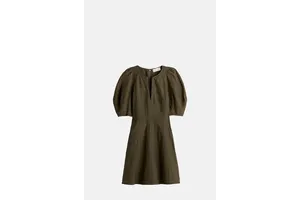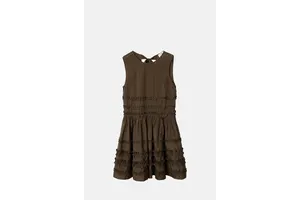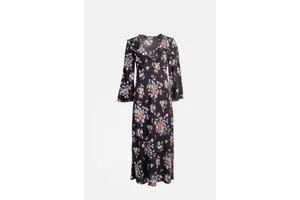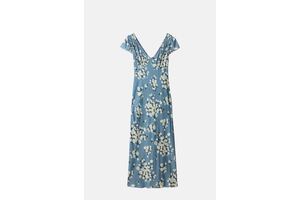
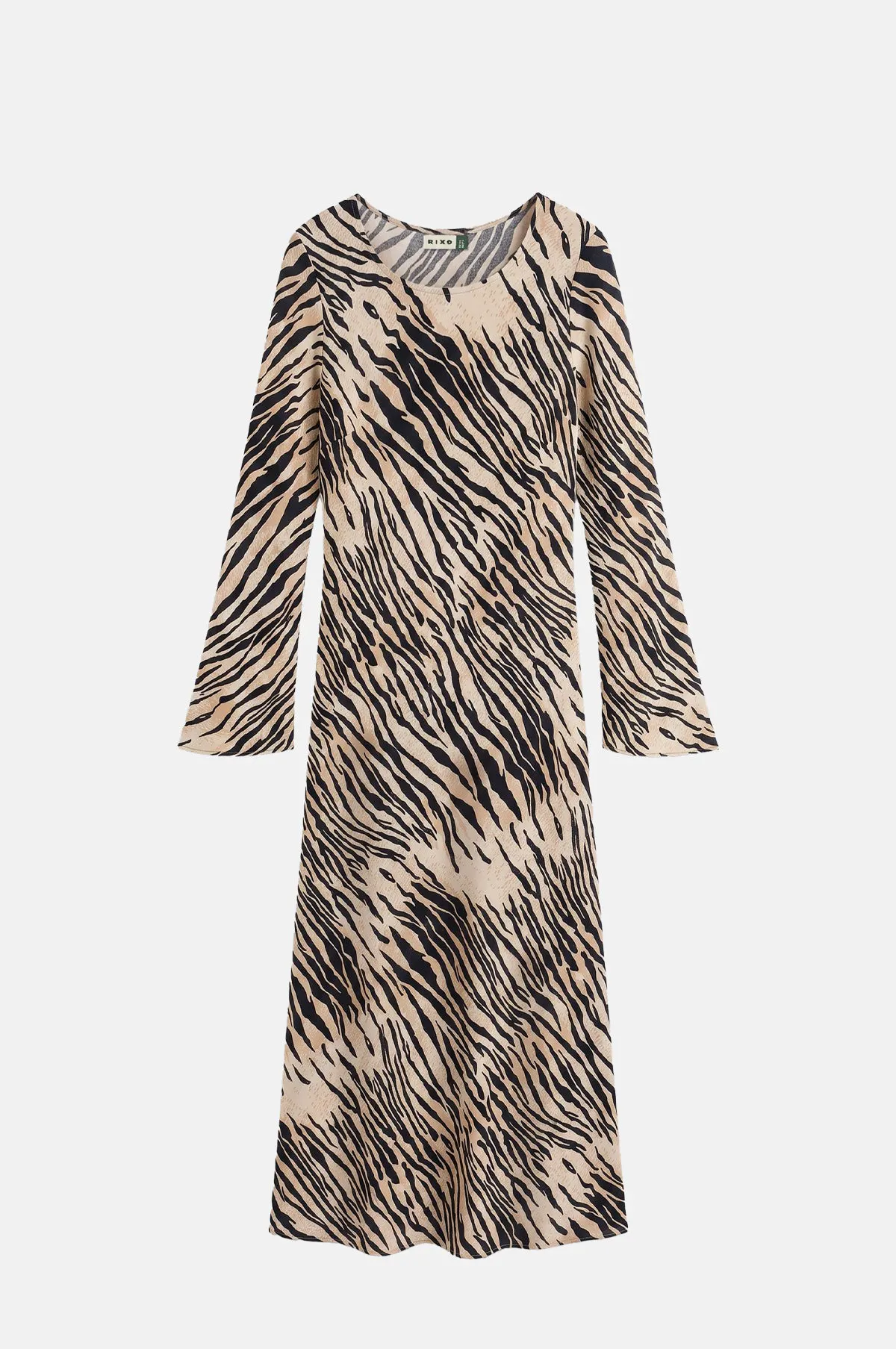

The Amal Dress from Rixo in the Cooper Tiger print on beige, made from a crepe de chine so it moves with you when you walk, with a wide scoop neckline and long sleeves with a subtle flare, unlined and bias cut, designed for a fitted silhouette, listed at 245 GBP with all four sizes in stock. It is worth beginning with the bust, because the numbers are negative at every size and the reason is not in the fibre panel. The pit to pit runs 40, 43, 46 and 49 centimetres, so doubling for the circumference gives about 31.5, 33.9, 36.2 and 38.6 inches. Against bodies of roughly 33 to 39 inches across a UK 8 to 14, that is minus 1.5 inches at the smallest size and minus 0.42 inches at the largest. Negative ease throughout, on a dress made of 100 per cent viscose with no elastane and no stretch of any kind, which on the straight grain would not go on. It is worth saying what makes it possible, because the answer is not where the run has been looking. The bullets say bias cut. Cloth cut on the bias has mechanical give without any stretch fibre, and roughly four per cent is well within it. So the key to this chart is not the composition panel, which is silent on the point, but a single word in the bullet list, one box further down the page. It is worth then turning to the grade, because the run's relationship holds here and predicts the direction correctly. The bust grades three centimetres flat per size, and a UK size step needs about 2.54 centimetres, so the dress grades faster than the body and the ease should rise by about 1.08 inches across the range. It rises by exactly that. And that is the problem: designed for a fitted silhouette means fitted, and at a UK 8 the ease is minus 1.5 inches, which is fitted, while at a UK 14 it is minus 0.42, which is not. The reference is the Amal Dress. Dongguan Bafinasa Garments Co., Ltd. develops comparable dresses on OEM and ODM terms, from cloth and print development to retail or FBA ready packing. We publish this as a development reference and build your own version of it, and we do not supply the branded original or reproduce anyone else's label.
Key Features
- A bust grading at 3 cm per size, faster than the 2.54 cm a UK size step needs, so the ease rises by about 1.1 in across the range. See the note below
- Negative ease at every size, from about -1.5 in at a UK 8 to about -0.42 in at a UK 14. See the note below
- Bias cut as stated, which is what makes negative ease possible without any stretch fibre. See the note below
- Slips on as stated, so there is no opening at all on a dress with negative ease. See the note below
- Designed for a fitted silhouette as stated, which holds at a UK 8 and has dissolved by a UK 14. See the note below
- A total length frozen at 136 cm across all four sizes, the first column in this run frozen across a whole range. See the note below
- 100% viscose in a crepe de chine, a weave usually associated with silk, with no weight given. See the note below
Customisable Options
- Cloth: a viscose crepe de chine to the reference, with the weight in grams per square metre stated, or a silk crepe de chine, or a viscose and silk mix, or a polyester crepe de chine, or a sand washed viscose, or an FSC certified viscose, each quoted separately
- Print: the Cooper Tiger print to the reference, with the motif size, the repeat and the placement stated, or a smaller motif, or a larger motif, or a placed print, or an engineered print, or a plain dyed cloth, each quoted separately
- Cut: a bias cut to the reference, with the amount of give measured and stated, or a straight grain cut, or a half bias, each quoted separately
- Neck: a wide scoop neckline to the reference, with the neck width and depth stated, or a narrower scoop, or a V neck, or a high round neck, each quoted separately
- Sleeve: long sleeves with a subtle flare to the reference, with the sleeve length, the cuff opening and the flare width measured, or a straight long sleeve, or a bishop sleeve, or a three quarter sleeve, each quoted separately
- Length: a midi length to the reference, graded across the sizes, or a shorter midi, or a maxi, or a knee length, each quoted separately
- Cloth weight, motif size, repeat and placement, bias give, neck width and depth, cuff opening and flare width, shoulder width, hip and hem circumference, opacity statement, size set, colour development, private label and care labelling
Specifications
| Style | Bias cut long sleeve midi dress in crepe de chine with a wide scoop neckline and sleeves with a subtle flare |
| Reference | Rixo, Amal Dress, colour Cooper Tiger Beige, style 010.00681.426.09081, sizes UK 8 to 14 |
| Composition | 100% viscose, as stated. See the note below |
| Cloth | Lightweight crepe de chine as stated in the bullets. See the note below |
| Cloth Weight | Lightweight as stated, with no figure given. See the note below |
| Weave | Crepe de chine as stated in the bullets |
| Handle | Moves with you when you walk, as stated, with no weight and no finish given |
| Cut | Bias cut as stated in the bullets. See the note below |
| Fit Word | Designed for a fitted silhouette as stated in the bullets. See the note below |
| Fit Statement | Designed for a fitted silhouette as stated, and the published ease supports it at a UK 8 but not at a UK 14. See the note below |
| Sizes Offered | 8, 10, 12 and 14, four sizes, all four in stock at the time of writing |
| Size Conversion | None published |
| Model | 176.1 cm and wearing a size UK 8, as stated. See the note below |
| Length | Midi length as stated in the bullets, and 136 cm across all four sizes. See the note below |
| Neck | Wide scoop neckline as stated in the description, and wide neckline in the bullets, with no neck width and no neck depth given. See the note below |
| Sleeve | Long sleeve as stated in the bullets, and long sleeves with a subtle flare in the description, measured at 63 to 66 cm, with no cuff opening and no flare width given. See the note below |
| Closure | Slips on as stated in the bullets, so there is no fastening at all. See the note below |
| Lining | Unlined for a non-restrictive feel as stated in the bullets, with no opacity statement. See the note below |
| Cooper Tiger print as stated in the title and the description, with no motif size, no repeat and no placement statement. See the note below | |
| Care | Dry Clean Only, as stated |
| Certification | None named |
| Bullet List | Eight bullets, the longest in this run |
| Measurements Published | Pit to pit, sleeve length and total length for all four sizes. See the note below |
| Published Bust | 40, 43, 46 and 49 cm pit to pit, stepping exactly 3 cm at every step. See the note below |
| Bust Around | 80, 86, 92 and 98 cm, or 31.50, 33.86, 36.22 and 38.58 in. See the note below |
| True Bust Grade | About 3 cm of flat measure per size, against about 2.54 cm needed for a UK size step. See the note below |
| Ease at the Bust | About -1.50 in at a UK 8, -1.14 in at a UK 10, -0.78 in at a UK 12 and -0.42 in at a UK 14. See the note below |
| Published Sleeve Length | 63, 64, 65 and 66 cm, stepping exactly 1 cm at every step |
| Published Total Length | 136, 136, 136 and 136 cm, frozen across all four sizes. See the note below |
| Waist | Not measured |
| Hip | Not measured |
| Hem Circumference | Not measured |
| Shoulder Width | Not measured |
| Cloth Weight | Not stated |
| Photographs | Six |
| Production | Made in China as stated, with no certification named |
| Reference Retail | 245 GBP as listed, quoted to show the price band this sits in, not as our price |
| Category | Filed by the reference under dresses |
| Occasion | Party, dinner, occasion, evening |
| MOQ | 100 pcs per style per colourway, mixed sizes and colourways accepted |
| Sampling | 7-10 days after tech pack or reference sample confirmation |
| Bulk Lead Time | 20-30 days after sample approval and deposit |
| Service | OEM / ODM / private label, viscose and silk crepe de chine sourcing by weight, tiger print development with the motif size and repeat set, bias cut pattern development with the give measured, long sleeve flared sleeve blocks, retail or FBA ready packing |
Size Chart as Published by the Reference
| Size | Pit to Pit (cm) | Sleeve Length | Total Length |
|---|---|---|---|
| 8 | 40 cm | 63 cm | 136 cm |
| 10 | 43 cm | 64 cm | 136 cm |
| 12 | 46 cm | 65 cm | 136 cm |
| 14 | 49 cm | 66 cm | 136 cm |
The pit to pit figures are flat half measures taken with the dress laid down, doubling to 80, 86, 92 and 98 cm around, or 31.50, 33.86, 36.22 and 38.58 in. Against bodies of roughly 33 to 39 in across a UK 8 to 14, the ease is negative at every size, running from about -1.50 in at the smallest to about -0.42 in at the largest. That is only wearable because the dress is bias cut, which gives the cloth mechanical stretch without any elastane. The bust grades 3 cm flat per size against the roughly 2.54 cm a UK size step needs, so the ease rises by about 1.1 in across the range and the fitted silhouette the page promises is at its loosest at the largest size. The sleeve grades evenly at 1 cm. The total length is 136 cm on all four sizes.
Our Proposed Body Chart
| Size | Body Bust | Sleeve | Body Waist | Body Hips | Length | Source |
|---|---|---|---|---|---|---|
| 8 | 33 in / 84 cm | 63 cm | 26 in / 66 cm | 36 in / 91 cm | 136 cm / 53.5 in | Our proposal |
| 10 | 35 in / 89 cm | 64 cm | 28 in / 71 cm | 38 in / 97 cm | 138 cm / 54.3 in | Our proposal |
| 12 | 37 in / 94 cm | 65 cm | 30 in / 76 cm | 40 in / 102 cm | 140 cm / 55.1 in | Our proposal |
| 14 | 39 in / 99 cm | 66 cm | 32 in / 81 cm | 42 in / 107 cm | 142 cm / 55.9 in | Our proposal |
Occasions and Styling
Suits parties, dinners and occasions. A bias cut printed midi with long sleeves works from autumn through to spring and needs little else.
Production and Quality Control
The reference publishes three measurements for all four sizes, grades its bust and its sleeve perfectly, gives eight bullets which is the longest list in this run, names its cloth, names its cut, names its neckline, its sleeve length, its closure, its lining and its silhouette, states its fibre, gives a model with a height in centimetres and a size, states the country of manufacture and names the style number, and carries all four sizes in stock with six photographs. It gives no cloth weight, no neck width or depth, no cuff opening, no flare width, no shoulder width, no waist, no hip, no hem circumference, no motif size, repeat or placement, no bias give, no opacity statement, no size conversion and no certification, and its total length is frozen across every size it offers. Three things follow: negative ease that the fibre panel cannot explain, a fitted silhouette that stops being fitted, and a length word that depends entirely on how tall the wearer is.
Minus one and a half, and that is the first thing, and it is worth showing the arithmetic before saying what it means. The pit to pit runs 40, 43, 46 and 49 centimetres, so the dress measures 80, 86, 92 and 98 centimetres around, or about 31.5, 33.9, 36.2 and 38.6 inches. Against bodies of roughly 33 to 39 inches, that is minus 1.5, minus 1.14, minus 0.78 and minus 0.42. Negative at every size. It is worth then saying why that should be impossible here, because the run has a direct comparison. Two batches ago a dress from another brand published negative ease of about minus 1.6 inches, and the run flagged it as a contradiction because its composition was 100 per cent cotton with no elastane and no stretch mechanism of any kind. This dress is 100 per cent viscose with no elastane either. So by the standard the run set then, this chart should be unwearable. It is worth then finding the thing that makes it wearable, because it is not where the run has been looking. The bullets say bias cut. Cloth cut at forty five degrees to the grain has mechanical give: it stretches and recovers without any elastic fibre at all, typically by five to ten per cent. Minus 1.5 inches on a 33 inch bust is about four and a half per cent, which is comfortably inside that. So the chart is readable, and the key to reading it is one word in the bullet list. It is worth saying why that matters as a finding, because it generalises. Two batches ago the run concluded that the fibre panel is the key to the size chart, after finding two garments from the same brand with the same negative ease where one declared five per cent elastane and one did not. That was right as far as it went. But here the fibre panel is silent: 100 per cent viscose tells you nothing about whether the dress will go on. The key is the cut. And the cut lives in a different box on the page, one section further down. To read a size chart you need the composition and the construction together, and no page in this run has ever connected them. It is worth adding one consequence that makes this more than academic. The bullets also say slips on. There is no zip, no buttons, no opening anywhere. So a dress with negative ease and no opening has to go on over the head or up from the feet, and it only does that because of the bias. The bias is load bearing, and nothing on the page says so.
Three, and then one point zero eight, and that is the second thing, and it is worth running the relationship because it holds and because it comes out pointing the other way. The bust grades three centimetres flat per size. A UK size step is about two inches of bust, which is about 5.08 centimetres around, which is 2.54 centimetres flat. So the dress grades 0.46 centimetres flat faster than the body needs, which is 0.92 centimetres around, which is about 0.36 inches per size, and over three steps that is about 1.08 inches of ease gained. Measured directly, the ease runs from minus 1.50 to minus 0.42, which is 1.08. It is worth saying plainly what that does to the design, because it is the part a customer would feel. The bullets say designed for a fitted silhouette. At a UK 8 the ease is minus 1.5 inches and that is a fitted dress. At a UK 14 it is minus 0.42 inches, which is barely touching, and the fit has gone. So the promise in the bullet list holds at the small end of the range and dissolves at the large end. It is worth setting that beside everything else this run has measured, because it completes the picture rather than contradicting it. Up to now every garment in this run graded more slowly than the body, ease fell, and the largest size ended up the tightest. This one grades faster, ease rises, and the largest size loses the shape the designer intended. The two look like opposite failures and they are the same failure: the grade does not match the rate at which the body grows. It is worth adding that the run can now state the general rule instead of half of it. What matters is not whether ease falls or rises but whether the grade matches the body, because a mismatch in either direction costs the wearer the fit. And in the same batch there is a second garment that grades too fast, a pair of jeans whose waist grows four inches faster than its own size labels say, so this is not a single outlier. It is worth noting finally that the sleeve is graded cleanly at one centimetre per size, from 63 to 66, and that 63 to 66 centimetres is a genuinely long sleeve, which makes this the fourth data point in two batches for that word: last batch the same word appeared at 28 centimetres on one garment, at 53 to 56 on another and at 74 to 76 on a third.
One hundred and thirty six, four times, and that is the third thing, and it is worth saying what it is a record for. The total length is 136 centimetres on a UK 8, a UK 10, a UK 12 and a UK 14. This run has found frozen length columns before: three of five sizes on a trouser, three of five on a dress, two of three on a tee. But this is the first time a length column has been frozen across every single size offered, with not one exception. A UK 8 and a UK 14 get the same 136 centimetres of dress, and those two bodies are not the same height. It is worth then taking the length word, because the page does something this run has been asking for and the result is not what the page claims. The bullets say midi length, and the model is given as 176.1 centimetres. A 136 centimetre dress on a 176 centimetre woman reaches close to the floor, because the shoulder sits roughly 30 to 35 centimetres below the top of the head. That is a maxi, not a midi. It is worth being careful here, because the run should not overclaim: the length may be measured from somewhere other than the shoulder, and the run has been reading these figures as shoulder to hem throughout. But on the reading the run has used consistently, the word and the number disagree, and this time there is a model height to check it against, which is exactly what this run has been asking pages to provide for its whole length. It is worth adding the consequence, because it is the same one that has followed every frozen length in this run. On a woman of 176 centimetres the dress is one thing and on a woman of 160 it is another, and the frozen figure means the shorter she is the longer the dress gets. It is worth then closing on the two smaller gaps. The neckline is a wide scoop, and wide is a width claim with no width figure, and no depth either. And the print is a tiger, and there is no motif size, no repeat and no placement statement. It is worth adding one point specific to this garment: the dress is bias cut and the cloth is printed, so the tiger runs on the diagonal, and no placement statement anywhere on the page addresses which way the motif falls. Every bulk shipment gets a measurement report against your approved chart.
Optional upgrades include grading the total length across the sizes, grading the bust at the 2.54 cm that holds the fitted silhouette, publishing the waist, hip, hem circumference and shoulder width, quoting the cloth weight in grams per square metre, measuring and publishing the bias give, the neck width and depth, the cuff opening and the flare width, the motif size, the repeat and the placement, adding an opacity statement for the unlined body, publishing a size conversion, silk, viscose and silk mix, polyester and sand washed crepe de chine and FSC certified viscose, smaller, larger, placed and engineered motifs and plain dyeing, straight grain and half bias cutting, narrower scoop, V and high round necks, straight, bishop and three quarter sleeves, shorter midi, maxi and knee lengths, size set, colour development, private label, hangtag and care labelling.
Pre-production sample approval, in-line inspection during cutting and sewing, and a final AQL inspection before packing, with measurement reports and photos shared before shipment.
Send us your tech pack, a photo or a reference garment and we will quote within 24 hours. Contact bafinasa@bafinasa.com or WhatsApp +86 13827222469.