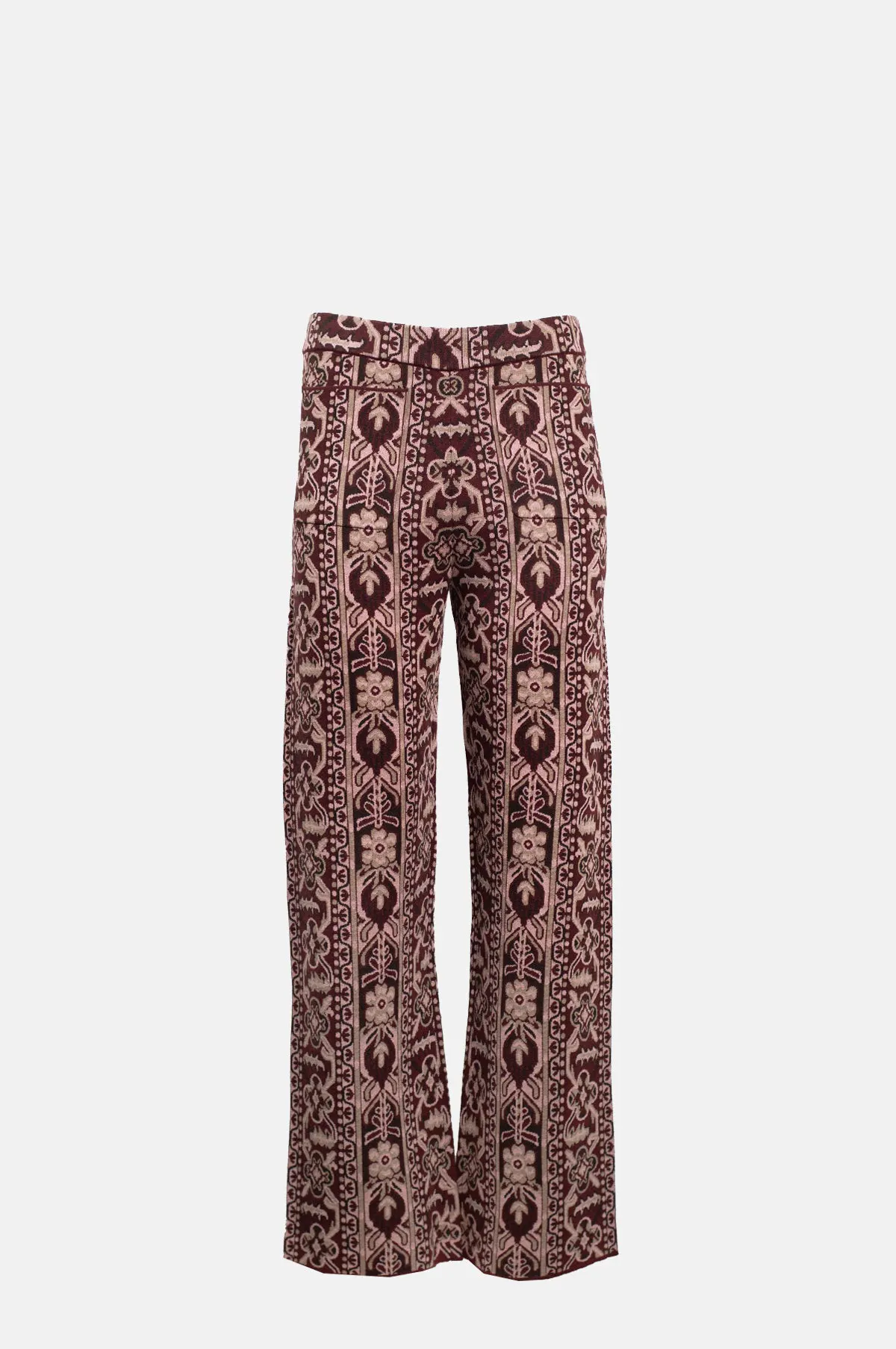

The Ceara Trouser from Rixo in Tapestry Bloom Multi, a bold tapestry-inspired printed trouser in a rich burgundy and blush colourway, made from a cosy wool blend with a high waist and a subtle wide leg for a 70s bohemian feel, listed at 275 GBP with three of four sizes in stock. It is worth beginning with the waist, because this is the second brand in two batches whose own size scale disagrees with itself, and this one is simpler to state than the last. The waist runs 31, 35, 37 and 40 centimetres, so the steps are four, two and three. That is a new shape in this run: every other irregular grade has declined steadily or changed once and held, and this one goes down and then back up. It is worth then setting it beside another Rixo garment this run measured last batch, because the two are the same in every respect that ought to decide this. Same brand, same price of 275 pounds, same size scale of UK 8 to 16, same measurements published in the same units. And the average waist grade is three centimetres per size on both, to the decimal. And yet one starts at about zero ease at the waist and the other starts at about minus 1.6 inches. So the whole range is shifted: Rixo's size 8 is two different waists depending on which garment you buy, and they are about an inch and a half apart at every size. It is worth then turning to the lengths, which is where this garment becomes useful. The inseam runs 73, 75, 77 and 79, and the total length 101, 103, 105 and 107. Both grade perfectly at two centimetres per size, and because both are published the rise can be worked out: twenty eight centimetres, on every size. The reference is the Ceara Trouser. Dongguan Bafinasa Garments Co., Ltd. develops comparable trousers on OEM and ODM terms, from cloth and print development to retail or FBA ready packing. We publish this as a development reference and build your own version of it, and we do not supply the branded original or reproduce anyone else's label.
Key Features
- An inseam and a total length both grading at exactly 2 cm per size, and a rise derivable at 28 cm. See the note below
- High waist as stated, measuring 28 cm, against 30 cm on another brand's mid-rise. See the note below
- A waist stepping 4, 2 and 3 cm, the only non-monotonic grade in this run. See the note below
- About 1.6 in less waist ease than another Rixo garment at every size, on the same size scale. See the note below
- A five-fibre composition panel, with wool at 29% and polyester at 38%. See the note below
- Patch pockets on the front as stated, the first pocket entry in this run to name the type. See the note below
- Slips on as stated, with negative ease at the waist on every size. See the note below
Customisable Options
- Cloth: a wool blend to the reference, with the full composition and the weight in grams per square metre stated, or a higher wool content, or a merino blend, or a recycled wool blend, or a wool and Tencel blend, or a polyester and viscose suiting, each quoted separately
- Print: a tapestry-inspired print in burgundy and blush to the reference, with the motif size, the spacing and the repeat stated, or a smaller motif, or a placed print, or an engineered print, or a yarn-dyed check, or a plain dyed cloth, each quoted separately
- Waist: a high waist to the reference, with the waist and hip both measured and graded and the rise published, or a mid waist, or a flat front, or an elasticated back waist, each quoted separately
- Leg: a subtle wide leg to the reference, with the leg opening, thigh and knee measured and published, or a full wide leg, or a straight leg, or a tapered leg, each quoted separately
- Length: an inseam and a total length to the reference, both graded across the sizes, or a shorter inseam, or a cropped length, or a full length, each quoted separately
- Pockets: front patch pockets to the reference, with the dimensions stated, or slanted side pockets, or welt pockets, or back patch pockets, or no pockets, each quoted separately
- Composition with every fibre stated, cloth weight, print motif size, spacing and repeat, waist and hip measurements, rise, leg opening, thigh, knee and hem, pocket dimensions, shrinkage figures, size set, colour development, private label and care labelling
Specifications
| Style | High waist wide leg trouser in a printed wool blend with front patch pockets and a pull-on waist |
| Reference | Rixo, Ceara Trouser, colour Tapestry Bloom Multi, style 303.03188.426.09314, sizes 8 to 14 |
| Composition | 38% polyester, 29% wool, 26% acrylic, 6% polyamide and 1% elastane, as stated. See the note below |
| Cloth | A cosy wool blend as stated in the description, and a lightweight knit as stated in the bullets. See the note below |
| Cloth Weight | Not stated, in any form. See the note below |
| Weave | Not stated |
| Handle | Soft and breathable as stated in the bullets, and cosy as stated in the description, with no weight given. See the note below |
| Stretch | 1% elastane as stated, the smallest elastane content in this run |
| Fit Word | High waist and wide leg as stated in the bullets and the description, and subtle wide leg as stated in the description. See the note below |
| Fit Statement | A 70s bohemian feel, as stated |
| Sizes Offered | 8, 10, 12 and 14, four sizes, with 8, 10 and 12 in stock at the time of writing |
| Size Conversion | None published |
| Model | 176 cm, wearing a size UK 8, as stated, with no weight given. See the note below |
| Rise | Not stated as a word, and about 28 cm derived from the two published lengths. See the note below |
| Leg | Subtle wide leg as stated, with no leg opening, thigh or knee measured and published. See the note below |
| Waist | High waist as stated, measured at 31 to 40 cm, with no hip measured. See the note below |
| Closure | Slips on as stated, with no elastic, no drawstring and no closure hardware named. See the note below |
| Pockets | Patch pockets on the front as stated, with no count and no dimensions given. See the note below |
| A tapestry-inspired print as stated, in a rich burgundy and blush colourway as stated, with no motif size, no spacing and no repeat given. See the note below | |
| Hip | Not measured |
| Thigh | Not measured |
| Knee | Not measured |
| Leg Opening | Not measured |
| Care | Hand Wash Cold, as stated, with no drying instruction. See the note below |
| Certification | None named |
| Bullet List | Five bullets |
| Measurements Published | Waist, inseam and total length for all four sizes. See the note below |
| Published Waist | 31, 35, 37 and 40 cm, stepping 4, 2 and 3 cm. See the note below |
| Waist Around | 62, 70, 74 and 80 cm, or 24.41, 27.56, 29.13 and 31.50 in. See the note below |
| True Waist Grade | About 3 cm of flat measure per size on average, against about 2.54 cm needed on a UK size step. See the note below |
| Ease at the Waist | About -1.6 in at a size 8, -0.4 in at a 10, -0.9 in at a 12 and -0.5 in at a 14. See the note below |
| Published Inseam | 73, 75, 77 and 79 cm, stepping exactly 2 cm at every step. See the note below |
| Published Total Length | 101, 103, 105 and 107 cm, stepping exactly 2 cm at every step. See the note below |
| Rise, Derived | About 28 cm on every size, being the total length less the inseam, which the page never states. See the note below |
| Hip | Not measured |
| Cloth Weight | Not stated |
| Photographs | Six |
| Production | Made in China as stated, with no certification named |
| Reference Retail | 275 GBP as listed, quoted to show the price band this sits in, not as our price |
| Category | Filed by the reference under trousers |
| Occasion | Everyday, work, weekend, dressing up, autumn and winter |
| MOQ | 100 pcs per style per colourway, mixed sizes and colourways accepted |
| Sampling | 7-10 days after tech pack or reference sample confirmation |
| Bulk Lead Time | 20-30 days after sample approval and deposit |
| Service | OEM / ODM / private label, wool blend sourcing with the full composition and the weight stated, tapestry print development with the motif size, spacing and repeat set, high waist wide leg trouser blocks with the waist, hip, rise, inseam, leg opening, thigh and knee all graded, retail or FBA ready packing |
Size Chart as Published by the Reference
| Size | Waist (cm) | Inseam (cm) | Total Length (cm) |
|---|---|---|---|
| 8 | 31 cm | 73 cm | 101 cm |
| 10 | 35 cm | 75 cm | 103 cm |
| 12 | 37 cm | 77 cm | 105 cm |
| 14 | 40 cm | 79 cm | 107 cm |
The waist figures are flat half measures taken with the trouser laid down, doubling to 62, 70, 74 and 80 cm around, or 24.41 to 31.50 in. Against bodies of roughly 26 to 32 in, the ease at the waist is negative on every size: about 1.6 in tight at a size 8, 0.4 at a 10, 0.9 at a 12 and 0.5 at a 14. The waist steps 4, 2 and 3 cm, so the grade falls and then rises, but averaged over the range it is about 3 cm per size against about 2.54 cm needed. The inseam and the total length both step a clean 2 cm at every step, and the difference between them puts the rise at about 28 cm on every size, which the page never states. No hip, thigh, knee or leg opening is published. Our proposal below grades the waist evenly, publishes the hip and the rise directly, and grades the inseam and the total length across the sizes.
Our Proposed Body Chart
| Size | Body Bust | Body Waist | Body Hips | Length | Source |
|---|---|---|---|---|---|
| 8 | 33 in / 84 cm | 26 in / 66 cm | 36 in / 91 cm | 101 cm / 39.8 in | Our proposal |
| 10 | 35 in / 89 cm | 28 in / 71 cm | 38 in / 97 cm | 103 cm / 40.6 in | Our proposal |
| 12 | 37 in / 94 cm | 30 in / 76 cm | 40 in / 102 cm | 105 cm / 41.3 in | Our proposal |
| 14 | 39 in / 99 cm | 32 in / 81 cm | 42 in / 107 cm | 107 cm / 42.1 in | Our proposal |
Occasions and Styling
Suits work, weekends and dressing up. A printed wide leg trouser in a wool blend works with a simple top for the day and with heels and a silky top for the evening, and carries the outfit on its own.
Production and Quality Control
The reference publishes three measurements for all four sizes, grades both of its length columns perfectly at every step, and publishes both the inseam and the total length so that the rise can be worked out, which only one other garment in this run does. It names its waist height, names its leg shape, names its pockets by type and location, names its closure as slips on, gives a five-fibre composition panel, names two colours in its print, gives a model height and the size worn, states its care and its country of manufacture and names the style number, and carries six photographs. It gives no cloth weight, no hip, no thigh, no knee, no leg opening, no rise measurement, no print motif size, spacing or repeat, no pocket count or dimensions, no elastic or drawstring detail, no drying instruction, no shrinkage figure, no size conversion and no certification, and its waist grade is non-monotonic. Three things follow: a waist range that is an inch and a half tighter than the same brand's other garment on the same size scale, a rise that can be derived and that sits below another brand's mid-rise, and a wool blend in which wool is the second-largest fibre.
Four, two, three, and that is the first thing, and it is worth saying what shape it is before what it means, because this run has been collecting shapes of bad grades for a long while and this is a new one. It has met grades that decline steadily, stepping three, two, one and one. It has met grades that stop. It has met grades with one outsized first step. And last batch it met a grade that halved exactly halfway through and held the new size, stepping four, four, two, two. What it has not met is a grade that falls and then rises. This one goes from a four to a two and then back up to a three. It is worth then doing the comparison that makes this matter, because on its own an irregular grade is only an irregular grade. Last batch this run measured another Rixo garment, a skirt at the same price of two hundred and seventy five pounds, on the same UK size scale, with the same two measurements published in the same units. Its waist stepped four, four, two and two. Averaged over its range, that is three centimetres per size. Averaged over this one's range, it is three centimetres per size. The same brand, the same price, the same size labels, the same average grade to the decimal. And then the starting points differ, and that is the whole finding. The skirt starts at about zero ease at the waist. This trouser starts at about minus one point six inches. And because the average grades match, that difference is not a difference in steepness, it is a shift: the entire range is offset, and the gap of about an inch and a half holds at every size from eight to sixteen. It is worth saying what that means in plain terms. Rixo's size eight is two different waists depending on which garment you buy, and the two are an inch and a half apart. It is worth then noting that this is now the second brand in two consecutive batches where two garments on one size scale disagree materially. Last batch it was another brand, whose two garments on a twenty four to thirty one scale graded at two centimetres and one. So the run will state the finding plainly rather than as a coincidence: a size label on a brand's own site does not reliably mean the same measurement from one garment to the next, and this run has now confirmed that on two brands in a row. It is worth then looking at what this garment's waist figures do on their own, because there is a second problem in them. The ease is negative on every size: one point six inches tight at a size eight, and between half and one inch tight everywhere else. And the bullets say slips on. There is no zip, no button and no drawstring, and the cloth carries one per cent elastane, which is the least stretch this run has seen on a garment that has to be pulled on. It is worth being careful about the conclusion here, because there are two readings and the page does not settle between them. Either the waistband is meant to stretch by an inch and a half to close, in which case one per cent elastane is doing a great deal of work and the fit at the waist will feel tight, or the measurement is taken somewhere other than where a body measures its waist. But the page publishes no hip either, and a pull-on trouser has to pass over the hip, which is the wider part and the one that decides whether it goes on at all. So the necessary numbers are the hip and the rise, and neither is there.
Two, two, two, twice, and that is the second thing, and it is worth saying why it makes this the most useful chart in this batch. The inseam runs seventy three, seventy five, seventy seven and seventy nine. The total length runs one hundred and one, one hundred and three, one hundred and five and one hundred and seven. Both grade perfectly, and both grade at the same rate in the same direction, which means the difference between them is constant. One hundred and one less seventy three is twenty eight. One hundred and seven less seventy nine is twenty eight. The rise is twenty eight centimetres on every size. It is worth then setting that beside the other derivable rises this run has, because the comparison is now the sharpest result the run has and it keeps getting sharper. Two batches ago the run worked out the rise on another brand's high rise jean: twenty five to twenty seven centimetres. Last batch it worked out the rise on the same brand's mid-rise trouser: thirty. Now a third garment, a third brand, labelled high waist: twenty eight. It is worth laying those three side by side, because the words and the numbers are in the wrong order. The two garments labelled high are twenty five to twenty seven and twenty eight. The one labelled mid is thirty. So the mid-rise is the highest of the three, and both of the highs are below it. It is worth saying how the run knows this, since that is worth more than the fact. Not one of the three pages states a rise. All three happen to publish the pair of numbers that reveal it, and each rise is visible only if you subtract one from the other on that page and then carry the answer across to another product page and compare. It is worth then noting what the run has now established over its whole length on this subject. For a long time the finding was that fit vocabulary is unmeasured and therefore cannot be trusted. That is still true. But it is now weaker than the truth, because on the one fit dimension that happens to be derivable from published numbers, the words are not merely unsupported, they are ordered wrongly across brands. It is worth then adding the two things this chart omits that it most needs. The description says subtle wide leg, and the leg opening is the measurement that defines a wide leg, and it is not there, and neither the thigh nor the knee nor the hip is there. It is worth noting that subtle is a degree word attached to a measurement that does not exist: subtle relative to what, the run asks, as it has asked of every such qualifier. It is worth finally taking the model, because this is one of the few garments in this batch to give one. The model is one hundred and seventy six centimetres and wears a UK eight, which has an inseam of seventy three centimetres. A leg on a person of that height runs roughly seventy nine to eighty three centimetres, so the trouser ends somewhere between six and ten centimetres above the ankle. That is a cropped trouser on this model, which is consistent with the styling advice to wear heels with it, and the page never says that it is cropped.
Twenty nine, and that is the third thing, and it is worth reading the two halves of the page against each other to see it. The description says made from a cosy wool blend. The composition panel says thirty eight per cent polyester, twenty nine per cent wool, twenty six per cent acrylic, six per cent polyamide and one per cent elastane. So wool is the second-largest fibre in the cloth, at less than a third, and polyester is the largest, at more than a third, and polyester is never mentioned anywhere in the prose. It is worth setting that beside what the run found last batch, because the two are versions of the same problem and the run now has both halves. On a trouser from another brand last batch, the claim was in the description and nowhere in the composition panel: the prose said regenerative cotton and the panel said one hundred per cent cotton. Here both halves are present, and they disagree in emphasis rather than in fact: the fibre the prose leads with is not the fibre that dominates the cloth. It is worth being fair about this, because the panel is honest and precise and the run should say so. Five fibres, every one stated, summing correctly. It is worth then asking what is missing from that precision, and the answer is the weight. There is no grams per square metre and no ounces anywhere on the page, and cosy is a warmth claim with nothing behind it, and the bullets call the cloth a lightweight knit and say it is soft and breathable while the description calls it cosy. It is worth noting that those two pull in different directions and that the garment is a trouser. It is worth then turning to the care label, because this is where the batch as a whole is most telling. This garment says hand wash cold, and nothing else. The other two garments in this batch are both one hundred per cent cotton and both say machine wash at thirty degrees and do not tumble dry. So the one garment here with wool in it is the only one with no drying instruction at all, and wool is the fibre most damaged by tumble drying, since it felts rather than merely shrinks. And none of the three gives a shrinkage figure. It is worth closing on the pockets, because this batch completes a tally worth stating. The bullets say patch pockets on the front, which names the type and the location. Last batch the run found front and reinforced back pockets on one garment, five pockets on another, and no mention at all on a third. So in two batches four garments name pockets four different ways, by type and location, by location and reinforcement, by count alone, and not at all, and not one of the four gives a dimension. It is worth adding that a patch pocket is the one pocket type whose size you can see and therefore the one whose dimensions matter most, and this page gives none. Every bulk shipment gets a measurement report against your approved chart.
Optional upgrades include grading the waist evenly and shifting the base size so the ease is positive at every size, grading the inseam and the total length across the sizes and publishing the rise directly, publishing the hip, the leg opening, the thigh and the knee, quoting the cloth weight in grams per square metre and giving the full composition, raising the wool content or moving to merino or recycled wool, giving the print motif size, the spacing and the repeat, naming the pocket dimensions, adding a drying instruction and a shrinkage figure to the label, slanted, welt and back patch pockets and no pockets, mid waist, flat front and elasticated back waists, full wide leg, straight leg and tapered leg, shorter, cropped and full lengths, size set, colour development, private label, hangtag and care labelling.
Pre-production sample approval, in-line inspection during cutting and sewing, and a final AQL inspection before packing, with measurement reports and photos shared before shipment.
Send us your tech pack, a photo or a reference garment and we will quote within 24 hours. Contact bafinasa@bafinasa.com or WhatsApp +86 13827222469.