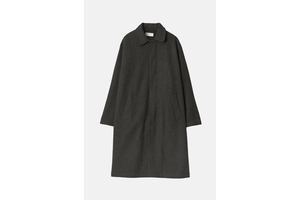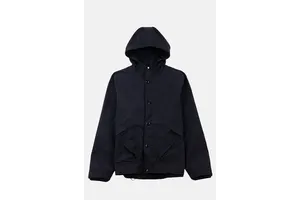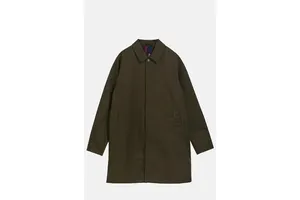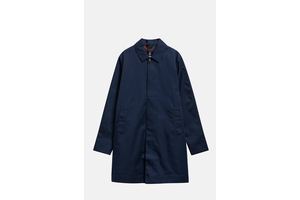
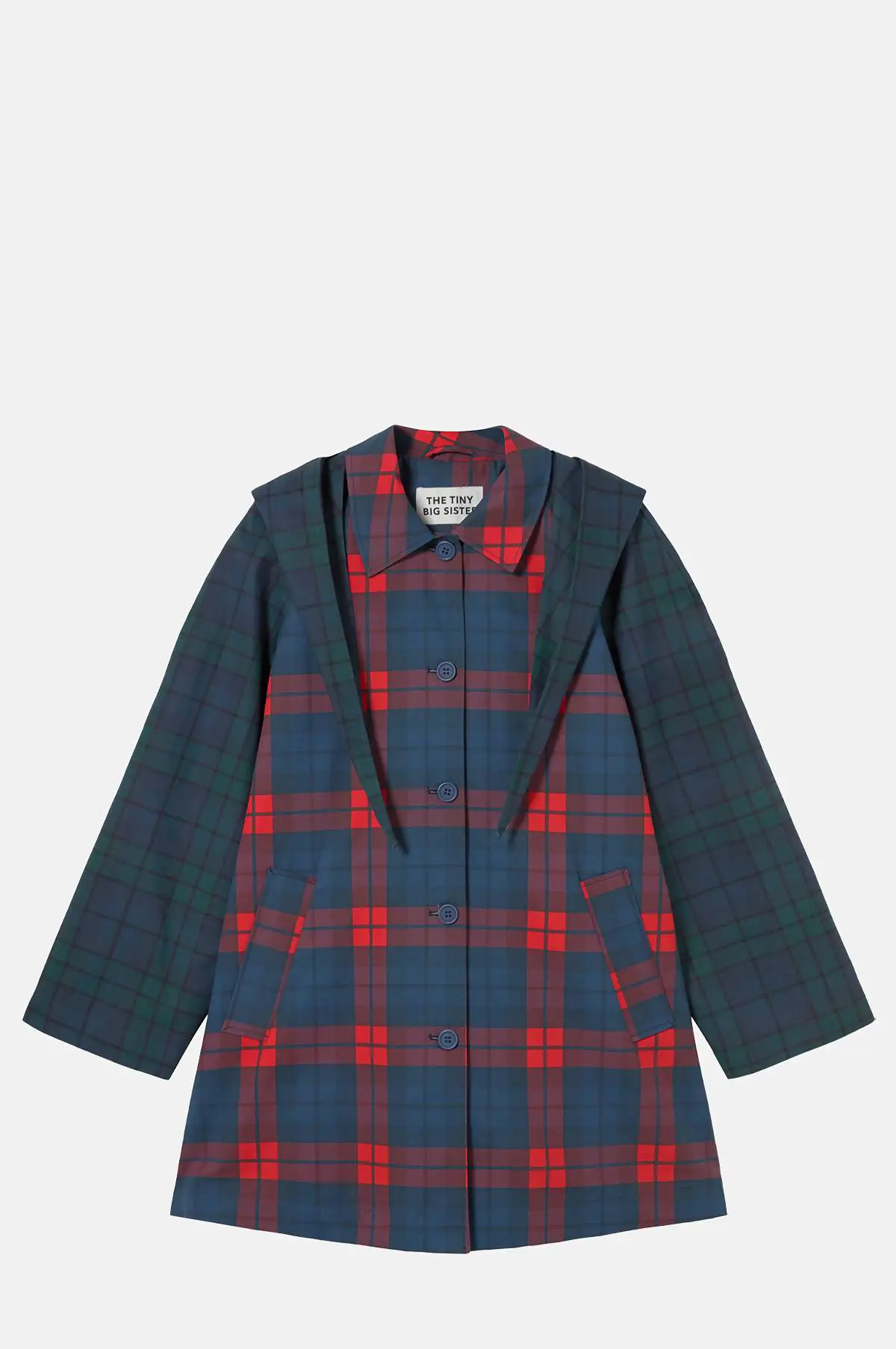

The Check Hood Trench Coat from The Tiny Big Sister in light navy and dark red, made from structured cotton twill with a water-resistant finish and soft quilted padding, patterned in a wine-red check and contrasted with a dark green check for a subtle colour-block effect, with a removable oversized hood that can be tied as a scarf, listed at 273 GBP with both sizes in stock. It is worth beginning with the sizes, because they are the reason this chart cannot be read. The coat comes in two sizes, S/M and M/L, and each of those is itself a range rather than a size. So the pit to pit steps two centimetres, the sleeve steps four and the total length steps one. Three measurements, three different rates. But since neither label is a size, none of those three numbers is a grade, and there is no way to say which of them is wrong. It is worth then looking at the sleeve, because four centimetres is the largest single step in this batch and the ambiguity is what makes it uninterpretable. If S/M and M/L are one size apart, then four centimetres of sleeve is fast. If they are two sizes apart, it is reasonable. The page does not say, and it cannot say, because its own labels do not mean anything precise. It is worth then turning to what the page does exceptionally well, which is the composition. It gives three lines: the shell at 100% cotton, the lining at 55% polyester and 45% viscose, and the padding at 100% polyester. This is the first three-part composition panel in this run, and it is genuinely good. It is worth then setting that beside the one performance claim on the page, which is water-resistant. There is no spray rating, no hydrostatic head, no standard. And the care label says machine wash at thirty degrees, and durable water repellent finishes degrade in washing, and there is no re-proofing instruction and no statement of how many washes the finish survives. The reference is the Check Hood Trench Coat. Dongguan Bafinasa Garments Co., Ltd. develops comparable coats on OEM and ODM terms, from cloth and check development to retail or FBA ready packing. We publish this as a development reference and build your own version of it, and we do not supply the branded original or reproduce anyone else's label.
Key Features
- A three-part composition panel covering the shell, the lining and the padding separately. See the note below
- A removable oversized hood that can be tied as a scarf, as stated. See the note below
- Relaxed fit as stated, and about 9 to 11.5 in of chest ease, so the word and the numbers agree. See the note below
- Water-resistant as stated, with no spray rating, no hydrostatic head and no standard. See the note below
- Padded as stated, with the padding fibre given and no weight. See the note below
- Two checks named with their colours, and no check size, repeat or scale on either. See the note below
- Welt pockets as stated, naming the pocket type with no dimensions. See the note below
Customisable Options
- Shell: a structured cotton twill to the reference, with the weight in grams per square metre stated, or an organic cotton twill, or a cotton and nylon blend, or a cotton and polyester twill, or a waxed cotton, or a recycled cotton twill, each quoted separately
- Finish: a water-resistant finish to the reference, with the spray rating and the test standard stated, or a fully waterproof membrane with the hydrostatic head stated, or a shower-resistant finish, or no finish, each quoted separately
- Padding: a soft quilted polyester padding to the reference, with the weight in grams per square metre stated, or a recycled polyester padding, or a down fill with the fill power stated, or a heavier padding, or no padding, each quoted separately
- Lining: a 55% polyester and 45% viscose lining to the reference, with the weight stated, or a cotton lining, or a cupro lining, or a taffeta lining, or a quilted self lining, each quoted separately
- Check: a wine-red check contrasted with a dark green check to the reference, with the check size and repeat of both stated, or a single check, or a windowpane check, or a plain dyed cloth, each quoted separately
- Hood: a removable oversized hood that can be tied as a scarf to the reference, with the hood depth and the tie length stated, or a fixed hood, or a detachable hood with a zip, or no hood, each quoted separately
- Shell weight, spray rating and test standard, padding weight, lining weight, check size and repeat, chest, waist, hip and sleeve measurements, hood depth and tie length, pocket dimensions, button count and size, shrinkage figures, size set, colour development, private label and care labelling
Specifications
| Style | Relaxed fit checked cotton twill trench coat with a removable hood, quilted padding, welt pockets and a front button closure |
| Reference | The Tiny Big Sister, Check Hood Trench Coat, colour Light Navy / Dark Red, style AW26-633, sizes S/M and M/L |
| Composition | 100% cotton, with a lining of 55% polyester and 45% viscose, and padding of 100% polyester, all as stated. See the note below |
| Cloth | Structured cotton twill as stated, with a water-resistant finish as stated. See the note below |
| Cloth Weight | Not stated, in any form. See the note below |
| Weave | Twill as stated, the only garment in this batch to name its weave |
| Handle | Structured as stated, with no weight and no stiffness figure given |
| Padding | Soft quilted padding as stated, and 100% polyester as stated, with no padding weight given. See the note below |
| Finish | Water-resistant as stated, with no spray rating, no hydrostatic head and no test standard named. See the note below |
| Fit Word | Relaxed fit as stated in the bullets, and a relaxed feel and a softly sculptural silhouette as stated in the description. See the note below |
| Fit Statement | Inspired by heritage outdoor wear, as stated |
| Sizes Offered | S/M and M/L, two sizes, both in stock at the time of writing. See the note below |
| Size Conversion | None published beyond the two combined labels |
| Model | 173 cm, wearing a size S/M, as stated, with no weight given. See the note below |
| Length | Not stated as a word, and 83 to 84 cm. See the note below |
| Neck | Classic collar as stated, with no collar dimensions and no neck circumference given |
| Closure | Front button closure as stated, with no button count and no button size given |
| Pockets | Welt pockets as stated, with no count, no location and no dimensions given. See the note below |
| Hood | A removable, oversized hood that can be tied as a scarf, as stated, with no hood depth and no tie length given. See the note below |
| Check | A wine-red check base contrasted with a dark green check, as stated, with no check size, no repeat and no scale given on either. See the note below |
| Construction | Minimal topstitch construction as stated, with no stitch spacing and no stitch count given |
| Chest | Pit to pit 59 to 61 cm, or 118 to 122 cm around. See the note below |
| Waist | Not measured |
| Hip | Not measured |
| Care | Machine wash at 30 degrees. Do not tumble dry. As stated. See the note below |
| Certification | None named |
| Bullet List | Seven bullets |
| Measurements Published | Pit to pit, sleeve length and total length for both sizes. See the note below |
| Published Pit to Pit | 59 and 61 cm, stepping 2 cm. See the note below |
| Chest Around | 118 and 122 cm, or 46.46 and 48.03 in. See the note below |
| Ease at the Chest | About 11.5 in on the S/M and about 9 in on the M/L. See the note below |
| Published Sleeve Length | 74 and 78 cm, stepping 4 cm. See the note below |
| Published Total Length | 83 and 84 cm, stepping 1 cm. See the note below |
| Hip | Not measured |
| Cloth Weight | Not stated |
| Photographs | Six |
| Production | Made in China as stated, with no certification named |
| Reference Retail | 273 GBP as listed, quoted to show the price band this sits in, not as our price |
| Category | Filed by the reference under coats and jackets |
| Occasion | Everyday, weekend, outdoor, autumn and winter |
| MOQ | 100 pcs per style per colourway, mixed sizes and colourways accepted |
| Sampling | 7-10 days after tech pack or reference sample confirmation |
| Bulk Lead Time | 20-30 days after sample approval and deposit |
| Service | OEM / ODM / private label, cotton twill sourcing with the weight and the water-resistant finish standard stated, padding sourcing by weight in grams per square metre, check development with the size and repeat of each check set, relaxed fit coat blocks with the chest, waist, hip and sleeve all graded, removable hood and tie development, retail or FBA ready packing |
Size Chart as Published by the Reference
| Size | Pit to Pit (cm) | Sleeve Length (cm) | Total Length (cm) |
|---|---|---|---|
| S/M | 59 cm | 74 cm | 83 cm |
| M/L | 61 cm | 78 cm | 84 cm |
The pit to pit figures are flat half measures taken with the coat laid down, doubling to 118 and 122 cm around, or 46.46 and 48.03 in, which is roughly nine to eleven and a half inches of ease at the chest. The three measurements step at three different rates: the chest by 2 cm, the sleeve by 4 cm and the total length by 1 cm. Because the two labels are themselves ranges rather than sizes, none of those three numbers can be read as a grade between sizes, and the page does not say how far apart S/M and M/L are meant to be. No waist, hip, collar or hood measurement is published. Our proposal below grades every column evenly across a proper size scale.
Our Proposed Body Chart
| Size | Body Bust | Sleeve | Body Waist | Body Hips | Length | Source |
|---|---|---|---|---|---|---|
| S/M | 35 in / 89 cm | 74 cm | 27 in / 69 cm | 37 in / 94 cm | 83 cm / 32.7 in | Our proposal |
| M/L | 39 in / 99 cm | 75 cm | 31 in / 79 cm | 41 in / 104 cm | 85 cm / 33.5 in | Our proposal |
Occasions and Styling
Suits everyday, weekends and outdoor wear. A checked padded trench works over knitwear or a shirt and carries an autumn and winter wardrobe on its own.
Production and Quality Control
The reference publishes three measurements for both of its sizes, gives the run's first three-part composition panel covering the shell, the lining and the padding separately, names its weave, names its fit word and has the numbers to support it, names its hood and describes a transforming feature in detail, names its pockets by type, names its collar and its closure, names both checks by colour, states its care with a temperature and a drying instruction, gives a model height and the size worn, states the country of manufacture and names the style number, and carries seven bullets and six photographs. It gives no cloth weight, no padding weight, no lining weight, no waist, no hip, no collar or hood measurement, no check size, repeat or scale, no pocket count, location or dimensions, no button count or size, no spray rating or test standard for its water-resistant claim, no shrinkage figure, no re-proofing instruction, no size conversion and no certification. Three things follow: size labels that make the chart unreadable, a three-part panel that is the best in this run, and a performance claim with no test behind it.
S slash M, and that is the first thing, and it is worth saying plainly what it does to everything else on the page. This coat comes in two sizes. The first is called S slash M and the second is called M slash L. Neither of those is a size. Each is a range that covers two sizes, and the two overlap, so a customer who is a medium has to choose between a label that includes her and a label that includes her, with nothing on the page to help her choose. It is worth then looking at what that does to the measurements, because it is a problem this run has not met before. The chart gives three columns across the two labels. The chest steps two centimetres. The sleeve steps four. The total length steps one. Three columns, three different rates, and the run has said many times that a chart which grades its columns at different rates is grading three different bodies. But here the run cannot say that, and it is worth being honest about why. To call a step a grade you need to know how many sizes it spans, and this page does not say. If S slash M is cut for a small-to-medium and M slash L for a medium-to-large, then the step between them is somewhere between one size and two, and the page gives no way to choose. So the four centimetre sleeve step is either fast, if the labels are one size apart, or reasonable, if they are two. And the two centimetre chest step and the one centimetre length step have the same problem in reverse. It is worth stating what this means for the run's method, because it is the first time the method has failed for this reason. This run has spent its whole length measuring the step between one size and the next and asking whether it is too fast or too slow. That requires the labels to be sizes. When they are not, there is no step to measure, and the three numbers on this page are three distances between two points whose separation nobody has defined. It is worth then adding the one thing the run can say, which is that the ratios between the three columns do not depend on how far apart the labels are. Whatever the separation, the sleeve grows four times as fast as the total length and twice as fast as the chest. A body does not do that. It is worth then taking the model, because this garment has one and it is worth using. The model is one hundred and seventy three centimetres and wears the S slash M, which is the smaller of the two. So the brand's own fit image, on a person of average-to-tall height, is the smaller size, which is a signal that the coat runs generous. And there is no photograph of the larger size on anybody, and no second model. It is worth finally noting the length, because it is checkable here in a way it usually is not. The coat is eighty three centimetres long on a model of one hundred and seventy three, which is about forty eight per cent of her height, so it falls around mid-thigh. And the page never says how long a trench it is: no mid-length, no longline, no cropped. It is worth saying why that matters, because trench is a length-bearing word. A trench coat implies a certain length relative to the body, and the run has recorded many pages qualifying a garment's length with a word, and this one does not, and the only way to find out where it falls is to do arithmetic against the model's height.
Three lines, and that is the second thing, and it is worth giving the credit first because it is real and it is the best of its kind in this run. The composition panel reads one hundred per cent cotton for the shell, then a separate line for the lining at fifty five per cent polyester and forty five per cent viscose, and a third line for the padding at one hundred per cent polyester. It is worth saying how this run got here, because the progression is quick and worth recording. For most of its length the run met single blended figures. Then in three consecutive batches it met two-part panels: a dress with a lace line, a skirt with a pocket lining line, another skirt with a lining line. Now a three-part panel covering every layer of a three-layer garment. That is a genuine improvement, and on a padded lined coat it is exactly the right thing to do, and the run will say so. It is worth then asking what is missing from all that precision, and the answer is weight, three times over. The shell has no grams per square metre and no ounces. The padding has no grams per square metre, and the padding weight is the single number that tells you how warm a padded coat is. And the lining has none either. And padded is the first bullet on the page. It is worth then turning to the one performance claim, because the gap there is larger than the gap about weight. The bullets say water-resistant, and the description says a water-resistant finish, and there is no spray rating, no hydrostatic head, and no standard named, not an ISO and not an AATCC. It is worth saying why that is a bigger omission than it looks. Of all the claims a garment can make, water resistance is the easiest to test and the most commonly certified, and the numbers are published as a matter of course by anyone who has tested it. So a page that says water-resistant and gives no rating has almost certainly not tested it, or has tested it and chosen not to publish. It is worth then making the connection the page does not make, which is to the care label. The label says machine wash at thirty degrees, and durable water repellent finishes lose their effect in washing, at a rate the finish and the wash both determine. There is no re-proofing instruction, and no statement of how many washes the finish is meant to survive. So the page's feature claim and the page's care instruction are in tension, and neither acknowledges the other. It is worth noting that this is the second batch running where the run has found this exact structure: last batch a skirt said dry clean only and carried five per cent metallised fibre, and the metallic content was plainly the reason and the page did not say so. The pattern is that a care label quietly undermines a feature claim, and the connection is left to the customer. It is worth then adding the other two unmeasured claims, both small and both the same shape. The hood is described as oversized, and oversized is a size word with no measurement, and a hood's depth is what decides whether it keeps the rain off. And the construction is described as minimal topstitch, and minimal is a degree word on a quantity that was never counted: no stitch spacing, no stitch count.
Two checks, and that is the third thing, and it is worth reading the sentence closely, because it is the most complete description of a pattern in this run and the most completely unmeasured. The description says the coat is patterned in a wine-red check base and contrasted with a dark green check that creates a subtle color-block effect. So there are two checks, not one, and both are given a colour, and the stated purpose of putting two together is the colour-block effect they produce. It is worth saying what that effect depends on, because it depends entirely on something the page does not give. A colour-block from two checks is a matter of relative scale: a large check against a small one reads as a block, and two checks of similar size read as a mess. So the design premise of this garment is the relationship between two pattern scales, and neither check has a size, a repeat or a scale. It is worth setting that beside the run's tally, because the tally is now long enough to be a finding in itself. This run has met thirteen patterns named on a page, and not one of the thirteen has carried a dimension. It is worth adding the word subtle, because it does something the run has now seen twice in one batch. The other garment in this batch describes a subtle wide leg, which is a degree word attached to a shape that is never measured. This one describes a subtle colour-block effect, which is a degree word attached to a pattern whose scale is never measured. In both cases the page qualifies something it has not quantified, and subtle is doing the work that a number should be doing. It is worth then closing on the two things this page gets right that most do not, because the run should not leave the impression that it is all gaps. The first is the fit word. The bullets say relaxed fit, and the chest ease works out at roughly eleven and a half inches on the smaller size and nine on the larger, which is genuinely loose, and which supports the word. It is worth saying how rare that is: this run has now tested four fit claims against the numbers on the same page, and this is the only one of the four where the word and the measurement agree. The second is the hood. A removable, oversized hood that can be tied as a scarf is a real feature and it is described properly, and it is the most interesting thing on the page. It is worth noting only that the hood's depth and the tie's length are not given, and that protective is a second performance claim with no test behind it, and that when the hood is removed there is no hood. Every bulk shipment gets a measurement report against your approved chart.
Optional upgrades include offering a proper size scale and grading every column evenly, publishing the chest, waist, hip, sleeve and length for each size, quoting the shell weight, the padding weight and the lining weight in grams per square metre, giving the spray rating and the test standard for the water-resistant finish and adding a re-proofing instruction to the label, giving the check size and repeat for both checks, naming the hood depth, the tie length, the collar dimensions and the pocket dimensions, adding a shrinkage figure to the label, organic, blended, waxed and recycled cotton twills, waterproof membranes with the hydrostatic head stated, recycled polyester and down fill with the fill power stated, cotton, cupro and taffeta linings, single check, windowpane check and plain dyeing, fixed hood, zip-off hood and no hood, size set, colour development, private label, hangtag and care labelling.
Pre-production sample approval, in-line inspection during cutting and sewing, and a final AQL inspection before packing, with measurement reports and photos shared before shipment.
Send us your tech pack, a photo or a reference garment and we will quote within 24 hours. Contact bafinasa@bafinasa.com or WhatsApp +86 13827222469.