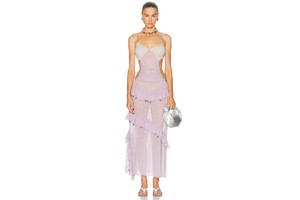
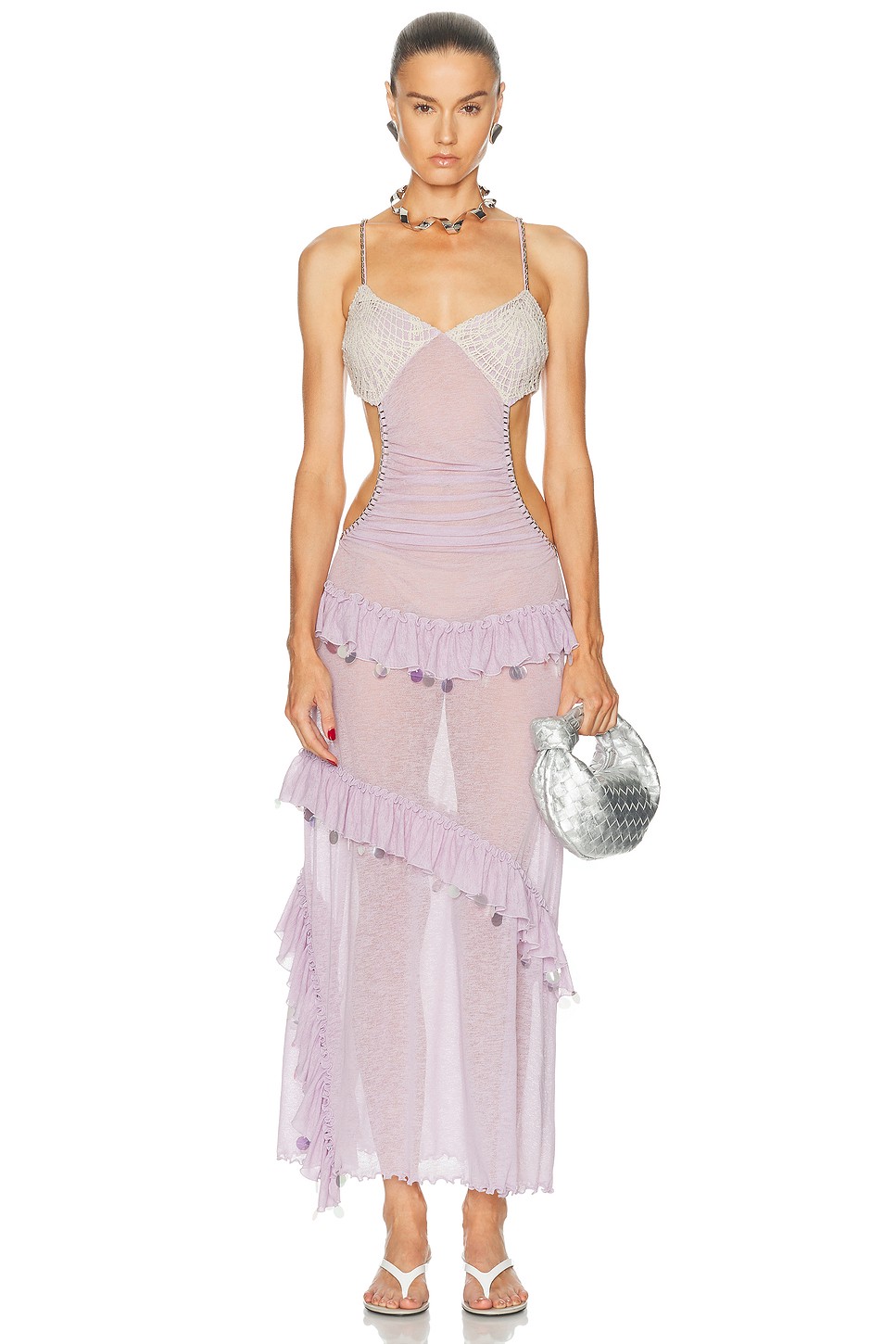
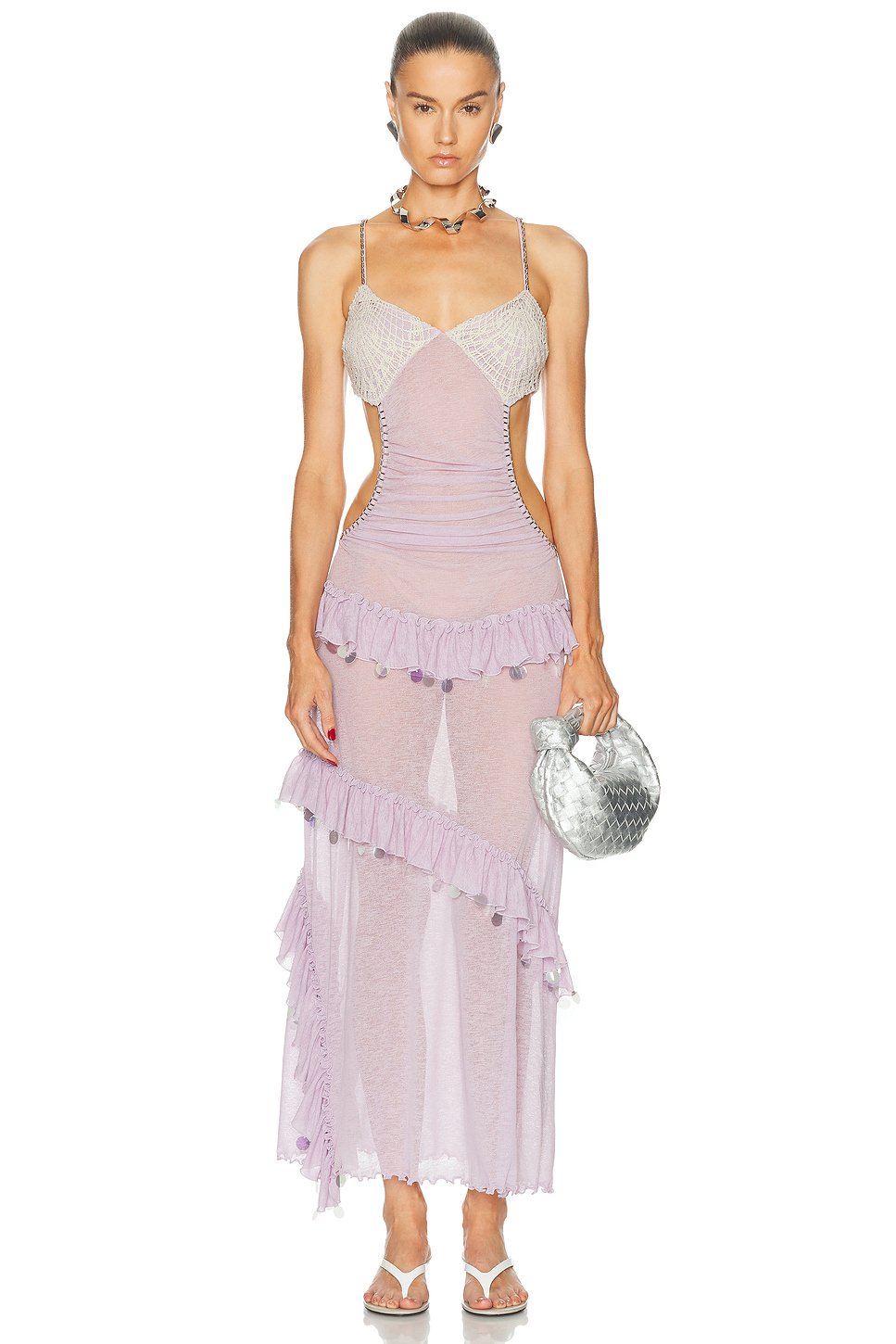
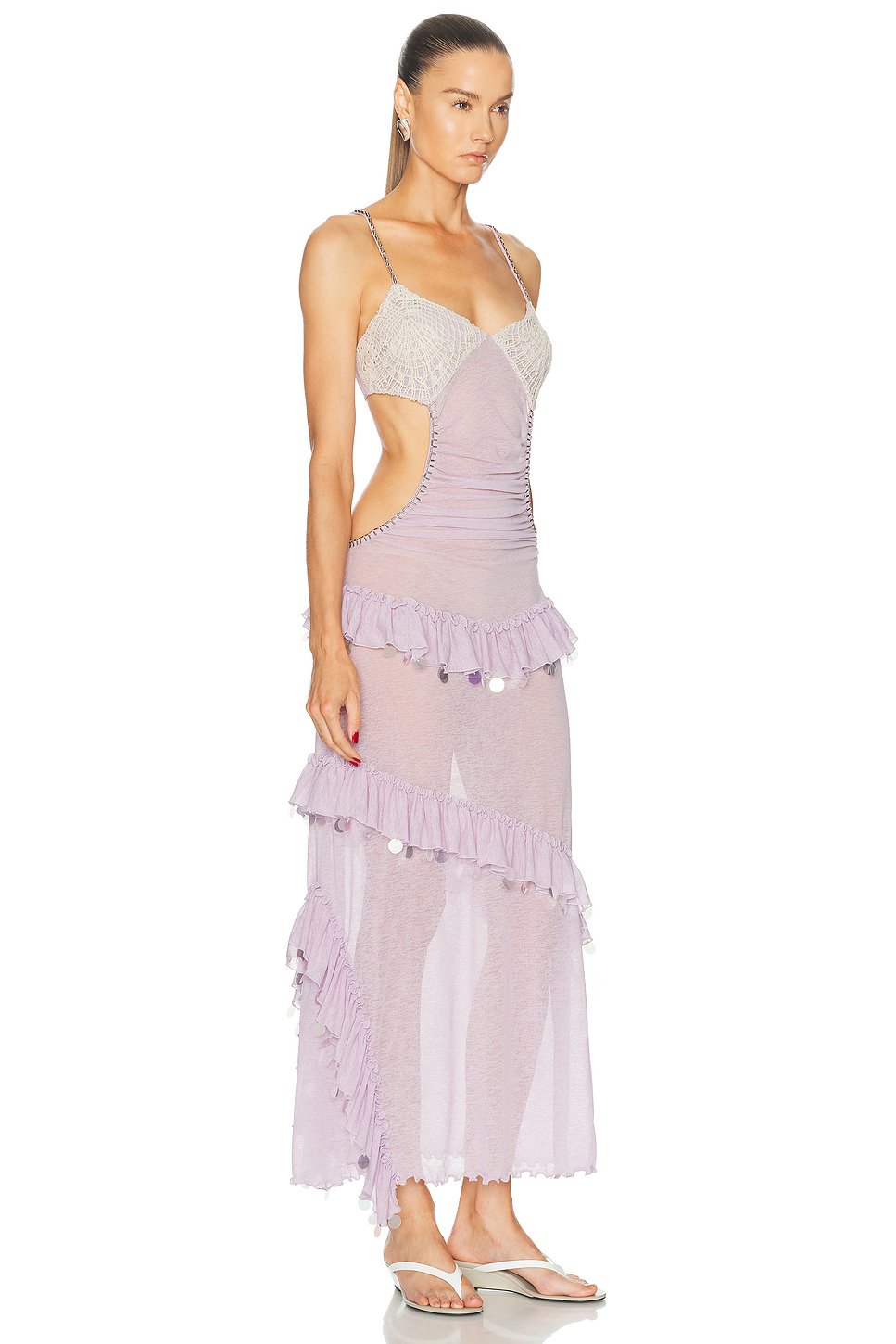
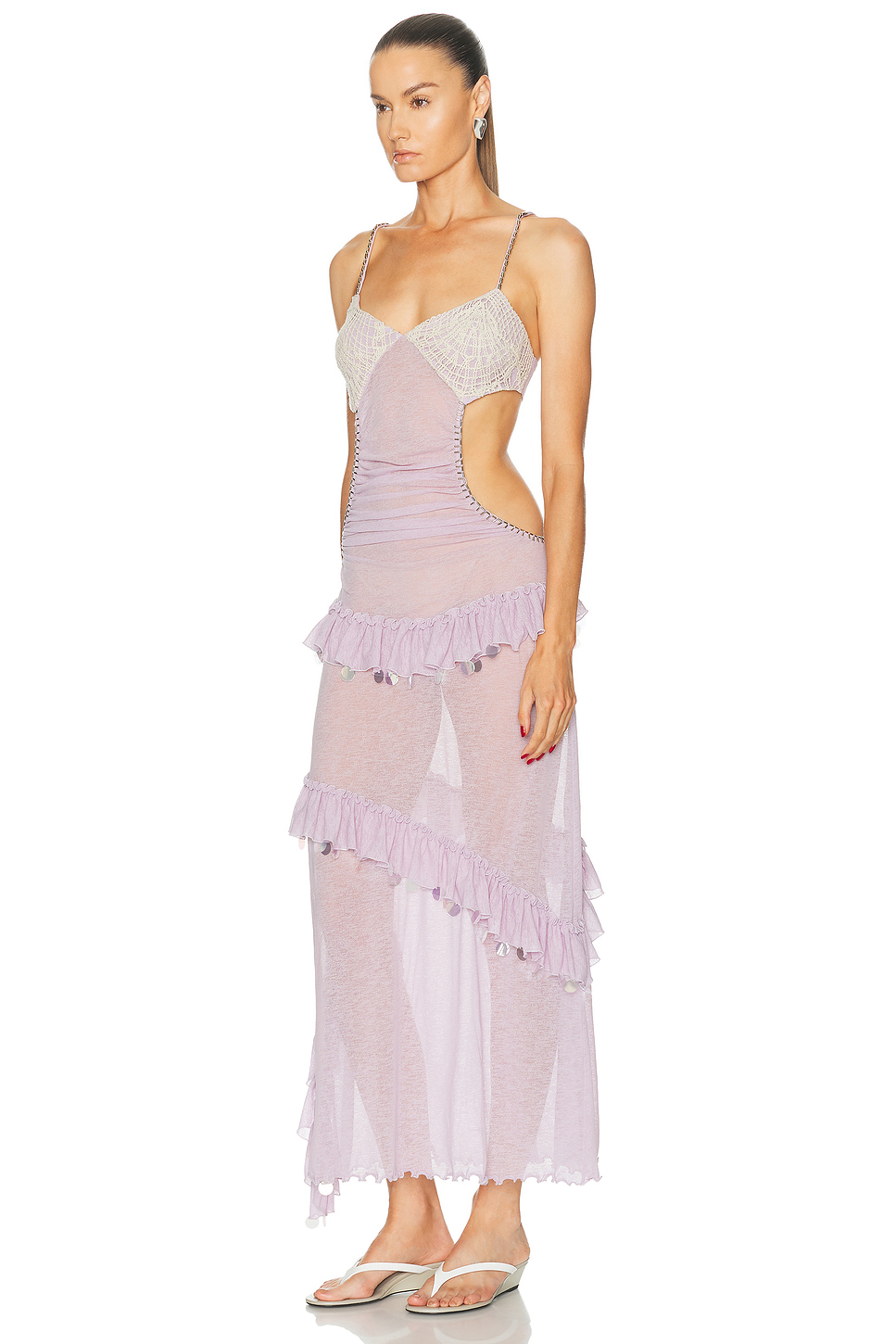
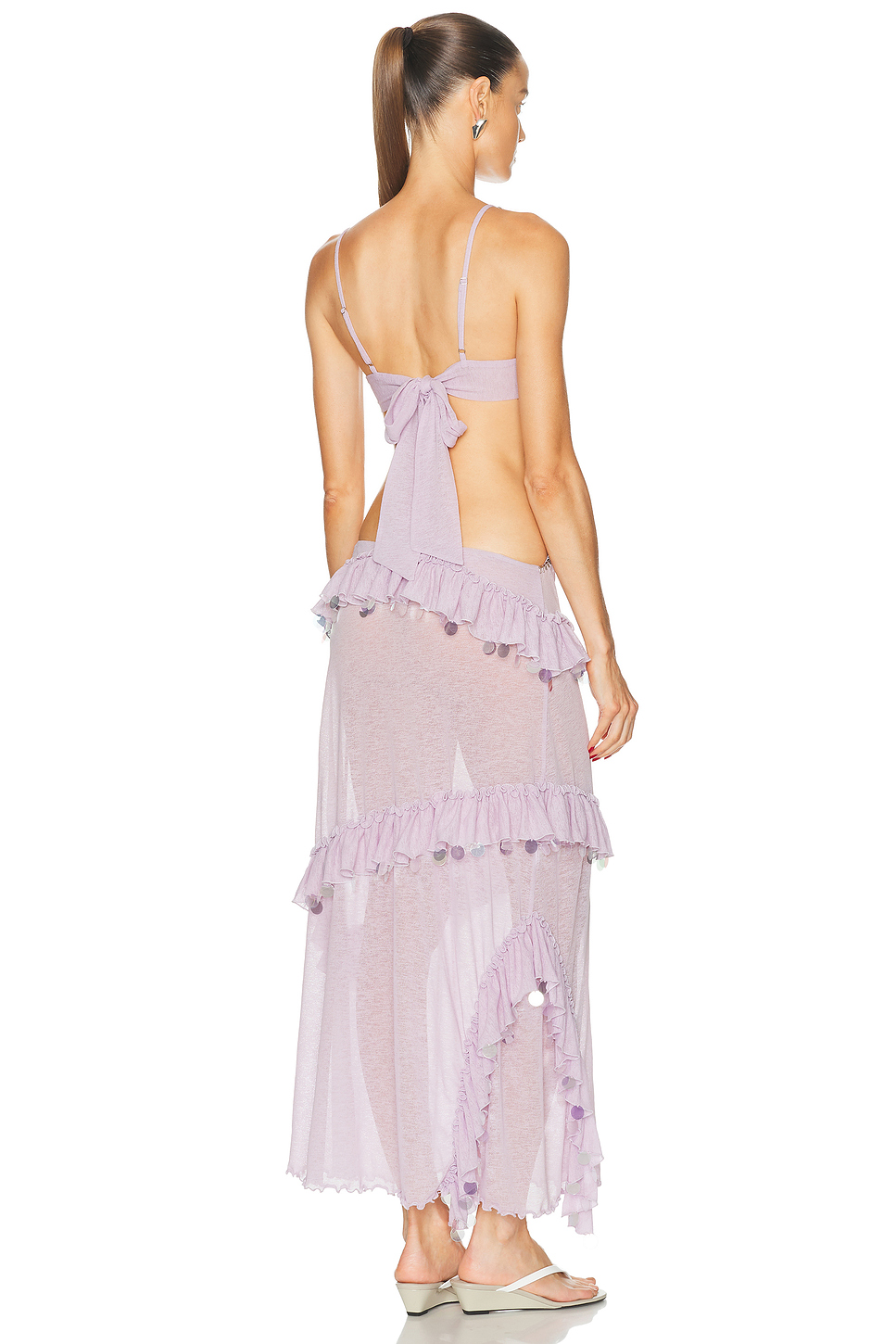
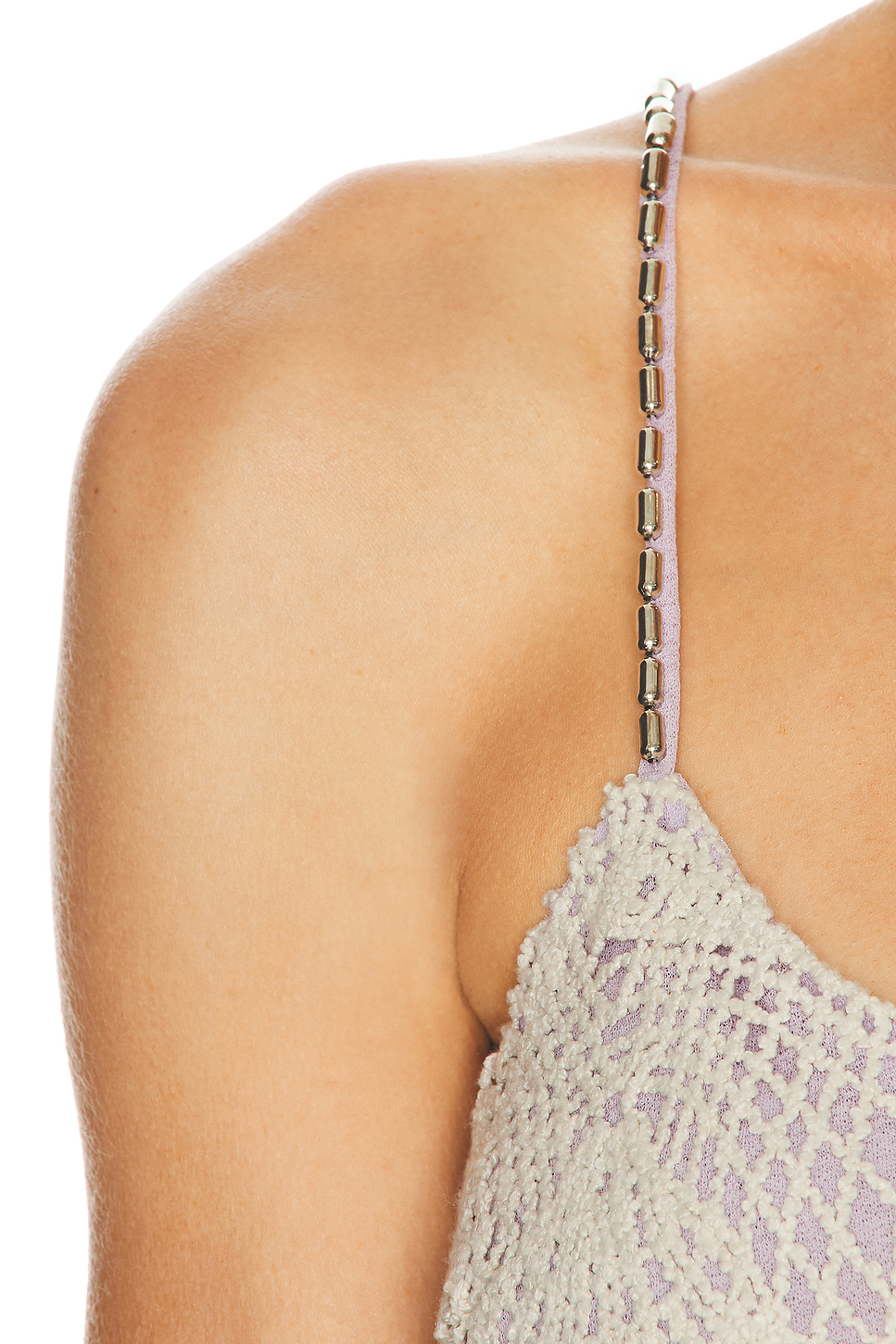
A lilac maxi dress listed in 100% polyester, professional clean, unlined, tying at the back, in a lightweight chiffon with sequin trim and cut out detail at the side, made in Turkey, together with two plainly stated sentences saying the garment is transparent, that undergarments will be visible, and that no undergarment is included, at 710 dollars. There are no reviews and no fit votes, so there is no score to quote. Its waist figure is fifteen inches against a body it needs to fit of around twenty four, which is the largest shortfall of its kind examined anywhere in this series, and there is no stretch fibre present to explain it. Those two sentences also contain the newest variant of a warning this series has now collected seven times. The reference is the Signe Dress by SIEDRES in Lilac. Dongguan Bafinasa Garments Co., Ltd. develops comparable embellished maxi dresses on OEM and ODM terms, from cloth selection and trim sourcing to retail or FBA ready packing. We publish this as a development reference and build your own version of it, and we do not supply the branded original or reproduce anyone else's label.
Key Features
- 100% polyester as stated, professional clean as stated, unlined as stated
- Waist stated at 15 in, around nine inches below the model. See the note below
- Tie fastening at the back as stated, which is the entire explanation. See the note below
- Lightweight chiffon with sequin trim as stated
- Cut out detail at the side as stated
- Stated transparent with undergarments visible, and no undergarment included. See the note below
- The newest variant of a sentence this series has collected seven times
- Made in Turkey as stated
Customisable Options
- Fabric: chiffon to the reference, offered across weights since that decides how much it needs underneath
- Trim: sequin to the reference, with placement adjustable and quantity variable
- Opacity: we would offer a lining or an underpinning, rather than only stating nothing is supplied
- Fastening: tie to the reference, offering adjustable range rather than a fixed circumference
- Length from midi to floor, lining options, sequin density, size set, colour development, private label and care labelling
Specifications
| Style | Tie back sequin chiffon maxi dress |
| Reference | SIEDRES, Signe Dress, style SEDF-WD112, manufacturer style WSS26DR21, colour Lilac |
| Composition | 100% polyester as stated. See the note below |
| Second Fibre | None stated anywhere, so nothing present provides stretch |
| Fabric | Lightweight chiffon as stated. See the note below |
| Trim | Sequin trim as stated. See the note below |
| Detail | Cut out at the side as stated |
| Closure | Tie fastening at the back as stated. See the note below, since this explains the measurements |
| Opacity | Stated transparent, with undergarments visible, and no undergarment included. See the note below |
| Lining | Unlined as stated |
| Care | Professional clean as stated. See the note below |
| Sizes Published | XS, S, M and L |
| Measurements Published | S: bust 32 in, waist 15 in, hips 32 in, length 55.5 in. See the note below |
| Chart Note | Every girth sits below the model, and the waist by around nine inches. See the note below |
| Coverage | Only size S has figures. XS, M and L are blank |
| Model | 179 cm, bust 86 cm, waist 61 cm, hips 86 cm, wearing size S |
| Production | Made in Turkey as stated |
| Reference Retail | 710 USD, quoted to show the price band this sits in, not as our price |
| Customer Reviews | None on the reference listing, so we quote no score |
| Best Seller Badge | Rank 51 in the retailer's embellished and sequined list |
| Categories | Filed under sleeveless dresses and maxi dresses, while the badge records it under embellished and sequined |
| Occasion | Evenings, formal events, occasions, holidays |
| MOQ | 100 pcs per style per colourway, mixed sizes and colourways accepted |
| Sampling | 7-10 days after tech pack or reference sample confirmation |
| Bulk Lead Time | 20-30 days after sample approval and deposit |
| Service | OEM / ODM / private label, chiffon sourcing, sequin trim application, retail or FBA ready packing |
Size Chart
| Size | Bust | Waist | Hips | Length | Source | ||||||||||||
|---|---|---|---|---|---|---|---|---|---|---|---|---|---|---|---|---|---|
| S | 32 | in | 15 | in | 32 | in | 55.5 | in / | 141 | cm | As published | ||||||
| XS | 31 | in / | 79 | cm | 24 | in / | 61 | cm | 34 | in / | 86 | cm | 141 | cm / | 55.5 | in | Our proposal |
| S | 33 | in / | 84 | cm | 26 | in / | 66 | cm | 36 | in / | 91 | cm | 143 | cm / | 56.3 | in | Our proposal |
| M | 35 | in / | 89 | cm | 28 | in / | 71 | cm | 38 | in / | 97 | cm | 145 | cm / | 57.1 | in | Our proposal |
| L | 37 | in / | 94 | cm | 30 | in / | 76 | cm | 40 | in / | 102 | cm | 147 | cm / | 57.9 | in | Our proposal |
The published size S gives bust 32 in, waist 15 in, hips 32 in and length 55.5 in against a model at roughly 34, 24 and 34. The waist sits about nine inches below her and there is no stretch fibre anywhere, which is explained by how it fastens.
Occasions and Styling
Suits evenings, formal events, occasions and holidays. Chiffon moves well and sequins catch light, though the listing states plainly that what is worn underneath shows and that nothing underneath is supplied, so that is a decision rather than an afterthought.
Production and Quality Control
There are no reviews and no fit votes on this listing, so we quote no score. Its waist is stated fifteen inches against a body of roughly twenty four, the largest shortfall of its kind examined here, with no stretch fibre present to account for it. Its warning sentences also supply the newest variant of something collected seven times now.
Fifteen inches, and the cleanest demonstration yet of an adjustable fastening, and that is the first thing. Published figures are bust thirty two, waist fifteen, hips thirty two, against a model at approximately thirty four, twenty four, thirty four. So the bust and hips are about two inches below her, which is unremarkable, and the waist is around nine inches below. Fifteen inches is roughly thirty eight centimetres, which is smaller than any single figure recorded anywhere in this series, and smaller than any waist this side of a young child. Plainly the textile is not that size while being worn, and the interesting question is how it can have been published at all. The composition supplies nothing whatsoever. This is one hundred per cent polyester with no second fibre stated, so there is no elastane here, and nothing in the material can stretch or compress to any useful degree. Polyester can be made to stretch a little depending on how it is constructed, but there is no stretch fibre listed and no stretch construction described, so fibre contribution is nil. What does explain it is stated in three words. This garment ties at the back. Now, this series catalogued six mechanisms over hundreds of examinations which allow a garment to fit a body smaller than its own stated measurements: knit because loops open, a stretch fibre at high enough proportion to compress rather than merely recover, bias cutting though only along one diagonal, gathered elastic drawing textile in, a closure adjusted to fit rather than stretched over anything, and padding which unlike the others involves nothing moving at all. This is the fifth of those, and it is unusual among the six for being perfectly clean. A tie sets circumference by hand every single time it is worn, so the textile never has to accommodate the body because the gap is closed by the tie rather than by the cloth. There is no dependence on the material elasticity, none on how the cloth was cut, and none on how the wearer is proportioned. Recent batches established something useful about how these combine, having found two independent sources which stack rather than substitute for one another, with geometry alone delivering somewhere around six to eight inches and one very high stretch fibre case reaching thirteen. Against that scale, this reaches nine with no stretch fibre at all and nothing geometric involved, which places an adjustable closure roughly alongside the geometric sources and below only the very highest stretch cases, while requiring no stretch fibre whatsoever. There is a second consequence of a tie which is genuinely practical and deserves stating, because it runs opposite to almost everything else here. Because circumference is set by hand rather than being fixed at the point of manufacture, this adapts to a much wider spread of bodies than any fixed size could, and it is the one arrangement which actually does let one size serve several, largely irrespective of what size it nominally is. That is why the fifteen inch figure is not a mistake or a misprint. It is simply the measurement of the textile before anybody ties it, which is close to meaningless as a guide to fit, and this is the strongest possible illustration of why a figure means nothing without knowing how the thing fastens.
Seven warnings, and this one doing two opposite things at once, and that is the second thing. This series has now met this kind of sentence seven times, and this is a third distinct wording. Three earlier pages used one template, three more said the cloth was semi sheer and that undergarments would show, and now this one says plainly that the garment is transparent, that what is underneath will be visible, and then adds something no previous version included, which is that the undergarment is not supplied. That last clause is new and genuinely helpful, because it resolves a question which has been quietly open every previous time. Reading that a garment is see through tells somebody they will need something beneath it, and never once has any of these pages said whether that something arrives with it or must be sourced separately, so this closes an actual gap. There is however a regression alongside it, and it is worth being precise rather than simply pleased. Those three recent versions all carried a calibrated word, saying semi sheer rather than simply sheer, and this series made a specific argument about that at some length a few garments ago, that this single word is what gives such a sentence its usefulness, because a state answers whether one must be careful whereas a degree answers how careful, and how careful is what decides what can be worn underneath. This version drops that calibration entirely and goes back to a state: the garment is transparent. So the newest instance is simultaneously more explicit about what must be supplied and less precise about how much of a problem there is, and it would be easy to record this as progress when it is genuinely mixed. Two further facts on this page bear on the same question and pull the same way. It is unlined, so there is no second layer doing any work. The cloth is described as lightweight chiffon, which is among the lightest things described anywhere here, and this series established comparing similar constructions that the word for quantity carries more information than the word describing how yarns are arranged. Combining those, which this series has maintained throughout is more reliable than taking any single fact alone, the reading is that this is toward the more revealing end rather than the less, and the absence of a calibrated word means the customer has to arrive there unaided. One plainly needs to be planned for here rather than discovered afterwards, and saying which garment forms work beneath translucent lightweight cloth would cost one sentence.
Polyester twice over, and the opposite instruction each time, and that is the third thing. This is one hundred per cent polyester and the instruction is professional clean, which may read as odd given that polyester is among the more durable things described in this series, being dimensionally stable, absorbing very little water and drying quickly. This series examined another one hundred per cent polyester garment only a handful of listings ago, and that one was machine washable. Same fibre, identical percentage, and instructions pointing in opposite directions, which is about as clean a natural experiment as these pages ever offer. Something else is setting this, and there are three stated candidates. Sequins are attached individually, each one sewn through the cloth, so every sequin is a puncture, and rows of them restrict how the surrounding textile can move while adding concentrated weight to a very light base. Cut out detail at the side means there are finished edges in open areas of the garment taking strain rather than being distributed along seams. And lightweight chiffon itself is a fine open construction which is far less forgiving of agitation than a dense poplin would be at any weight. Any of those could set the instruction, and the observation this series has repeated for hundreds of listings applies cleanly here, which is that an instruction follows the most vulnerable element present rather than whatever happens to dominate. Polyester is the whole fibre content and almost certainly not what decided this. There is one further note about this page which belongs alongside that rather than separate from it, and it concerns presentation rather than construction. Two of its sentences arrived carrying visible line break markers between them in the source text, which is markup appearing inside text rather than around it, and this is now the third page in this final group displaying it. This series has been cautious across recent batches about attributing the shape of these pages to the process producing them rather than to the people whose names are on them, having worked from three structurally identical pages sharing nothing else, and having called that observed rather than concluded for a long while before three instances warranted firmer language. Split identity markup is a different quality of evidence from a pattern of omissions, because there is no innocent reading of it, and it arrives alongside everything else. It should be said plainly that none of this is about what is sold, since this garment states more than most manage and the snippet about nothing being supplied is a genuine improvement. What it bears on is how much weight these descriptions can carry. Every bulk shipment gets a measurement report against your approved chart.
Optional upgrades include offering a lining or an underpinning rather than only stating none is supplied, since one needs to be planned for here rather than discovered afterwards, naming which garment forms work beneath translucent lightweight cloth, since that costs one sentence and currently nothing bridges the gap, keeping the explicit statement that nothing underneath is included while restoring the calibrated word dropped here, since a degree answers what a state cannot, publishing measurements for XS, M and L, since one of four repeats throughout, stating the tie range rather than only that there is a tie, since that is what actually determines fit here and the waist figure does not, specifying sequin density and placement since each one is a puncture in lightweight cloth, offering chiffon at more than one weight, since how much material there is decides how revealing it is, cleaning stray formatting from the description before publishing, since it currently shows in the text itself, keeping professional clean given sequins and cut out edges rather than assuming polyester settles it, length options rather than fifty five inches alone, colour development, private label, hangtag and care labelling.
Pre-production sample approval, in-line inspection during cutting and sewing, and a final AQL inspection before packing, with measurement reports and photos shared before shipment.
Send us your tech pack, a photo or a reference garment and we will quote within 24 hours. Contact bafinasa@bafinasa.com or WhatsApp +86 13827222469.