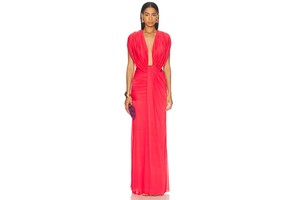
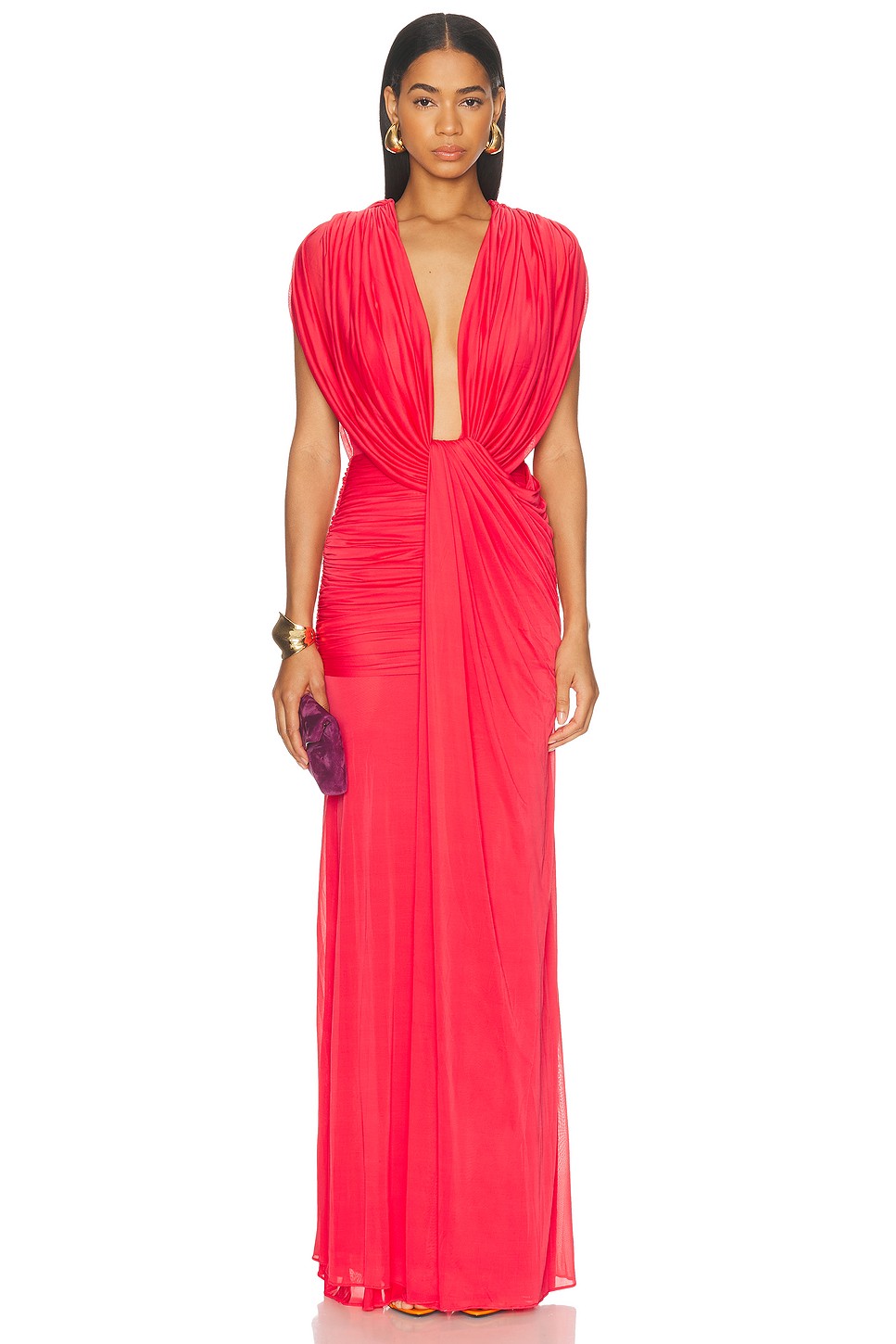
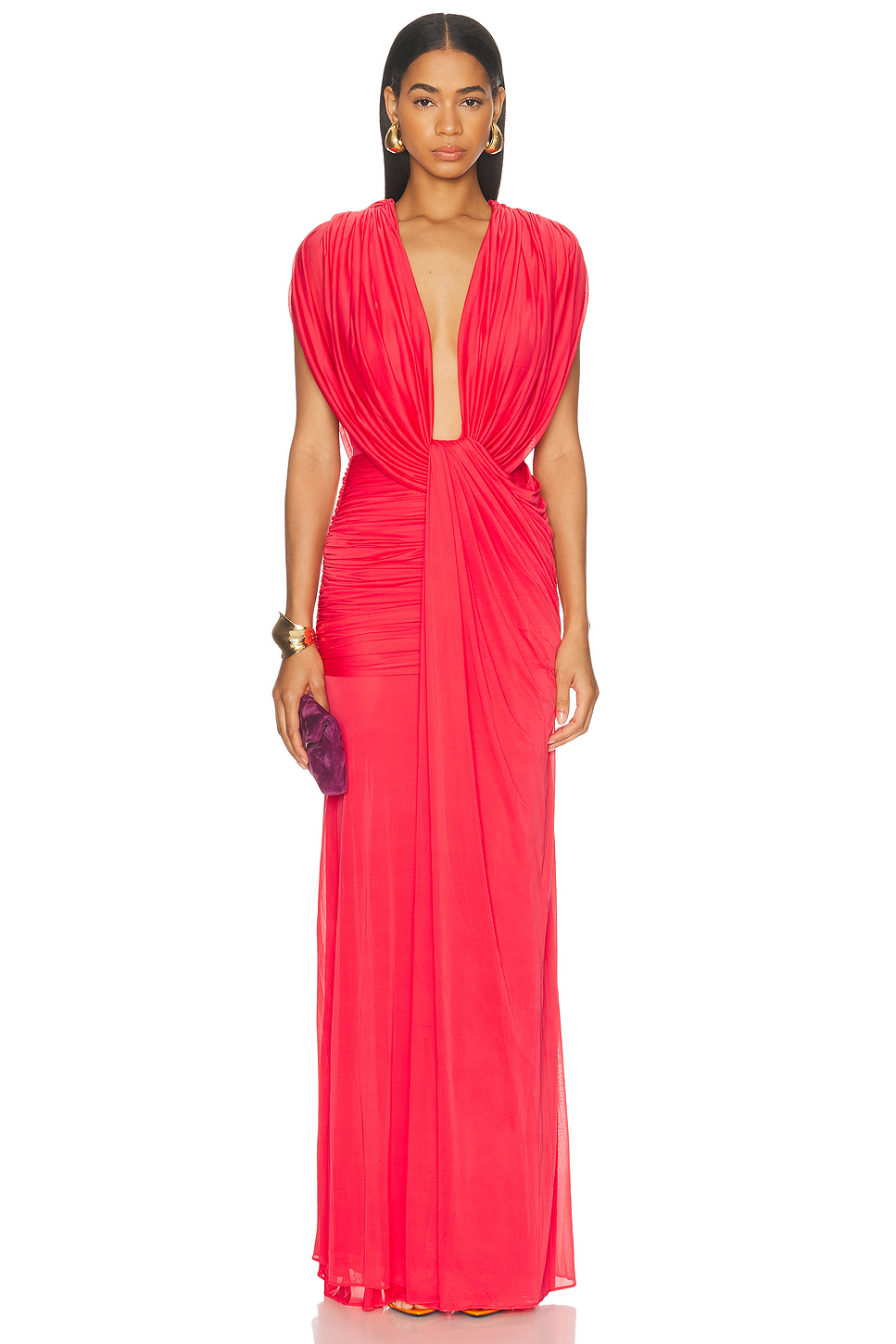
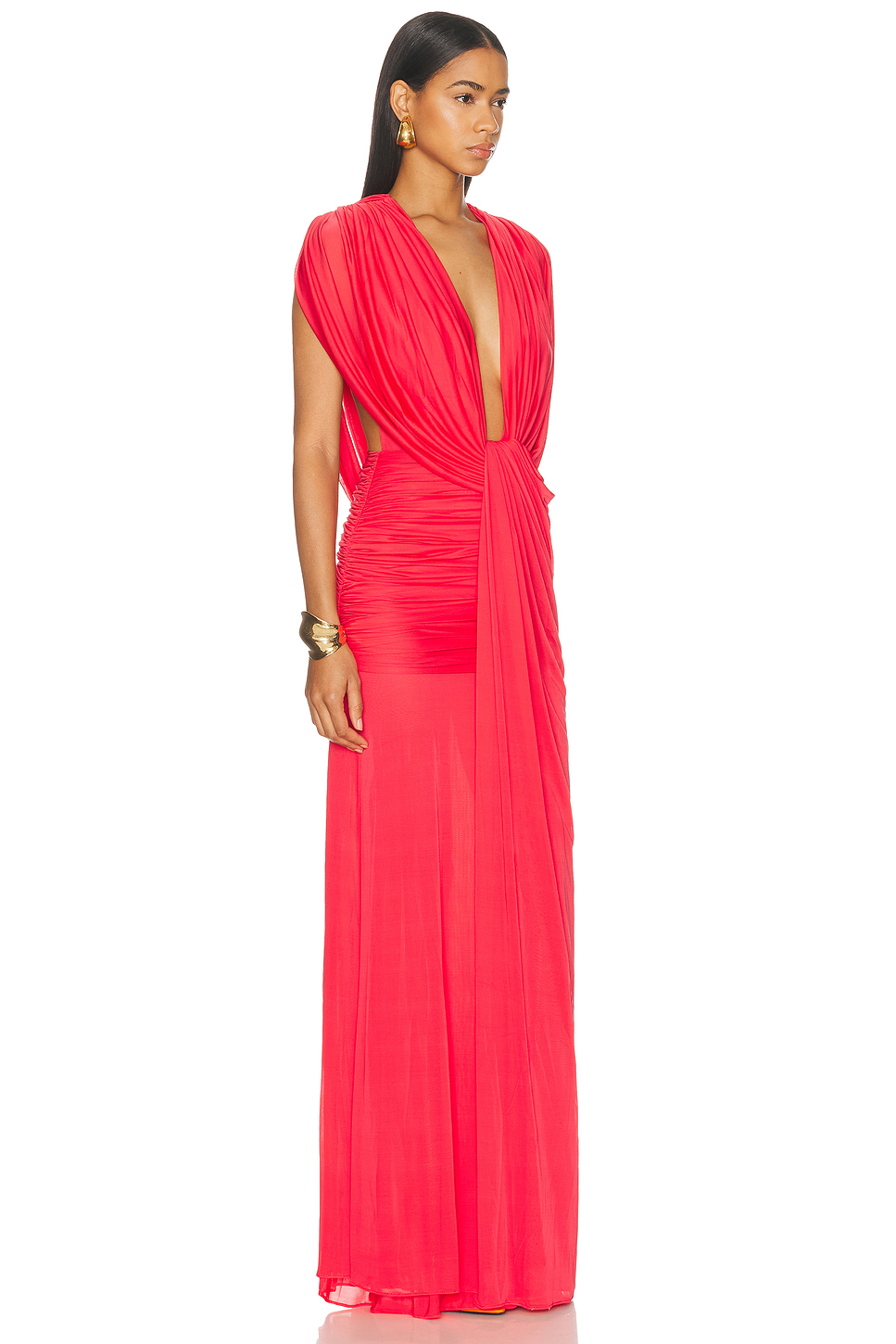
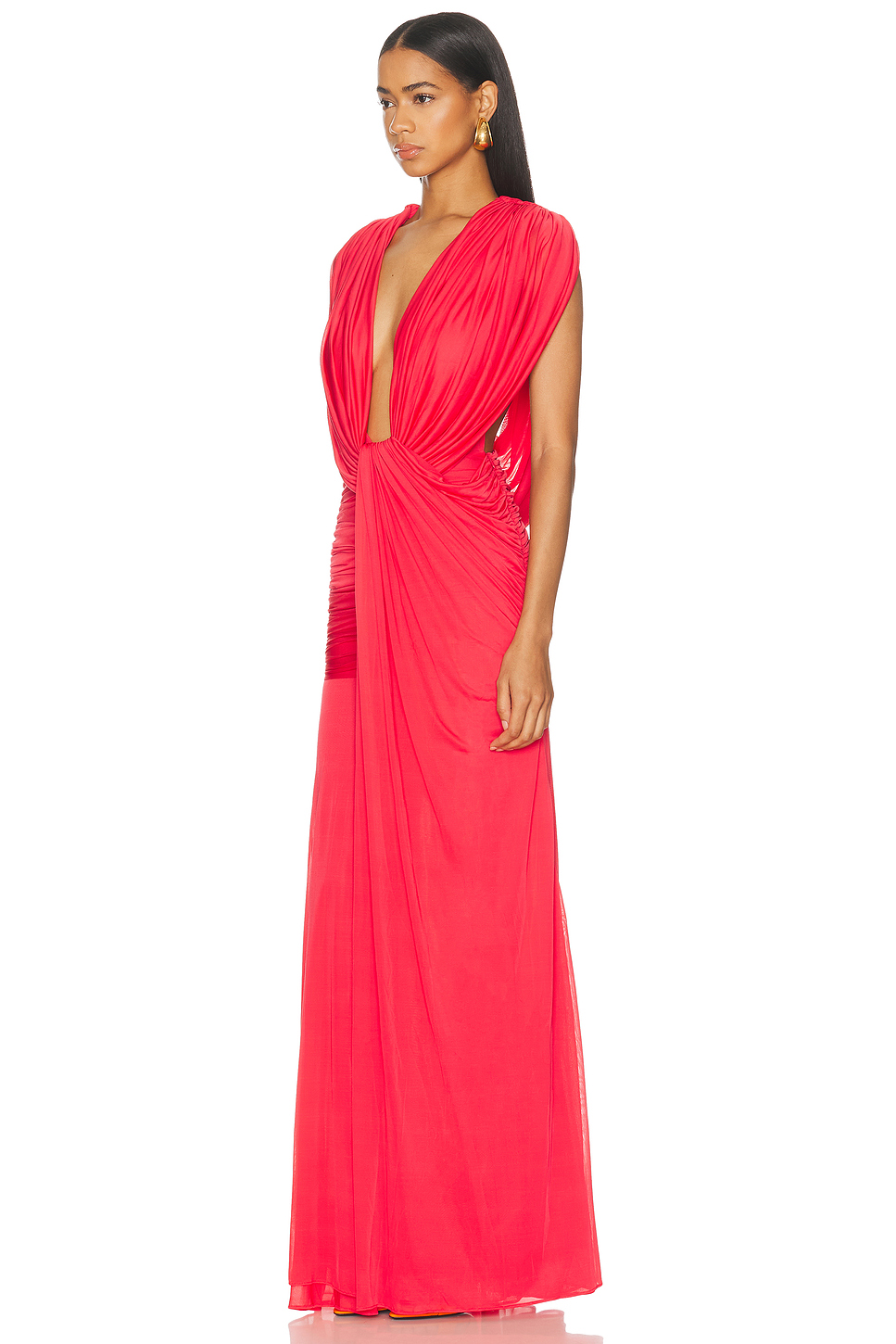
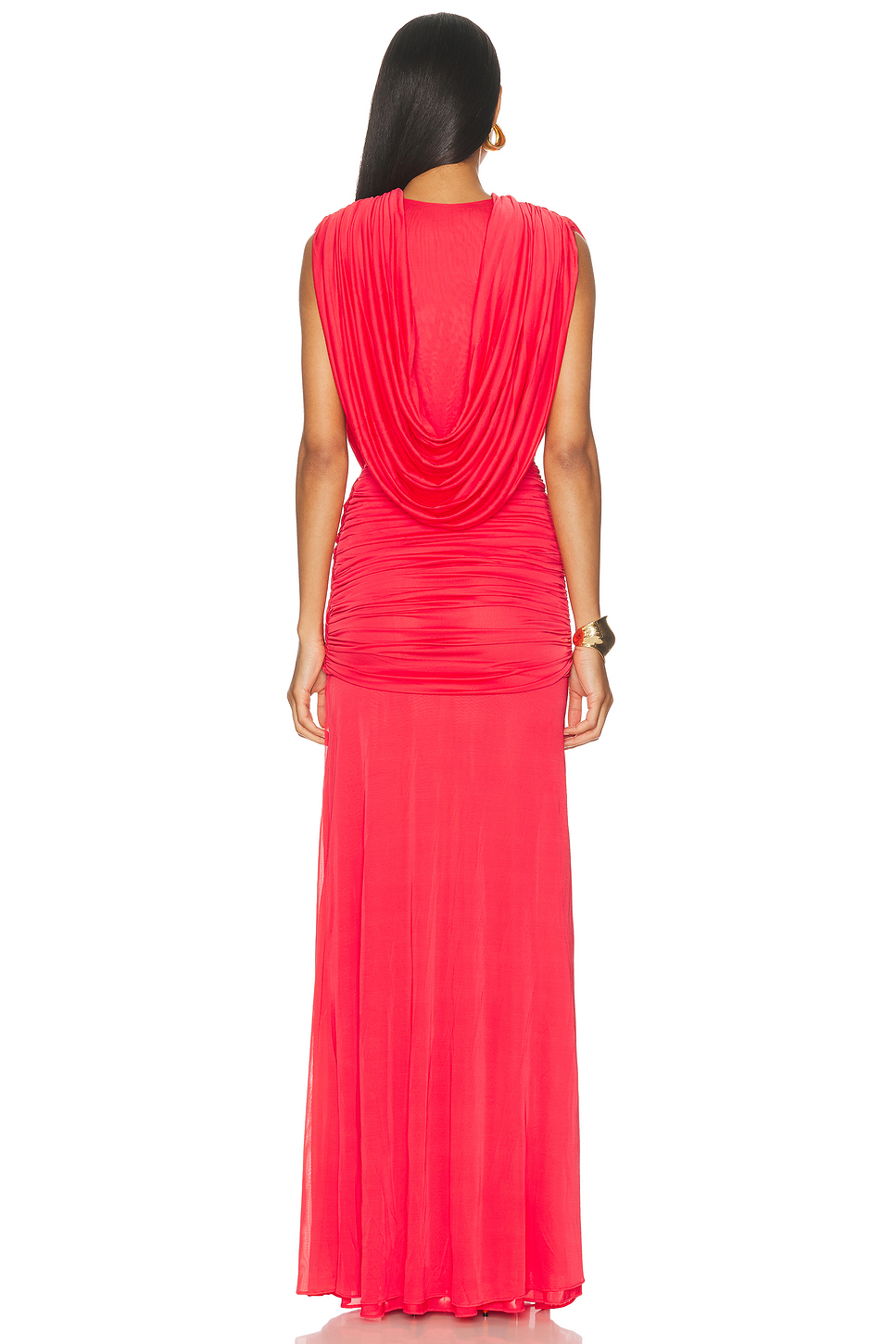
A draped column gown listed in 71% rayon and 21% polyester, dry clean only, partially lined, with a hidden zipper at the side, a plunging neckline, ruching at the waistband and draped fabric at the front, in a midweight fitted cloth, made in China, at 931 dollars. There are no reviews and no fit votes, so there is no score to quote, and this is the only item in the whole set of over three hundred which carried no listing placement at all. Two things make it worth reading closely. The percentages published do not reach a hundred, and here the missing portion is doing something rather than merely absent. And its hip figure is the smallest of its four figures by some distance, while being the longest garment shape I have measured apart from one. When this was examined, everything else in the group had already been accounted for, and it turned out this one had simply never been put up. The reference is the Ripple Drape Gown by Christopher Esber in Watermelon. Dongguan Bafinasa Garments Co., Ltd. develops comparable column gowns on OEM and ODM terms, from cloth selection and drape development to retail or FBA ready packing. We publish this as a development reference and build your own version of it, and we do not supply the branded original or reproduce anyone else's label.
Key Features
- 71% rayon and 21% polyester as stated, totalling ninety two. See the note below, since here it matters
- Dry clean only as stated, the strict form rather than the optional form
- Partially lined as stated, rather than fully or not at all. See the note below
- Hidden zipper at the side as stated
- Plunging neckline as stated
- Ruching at the waistband and draped fabric at the front, as stated
- Hip figure smaller than bust, waist or length. See the note below
- Five sizes offered, each labelled with two sizing systems at once
Customisable Options
- Fabric: midweight rayon blend to the reference, offered across weights since that decides drape
- Composition: we would state the whole thing, including the eight percent. See the note below
- Lining: partial to the reference, though we would say which parts rather than only that it is partial
- Fastening: hidden side zipper to the reference, with length of opening adjustable
- Length from midi to floor, lining coverage, drape placement, size set, colour development, private label and care labelling
Specifications
| Style | Rayon blend draped column gown |
| Reference | Christopher Esber, Ripple Drape Gown, style CHRF-WD366, manufacturer style 24043346, colour Watermelon |
| Composition | 71% rayon, 21% polyester as stated. See the note below, since this is the interesting part |
| Stated Total | Ninety two percent, with eight unstated. See the note below |
| Care | Dry clean only as stated, the strict form rather than the optional form |
| Lining | Partially lined as stated. See the note below |
| Fabric | Midweight fitted cloth as stated. See the note below |
| Closure | Hidden zipper at the side as stated |
| Neckline | Plunging neckline as stated |
| Detail | Ruching at the waistband and draped fabric at the front as stated |
| Sizes Published | Aus 4/US 0, Aus 6/US 2, Aus 8/US 4, Aus 10/US 6, Aus 12/US 8 |
| Measurements Published | Aus 6/US 2: bust 24 in, waist 24 in, hips 22 in, length 57 in. See the note below |
| Chart Note | Hip is the smallest figure in the row, twelve inches below the model, while bust is nine below. See the note below |
| Coverage | Only Aus 6/US 2 has figures. The other four are blank |
| Model | 178 cm, bust 84 cm, waist 58 cm, hips 86 cm, approximately 33 / 23 / 34, wearing Aus 6/US 2 |
| Production | Made in China as stated |
| Reference Retail | 931 USD, quoted to show the price band this sits in, not as our price |
| Customer Reviews | None on the reference listing, so we quote no score |
| Best Seller Badge | None listed, the only such case across the whole set. See the note below |
| Categories | Filed under gowns and sleeveless dresses. See the note below |
| Occasion | Formal events, evenings, occasions, black tie, galas |
| MOQ | 100 pcs per style per colourway, mixed sizes and colourways accepted |
| Sampling | 7-10 days after tech pack or reference sample confirmation |
| Bulk Lead Time | 20-30 days after sample approval and deposit |
| Service | OEM / ODM / private label, rayon blend sourcing, column pattern development, retail or FBA ready packing |
Size Chart
| Size | Bust | Waist | Hips | Length | Source | ||||||||||||
|---|---|---|---|---|---|---|---|---|---|---|---|---|---|---|---|---|---|
| Aus 6/US 2 | 24 | in | 24 | in | 22 | in | 57 | in / | 145 | cm | As published | ||||||
| Aus 4/US 0 | 31 | in / | 79 | cm | 24 | in / | 61 | cm | 34 | in / | 86 | cm | 145 | cm / | 57.1 | in | Our proposal |
| Aus 6/US 2 | 33 | in / | 84 | cm | 26 | in / | 66 | cm | 36 | in / | 91 | cm | 147 | cm / | 57.9 | in | Our proposal |
| Aus 8/US 4 | 35 | in / | 89 | cm | 28 | in / | 71 | cm | 38 | in / | 97 | cm | 149 | cm / | 58.7 | in | Our proposal |
| Aus 10/US 6 | 37 | in / | 94 | cm | 30 | in / | 76 | cm | 40 | in / | 102 | cm | 151 | cm / | 59.4 | in | Our proposal |
| Aus 12/US 8 | 39 | in / | 99 | cm | 32 | in / | 81 | cm | 42 | in / | 107 | cm | 153 | cm / | 60.2 | in | Our proposal |
The published Aus 6/US 2 gives bust 24 in, waist 24 in, hips 22 in and length 57 in against a model at roughly 33, 23, 34. Hip is the smallest figure in the row, sitting about twelve inches below her, and there is no stretch fibre stated anywhere.
Occasions and Styling
Suits formal events, evenings, occasions, black tie and galas. Draping across the front is what this is built around, so it wants minimal jewellery and a heel rather than anything competing with it.
Production and Quality Control
There are no reviews and no fit votes on this listing, so we quote no score, and it is the only garment across the whole set carrying no listing placement whatsoever. Two things make it worth reading closely. Its published percentages do not reach a hundred, and here the missing portion is doing something rather than merely being absent. Its hip figure is also by far the smallest of its four, on one of the longest garment shapes examined.
Eight percent missing, and this time it is load bearing, and that is the first thing. This series has been noting incomplete arithmetic on these pages for hundreds of examinations, usually finding totals falling short by a percent or two, with no indication whether something unstated completes it or whether the figures were never reconciled, and most often observing that there is no way to tell whether what is missing amounts to a sewing thread or an interlining. Those smaller cases are worth knowing about but they are bookkeeping. This one is not, and the reason is that the numbers elsewhere on this very page identify the missing part by elimination. Published figures are bust twenty four, waist twenty four, hips twenty two and length fifty seven, against a model at approximately thirty three, twenty three, thirty four. So the hip sits about twelve inches below the body it was modelled on, which by any standard in this series is enormous, and there is nothing stated anywhere which could produce it. Now consider what that requires. Twelve inches of shortfall cannot be closed by how something is cut, since cutting changes where fullness goes rather than how far cloth extends. It cannot be a proportion of body it was never meant to reach, because this is a column shape falling to the floor and it covers the hips entirely. It cannot be explained by anything fastened rather than stretched over something, because although there is a zipper here it is at the side and short, and a gown this long does not open far enough to be stepped into without anything passing over the hips. So the cloth itself has to extend, and substantially, and there is no stretch fibre stated anywhere on this page to make that possible. Which leaves exactly one conclusion available: something is present which has not been published, and it sits in the eight percent the page does not account for. Put plainly, the proportion which is not stated here is the proportion the entire garment depends on. That converts something this series has treated as tidy arithmetic into something with real consequence, and there is a practical edge to it worth stating rather than leaving implied. A buyer choosing between this and something else, or trying to work out how it will behave after wearing, is working from ninety two percent of the truth, and the missing part is the only part doing the work described above. There is a second observation about the eighty two percent which is stated, and it is fairly unflattering. At seventy one percent, a regenerated cellulose is the dominant thing here, and this series established long ago that it loses close to half its strength when wet. Combined with a fibre known for marking where water sits rather than where anything was spilled, the instruction follows cleanly from what is published, with no need to consider the twenty one percent polyester at all.
Hip smaller than everything else, and the three mechanisms stacked here, and that is the second thing. The order within this single row is unusual enough to be worth stating outright: length fifty seven, bust twenty four, waist twenty four, hips twenty two. So the hip is the smallest measurement in the row, below even the waist, on a garment which reaches the floor. My experience across hundreds of these has been the opposite nearly everywhere, since hips are usually the largest figure because garments pass over them, and where they have not been largest there has been a specific explanation each time: once because a bubble shape put the widest point elsewhere, once because an eighteen inch surplus bought access past a partway buttoning, and several times because a closure was adjusted rather than being able to open. Here the hip is not merely not largest, it is smallest, and assembling what is stated gives three contributors working together. There is a knit mentioned nowhere explicitly but implied by the fitted midweight description and required by the numbers, since loops opening under load is the mechanism which allows the largest movements of any in this series and the one permitting the largest negative figures. There is the unstated stretch proportion identified above, which without any construction at all would allow motion but not recovery, so its role is more likely holding the result in place afterwards than producing it. And there is ruching at the waistband, which draws cloth in from a wider cut so that some of what is measured there is fullness rather than circumference. This series noted recently that two sources stack rather than substitute, and further that where that happens anybody assuming one carries the whole burden will badly misjudge each of them. That applies with more force here because there are three, and because unlike recent cases the most important of the three is not published. The honest summary is that these figures cannot be checked against this page at all, because the page does not contain everything needed to add them up.
Partial lining, no placement, and no listing position, and that is the third thing. Three smaller observations finish this off, and none of them concerns the cloth. The first concerns lining, which this series has treated as perhaps the single most consequential undisclosed decision across hundreds of these pages, since it determines opacity, how a garment sits, and how much of it has to be cared for at once. This is one of very few pages to say partial rather than claiming full or saying nothing. That is genuinely better than silence, because it tells a buyer that most of this garment is unlined, which is exactly what someone would want to know about a light coloured fitted gown. But it stops one step short of the useful version, since it does not say which parts, and on a garment measured this closely the difference between lining through the body and lining only the bodice is considerable. The second concerns the size row, which is labelled with two sizing systems at once. That is more informative than picking one, and it also quietly reveals how much conversion these pages expect the reader to perform unaided, since nothing anywhere explains the offset between the two. The third is that this is the only garment across the whole set carrying no listing position at all. Every other one, including several with no reviews and nothing but two photographs, has been assigned one. So this is a small independent instance of something argued at length recently: where these fields turn up empty, they tend to be marking something about the record rather than something about the garment, because there is no reading on which this gown lacks information that several others with busy records possess. Every bulk shipment gets a measurement report against your approved chart.
Optional upgrades include publishing the whole composition rather than ninety two percent of it, since the missing portion is the part allowing a hip figure twelve inches below the body, naming the knit construction explicitly rather than leaving it to be inferred from the numbers, stating the stretch proportion as a figure since below five percent it only assists recovery while higher up it genuinely changes how something fits, publishing measurements for all five sizes rather than one, since a single row is hard to read at the best of times and impossible here, saying which parts are lined rather than only that some are, since that is the difference between a helpful statement and a nearly helpful one, offering a lining through the body as an option, giving the weight as a number rather than an approximate word, since weight decides how this falls, lengthening the zipper opening so the gown can be stepped into rather than worked over the hips, keeping rayon but testing whether a smaller proportion reduces the strictness of the instruction, length options rather than fifty seven inches alone, colour development, private label, hangtag and care labelling.
Pre-production sample approval, in-line inspection during cutting and sewing, and a final AQL inspection before packing, with measurement reports and photos shared before shipment.
Send us your tech pack, a photo or a reference garment and we will quote within 24 hours. Contact bafinasa@bafinasa.com or WhatsApp +86 13827222469.