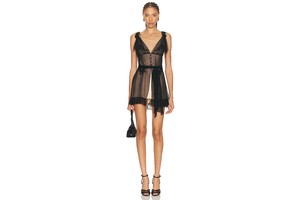
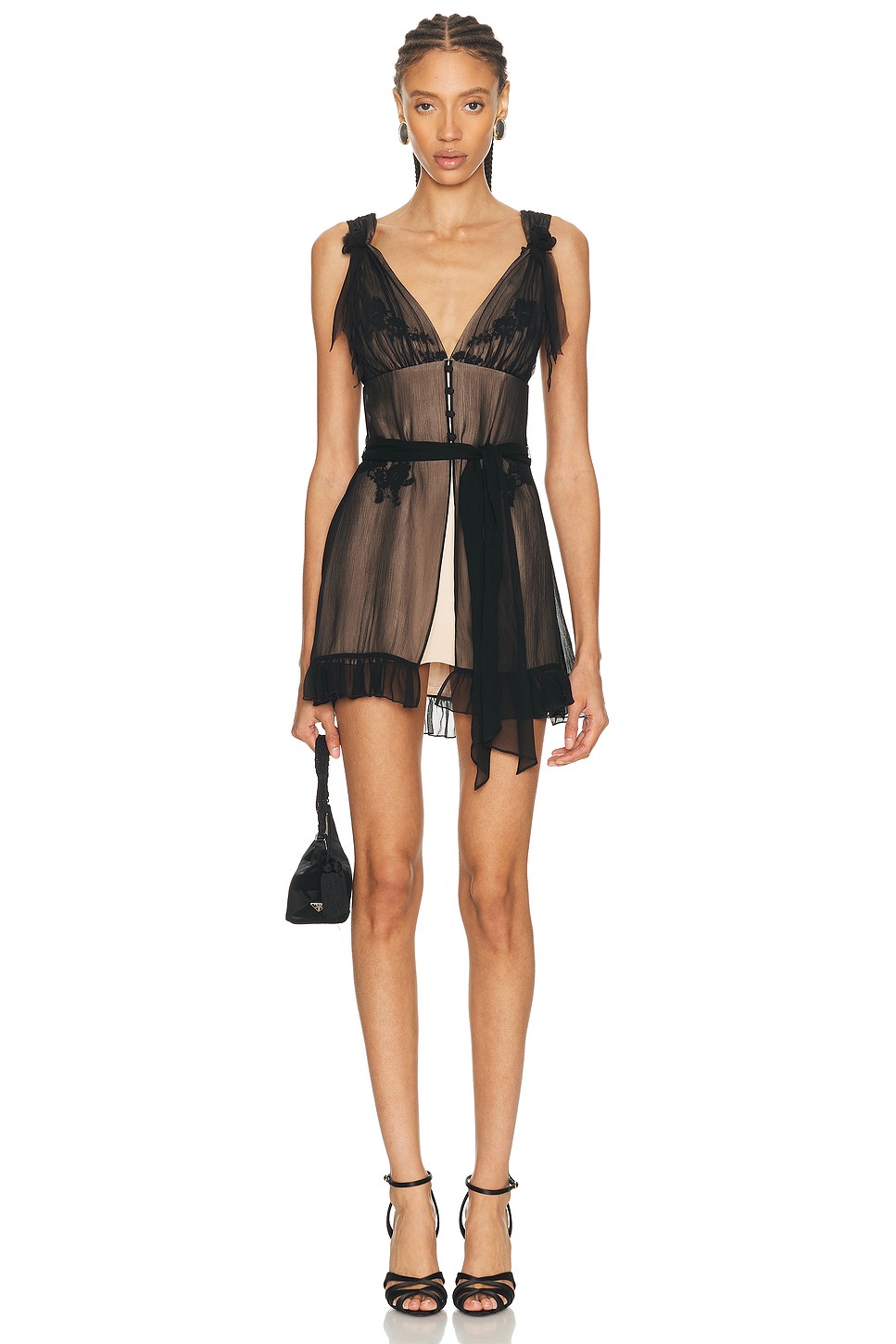
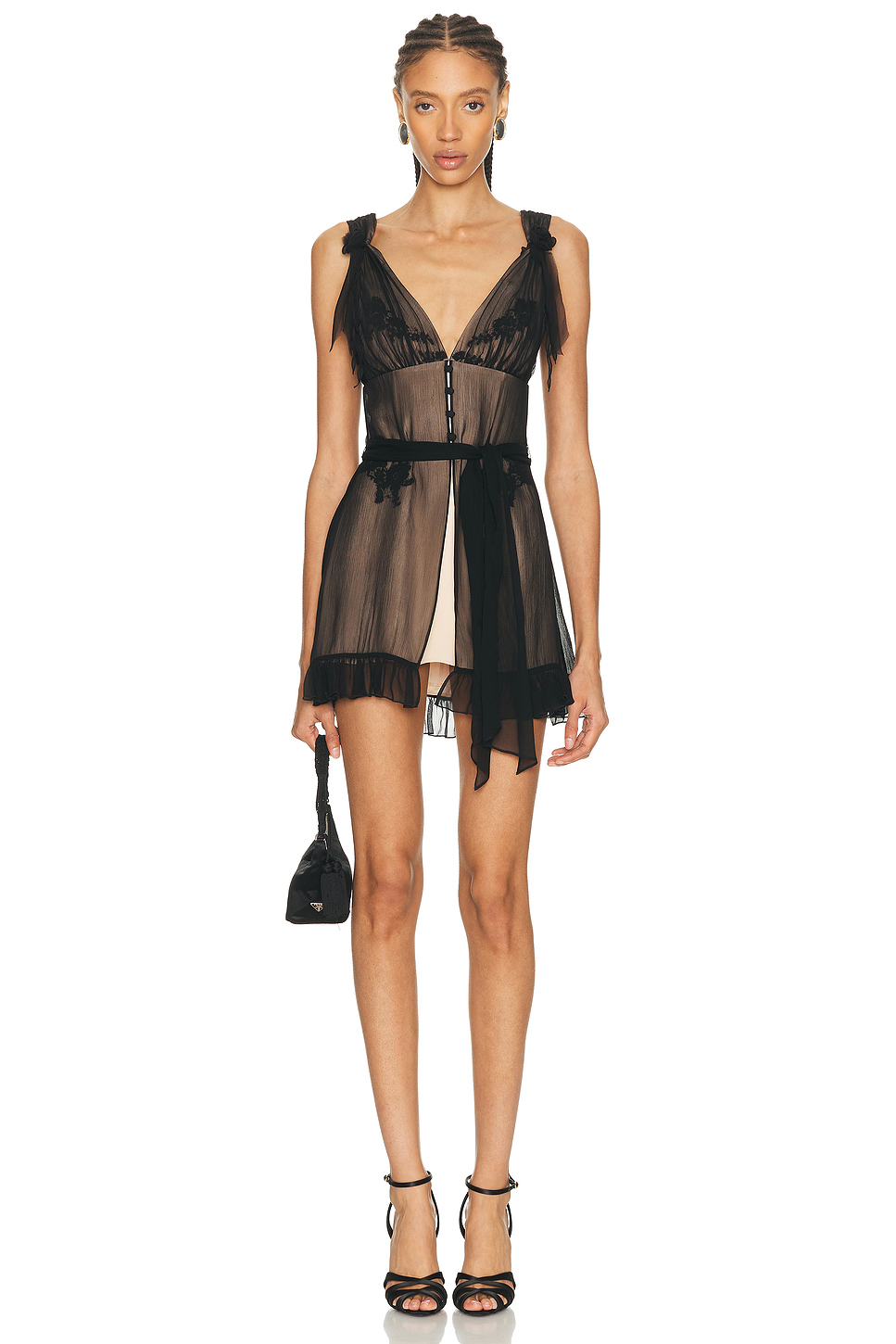
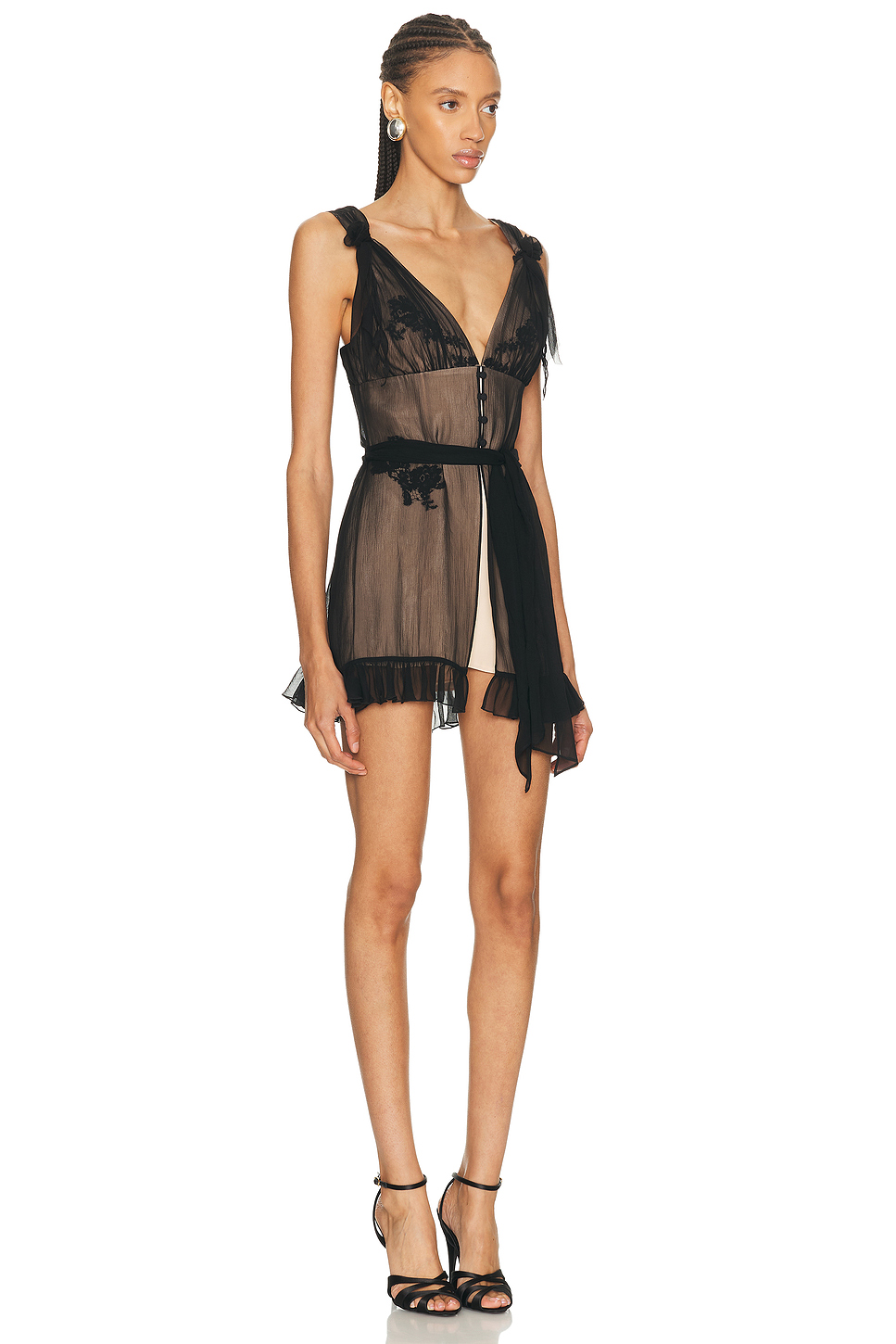
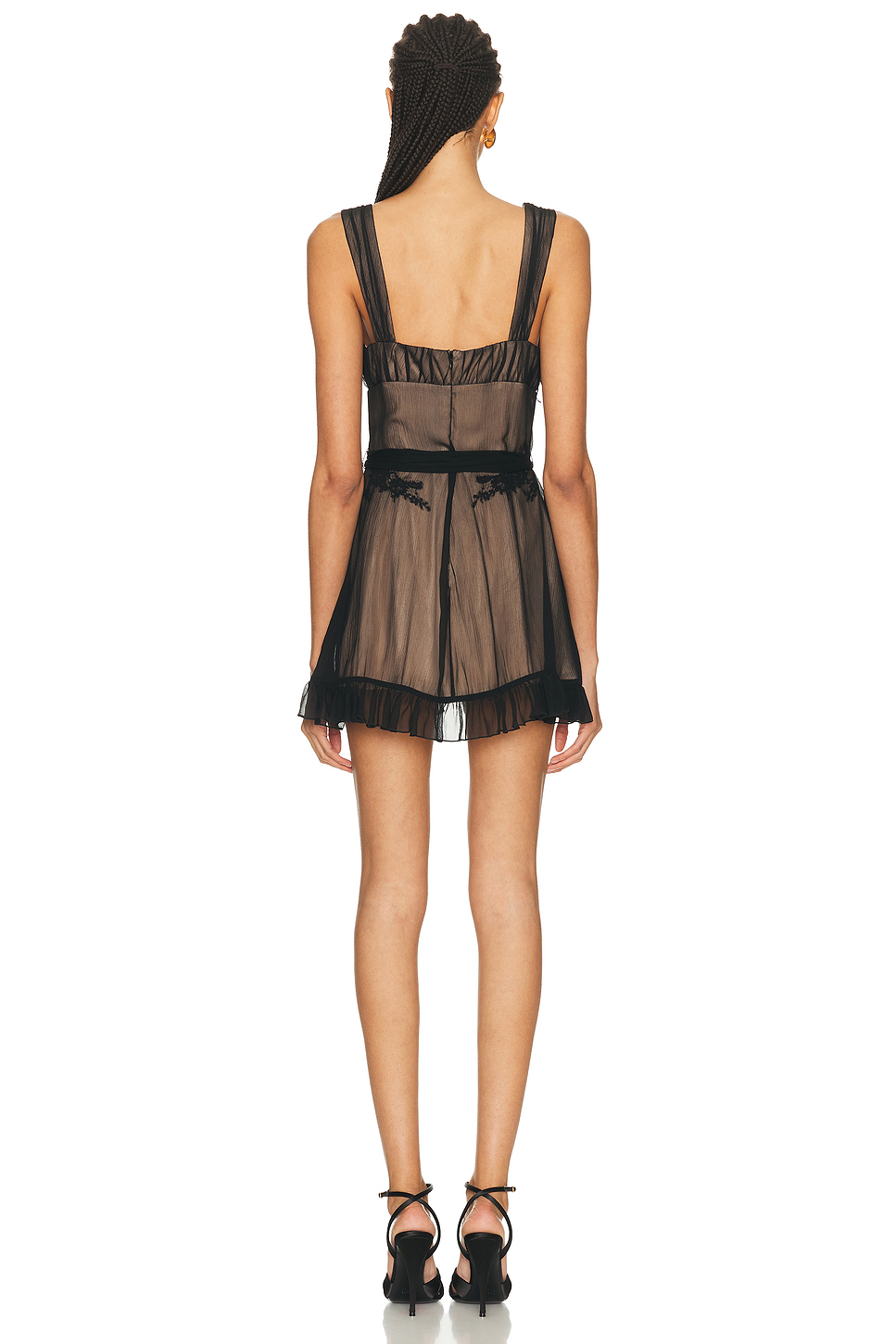
A silk mini dress listing four separate components: fabric one in 100% silk, fabric two in 100% silk, fabric three in 75% cotton and 25% polyamide, and a lining in 100% silk, professional clean, fully lined, with a hidden zipper at the back, button loops at the front and floral detailing, in satin with an overlay of chiffon, made in China, at 995 dollars. There are no reviews and no fit votes, so there is no score to quote. This carries more declared components than anything else examined in this series, and it happens to answer a question left open by a garment examined alongside it. It also displays something visible in the text itself which supports a conclusion this series reached recently and could previously only describe as observed. The reference is the Mini Dress by Mirror Palais in Honey and Noir. Dongguan Bafinasa Garments Co., Ltd. develops comparable layered silk dresses on OEM and ODM terms, from cloth selection and layered construction to retail or FBA ready packing. We publish this as a development reference and build your own version of it, and we do not supply the branded original or reproduce anyone else's label.
Key Features
- Four separate components listed, more than any other page examined here. See the note below
- Fabric one and fabric two both in 100% silk, and the difference between them is stated elsewhere. See the note below
- Fabric three in 75% cotton and 25% polyamide as stated
- Lining in 100% silk as stated
- Satin with an overlay of chiffon as stated, which is what distinguishes the two silk entries
- Hidden zipper at the back as stated, alongside button loops at the front
- Fully lined as stated
- Professional clean as stated, and three of the four components ask for it
Customisable Options
- Cloth: satin and chiffon to the reference, offered across weights since that decides how each layer behaves
- Layers: all four to the reference, or reduced to fewer where one would do the work
- Trim: the third cloth as stated, offered in alternative fibres if cost or supply prefers
- Care: professional clean to the reference, since silk in three components makes that difficult to avoid
- Length from mini to knee, layer count, trim placement, size set, colour development, private label and care labelling
Specifications
| Style | Multi layer silk mini dress |
| Reference | Mirror Palais, Mini Dress, style MRPF-WD53, manufacturer style MP2522, colour Honey and Noir |
| Fabric One | 100% silk as stated |
| Fabric Two | 100% silk as stated. See the note below, since this is the part worth careful reading |
| Fabric Three | 75% cotton, 25% polyamide as stated |
| Lining | 100% silk as stated |
| Component Count | Four stated components, the highest found anywhere in this series. See the note below |
| Cloth | Satin with an overlay of chiffon as stated. See the note below |
| Closure | Hidden zipper at the back as stated, with button loops at the front as stated |
| Detail | Floral detailing and gathered raw edge seams as stated |
| Lining Coverage | Fully lined as stated |
| Care | Professional clean as stated. See the note below |
| Sizes Published | XS, S, M and L |
| Measurements Published | S: bust 30 in, waist 26 in, hips 39 in, length 30 in. See the note below |
| Chart Note | The bust sits just below the model while waist and hips sit above her |
| Coverage | Only size S has figures. XS, M and L are blank |
| Model | 178 cm, bust 79 cm, waist 62 cm, hips 86 cm, wearing size S |
| Production | Made in China as stated |
| Reference Retail | 995 USD, quoted to show the price band this sits in, not as our price |
| Customer Reviews | None on the reference listing, so we quote no score |
| Best Seller Badge | Rank 36 in the retailer's black dress list |
| Categories | Filed under mini dresses and sleeveless dresses, while the badge records it under black |
| Occasion | Occasions, parties, evenings, going out |
| MOQ | 100 pcs per style per colourway, mixed sizes and colourways accepted |
| Sampling | 7-10 days after tech pack or reference sample confirmation |
| Bulk Lead Time | 20-30 days after sample approval and deposit |
| Service | OEM / ODM / private label, silk sourcing, layered construction, retail or FBA ready packing |
Size Chart
| Size | Bust | Waist | Hips | Length | Source | ||||||||||||
|---|---|---|---|---|---|---|---|---|---|---|---|---|---|---|---|---|---|
| S | 30 | in | 26 | in | 39 | in | 30 | in / | 76 | cm | As published | ||||||
| XS | 31 | in / | 79 | cm | 24 | in / | 61 | cm | 34 | in / | 86 | cm | 76 | cm / | 29.9 | in | Our proposal |
| S | 33 | in / | 84 | cm | 26 | in / | 66 | cm | 36 | in / | 91 | cm | 78 | cm / | 30.7 | in | Our proposal |
| M | 35 | in / | 89 | cm | 28 | in / | 71 | cm | 38 | in / | 97 | cm | 80 | cm / | 31.5 | in | Our proposal |
| L | 37 | in / | 94 | cm | 30 | in / | 76 | cm | 40 | in / | 102 | cm | 82 | cm / | 32.3 | in | Our proposal |
The published size S gives bust 30 in, waist 26 in, hips 39 in and length 30 in against a model at roughly 31, 24 and 34. The bust sits just below her while hips are five inches above, and the fastening explains how it goes on.
Occasions and Styling
Suits occasions, parties, evenings and going out. Satin under chiffon gives a surface that moves and catches light, though what sits beneath it matters, since the listing states it is fully lined.
Production and Quality Control
There are no reviews and no fit votes on this listing, so we quote no score. This declares more components than anything else examined here, and it happens to answer a question left open one garment ago. It also shows something visible in its own text which supports a conclusion reached recently and previously only describable as observed.
Four components, and it answering what the previous garment could not, and that is the first thing. This page lists fabric one, fabric two, fabric three and a lining, and gives all four fully, which is the largest number of declared parts found anywhere in this series. The previous highest was two, and those two usually amounted to a shell and something else, often unnamed. Now for what makes this genuinely useful rather than merely more. Fabric one and fabric two are both stated as one hundred per cent silk, so the page gives the same fibre twice under two headings. A garment examined directly alongside this one did almost exactly this and could not be read. That page gave a shell in one rendering of a fibre name and a lining in another rendering of the same name, and this series argued there that a customer had no way to know whether they were reading two things written differently or one thing written twice, and further that guessing wrongly there produced the less common and more consequential error, since the same quantity of fibre came to look like less of it by appearing under two headings. That question was left open, because the page offered nothing which could settle it. This one does, and the difference is instructive. Alongside its four components this page also states that the garment is satin with an overlay of chiffon. That single sentence distinguishes the two silk entries, because satin and chiffon are different cloths built from the same fibre, one dense and lustrous and the other open and sheer, and nothing about their composition would ever have revealed that they differ. So the answer to the open question is now available and worth stating plainly: a composition line cannot resolve whether two entries are one thing twice or two different things, no matter how carefully it is written, because two entirely different cloths can share one hundred per cent of one fibre. What resolves it is naming the cloth. This series has spent recent batches arguing that these pages should give three separate things about a fabric rather than one, having established that a construction name does not say how much material is present and then that it does not identify the material either. There is a third requirement now, arrived at from a different direction: fibre, weight and cloth are all needed, because knowing any two still leaves the question above open.
Something visible in the text itself, and what three instances permit saying, and that is the second thing. The four components arrive separated by visible line break markers in the source text of this listing, and the same visible markers appear in another line on this page and again on further pages examined in this final group. That means markup intended to control how text displays has ended up inside the text rather than around it, which is a specific technical thing rather than a matter of style. It happens when material is written into one place and then moved into another without being properly translated between the two. Now, this series has been cautious for some time about a conclusion which begins to look considerably firmer than it did. Working through three pages which shared an exact structure while sharing nothing else, structurally identical across different houses, different fibres and radically different prices, this series suggested those pages were being produced by a process rather than written individually, and held back from calling that concluded because one instance proves nothing and two could be coincidence. Three warranted firmer language than either. This adds something qualitatively different to that, because it is not a pattern of omissions which might conceivably have another explanation. It is evidence of a mechanical step, visible in the record itself. An author writing about their own product does not produce line break markers in the middle of their sentences. A transfer process which does not fully handle what it is carrying does. There is a second smaller instance on the same page, which is worth noting because it is the kind of thing only noticed in passing. One line here is written in English while every other line around it is not. That is the third time in this series that a single phrase has arrived in a different language from its neighbours, and while each instance alone could be anything at all, the recurring shape is consistent with something assembled rather than composed. None of this concerns the garment, which is worth saying plainly, since it is easy to read criticism of a page as criticism of what is sold. A dress made with four declared components and sewn properly is a better made thing than one where none of that is known. What it bears on is how much weight these descriptions can carry, and why an empty field is more often a fact about a record than about a garment.
Professional clean, and how it goes on, and that is the third thing. Three of the four components here are one hundred per cent silk, and this series has described silk repeatedly across hundreds of listings: it marks permanently wherever water sits and then dries, so marks appear where water was rather than where anything was spilled, and it loses brightness under light over time. Nothing here competes with that. The cotton and polyamide in the third cloth barely registers at this level, since an instruction follows the most vulnerable element present rather than whatever is dominant, and silk is by some distance the most vulnerable thing on this page. So professional clean follows cleanly, and unlike several recent cases there is nothing puzzling to resolve. There are two smaller things worth recording, both concerning how this fits. Published figures are bust thirty, waist twenty six, hips thirty nine against a model at approximately thirty one, twenty four, thirty four, so the bust sits just below her, the waist is slightly above, and the hips are five inches above. This is a much gentler set than several examined recently, and the reason is stated on the page: there is a hidden zipper at the back. A zipper means the garment opens, so nothing along it has to be travelled over the widest part of the body, and therefore none of these figures carries access cost. This series worked this out recently in reverse, finding that a fastening which stops partway leaves everything below it obliged to be large enough to be pulled over the hips, and then finding that a full opening removes that obligation entirely. This is the same principle producing the opposite result, and seeing both ends within a few garments is what makes it reliable rather than an ad hoc explanation arrived at to fit one garment. The other small point concerns the front, which has button loops. Loops fasten rather than stretch, so how far this closes depends where the buttons sit and can be adjusted within that, which is one of the mechanisms allowing a garment to sit closer than its own measurements suggest. Nothing here requires an elaborate explanation, and that is itself worth noting given how often this series has had to assemble two or three mechanisms to account for a number. Every bulk shipment gets a measurement report against your approved chart.
Optional upgrades include naming each cloth as well as each fibre, since two entirely different materials can share one hundred per cent of one fibre and nothing in a composition line reveals it, publishing measurements for XS, M and L, since one of four repeats throughout, reducing four components to fewer where one would serve, and saying which of them does what, cleaning stray formatting from the detailed listing before it is published, since it currently shows in the text itself, keeping professional clean rather than attempting anything gentler given three silk components, stating weights for each layer rather than only naming them, since that decides most practical questions about each, offering alternative fibres for the third cloth where cost or supply prefers, length options rather than thirty inches alone, keeping the button loops rather than substituting something fixed, since adjustable fastening explains how this sits as close as it does, colour development, private label, hangtag and care labelling.
Pre-production sample approval, in-line inspection during cutting and sewing, and a final AQL inspection before packing, with measurement reports and photos shared before shipment.
Send us your tech pack, a photo or a reference garment and we will quote within 24 hours. Contact bafinasa@bafinasa.com or WhatsApp +86 13827222469.