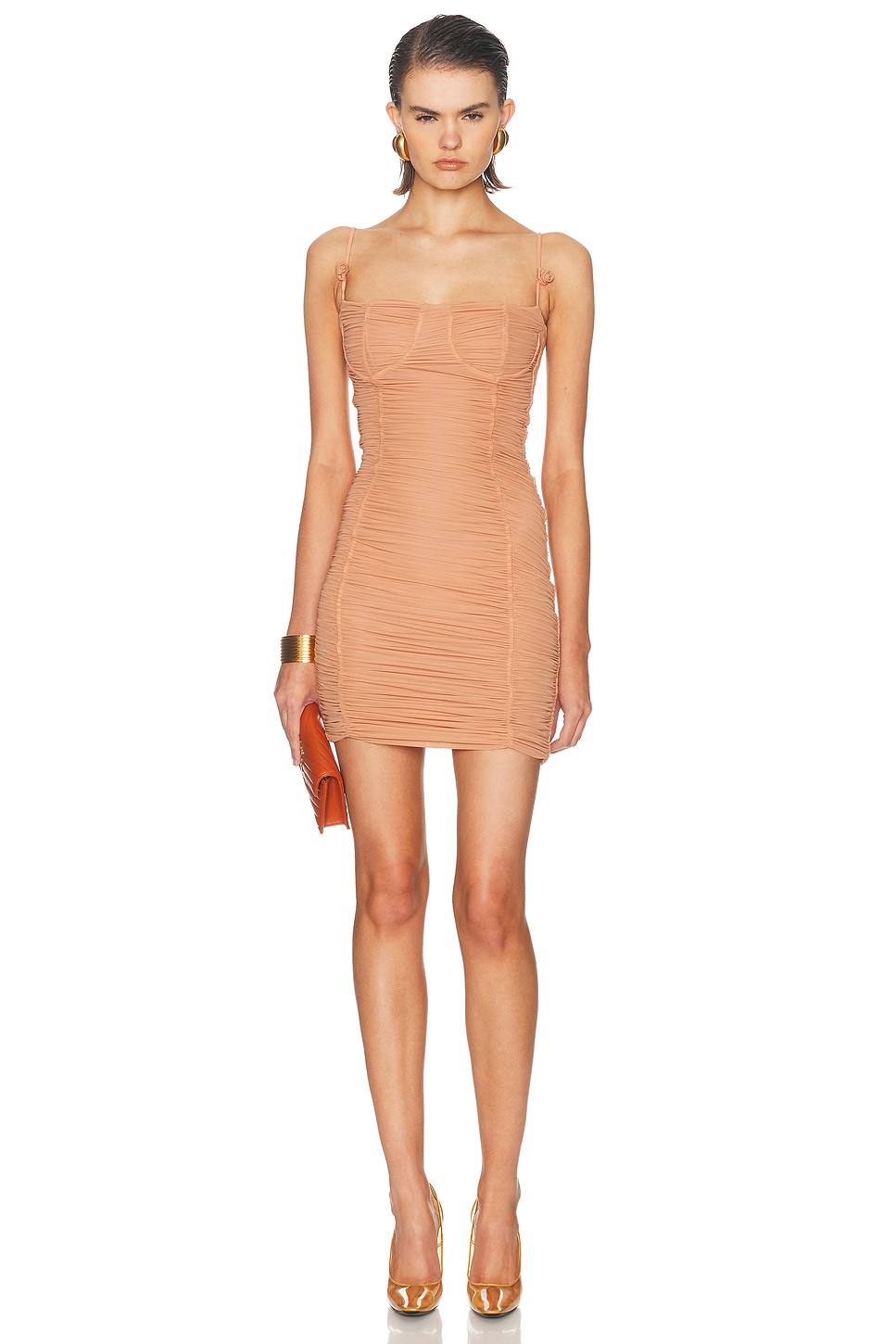
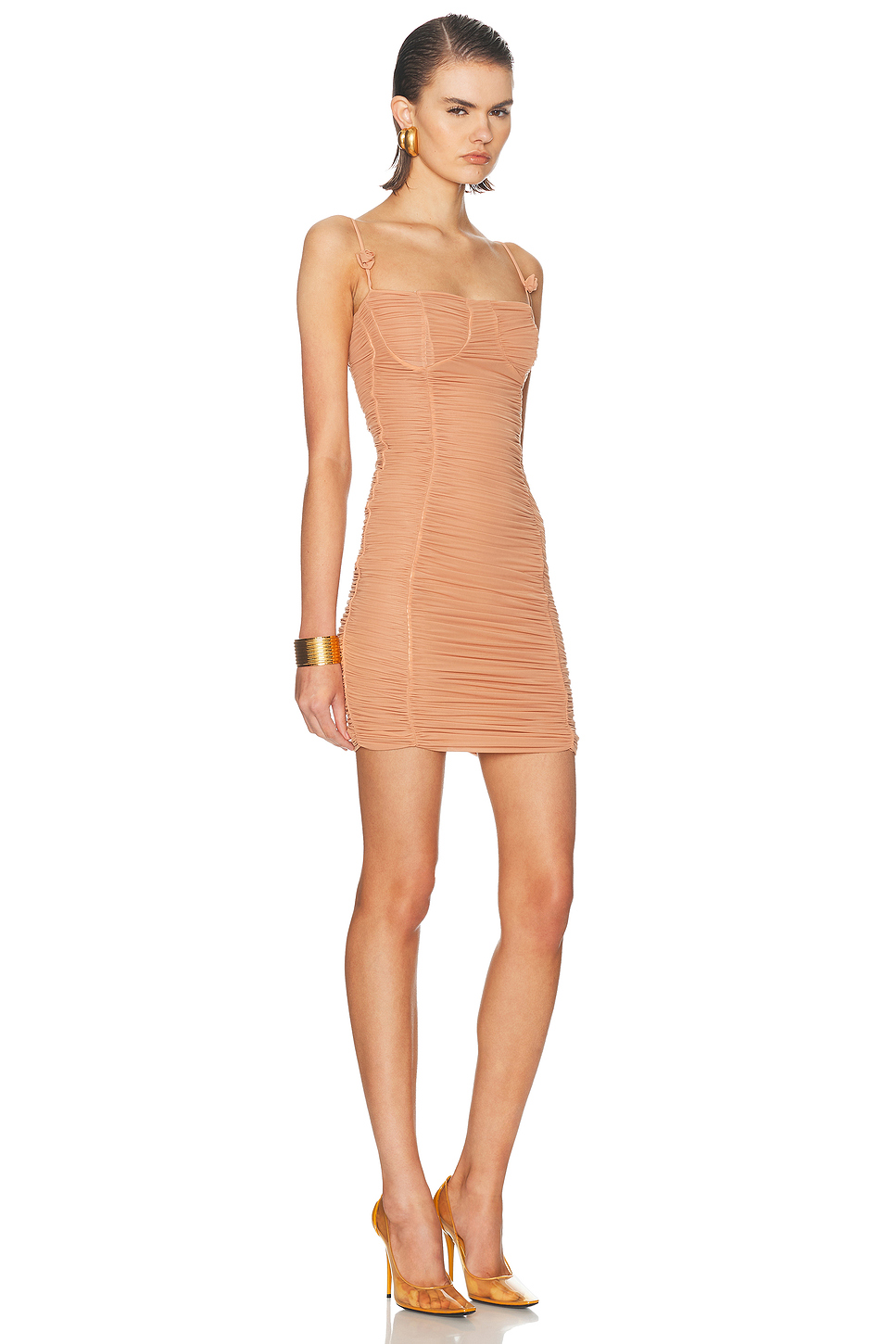
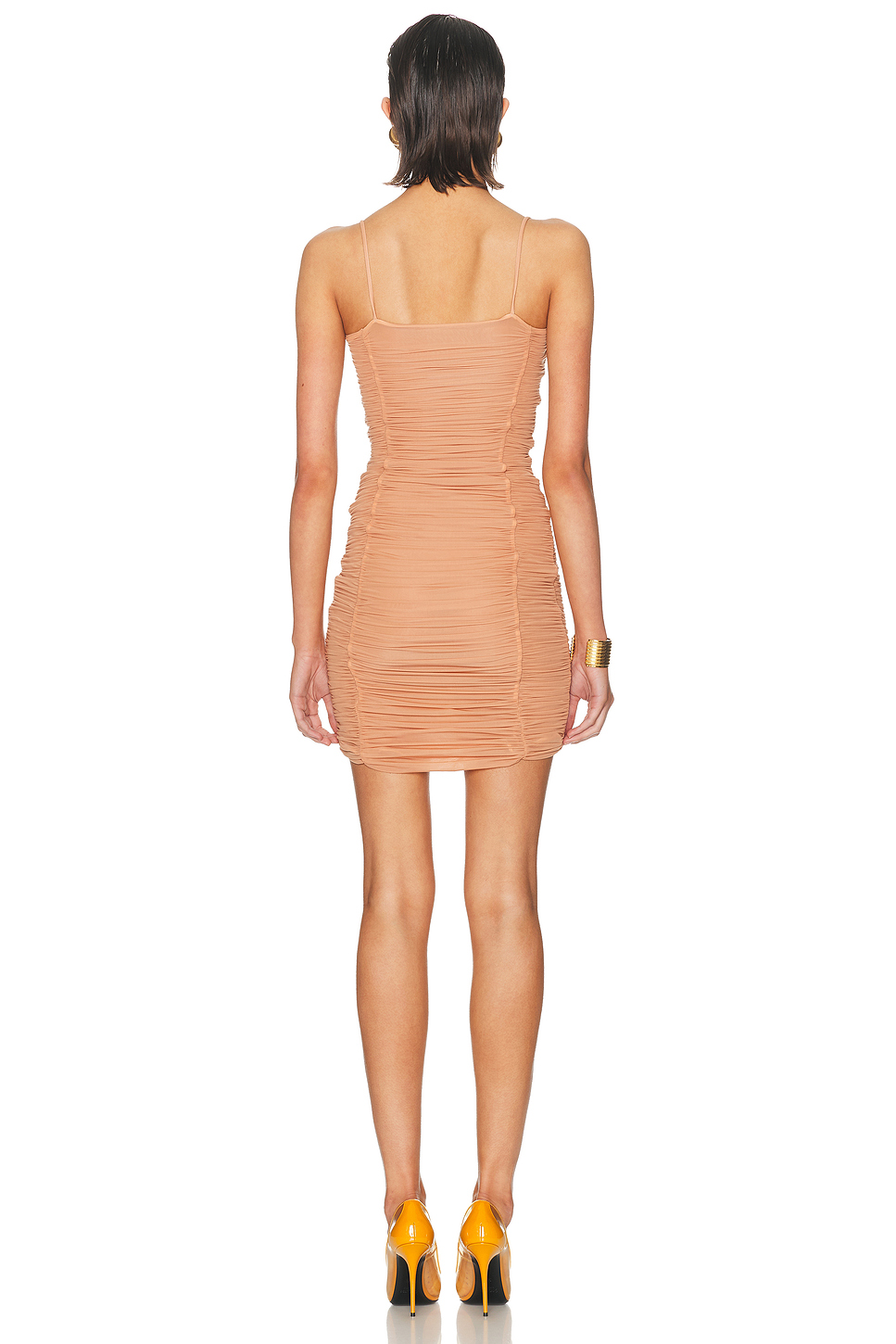
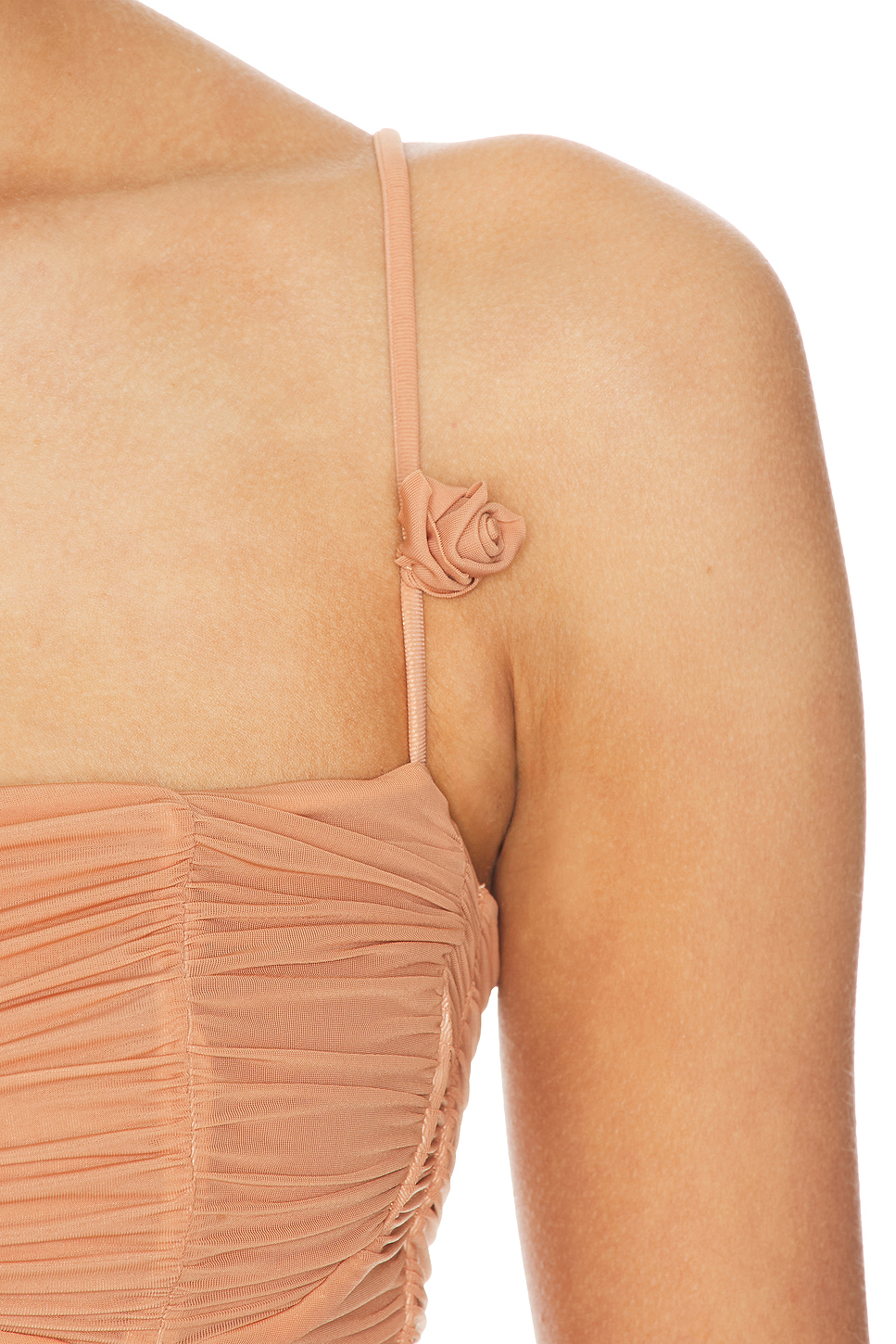
A bodycon mini dress listed in 77% polyamide and 23% elastane, hand wash, unlined, with a pull on construction, in a stretch jersey, made in Colombia, at 490 dollars. There are no reviews and no fit votes, so there is no score to quote. This carries the highest proportion of elastane encountered anywhere in this series, and the measurements are by some distance the largest negative ease figures met, and the two facts are the same fact. There is also something about how the sizes are labelled here which quietly removes most of the usefulness from those numbers. The reference is the Cromia Dress by Maygel Coronel in Copper. Dongguan Bafinasa Garments Co., Ltd. develops comparable stretch dresses on OEM and ODM terms, from yarn selection and knit development to retail or FBA ready packing. We publish this as a development reference and build your own version of it, and we do not supply the branded original or reproduce anyone else's label.
Key Features
- 77% polyamide and 23% elastane as stated, the highest elastane proportion recorded in this series. See the note below
- Measurements around thirteen inches below the body at bust and hips. See the note below
- Pull on construction as stated, which together with the above is the whole explanation
- Stretch jersey as stated
- Combined sizes offered rather than single ones, which complicates every number. See the note below
- Hand wash as stated, and the absence of drying guidance matters more at this stretch level
- Unlined as stated
- Made in Colombia as stated
Customisable Options
- Yarn: polyamide and elastane to the reference, with elastane level adjusted to the compression wanted
- Knit: stretch jersey to the reference, offered at several recovery levels rather than one
- Sizing: offered as single sizes rather than combined, since combined labels make the measurements unusable
- Care: hand wash to the reference, plus drying instructions since elastane has its own heat ceiling
- Length from mini to knee, compression level, size range, colour development, private label and care labelling
Specifications
| Style | High stretch bodycon mini dress |
| Reference | Maygel Coronel, Cromia Dress, style MAYF-WD120, manufacturer style VT-208 CPP-172, colour Copper |
| Composition | 77% polyamide, 23% elastane as stated. See the note below |
| Elastane Level | 23%, the highest recorded anywhere in this series. See the note below |
| Fabric | Stretch jersey as stated |
| Construction | Pull on as stated. See the note below |
| Lining | Unlined as stated |
| Care | Hand wash as stated. See the note below |
| Sizes Published | XXS/XS, S/M and M/L, three combined sizes. See the note below |
| Measurements Published | S/M: bust 20 in, waist 16 in, hips 22 in, length 29 in. See the note below |
| Chart Note | Every girth sits far below the model, by as much as thirteen inches. See the note below |
| Coverage | Only one of the three sizes has figures, and it covers two ordinary sizes at once |
| Model | 178 cm, bust 84 cm, waist 62 cm, hips 89 cm, wearing size S/M |
| Production | Made in Colombia as stated |
| Reference Retail | 490 USD, quoted to show the price band this sits in, not as our price |
| Customer Reviews | None on the reference listing, so we quote no score |
| Best Seller Badge | None. The listing carries no rank |
| Categories | Filed by the retailer under bodycon dresses and mini dresses |
| Occasion | Parties, evenings, occasions, going out |
| MOQ | 100 pcs per style per colourway, mixed sizes and colourways accepted |
| Sampling | 7-10 days after tech pack or reference sample confirmation |
| Bulk Lead Time | 20-30 days after sample approval and deposit |
| Service | OEM / ODM / private label, stretch knit sourcing, compression development, retail or FBA ready packing |
Size Chart
| Size | Bust | Waist | Hips | Length | Source | ||||||||||||
|---|---|---|---|---|---|---|---|---|---|---|---|---|---|---|---|---|---|
| S/M | 20 | in | 16 | in | 22 | in | 29 | in / | 74 | cm | As published | ||||||
| XXS/XS | 31 | in / | 79 | cm | 24 | in / | 61 | cm | 34 | in / | 86 | cm | 74 | cm / | 29.1 | in | Our proposal |
| S/M | 33 | in / | 84 | cm | 26 | in / | 66 | cm | 36 | in / | 91 | cm | 76 | cm / | 29.9 | in | Our proposal |
| M/L | 35 | in / | 89 | cm | 28 | in / | 71 | cm | 38 | in / | 97 | cm | 78 | cm / | 30.7 | in | Our proposal |
| L/XL | 37 | in / | 94 | cm | 30 | in / | 76 | cm | 40 | in / | 102 | cm | 80 | cm / | 31.5 | in | Our proposal |
The published S/M gives bust 20 in, waist 16 in, hips 22 in and length 29 in against a model at roughly 33, 24 and 35, so shortfalls of around thirteen inches at two points. Note that this one row of figures is doing duty for two ordinary sizes at once.
Occasions and Styling
Suits parties, evenings, occasions and going out. Very high stretch means nothing further is needed beneath and nothing needs arranging once on, so this is a garment put on rather than assembled.
Production and Quality Control
There are no reviews and no fit votes on this listing, so we quote no score. This carries the highest proportion of elastane encountered anywhere here, and it also carries by some distance the largest negative ease figures met, and those turn out to be the same fact rather than two. Something about how the sizes are labelled then removes most of the usefulness from the numbers.
Twenty three per cent, thirteen inches, and one fact rather than two, and that is the first thing. This series has established a way of reading elastane which has been applied hundreds of times: below roughly five per cent behaves mostly as a recovery additive, toward one fifth it begins genuinely compressing rather than merely recovering, and anything in between calls for looking rather than assuming. That put a garment at twelve per cent squarely in the middle ground, and buyer reviews then settled it by describing the garment drawing them in. This one sits at twenty three, comfortably beyond the one fifth line, and it is the highest proportion encountered anywhere in this series. The measurements make it plain what that buys. Published figures are bust twenty, waist sixteen, hips twenty two against a model at approximately thirty three, twenty four, thirty five, so shortfalls of around thirteen inches at bust and hips and about eight at the waist. Nothing else examined here has come close. Now this series has been building toward a distinction which this garment completes. There appear to be two independent sources of negative ease, and they stack rather than substituting for one another. One is geometry, meaning loop structure, since loops open under load because of how they are arranged rather than because of what they are made from. The other is material, meaning a fibre which actively pulls back. Everything learned recently about the geometric side came from garments with no elastane at all: two crocheted pieces and one fine knit produced shortfalls around six and eight inches purely from construction. So the useful and rather clean conclusion available now is quantitative. Geometry alone appears able to deliver something in the region of six to eight inches. Reaching thirteen required twenty three per cent elastane alongside a knit structure permissive enough to let it work. Neither alone would have got there. It follows that these two sources are genuinely additive, which matters practically because it means negative ease can be designed rather than merely observed, and it means somebody looking at a smaller figure should not conclude the construction is doing less than it is. There is one consequence specific to very high elastane which deserves stating, because it is a trade rather than a benefit. Elastane governs how this garment behaves, and elastane degrades. Its strands lose their pull back gradually through wear and repeated washing and exposure to heat, so the compression this depends on will not remain at this level indefinitely. A garment relying on twenty three per cent for its fit is relying on the most age sensitive element in its own composition, and unlike a construction change there is nothing anybody can do about that afterwards. That is not an argument against doing it, since this level of shaping cannot be achieved another way, but it is worth knowing before choosing this level rather than twelve.
Three sizes covering six, and a measurement which therefore belongs to nobody, and that is the second thing. The sizes offered are XXS/XS, S/M and M/L. Those are three entries rather than a list, each one spanning two ordinary sizes, which this series has not met before. It is immediately obvious why it has been done, and it is honestly quite elegant: there is little point offering two sizes across one range on a garment whose fit is almost entirely a property of its own stretch rather than of its cut. If twenty three per cent elastane allows the cloth to travel that far, why make two sizes where one would serve. This series has noted before, working through garments whose labels promise stretch, that there is frequently a gap between what such a word promises and what the stated percentage can actually deliver, and observed that disappointment tends to live in that gap. Here there is no gap at all, since the sizing itself makes the promise and the elastane level is high enough to honour it. So this is in one sense the most honest arrangement encountered: the label does not merely claim stretch, it has removed half the sizes which that stretch makes unnecessary. But something has been lost in doing it, and it is genuinely important. There is one published row of measurements, for S/M, and that row now has to describe two different bodies. Every other case in this series has involved a single size being measured, which is difficult enough, but there at least the figures belong to one size and a customer can reason about their distance from it. Here the numbers describe something in between. A customer wanting S cannot know whether twenty inches of bust is what S measures or the midpoint between S and M, and likewise for M. So the largest negative ease figures encountered anywhere here are simultaneously the least usable ones, because nobody can tell what they are measured against. That is worth dwelling on rather than merely noting, because it is a new kind of problem. Usually this series argues that publishing one size is a partial solution to nothing being published. Here the issue is not how much was published but that what was published has become ambiguous, since combining sizes removed the reference point which gives a measurement meaning. Offering single sizes, or publishing both ends of each combined range, would resolve it at the cost of a few rows in a table which already exists.
Hand wash and the part that follows, plus what two categories got right, and that is the third thing. The instruction is hand wash, and nothing further, which is the gap this series has found on nearly every hand wash encountered, sometimes noting that the instruction covers washing and stays silent about the stage where things actually go wrong. Here there is a specific reason the silence matters more than usual. Elastane has its own ceiling for heat, considerably below what the polyamide alongside it tolerates, and this is a garment whose entire fit depends on that fibre retaining its pull back. So drying is not a neutral afterthought at this level of elastane. Heat is the thing which degrades it fastest, and there is no restoring it once gone. Combined with what was worked out above about elastane governing how this garment behaves, the instruction covers cleaning and then leaves the part where the single most consequential element gets damaged entirely unaddressed. One added line about drying away from heat would cover it, and every bulk order here gets a care label saying so. There are two smaller things worth recording. The first is that unlined at this level of stretch is not the gap it would be elsewhere, since nothing here relies on a second layer to hold shape, which is worth distinguishing from cases where the absence of lining removes the only thing settling whether something reads sheer. The second concerns the categories, and it is another small piece of support for something argued recently. This is filed under bodycon and under mini, and both are claims about the garment rather than about a photograph, and both hold up. Bodycon is corroborated by twenty three per cent elastane, since that is what makes such a claim true rather than aspirational, and twenty nine inches sits comfortably within whatever this word covers, being among the shortest met anywhere here. So the pattern continues: labels asserting something about construction or silhouette or presence are checkable and frequently correct, while labels asserting length continue to be the ones which fail, having recently produced a set no consistent threshold could arrange and then stopped being applied at all to a garment too long for the sequence. Every bulk shipment gets a measurement report against your approved chart.
Optional upgrades include offering single sizes rather than combined ones, or publishing both ends of each combined range, since measurements currently belong to two sizes at once and nobody can tell what they were taken against, adding drying guidance to the care label, since elastane carries the lowest heat ceiling here and the whole fit depends on it retaining its pull back, publishing figures for the other two sizes rather than one row for all three, offering several compression levels rather than twenty three per cent only, since lower levels age more slowly and higher ones shape more, length options rather than twenty nine inches alone, confirming whether a lining is wanted given what it would or would not add at this stretch level, colour development, private label, hangtag and care labelling.
Pre-production sample approval, in-line inspection during cutting and sewing, and a final AQL inspection before packing, with measurement reports and photos shared before shipment.
Send us your tech pack, a photo or a reference garment and we will quote within 24 hours. Contact bafinasa@bafinasa.com or WhatsApp +86 13827222469.