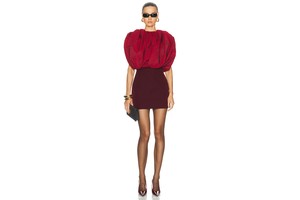
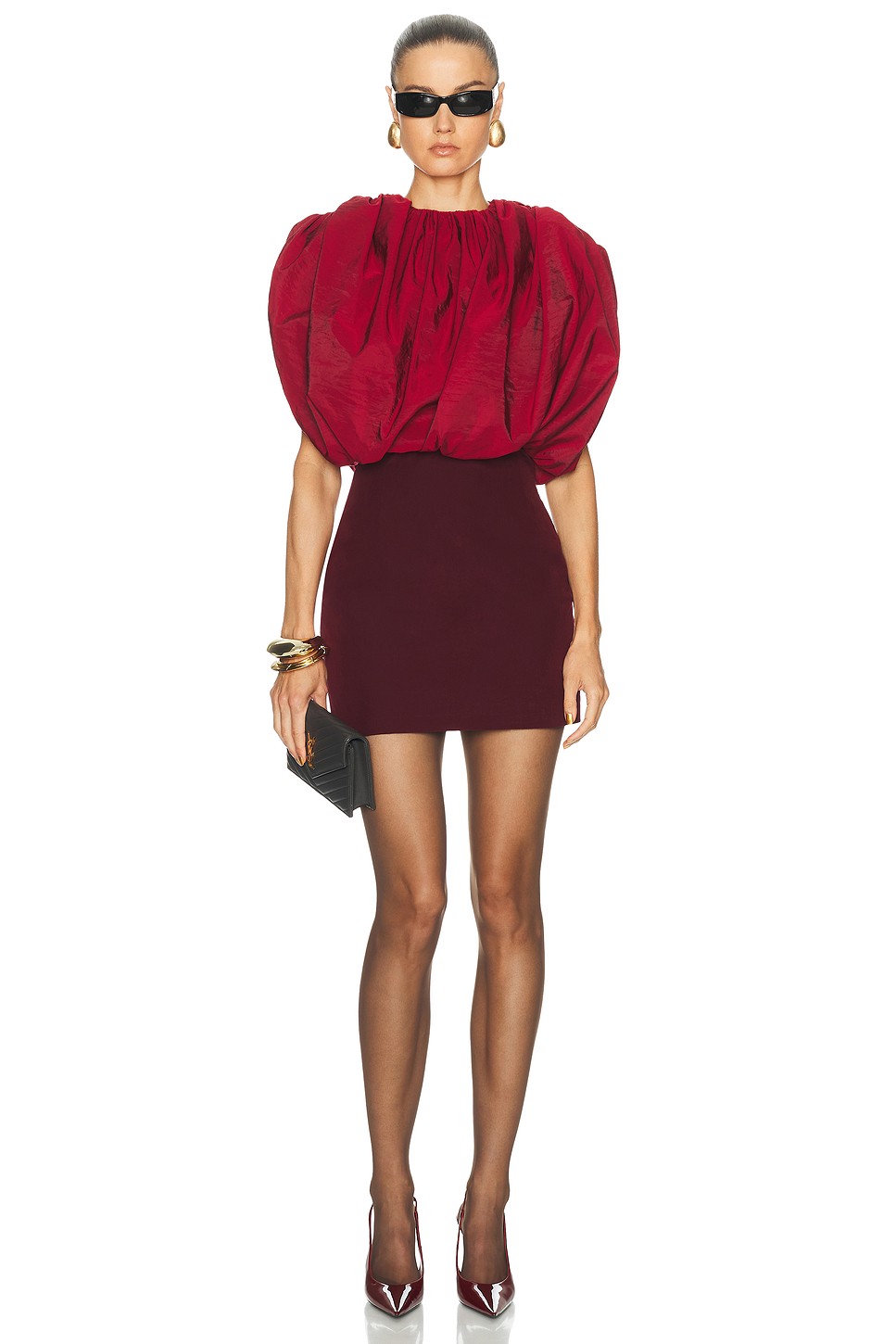
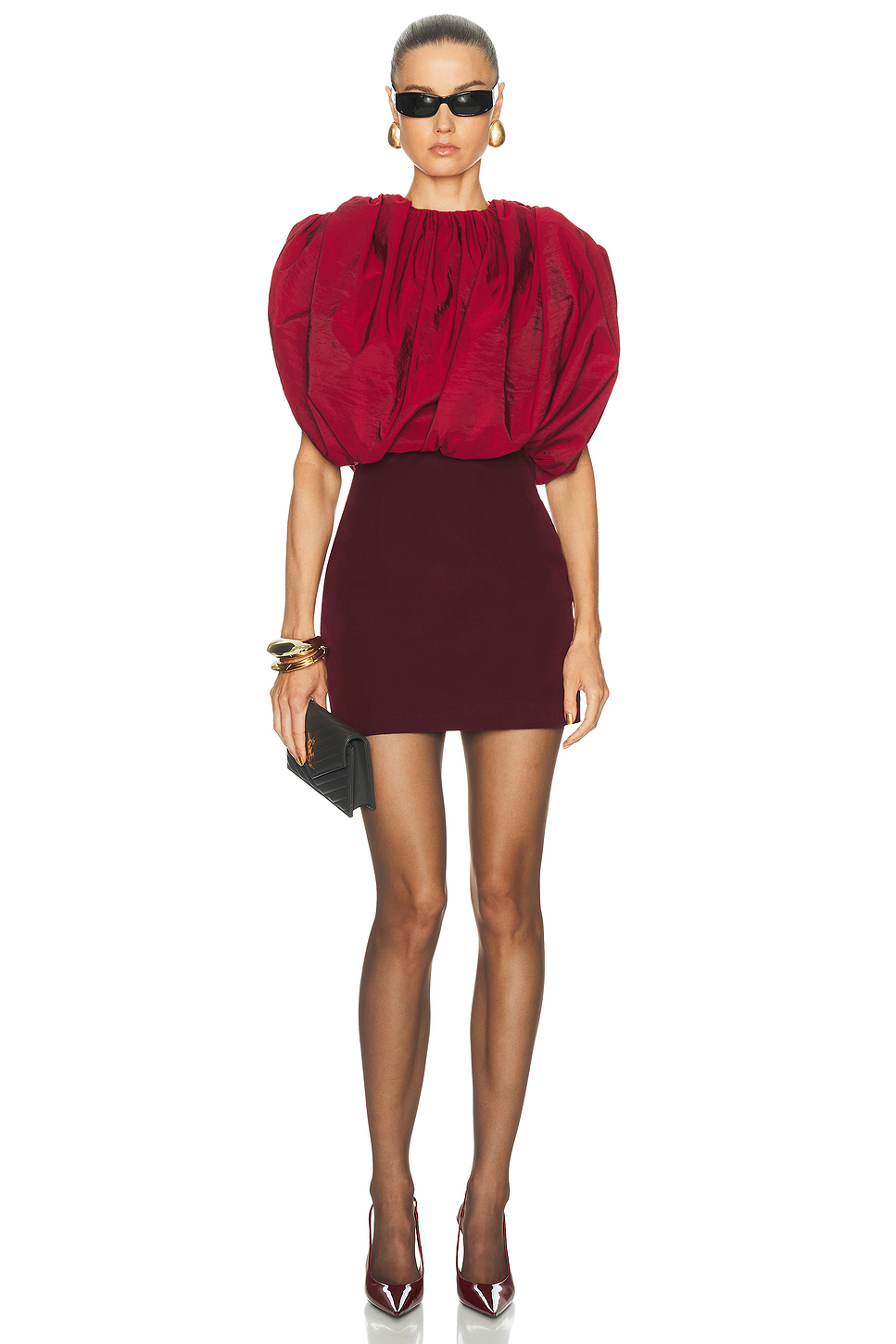
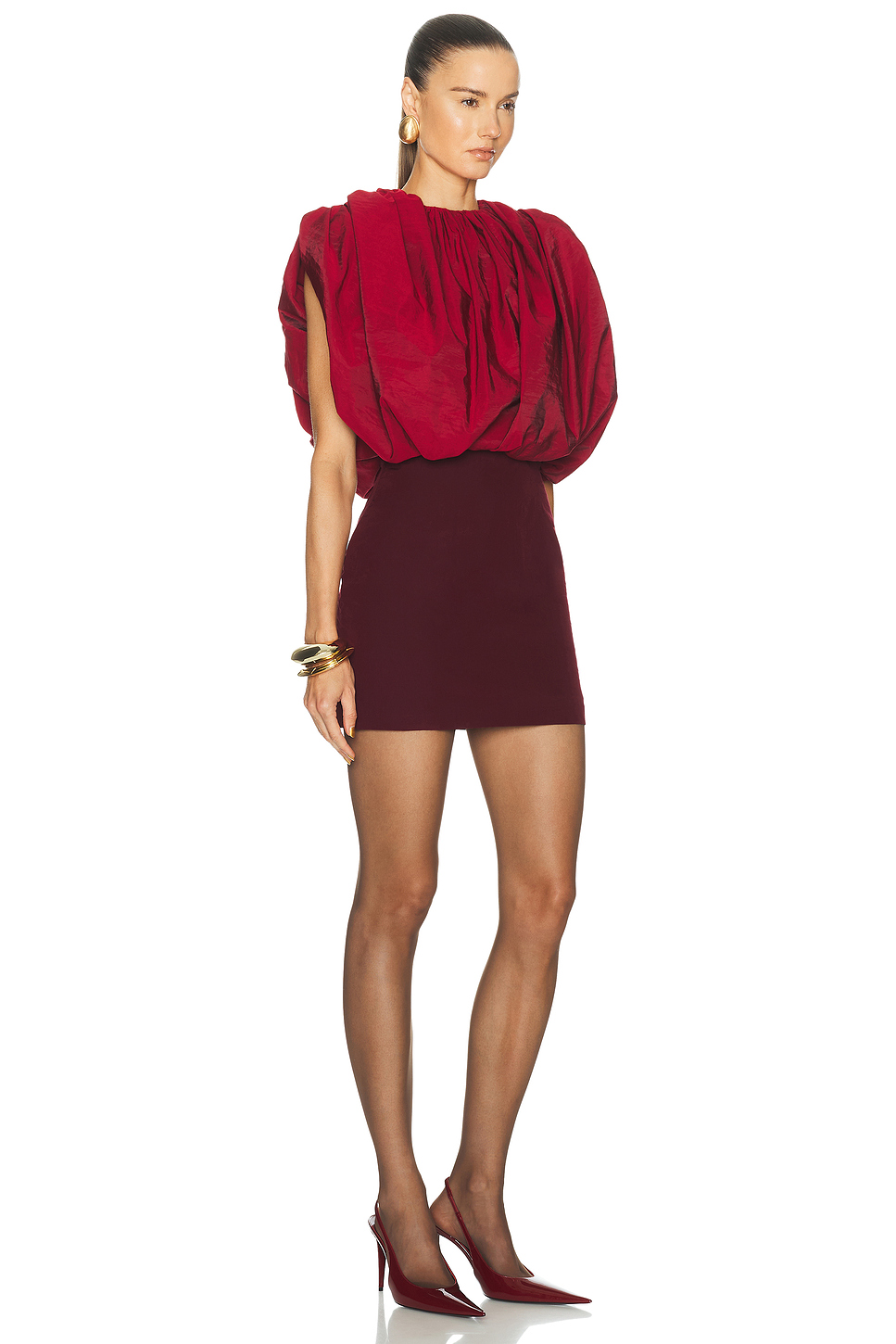
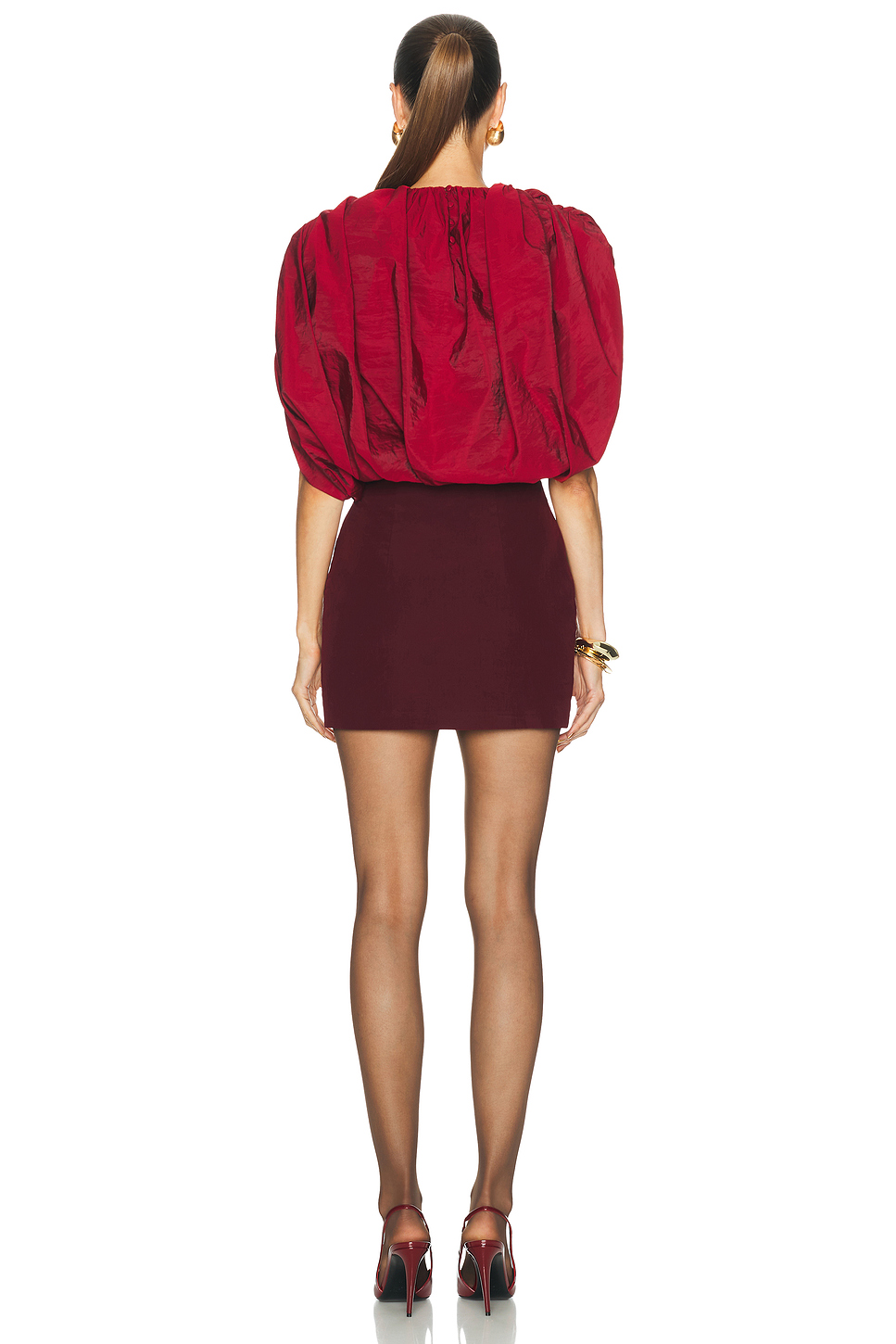
A red sleeveless mini dress listing three components: fabric one in 72% silk and 28% polyester, fabric two in 70% cotton and 30% silk, and a lining in 100% silk, professional clean, fully lined, with a hidden zipper and button loops at the side, in a lightweight poplin, made in Poland, at 2,435 dollars. There are no reviews and no fit votes, so there is no score to quote. Two of its measurements sit exactly on the body it was modelled on, which is rarer than it sounds and worth being precise about. There is also something quietly unusual about how thoroughly this page accounts for itself. The reference is recorded under style MAGF-WD173, created by a maker named in the product description, in Red. Dongguan Bafinasa Garments Co., Ltd. develops comparable occasion dresses on OEM and ODM terms, from cloth selection and layered construction to retail or FBA ready packing. We publish this as a development reference and build your own version of it, and we do not supply the branded original or reproduce anyone else's label.
Key Features
- Three components listed, with all three totalling one hundred individually. See the note below
- Fabric one in 72% silk and 28% polyester as stated
- Fabric two in 70% cotton and 30% silk as stated
- Lining in 100% silk as stated
- Lightweight poplin as stated, while none of the three components is a synthetic plain weave
- Hidden zipper with button loops at the side as stated
- Gathered bodice with a tailored skirt as stated
- Made in Poland as stated
Customisable Options
- Cloth: silk blend and cotton silk to the reference, offered across weights since that decides how each holds
- Layers: all three to the reference, or simplified where one cloth would serve
- Fastening: hidden zipper with button loops to the reference, or any closure that opens fully
- Silhouette: gathered bodice with tailored skirt to the reference, with fullness adjustable
- Length from mini to knee, layer count, size set including larger sizes, colour development, private label and care labelling
Specifications
| Style | Sleeveless poplin cocktail mini dress |
| Reference | Style MAGF-WD173, manufacturer style 152726, colour Red, made in Poland |
| Fabric One | 72% silk, 28% polyester as stated, totalling one hundred |
| Fabric Two | 70% cotton, 30% silk as stated, totalling one hundred |
| Lining | 100% silk as stated |
| Component Count | Three stated components, all individually totalling one hundred. See the note below |
| Fabric | Lightweight poplin as stated. See the note below |
| Closure | Hidden zipper with button loops at the side as stated. See the note below |
| Silhouette | Gathered bodice with tailored skirt as stated |
| Lining Coverage | Fully lined as stated |
| Care | Professional clean as stated. See the note below |
| Sizes Published | 34, 36, 38 and 40, four even numbered sizes |
| Measurements Published | 36: bust 34 in, waist 26 in, hips 34 in, length 32.5 in. See the note below |
| Chart Note | Bust and hips sit exactly on the model while waist sits above her. See the note below |
| Coverage | Only size 36 has figures. Sizes 34, 38 and 40 are blank |
| Model | 179 cm, bust 86 cm, waist 61 cm, hips 86 cm, wearing size 36 |
| Production | Made in Poland as stated |
| Reference Retail | 2,435 USD, quoted to show the price band this sits in, not as our price |
| Customer Reviews | None on the reference listing, so we quote no score |
| Best Seller Badge | Rank 76 in the retailer's cocktail dress list |
| Categories | Filed under mini dresses and sleeveless dresses, while the badge records it under cocktail |
| Occasion | Occasions, cocktail, parties, formal events, evenings |
| MOQ | 100 pcs per style per colourway, mixed sizes and colourways accepted |
| Sampling | 7-10 days after tech pack or reference sample confirmation |
| Bulk Lead Time | 20-30 days after sample approval and deposit |
| Service | OEM / ODM / private label, silk blend sourcing, layered construction, retail or FBA ready packing |
Size Chart
| Size | Bust | Waist | Hips | Length | Source | ||||||||||||
|---|---|---|---|---|---|---|---|---|---|---|---|---|---|---|---|---|---|
| 36 | 34 | in | 26 | in | 34 | in | 32.5 | in / | 83 | cm | As published | ||||||
| 34 | 31 | in / | 79 | cm | 24 | in / | 61 | cm | 34 | in / | 86 | cm | 83 | cm / | 32.7 | in | Our proposal |
| 36 | 33 | in / | 84 | cm | 26 | in / | 66 | cm | 36 | in / | 91 | cm | 85 | cm / | 33.5 | in | Our proposal |
| 38 | 35 | in / | 89 | cm | 28 | in / | 71 | cm | 38 | in / | 97 | cm | 87 | cm / | 34.3 | in | Our proposal |
| 40 | 37 | in / | 94 | cm | 30 | in / | 76 | cm | 40 | in / | 102 | cm | 89 | cm / | 35 | in | Our proposal |
The published size 36 gives bust 34 in, waist 26 in, hips 34 in and length 32.5 in against a model at roughly 34, 24 and 34. Bust and hips sit exactly on her while the waist is two inches above, which is tighter than it sounds.
Occasions and Styling
Suits occasions, cocktail events, parties, formal events and evenings. A gathered bodice over a tailored skirt reads dressed without being elaborate, and being fully lined means it does its own work underneath.
Production and Quality Control
There are no reviews and no fit votes on this listing, so we quote no score. Two of its measurements sit exactly on the body it was modelled on, which is rarer than it sounds and worth being precise about, and the page also accounts for itself more thoroughly than most.
Exactly zero, twice, and what that does and does not tell you, and that is the first thing. Published figures for size 36 are bust thirty four, waist twenty six, hips thirty four, against a model at approximately thirty four, twenty four, thirty four. So the bust and the hips sit at precisely the body's own measurement, with no ease at all at either point, while the waist is two inches above hers. This series has met zero ease once before, quite recently, where a single figure came out exactly level with the body, and the point was made there that something which opens needs nothing extra to be pulled over anything. There is a specific reason it is worth dwelling on here rather than passing over, which is that zero ease is not the same thing as close fitting, and the two get confused easily. Zero ease means the textile is the same size as the body it is measured against, so there is nothing either pressing or gaping at rest, and everything depends on how accurately that size is reproduced from one size to the next. It also means there is no margin whatsoever, so anybody whose actual proportion differs from this model even slightly will find this either firm or loose rather than fitted, and there is no tolerance absorbing that difference. What makes it workable here is stated on the page: there is a zipper and there are button loops, so this opens rather than being pulled over anything, and nothing about it needs extra room for getting it on. That point was established recently and it is doing real work here, because a garment with these same figures and no opening would simply not go on. Now for the part this series finds genuinely useful, which is what the two inches at the waist are doing. Twenty six against a waist of around twenty four is a small positive ease at the one point where the other two are exact, and looking at what else is stated explains it cleanly, since the bodice is gathered. Gathering draws textile in from a larger cut width, so the cloth at that point was cut wider than it finishes, and some of what is being measured there is fullness rather than circumference. This series has noted before, working through several garments in succession, recent garments increasingly need two or three mechanisms together before their figures make sense, and further that the recurring lesson worth keeping is to look for stated things which either move or distort how a figure is taken before reaching for anything elaborate. This case needs only one, and it is stated outright. There is one more thing worth being precise about, and it concerns honesty rather than construction. Only one size out of four is measured. So somebody considering size 34 or 38 or 40 is not merely guessing about sizes adjacent to a known one, but has nothing at all, and that is a garment whose whole design rests on precision at the bust and hip, which deserves more explanation than most rather than one row like everywhere else.
Three components, all totalling one hundred, and poplin made of something else again, and that is the second thing. This page declares three separate parts and gives all three in full, and every one of them adds to one hundred. That deserves credit in a way worth being specific about, because this series has been tracking arithmetic on these pages for hundreds of examinations and has repeatedly found totals falling short, most often missing a percent or two, with no indication whether something unstated completes it or whether the figures were never reconciled. Here there is nothing unaccounted for anywhere, across three separate statements, on the same page. That is rarer than it should be. There is a further point about how the three relate which is more interesting than the arithmetic itself. Silk appears in all three: twenty eight percent silk in the first alongside polyester, thirty percent silk in the second alongside cotton, and one hundred percent silk in the lining. So there is no shared dominant fibre binding them together, and yet unlike a case examined recently there is not total separation either. This series looked recently at two more recently examined arrangements at opposite ends of this range. One paired a regenerated cellulose with untreated cellulose, which share a raw material and move together when anything happens to them, so the two layers stay in proportion and the pairing goes quietly right. The other paired two protein fibres with no shared behaviour whatsoever, each failing in a wholly different way while sharing one fate, which is considerably harder to manage. This sits between them by design rather than by accident, since silk running through all three means the three parts share one behaviour in common even though none of them is mostly silk. Having some overlap rather than none is what keeps layers from separating, and it is the sort of thing which goes unnoticed precisely because it does its job. There is also a small opportunity here to recheck something established recently. The fabric is stated as lightweight poplin, and this series established comparing two cotton poplin garments that the construction word does not tell you how much material there is while the weight word does, then established on a polyester example that the construction word does not identify the material either. Poplin describes an arrangement of fine warp threads crossing a much thicker weft, producing that fine horizontal rib, and nothing in the description names a fibre. Here it is built mostly from silk and cotton blends, whereas the recent example was polyester and the earlier ones were cotton. Three garments, one construction word, three different materials and virtually no shared practical behaviour between them, which is a tidy confirmation arrived at without looking for it.
Professional clean, and how one number quietened a suspicion, and that is the third thing. The instruction is professional clean, and unlike some recent cases there is nothing perplexing to resolve. Silk appears throughout, and this series has stated repeatedly what that obliges: it marks permanently wherever water sits and dries, so the mark follows the water rather than whatever was spilled, and it loses brightness under light over time. With silk in all three components there is no vulnerable minority and no dominant majority competing, just one requirement applied uniformly, so one instruction covers everything sensibly. Two smaller points are worth finishing on. The first concerns the categories, and it is another small piece of support for a pattern this series has been tracking rather than one fresh conclusion. Three schemes describe this garment as mini, as sleeveless and as cocktail, and two of those are claims about the thing itself rather than about how it looked in a photograph. Sleeveless is verifiable by looking at it. Thirty two and a half inches is genuinely short by the standards of everything measured here, so mini is doing real work for once rather than being loose description. This is the same distinction drawn recently between labels making claims about construction or silhouette, which can be right or wrong and can be checked, and labels making claims about length, which have repeatedly turned out to describe a photograph of one particular person. The suspicion this series holds toward these headings should not relax simply because some turn out to be right, since it would be extraordinary if none ever were. What continues to be useful is knowing which kind is which. The second point is rather encouraging and worth ending on, because it concerns how much this page says rather than how little. Across hundreds of examinations this series has repeatedly found description fields empty while identification fields were complete, and has concluded more than once that an empty field is usually a fact about a record rather than about a garment. This page is the reassuring inverse: three components given in full and correctly totalled, a stated construction word, a stated weight word, a stated fastening, a stated lining, and measurements for one size against a stated body. So the fields are available and usable here, and whatever accounts for emptiness elsewhere is not a limitation in what can be recorded. Every bulk shipment gets a measurement report against your approved chart.
Optional upgrades include publishing measurements for sizes 34, 38 and 40, since one of four repeats throughout and a silhouette resting on precision at the bust and hip is the last place anyone should be guessing, extending the size range past 40 if demand supports it, naming each cloth as well as each fibre, since two different materials can share one fibre entirely and nothing in a composition line reveals which is which, giving the weight as a number rather than an approximate word, since how much material there is decides most of what follows, keeping silk present in each component rather than substituting, since shared behaviour between layers is what stops them separating, offering the design at a second length since thirty two inches suits a narrow range of heights, stating how gathered the bodice is rather than only that it gathers, since that explains the waist figure, keeping the zipper rather than any closure requiring the garment to be worked over the hips, colour development, private label, hangtag and care labelling.
Pre-production sample approval, in-line inspection during cutting and sewing, and a final AQL inspection before packing, with measurement reports and photos shared before shipment.
Send us your tech pack, a photo or a reference garment and we will quote within 24 hours. Contact bafinasa@bafinasa.com or WhatsApp +86 13827222469.