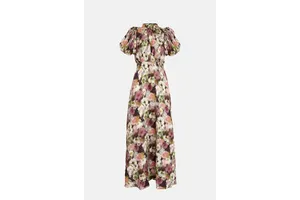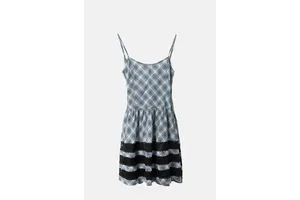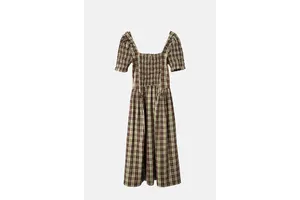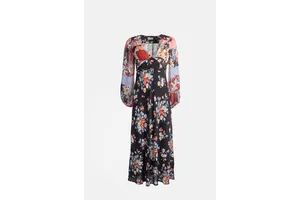
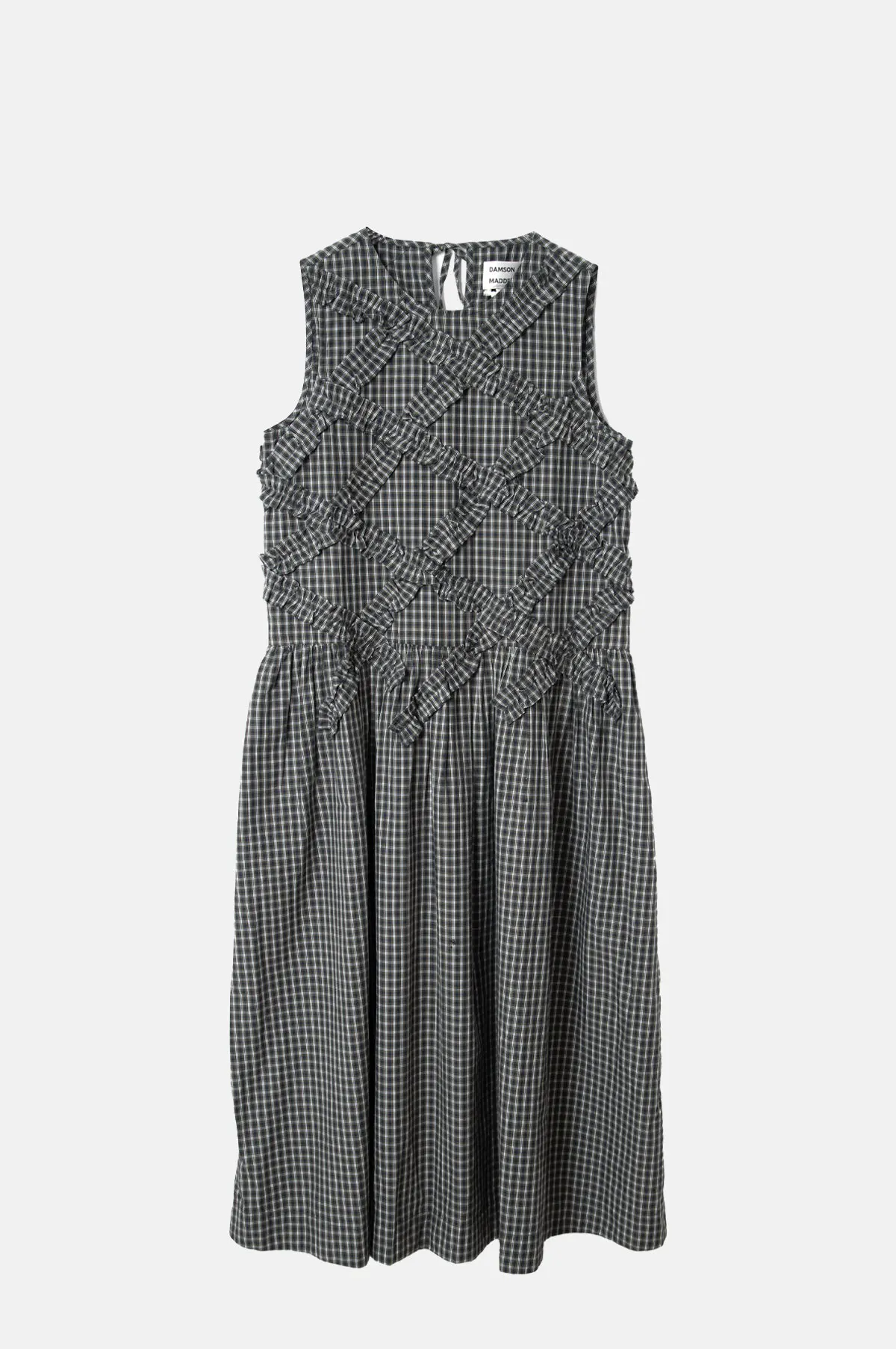

A sleeveless midi dress from Damson Madder in a crisp organic cotton poplin in a Lyra check, with lattice ruffle detailing across the bodice, a gathered waist falling into a full skirt, a keyhole tie fastening at the back and a small embroidered logo at the chest, listed at 100 GBP with five of six sizes in stock and the 10 sold out. It publishes two columns for all six sizes, pit to pit and total length, and the chest produces the tightest figures this run has measured on a woven dress: the ease runs from half an inch at a UK 6 to two and a third at a UK 16. On a sleeveless poplin dress with a keyhole at the back and no zip, half an inch is not a fitting, it is a question, and the question has two answers, and both of them are worth setting out because between them they explain most of the odd numbers in this run. The length, by contrast, is the cleanest column in this batch, grading exactly one centimetre per size. The reference is the Elora Midi Dress in Lyra Check. Dongguan Bafinasa Garments Co., Ltd. develops comparable woven dresses on OEM and ODM terms, from cloth selection and trim specification to retail or FBA ready packing. We publish this as a development reference and build your own version of it, and we do not supply the branded original or reproduce anyone else's label.
Key Features
- Two columns published for all six sizes, with the length grading a clean one centimetre per size, 124 to 129 cm
- Chest ease of 0.5 inches at a UK 6 rising to 2.3 at a UK 16, the tightest bodice in this run. See the note below
- Sleeveless bodice with lattice ruffle detailing as stated, with no ruffle depth, no gathering ratio and no armhole measurement. See the note below
- Gathered waist and full skirt as stated, with no waist measurement and no skirt length published. See the note below
- Back keyhole closure with a tie fastening as stated, and no zip described. See the note below
- 100% organic cotton poplin as stated, made in India, wash inside out at 30, with no certifying body named
- Three photographs, and no model height or body measurements
Customisable Options
- Cloth: organic cotton poplin to the reference, with the weight in grams per square metre set to your market since none is given
- Certification: organic claim to the reference, with GOTS or OCS certification and a transaction certificate quoted as an option
- Bodice: lattice ruffle to the reference, with the depth and the gathering ratio specified, or a plain bodice, or pintucks, or smocking
- Waist: gathered to the reference, with the waist measurement and the gather ratio specified, or a fixed waistband, or a smocked panel
- Back: keyhole with a tie fastening to the reference, or a covered zip, or a button loop closure
- Skirt: full to the reference, with the hem circumference specified, or a gentler A-line, or a gathered tier
- Cloth weight, check repeat, ruffle depth and gathering ratio, waist and hem measurements, armhole depth, body length, size set, colour development, private label and care labelling
Specifications
| Style | Sleeveless midi dress in organic cotton poplin with a lattice ruffle bodice |
| Reference | Damson Madder, Elora Midi Dress, style AW26-DM-4193, Lyra Check, UK size 6 to 16 |
| Composition | 100% organic cotton as stated, with no certifying body named. See the note below |
| Cloth | Crisp organic cotton poplin in a Lyra check as stated, with no weight and no check repeat given. See the note below |
| Bodice | Sleeveless, with lattice ruffle detailing across it as stated. See the note below |
| Waist | Gathered waist as stated, with no measurement and no gather ratio given. See the note below |
| Skirt | Full midi skirt as stated, with no hem circumference and no skirt length given. See the note below |
| Back | Keyhole closure with a tie fastening as stated, and no zip described. See the note below |
| Branding | Small embroidered logo at the chest as stated |
| Care | Wash inside out at 30 degrees as stated, with no drying instruction given |
| Sizes Offered | UK 6 to 16, six sizes, five in stock with the UK 10 sold out |
| Measurements Published | Pit to pit and total length only, for all six sizes. See the note below |
| Published Chest | Pit to pit 40, 43, 46, 49, 52 and 55 cm flat, or 15.7 through 21.7 in. See the note below |
| Chest Around | 80, 86, 92, 98, 104 and 110 cm, or 31.5, 33.9, 36.2, 38.6, 40.9 and 43.3 in. See the note below |
| Ease Against Body Bust | About 0.5, 0.9, 1.2, 1.6, 1.9 and 2.3 in from smallest to largest. See the note below |
| Published Length | 124, 125, 126, 127, 128 and 129 cm, grading one centimetre per size |
| Published Waist | None, on a dress whose waist is gathered. See the note below |
| Published Hip | None. See the note below |
| Published Skirt Length | None, only the total length is given. See the note below |
| Published Armhole | None, on a sleeveless dress. See the note below |
| Ruffle Depth | Not stated, and neither is the gathering ratio. See the note below |
| Model | None stated, no height and no body measurements |
| Photographs | Three |
| Cloth Weight | Not stated, only the word crisp. See the note below |
| Production | Made in India as stated |
| Reference Retail | 100 GBP as listed, quoted to show the price band this sits in, not as our price |
| Category | Filed by the reference under dresses |
| Occasion | Spring and summer, autumn with knitwear, weddings, garden parties, everyday |
| MOQ | 100 pcs per style per colourway, mixed sizes and colourways accepted |
| Sampling | 7-10 days after tech pack or reference sample confirmation |
| Bulk Lead Time | 20-30 days after sample approval and deposit |
| Service | OEM / ODM / private label, poplin sourcing, checked cloth development and matching, ruffle construction, retail or FBA ready packing |
Size Chart as Published by the Reference
| Size | Pit to Pit (flat) | Total Length |
|---|---|---|
| UK 6 | 40 cm | 124 cm |
| UK 8 | 43 cm | 125 cm |
| UK 10 | 46 cm | 126 cm |
| UK 12 | 49 cm | 127 cm |
| UK 14 | 52 cm | 128 cm |
| UK 16 | 55 cm | 129 cm |
The chest figures are flat half measures taken with the dress laid down, doubling to 80, 86, 92, 98, 104 and 110 cm around, or 31.5 through 43.3 in. Against a body bust that runs 31, 33, 35, 37, 39 and 41 in, the ease is about half an inch at a UK 6 and about two and a third at a UK 16, rising steadily because the flat grade of three centimetres per size is 2.36 in of circumference against a body grade of two inches. The length grades exactly one centimetre per size, from 124 to 129 cm, which is the cleanest grade in this batch. No waist, no hip and no skirt length are published.
Our Proposed Body Chart
| Size | Body Bust | Body Waist | Body Hips | Length | Source |
|---|---|---|---|---|---|
| UK 6 | 31 in / 79 cm | 24 in / 61 cm | 34 in / 86 cm | 124 cm / 48.8 in | Our proposal |
| UK 8 | 33 in / 84 cm | 26 in / 66 cm | 36 in / 91 cm | 126 cm / 49.6 in | Our proposal |
| UK 12 | 37 in / 94 cm | 30 in / 76 cm | 40 in / 102 cm | 128 cm / 50.4 in | Our proposal |
| UK 14 | 39 in / 99 cm | 32 in / 81 cm | 42 in / 107 cm | 130 cm / 51.2 in | Our proposal |
| UK 16 | 41 in / 104 cm | 34 in / 86 cm | 44 in / 112 cm | 132 cm / 52 in | Our proposal |
Occasions and Styling
Suits spring and summer, and autumn with a cardigan or a jacket over it. A checked poplin midi with a full skirt is a dressed-up everyday dress rather than an occasion one, and it works for weddings and garden parties as easily as for a weekend, which is what a gathered waist and a full skirt have always been for.
Production and Quality Control
The reference publishes two columns for all six sizes, states its fibre and its cloth, describes the bodice, the waist, the skirt, the back closure and the branding, gives a care instruction and states the country of make. It gives no waist, no hip and no skirt length, and no model. Three things follow: what half an inch of bust ease means and why the figure may not mean what it appears to, why the grade runs the opposite way to every other garment in this run, and what is missing from a dress built on a gathered waist and a full skirt.
Half an inch, and the two readings, and that is the first thing. The published chest doubles to 80 cm at a UK 6 against a body bust of 31 inches, or 79 cm, which is one centimetre of ease on a woven non stretch poplin. Reading one is that the figure is the bust, and in that case the dress does not go on: a bodice with one centimetre of ease in a cloth with no give, closed by a keyhole and a tie at the back of the neck and with no zip anywhere on the garment, cannot pass over a body, and that is not a matter of taste but of geometry. Reading two is that the figure is not the bust, and this is the more likely one and the more interesting one. Pit to pit is taken across the front from one underarm seam to the other, and on a flat fronted garment like a tee or a coat that doubled figure is a fair reading of the chest. On a garment with bust shaping it is not, because the underarm sits above the fullest point, and the circumference there is smaller than the circumference at the bust, typically by two to five centimetres and by more on a fuller bust. A fitted sleeveless dress with a shaped bodice is exactly the case where the gap is widest. So the same convention that works well enough on a tee produces a systematically pessimistic number on a dress, and that is a large part of why the dresses in this run look tighter than the tops: the tighter the bodice is shaped, the more the published figure understates the real one. Whichever reading is right, the conclusion for anyone using this page is the same and it is the practical one: the published number cannot be used as a bust specification. Taken as an underarm width and drafted from, it is useful. Taken as a bust and copied, it produces a bodice that will not close. This is why we state the measurement point on every figure we publish, and why we recommend publishing two girths on a dress rather than one: the underarm width and the bust at the fullest point, or the bust and the waist and the hip, which is the set a dress actually needs. There is a second point that belongs here and it is specific to this garment. With no zip and only a keyhole at the back, this dress has to go on over the head or over the hips, and that is a decision that has to be reconciled with the measurements on paper before a sample is cut, not discovered in a fitting, because it constrains the bust and the waist together and it is much cheaper to settle in a tech pack than in a second round of samples.
Three centimetres per size, and the grade that runs the other way, and that is the second thing. The flat grade here is a constant three centimetres, which is six centimetres of circumference, or 2.36 in, against a body chart moving two inches per size. So this garment gains about 0.36 in of ease at every step and about 1.8 in across the range, and the ease runs 0.5, 0.9, 1.2, 1.6, 1.9 and 2.3 in, rising from the smallest size to the largest. This run has now met the same calculation in both directions and it is worth putting the four results side by side, because together they are the clearest thing this run has established. A flat grade of one centimetre per size, on the trench coat, loses about six inches of ease across six sizes. Two centimetres, on the blouse and on the hooded top, loses about two and a fifth. Three centimetres, here, gains about one and four fifths. And two and a half, or 2.54 to be exact, is the one grade that neither gains nor loses, because it is one inch of flat width and therefore two inches of circumference, which is what the body chart does. Not one garment in this run has used it. The reason is not that 2.54 is a magic number, it is that the body chart is in inches and the grading is done in round centimetres, and the rounding accumulates in whichever direction the round number happens to fall. There is a consequence for this dress in particular, which is that the problem sits at the bottom of the size range: the tightest bodice is the smallest size, and the size that is sold out is the 10, in the middle. Then there is what is not measured on a sleeveless dress, and the armhole is the one that matters. A sleeveless bodice lives or dies on its armhole: too low and it gapes and shows a bra, too high and it cuts, too wide and the whole front falls away from the body, and the measurements that describe it are the armhole depth from the shoulder, the armhole width, and the strap width where there is one. None of them is published, and no strap width can be inferred from a pit to pit figure. A gaping armhole is the commonest fault on a sleeveless dress and the first thing a customer notices, and it is the sort of thing that is solved on a sample and then written into a spec, which is precisely the information a published table is supposed to carry and does not.
A gathered waist with no waist measurement, and the claims that go unnumbered, and that is the third thing. Two columns are published for a garment with four important ones. The waist is the point the whole dress is built around, since the description promises a gathered waist leading into a full skirt, and no waist figure appears, so nobody can tell where on the body the gathers will sit, or how much cloth is gathered into them, or whether the waist is elasticated, or fixed and gathered, or drawn with a tie. Those are three different constructions with three different costs and three different fits, and the page gives no way to tell them apart. The hip is missing too, which on a dress with a full skirt is the measurement that decides whether the skirt hangs cleanly or catches, and the hip is where a gathered skirt either falls or pulls. And the skirt length is not separated from the total length, so even with 124 cm given there is no way to know where the waist seam falls and therefore no way to know the proportion of bodice to skirt, which on this dress is the entire design. Then the length itself, and it is worth a word because it is the one column this page does well: it grades exactly one centimetre per size from 124 to 129 cm, which is a sensible grade and a clean one. But 124 cm for a garment called a midi is a long midi, and with no model height and no measurement origin there is no way to place it: on a woman of five foot four it will fall near the ankle and on one of five foot ten at mid calf, and those are two different dresses for two different occasions. Then the ruffle. Lattice ruffle detailing across the bodice is described as intricate and architectural, and no depth and no gathering ratio is given, which means the cloth consumption cannot be calculated and neither can the price, since a gathered ruffle takes between one and a half and three times the length of cloth it covers depending on how tightly it is gathered. And it is set on a check, where the repeat will not run through a gather, so the decision has to be made deliberately: accept a broken check across the ruffle, which is normal and can look well, set the ruffle in a plain or a contrast cloth, or cut it on the bias and raise the consumption again. Then the fibre and the cloth. 100% organic cotton is stated with no certifying body named, which is the sixth time this run has met that shape of claim and the recommendation does not change: name the standard and hold the transaction certificate. The cloth is described as crisp, which is the seventh unnumbered weight description in this run, and on this dress the weight is what decides whether the lattice stands up or collapses, which is the whole point of calling it architectural. And there is a small embroidered logo at the chest, which we note and do not reproduce, since a private label programme uses your own mark. Three photographs, no model, and no hip or waist to go with the one girth that is published. Every bulk shipment gets a measurement report against your approved chart.
Optional upgrades include publishing the bust at the fullest point alongside the underarm width and stating where each is taken, publishing the waist and the hip, which on a gathered dress decide where the gathers sit and how the skirt hangs, publishing the skirt length separately from the total length, publishing the armhole depth and the strap width on a sleeveless bodice, adding a covered zip or stating that the garment is pulled on, since that constrains the bust and together with the waist, specifying the ruffle depth and the gathering ratio and deciding how the check behaves across it, stating the cloth weight in grams per square metre and the check repeat in centimetres, naming the certifying body behind the organic claim and holding the transaction certificate, adding a model height so 124 cm can be placed on a body, a plain bodice or a smocked alternative, a fixed waistband option, a gentler A-line skirt, knee and maxi lengths, size set, colour development, private label, hangtag and care labelling.
Pre-production sample approval, in-line inspection during cutting and sewing, and a final AQL inspection before packing, with measurement reports and photos shared before shipment.
Send us your tech pack, a photo or a reference garment and we will quote within 24 hours. Contact bafinasa@bafinasa.com or WhatsApp +86 13827222469.