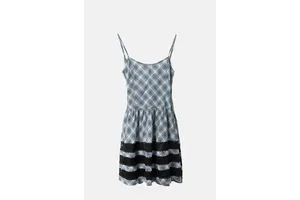
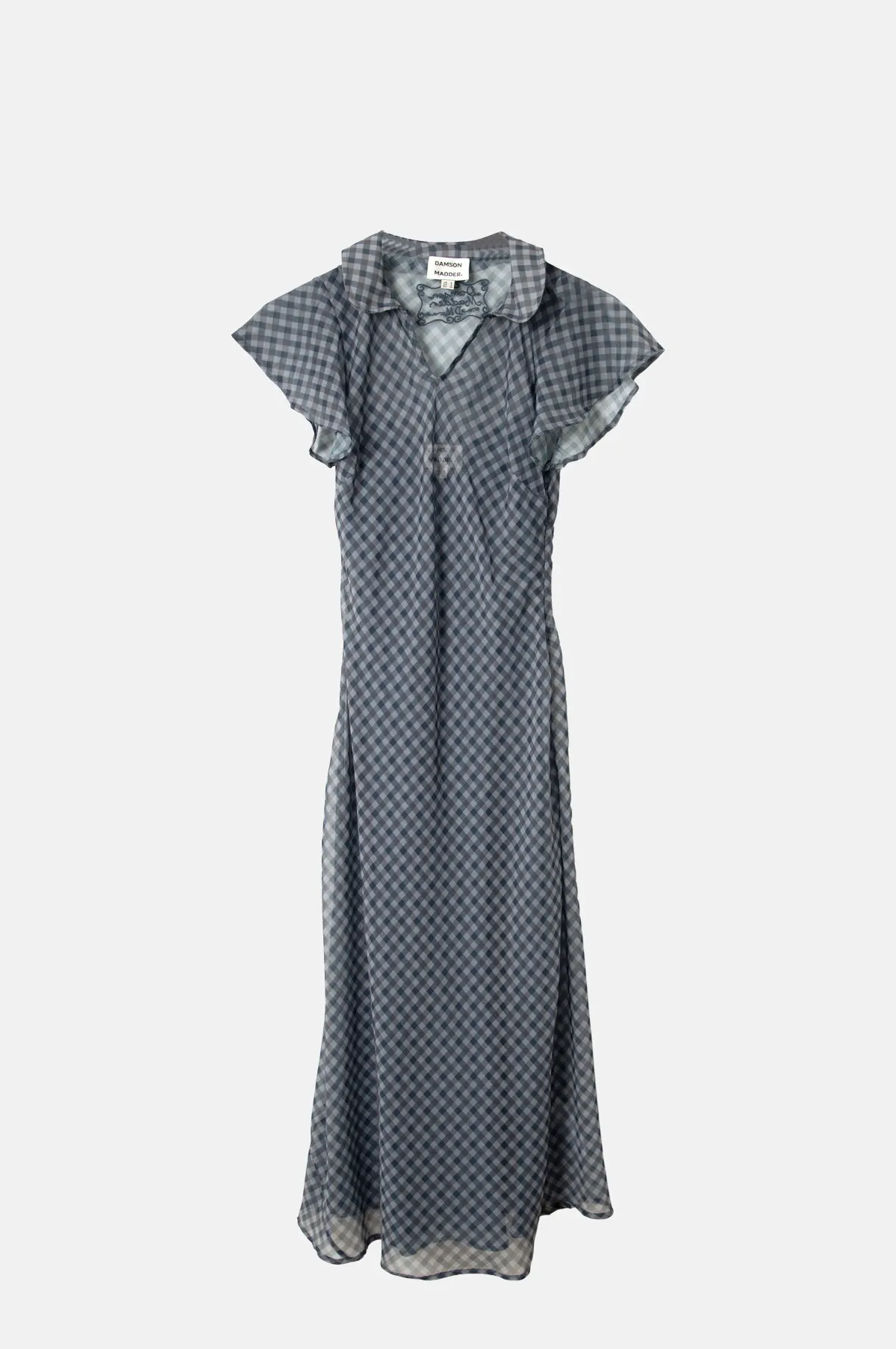

A midi dress from Damson Madder in a sheer textured chiffon with a removable lining, flutter sleeves, a Peter Pan collar and a keyhole detail, in a soft blue grey gingham, listed at 100 GBP with five of six sizes in stock and the 8 sold out. The shell is 100% recycled polyester and the removable lining is 51% Lenzing Lyocell and 49% organic cotton, which is the most complex composition this run has met and one of the more interesting constructions, because a lining that comes out is a different garment from a lining that is sewn in. It publishes pit to pit, sleeve and length for all six sizes, and the chest column produces the most extreme figure in this run: the ease runs from two inches at a UK 6 to minus two and a half at a UK 16, so from the middle of the range upward the published chest is smaller than the body it is labelled for. The length reads 130 cm on all six sizes. The reference is the Hudson Midi Dress in Sheer Willow Gingham. Dongguan Bafinasa Garments Co., Ltd. develops comparable dresses on OEM and ODM terms, from cloth and lining selection to retail or FBA ready packing. We publish this as a development reference and build your own version of it, and we do not supply the branded original or reproduce anyone else's label.
Key Features
- Sheer textured chiffon shell with a removable lining as stated, in two different fibre compositions. See the note below
- Chest ease running from 2.1 inches at a UK 6 to minus 2.4 at a UK 16, the most negative figure in this run. See the note below
- Slim fit as stated, and the measurements agree that it is slim, to the point of being tighter than the body. See the note below
- Total length published at 130 cm on all six sizes, the second dress in this batch not to grade its length. See the note below
- Flutter sleeves, Peter Pan collar and keyhole detail as stated, with no armhole or collar measurements. See the note below
- Recycled polyester shell with a Lenzing Lyocell and organic cotton lining, with no standard named for any of the three. See the note below
- Wash inside out at 30 as stated, the only care instruction on a sheer lined dress. See the note below
Customisable Options
- Cloth: sheer textured chiffon to the reference, with the weight in grams per square metre and the opacity level set to your market since neither is given
- Lining: removable to the reference, on snaps or on buttons or as a separate slip, each quoted separately, or a fixed lining
- Certification: GRS or RCS for the recycled polyester and GOTS or OCS for the organic cotton, with transaction certificates quoted as an option
- Fit: slim to the reference, with the ease set deliberately across the size set, or eased out for a straighter dress
- Sleeves: flutter to the reference, with the depth specified, or a plain short sleeve, or a sleeveless version
- Collar: Peter Pan with a keyhole to the reference, or a plain round neck, or a stand collar
- Cloth and lining weights, lining attachment and length, hardware, ease, body length, sleeve length, size set, colour development, private label and care labelling
Specifications
| Style | Midi dress in sheer textured chiffon with a removable lining and flutter sleeves |
| Reference | Damson Madder, Hudson Midi Dress, style AW26-DM-4190, sheer willow gingham, blue grey, UK size 6 to 16 |
| Composition | Shell 100% recycled polyester, lining 51% Lenzing Lyocell and 49% organic cotton, as stated, with no standard named for any of the three. See the note below |
| Cloth | Sheer textured chiffon as stated, with no weight and no measure of how sheer it is. See the note below |
| Fit | Slim fit as stated. See the note below |
| Lining | Removable lining as stated, with the attachment method and the length not given. See the note below |
| Sleeves | Flutter sleeves as stated, measured at 12 to 14 cm. See the note below |
| Collar | Peter Pan collar with a keyhole detail as stated |
| Care | Wash inside out at 30 degrees as stated, with no drying instruction given. See the note below |
| Sizes Offered | UK 6 to 16, six sizes, five in stock with the UK 8 sold out |
| Measurements Published | Pit to pit, sleeve length and total length for all six sizes. See the note below |
| Published Chest | Pit to pit 42, 43, 44, 45, 47 and 49 cm flat, or 16.5 through 19.3 in. See the note below |
| Chest Around | 84, 86, 88, 90, 94 and 98 cm, or 33.1, 33.9, 34.6, 35.4, 37.0 and 38.6 in. See the note below |
| Ease Against Body Bust | About 2.1, 0.9, minus 0.4, minus 1.6, minus 2.0 and minus 2.4 in from smallest to largest. See the note below |
| Published Sleeve | 12, 12, 13, 13, 14 and 14 cm, grading in pairs. See the note below |
| Published Length | 130 cm on every one of the six sizes, with no grading at all. See the note below |
| Published Waist | None. See the note below |
| Published Hip | None. See the note below |
| Published Armhole | None. See the note below |
| Lining Length | Not stated, on a dress with a sheer shell. See the note below |
| Opacity | Not stated, only the word sheer. See the note below |
| Model | None stated, no height and no body measurements |
| Photographs | Four |
| Cloth Weight | Not stated, for either the shell or the lining |
| Production | Made in India as stated |
| Reference Retail | 100 GBP as listed, quoted to show the price band this sits in, not as our price |
| Category | Filed by the reference under dresses |
| Occasion | Spring and summer, weddings, garden parties, evenings, over a slip |
| MOQ | 100 pcs per style per colourway, mixed sizes and colourways accepted |
| Sampling | 7-10 days after tech pack or reference sample confirmation |
| Bulk Lead Time | 20-30 days after sample approval and deposit |
| Service | OEM / ODM / private label, chiffon sourcing, lining development and detachable construction, certification, retail or FBA ready packing |
Size Chart as Published by the Reference
| Size | Pit to Pit (flat) | Sleeve Length | Total Length |
|---|---|---|---|
| UK 6 | 42 cm | 12 cm | 130 cm |
| UK 8 | 43 cm | 13 cm | 130 cm |
| UK 10 | 44 cm | 13 cm | 130 cm |
| UK 12 | 45 cm | 14 cm | 130 cm |
| UK 14 | 47 cm | 14 cm | 130 cm |
| UK 16 | 49 cm | 14 cm | 130 cm |
The chest figures are flat half measures taken with the dress laid down, doubling to 84, 86, 88, 90, 94 and 98 cm around, or 33.1 through 38.6 in. Against a body bust that runs 31, 33, 35, 37, 39 and 41 in, the ease is about two inches at a UK 6, about nothing at the 10, and about minus two and a half at the 16, so from the middle of the range upward the published chest is smaller than the body it is labelled for. It gets there because the flat grade is one centimetre for three sizes and two for two, averaging 1.4 cm per size, or 1.1 in of circumference, against a body grade of two inches. The sleeve grades in pairs, 12, 12, 13, 13, 14 and 14, and the total length is 130 cm on all six sizes.
Our Proposed Body Chart
| Size | Body Bust | Sleeve | Body Waist | Body Hips | Length | Source |
|---|---|---|---|---|---|---|
| UK 6 | 31 in / 79 cm | 13 cm | 24 in / 61 cm | 34 in / 86 cm | 130 cm / 51.2 in | Our proposal |
| UK 10 | 35 in / 89 cm | 14 cm | 28 in / 71 cm | 38 in / 97 cm | 132 cm / 52 in | Our proposal |
| UK 12 | 37 in / 94 cm | 15 cm | 30 in / 76 cm | 40 in / 102 cm | 134 cm / 52.8 in | Our proposal |
| UK 14 | 39 in / 99 cm | 16 cm | 32 in / 81 cm | 42 in / 107 cm | 136 cm / 53.5 in | Our proposal |
| UK 16 | 41 in / 104 cm | 17 cm | 34 in / 86 cm | 44 in / 112 cm | 138 cm / 54.3 in | Our proposal |
Occasions and Styling
Suits spring and summer, weddings, garden parties and evenings. A sheer gingham dress over a lining is a warm weather piece that reads as dressed without being formal, and the removable lining is what lets it be worn two ways, lined for the day and over a slip for the evening.
Production and Quality Control
The reference publishes three columns for all six sizes, states the composition of both the shell and the lining, describes the sleeves, the collar, the fit and the lining, gives a care instruction and states the country of make. It gives no waist, no hip and no armhole, and no model. Three things follow: what minus two and a half inches of ease means and how much of it is real, what a constant 130 cm means on a dress, and what a removable lining with three fibre claims needs specified.
Minus two and a half inches, and how much of it is real, and that is the first thing. The published chest doubles to 98 cm at a UK 16 against a body bust of 41 inches, or 104 cm, so the garment is six centimetres narrower than the body it is labelled for, and the same is true from a UK 10 upward. This run has now met four garments whose ease reaches or passes zero: the corduroy skirt at minus 0.5 in, the twill trouser at minus 0.1, the checked blouse at minus 0.1, and this at minus 2.4, which is five times the worst of them. It is worth being careful about what that means, and there are three candidate explanations and they are not equally likely. The first is that the figures are simply not the garment's, which happens on retail charts more often than anyone admits and which this run has good reason to suspect, since two columns in the last two batches did not grade at all and one contradicted itself. The second is the convention, and it is the one this run has already set out on the sleeveless poplin dress published alongside this one: pit to pit is taken across the front from underarm to underarm, and on a garment with bust shaping that point sits above the fullest part of the bust, so the doubled figure systematically understates the real circumference, by two to five centimetres and more on a fuller bust. On a slim fitting dress with a shaped front, that is a large part of the difference. The third is that the garment genuinely is that close, and it is worth saying why it probably is not: polyester chiffon has no stretch on the straight grain and a little give on the bias, but not two and a half inches of it, and a woven dress with negative ease does not close. Whichever of the three applies, and the second is the most likely, the practical conclusion is identical and it is the one this run keeps arriving at: the published figure cannot be taken as a bust specification. If you copy 42 and 49 cm off this page as your chest spec you will cut dresses that do not close on the upper half of your size range, and the fact that the source is a real brand selling real garments does not save you, because the figure and the garment are not measuring the same thing. We state the measurement point on every girth we publish and we recommend two girths on a dress rather than one, the underarm width and the bust at the fullest point, because that single addition removes the ambiguity entirely. Now the grade, which is worth a paragraph because it is the steepest in this run after the trench coat. The flat width goes up by one, one, one, two and two centimetres, which averages 1.4 cm per size, or 2.75 cm of circumference, or 1.1 in, against a body chart moving two inches. So about nine tenths of an inch of ease is lost at every step and about four and a half inches across the range, which is the whole distance from two inches of ease to minus two and a half. Set beside the run so far: one centimetre per size loses six inches, this mixed grade loses four and a half, two centimetres loses two and a fifth, three gains one and four fifths, and 2.54 holds. This dress and the poplin dress published beside it are the two clearest illustrations of why, since they are from the same house, in the same season, on the same size chart, and one of them grades at three centimetres and gains ease while the other grades at just over one and loses four and a half inches. Same brand, same chart, opposite outcomes, decided entirely by a rounding convention.
One hundred and thirty centimetres six times, and the midi that is not a length, and that is the second thing. This is the fourth ungraded column in two batches and the second dress length, and on a dress the length is the measurement that decides what the garment is called. One hundred and thirty centimetres from the shoulder reaches the ankle or below on most women under about five foot seven, which most people would call a maxi rather than a midi, and it reaches mid calf on a woman of five foot ten. So the word on the page and the number on the page disagree for a large part of the market, and there is no model height published to settle it, and no measurement origin either, which is the same gap this run has raised on the trench coat: 130 cm from a neck seam and 130 from a shoulder seam are different dresses by five to eight centimetres, and on a dress with a collar, more. It is worth saying what a graded length would have looked like, because it is not a big change: a dress is normally graded one to one and a half centimetres per size, which would take this range from about 130 at a UK 6 to about 135 at a UK 16, and that keeps the hem at the same place on the body across the range rather than in a different place on every size. Then there is the sleeve, which reads 12, 12, 13, 13, 14 and 14, grading in pairs, which is the pattern of a size set graded in blocks rather than size by size, and it is the same signature this run saw on the checked blouse, whose length stepped in pairs as well. A flutter sleeve at 12 cm is a cap sleeve, and a flutter is a shaped piece whose depth decides how much it flutters, and no depth is given, which is the same omission as on the ruffles of the blouse and the bodice of the poplin dress: shape without dimensions. And the Peter Pan collar, which is the detail that gives this dress its character, carries no measurement at all: no collar depth, no neck width, no keyhole length, and a collar that sits flat or stands up is decided by the depth and by the interfacing, neither of which is described.
A lining that comes out, three fibre claims, and a care instruction that stops halfway, and that is the third thing. Start with the composition, because it is the most detailed in this run and because the way it is stated is instructive. The shell is 100% recycled polyester and the lining is 51% Lenzing Lyocell and 49% organic cotton. Two of those three claims are unverifiable as written: recycled polyester wants the Global Recycled Standard or the Recycled Claim Standard and organic cotton wants the Global Organic Textile Standard or the Organic Content Standard, and no standard is named for either. The third is different and worth crediting: Lenzing Lyocell names its producer, and a branded fibre from a named mill carries its own chain of custody, so the claim is traceable in a way that a bare fibre name is not. That is the right way to make a claim, and it is the contrast this run has been drawing for eleven batches: name the source or the standard, and hold the certificate, because a claim you can produce paperwork for is worth more than one you cannot. Then the removable lining, which is the construction that makes this dress and which the page describes in two words. A lining that can come out has to be held by something. It can hang from snaps at the shoulder, which is the cheapest and leaves the lining swinging free; it can be buttoned or snapped at the waist as well, which costs two more operations and two more trims and keeps it in place; or it can be a separate slip altogether, which is a second garment with its own straps, its own seams and its own size, and which doubles the number of sizes that have to be right. Those are three different products at three different prices, and the page does not say which it is. There is a second thing a removable lining needs that a fixed one does not, and it is a length: on a dress with a sheer shell, how far the lining comes down the leg decides whether the hem reads as one layer or two, and that is a visible design decision, and no lining length is given. And there is a quality point specific to detachable linings, which is that the attachment points are the failure point: a snap set through a sheer chiffon without reinforcement will tear out, and the fix is a small stay or a reinforced patch behind it, which is the sort of thing that costs nothing in a tech pack and everything in a returns rate. Then the cloth and the care. Sheer textured chiffon is described, and sheer is a word where a number would help, since a chiffon at 30 grams per square metre and one at 60 differ in opacity, in drape and in how they behave under a needle, and neither weight is given for the shell or for the lining. The care instruction is wash inside out at 30 degrees and nothing else, with no drying instruction and no shrinkage figure, and on this garment that is a real gap rather than a formality, because the shell and the lining are made of cloths that move differently in water: polyester does not shrink, cotton does, and lyocell moves more than either. A lined dress washed at 30 and dried hard will therefore have a lining that has moved against a shell that has not, and it shows as puckering at the attachment points, which on a garment whose whole appeal is a clean sheer layer over a lining is the worst place to have it. Finally the absences, which by now are familiar: no waist, no hip, no armhole, no collar measurement, no model height, and the UK 8 sold out, which is the second size in a range whose tightest figures are at the top. Every bulk shipment gets a measurement report against your approved chart.
Optional upgrades include publishing the bust at the fullest point alongside the underarm width and stating where each is taken, setting the chest grade so the ease holds across the range instead of losing four and a half inches, grading the body length across the size set and stating the point it is measured from, publishing the waist and the hip, specifying the lining attachment as snaps, buttons or a separate slip and quoting them separately, publishing the lining length, stating the cloth weight in grams per square metre for both the shell and the lining and giving the opacity of the chiffon, naming GRS or RCS for the recycled polyester and GOTS or OCS for the organic cotton and holding the transaction certificates, reinforcing the points where a detachable lining attaches to a sheer shell, completing the drying instruction and publishing a shrinkage figure, adding a model height so 130 cm can be placed on a body, a fixed lining option, a sleeveless version and a plain neck option, knee and maxi lengths, size set, colour development, private label, hangtag and care labelling.
Pre-production sample approval, in-line inspection during cutting and sewing, and a final AQL inspection before packing, with measurement reports and photos shared before shipment.
Send us your tech pack, a photo or a reference garment and we will quote within 24 hours. Contact bafinasa@bafinasa.com or WhatsApp +86 13827222469.