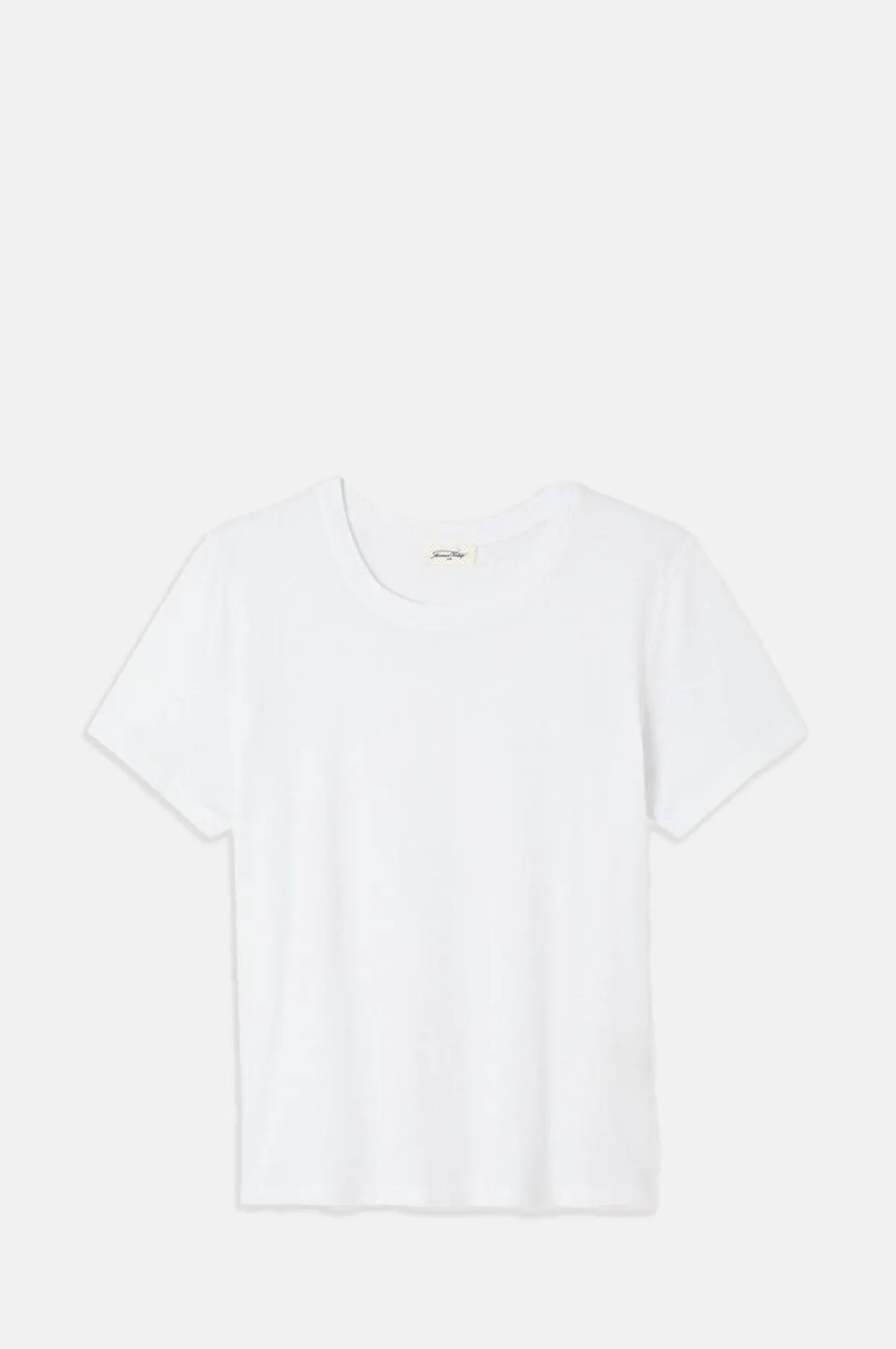

A white short sleeve tee from American Vintage in 100% cotton with a relaxed fit and a round neckline, listed at 45 GBP with all three sizes in stock and six photographs, where the pink and the navy versions of the same garment carry two each. It is the same tee as the other two in this batch, with the same table to the last digit, and examining the three side by side is the most useful thing this run can do with them, because a white cotton tee is the case where the missing numbers hurt most. Every colourway has its own specification question, and the white one is opacity, which is decided by the weight of the cloth and by nothing else, and no weight is published. A white tee is also the garment where the smallest production decisions are most visible, from the needle marks at the hem to the shade of the white itself, and none of that is on the page. The reference is the Apoly T-Shirt in Blanc. Dongguan Bafinasa Garments Co., Ltd. develops comparable knit tops on OEM and ODM terms, from yarn and cloth selection to retail or FBA ready packing. We publish this as a development reference and build your own version of it, and we do not supply the branded original or reproduce anyone else's label.
Key Features
- Six photographs, against two on each of the other two colourways of the same tee. See the note below
- White cotton with no weight and no opacity given, which is the specification a white tee needs most. See the note below
- Identical description on all three colourways apart from the final three words. See the note below
- Three sizes, S, M and L, with no UK, EU or US equivalence published. See the note below
- Short sleeve measured at 16 to 20 cm, graded in absolute centimetres rather than in proportion. See the note below
- Round neckline and relaxed fit as stated, 100% cotton, made in Portugal, wash at 30, do not tumble dry, iron on low
- 45 GBP as listed, with all three sizes in stock
Customisable Options
- Cloth: cotton jersey to the reference, with the weight in grams per square metre set to your market since none is given
- Opacity: a stated weight and a stated opacity level, or a heavier cloth, or a double layer front panel, or a built in vest
- Shade: a white standard agreed on a shade card, with a whiteness or a brightness figure held to a tolerance
- Size set: S, M and L to the reference, with the equivalence published, or an extended set from XS to XL
- Neck: round neckline to the reference, with the rib or the binding specified and the rib matched for shade
- Length: 57 to 61 cm to the reference, with hip length and long line options
- Cloth weight, opacity level, white shade standard, size set and equivalence, ease, body length, sleeve length, neck trim and rib shade, packing method, private label and care labelling
Specifications
| Style | Relaxed fit short sleeve tee in white cotton with a round neckline |
| Reference | American Vintage, Apoly T-Shirt, style APO02EH26BLANC, blanc, a clean white, sizes S, M and L |
| Composition | 100% cotton as stated, with no organic or other claim attached |
| Cloth | Cotton jersey as stated, with no weight, no construction and no opacity figure given. See the note below |
| Fit | Relaxed fit as stated. See the note below |
| Neck | Round neckline as stated |
| Sleeves | Short sleeves as stated, measured at 16, 18 and 20 cm. See the note below |
| Care | Wash at 30 degrees, do not tumble dry, iron on a low setting, as stated. See the note below |
| Sizes Offered | S, M and L, three sizes, all three in stock |
| Size Equivalence | None published, no UK, EU or US equivalent and no body measurements given. See the note below |
| Measurements Published | Pit to pit, sleeve length and total length for all three sizes, identical to the other two colourways. See the note below |
| Published Chest | Pit to pit 47, 49 and 51 cm flat, or 18.5, 19.3 and 20.1 in. See the note below |
| Chest Around | 94, 98 and 102 cm, or 37.0, 38.6 and 40.2 in. See the note below |
| Ease Against Body Bust | About 4.0, 1.6 and minus 0.8 in read as UK 8, 12 and 16, or about 4.0, 3.6 and 3.2 in read as UK 8, 10 and 12. See the note below |
| Published Sleeve | 16, 18 and 20 cm, grading two centimetres per size on a measurement only 16 cm long. See the note below |
| Published Length | 57, 59 and 61 cm, grading two centimetres per size |
| Published Hem Or Hip | None. See the note below |
| Opacity | Not stated, on a white cotton tee. See the note below |
| White Shade Standard | Not stated, no whiteness or brightness figure and no tolerance. See the note below |
| Model | None stated, no height and no body measurements |
| Photographs | Six, against two on each of the other two colourways. See the note below |
| Cloth Weight | Not stated, which on a white tee is the figure that decides whether it can be worn alone |
| Production | Made in Portugal as stated |
| Reference Retail | 45 GBP as listed, quoted to show the price band this sits in, not as our price |
| Category | Filed by the reference under t-shirts |
| Occasion | Everyday, weekend, layering, under knitwear in winter, summer with shorts |
| MOQ | 100 pcs per style per colourway, mixed sizes and colourways accepted |
| Sampling | 7-10 days after tech pack or reference sample confirmation |
| Bulk Lead Time | 20-30 days after sample approval and deposit |
| Service | OEM / ODM / private label, jersey sourcing and weight selection, white shade matching and opacity control, retail or FBA ready packing |
Size Chart as Published by the Reference
| Size | Pit to Pit (flat) | Sleeve Length | Total Length |
|---|---|---|---|
| S | 47 cm | 16 cm | 57 cm |
| M | 49 cm | 18 cm | 59 cm |
| L | 51 cm | 20 cm | 61 cm |
The chest figures are flat half measures taken with the tee laid down, doubling to 94, 98 and 102 cm around, or 37.0, 38.6 and 40.2 in, and they are identical to the figures on the pink and the navy colourways of this same tee. What the ease comes to depends on what S, M and L stand for, and no equivalence is published. Read as UK 8, 12 and 16 with a bust of 33, 37 and 41 in, the ease is about four inches at the S, one and three fifths at the M and minus four fifths at the L. Read as UK 8, 10 and 12, it is about four, three and a half and three and a quarter throughout. The sleeve grades two centimetres per size on a measurement of sixteen, and the length grades two centimetres from 57 to 61 cm.
Our Proposed Body Chart
| Size | Body Bust | Sleeve | Body Waist | Body Hips | Length | Source |
|---|---|---|---|---|---|---|
| S | 33 in / 84 cm | 16 cm | 26 in / 66 cm | 36 in / 91 cm | 57 cm / 22.4 in | Our proposal |
| M | 37 in / 94 cm | 17 cm | 30 in / 76 cm | 40 in / 102 cm | 59 cm / 23.2 in | Our proposal |
| L | 41 in / 104 cm | 18 cm | 34 in / 86 cm | 44 in / 112 cm | 61 cm / 24 in | Our proposal |
Occasions and Styling
Suits everyday wear, weekends and layering. A white tee is the most worn thing in most wardrobes and the hardest to specify, and at this length it works under a jumper in winter and with loose shorts in summer, which is exactly the range the reference claims for it.
Production and Quality Control
The reference publishes three columns for all three sizes, has every size in stock, states its fibre, describes the fit, the neck and the sleeves, gives a care instruction with an ironing note, names the country of make and shows six photographs, which is more than either of the other two colourways. Three things follow: what a white tee needs specified that no other colour needs, why identical copy across colourways fails the customer, and what the sleeve column does when a grade is applied in absolute centimetres.
Opacity, and the number that decides it, and that is the first thing. A white cotton tee has one specification question that no other colour has, which is whether you can see through it, and that question is answered by the weight of the cloth and by almost nothing else. A single cotton jersey at 140 grams per square metre in white is semi sheer and most people will wear something under it; at 180 it is borderline; at 200 or more it is opaque. Those three cloths are different prices, they drape differently, they are appropriate for different markets and different seasons, and the page gives no weight at all, and no opacity figure either. This is the eighth garment in this run to describe its cloth without a number, after heavyweight, finest, soft, reassuring weight, super soft, crisp and sheer, and it is worth saying why white is the worst place to leave it out: on a navy or a pink the customer can guess from the photograph, and on a white one she cannot, because a product photograph of a white tee is almost always lit and styled so that the question does not arise. So the weight is not a nicety here, it is the difference between a garment that can be worn alone and one that cannot, and it belongs in the specification alongside the measurements. There are two more things a white garment needs that a coloured one does not, and both are cheap to specify and expensive to get wrong. The first is the shade of the white itself. Whites are not all the same: an optical white with a brightener in it, a natural white, a cream and a bleached blue white are four different colours that look like one another on a screen and look nothing like one another side by side, and a garment with a rib at the neck and a tape at the shoulder has three components that have to be matched to the same standard. The remedy is a shade card with a whiteness or a brightness figure and a tolerance, agreed before bulk, which is standard practice on any white programme and takes an hour. The second is that white shows the making. Every needle hole, every skipped stitch at the hem, every shade variation between panels, every mark from a machine and every speck of dust in the packing is visible on white and invisible on navy, so a white programme needs a finer needle, a cleaner room, a slower final inspection and a packing method that keeps it away from dark garments in the same carton. None of that is on this page, and all of it is the difference between a white tee that sells once and one that sells twice. And there is a care point that belongs to white specifically: the instruction is wash at 30, do not tumble dry, iron low, which is a good instruction, and a white tee additionally needs protection from dye pickup in the wash, since a white washed with a new navy will go grey, and a wash separately or wash with like colours note is the cheapest insurance on the garment.
One description, three colours, and what a template cannot carry, and that is the second thing. The three listings for this tee carry the same description word for word, differing only in the last three words: in a bold pink, in a clean white, in a deep navy blue. The measurements are identical, the fibre is identical, the care is identical and the price is identical, so on one reading the shared copy is efficient and honest, because the garment is the same garment. But the colourway is exactly where the differences live, and a template cannot carry them. A white has an opacity question and a soiling question and a shade matching question. A deep navy has a crocking question, a wash fastness question and a fading question, and it is usually put through a heavier dye process that can change the dimensions, which is the reason a shared size table is a claim rather than a fact. A bright pink has a light fastness question and a dye migration question, and pinks are among the shades most likely to move in the light or to bleed onto what they are packed against. Three garments, three different risk profiles, one paragraph of copy, and none of the three risks mentioned anywhere. It is worth being fair about why this happens and about what it costs, because it is not laziness so much as a workflow: copy is written once per style and the colourway is a variant in the system, so the colour specific line is the one thing the process does not generate. The fix is a sentence per colourway, which costs a minute and which is also the cheapest possible improvement to the page, because it is the only place a customer can learn something she cannot see in a photograph. There is a second, smaller oddity in the same direction, and it is the one thing that is not uniform across the three listings: the photography. Six photographs here, two on the pink, two on the navy. So the same garment is presented with three different amounts of evidence depending on the colour someone happens to click, and the customer who wants the navy has a third of the information the customer who wants the white has. It is a small thing and it is very common, and it is the sort of inconsistency that shows up in the returns rate rather than in the sales figures, because the customer who buys with less information is the customer who returns.
Two centimetres on a sixteen centimetre sleeve, and the measurements that are missing, and that is the third thing. The sleeve is published at 16, 18 and 20 cm, which is tidily graded and which is the only short sleeve measurement in this run apart from the one on the graphic tee two batches ago. But look at what a two centimetre step means on a measurement of that size: it is twelve and a half per cent of the sleeve. The same two centimetres on the sixty centimetre sleeve of the trench coat in this run is three per cent, and on the seventy six centimetre sleeve of the hooded top it is under three. Grading in absolute centimetres therefore treats a cap sleeve and a coat sleeve as if they were the same kind of thing, and it is not a rule anyone has to follow: a grade can be set in proportion to the measurement it is applied to, or better, in proportion to the body measurement the sleeve is serving, which is what keeps a sleeve the same length relative to the body across a range. Here the sleeve grows four centimetres across three sizes while the body length grows four centimetres as well, so the two keep pace in absolute terms and not in proportion, and the result is a sleeve that is longer relative to the garment at the L than at the S. It is a small effect and it is the sort of thing that is visible only when two sizes are hung side by side, which is precisely when a customer sees it. Then the absences, which are the same ones this run has been counting and which are worth counting once more because they apply to all three colourways equally. No size equivalence for S, M and L, so the chest figures cannot be turned into an ease figure without guessing what the letters mean, and the two guesses differ by five inches of ease at the top of the range. No hip or hem width, so a tee described as relaxed cannot be checked for how it falls. No model height and no body measurements, so the 57 cm length cannot be placed on anyone, and 57 cm is the shortest body length in this run by more than ten centimetres, which is a real difference in wear: this is a hip length tee where the other tees in this run have been long line ones. And no cloth weight, which on this colourway is the figure that decides whether it can be worn at all. Every bulk shipment gets a measurement report against your approved chart.
Optional upgrades include stating the cloth weight in grams per square metre and the opacity level, or offering a heavier cloth and a double front panel as options, agreeing a white shade standard with a whiteness figure and a tolerance and matching the rib and the tape to it, publishing the UK or EU equivalent for S, M and L or the body measurements each size is drafted for, grading the sleeve in proportion rather than in absolute centimetres, publishing the hem width so a relaxed tee can be checked for how it falls, adding a wash with like colours note to the care instruction, packing whites away from darks, using a finer needle and a cleaner room on a white programme, extending the size range, a V neck and a boat neck option, cap and long sleeve options, hip length and long line options, size set, colour development, private label, hangtag and care labelling.
Pre-production sample approval, in-line inspection during cutting and sewing, and a final AQL inspection before packing, with measurement reports and photos shared before shipment.
Send us your tech pack, a photo or a reference garment and we will quote within 24 hours. Contact bafinasa@bafinasa.com or WhatsApp +86 13827222469.