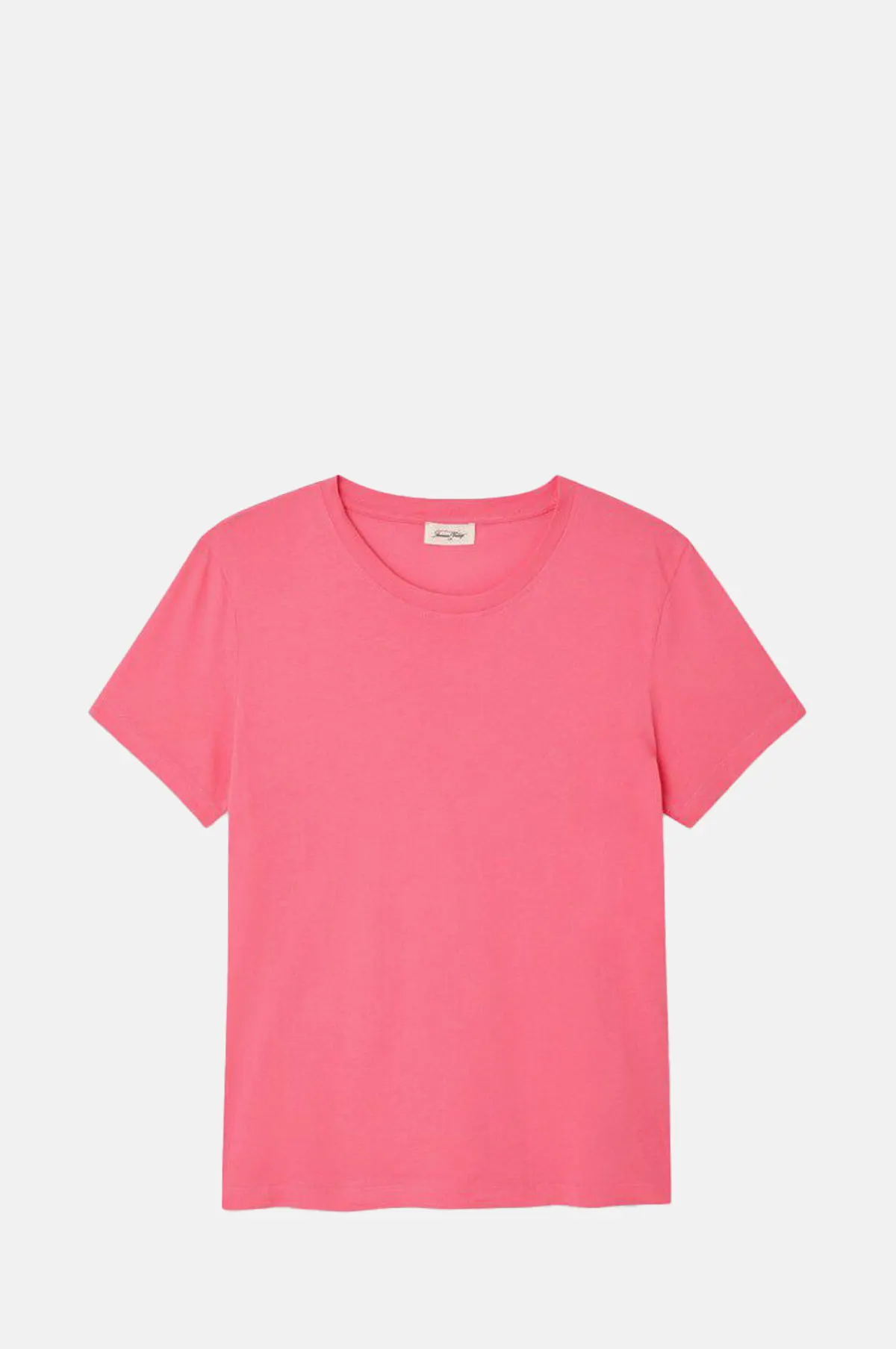

A bold pink short sleeve tee from American Vintage in 100% cotton with a relaxed fit and a round neckline, listed at 45 GBP with all three sizes in stock. It is the first reference in this run to come in three sizes, S, M and L, rather than the five or six that everything before it has used, and it publishes pit to pit, sleeve and length for all three. The table is the tidiest this run has seen: every column grades exactly two centimetres per size, with no stray figure and no flat stretch anywhere in it. That tidiness is worth two cheers rather than three, because two centimetres of flat width is 1.57 inches of circumference, and what that is worth depends entirely on how big a step S to M to L turns out to be, and the page never says. Read one way this tee carries about four inches of ease and is comfortably relaxed. Read another it reaches minus one at the L, and the distance between those two readings is the whole of the size range. There is a second point, and it is the one this run has been circling for eleven batches: this tee is listed in three colourways and all three of them carry a byte identical table, so the question of whether one table can serve several colours can now be examined directly rather than in the abstract. The reference is the Apoly T-Shirt in Geranium. Dongguan Bafinasa Garments Co., Ltd. develops comparable knit tops on OEM and ODM terms, from yarn and cloth selection to retail or FBA ready packing. We publish this as a development reference and build your own version of it, and we do not supply the branded original or reproduce anyone else's label.
Key Features
- Three sizes, S, M and L, the first size set in this run shorter than five. See the note below
- Every column grading exactly two centimetres per size, the tidiest table in this run, and the reason tidiness is not the same as correctness. See the note below
- The same table published on all three colourways of this tee, which this run can now examine directly rather than in theory. See the note below
- Short sleeve measured at 16 to 20 cm, so a two centimetre grade is a step of more than twelve per cent on the measurement itself. See the note below
- Relaxed fit and 100% cotton as stated, with no fibre claim attached to police, made in Portugal as stated
- Body length of 57 to 61 cm, the shortest in this run by more than ten centimetres. See the note below
- A style code built from a base and a colour suffix, the clearest coding in this run. See the note below
Customisable Options
- Cloth: cotton jersey to the reference, with the weight in grams per square metre set to your market since none is given
- Size set: S, M and L to the reference, with the UK or EU equivalent published, or an extended set from XS to XL
- Fit: relaxed to the reference at about four inches of ease, with the ease held constant once the size increment is fixed
- Neck: round neckline to the reference, with the rib or the binding specified, or a V or a boat neck
- Sleeve: short to the reference at 16 to 20 cm, or a cap sleeve, or a long sleeve on the same body
- Length: 57 to 61 cm to the reference, with hip length and long line options
- Cloth weight, size set and equivalence, ease, body length, sleeve length, neck trim, colour development and fastness testing, private label and care labelling
Specifications
| Style | Relaxed fit short sleeve tee in cotton with a round neckline |
| Reference | American Vintage, Apoly T-Shirt, style APO02EH26GERANI, geranium, a bold pink, sizes S, M and L |
| Composition | 100% cotton as stated, with no organic or other claim attached. See the note below |
| Cloth | Cotton jersey as stated, with no weight and no construction given. See the note below |
| Fit | Relaxed fit as stated. See the note below |
| Neck | Round neckline as stated |
| Sleeves | Short sleeves as stated, measured at 16, 18 and 20 cm. See the note below |
| Care | Wash at 30 degrees, do not tumble dry, iron on a low setting, as stated |
| Sizes Offered | S, M and L, three sizes, all three in stock |
| Size Equivalence | None published, no UK, EU or US equivalent and no body measurements given. See the note below |
| Measurements Published | Pit to pit, sleeve length and total length for all three sizes. See the note below |
| Published Chest | Pit to pit 47, 49 and 51 cm flat, or 18.5, 19.3 and 20.1 in. See the note below |
| Chest Around | 94, 98 and 102 cm, or 37.0, 38.6 and 40.2 in. See the note below |
| Ease Against Body Bust | About 4.0, 1.6 and minus 0.8 in read as UK 8, 12 and 16, or about 4.0, 3.6 and 3.2 in read as UK 8, 10 and 12. See the note below |
| Published Sleeve | 16, 18 and 20 cm, grading two centimetres per size on a measurement only 16 cm long. See the note below |
| Published Length | 57, 59 and 61 cm, grading two centimetres per size, the shortest body length in this run |
| Published Hem Or Hip | None. See the note below |
| Model | None stated, no height and no body measurements |
| Photographs | Two, against six on the white colourway of the same tee. See the note below |
| Cloth Weight | Not stated |
| Production | Made in Portugal as stated |
| Reference Retail | 45 GBP as listed, quoted to show the price band this sits in, not as our price |
| Category | Filed by the reference under t-shirts |
| Occasion | Everyday, weekend, layering, under knitwear in winter, summer with shorts |
| MOQ | 100 pcs per style per colourway, mixed sizes and colourways accepted |
| Sampling | 7-10 days after tech pack or reference sample confirmation |
| Bulk Lead Time | 20-30 days after sample approval and deposit |
| Service | OEM / ODM / private label, jersey sourcing and weight selection, size set development and grading, retail or FBA ready packing |
Size Chart as Published by the Reference
| Size | Pit to Pit (flat) | Sleeve Length | Total Length |
|---|---|---|---|
| S | 47 cm | 16 cm | 57 cm |
| M | 49 cm | 18 cm | 59 cm |
| L | 51 cm | 20 cm | 61 cm |
The chest figures are flat half measures taken with the tee laid down, doubling to 94, 98 and 102 cm around, or 37.0, 38.6 and 40.2 in. What that means depends entirely on what S, M and L stand for, and the page publishes no equivalence. Read as three sizes spanning the same range this run has worked to, so UK 8, 12 and 16 with a bust of 33, 37 and 41 in, the ease is about four inches at the S, about one and three fifths at the M and about minus four fifths at the L. Read as a narrower set, UK 8, 10 and 12 with a bust of 33, 35 and 37 in, the ease is about four, three and a half and three and a quarter, which is a comfortably relaxed tee throughout. Both readings are consistent with a table whose every column grades exactly two centimetres per size.
Our Proposed Body Chart
| Size | Body Bust | Sleeve | Body Waist | Body Hips | Length | Source |
|---|---|---|---|---|---|---|
| S | 33 in / 84 cm | 16 cm | 26 in / 66 cm | 36 in / 91 cm | 57 cm / 22.4 in | Our proposal |
| M | 37 in / 94 cm | 17 cm | 30 in / 76 cm | 40 in / 102 cm | 59 cm / 23.2 in | Our proposal |
| L | 41 in / 104 cm | 18 cm | 34 in / 86 cm | 44 in / 112 cm | 61 cm / 24 in | Our proposal |
Occasions and Styling
Suits everyday wear, weekends and layering, and the reference is right that it works both ways round: under a jumper in winter and with loose shorts in summer. A 57 to 61 cm body length is a hip length tee rather than a long one, which is the reason it layers under knitwear without bunching.
Production and Quality Control
The reference publishes three columns for all three sizes, has every size in stock, states its fibre, describes the fit, the neck and the sleeves, gives a care instruction with an ironing note and names the country of make. It publishes no size equivalence, no cloth weight and no model. Three things follow: what a three size range with no equivalence is worth, why a tidy grade can still be the wrong grade, and what it means for three colourways to share one table.
Three sizes, and no way to place them, and that is the first thing. Every other garment in this run has come in five or six sizes with a number or a letter that can be set against a body chart: UK 6 to 16, or 0 to 4. This one comes in S, M and L and publishes nothing that ties those letters to anything. So the arithmetic on the chest table has two answers and the page gives no way to choose between them. If S, M and L span the full range, UK 8 to 16, then the bust goes 33, 37 and 41 in and the ease runs about plus four, plus one and three fifths, and minus four fifths: a relaxed tee at the small end and a garment that does not go on at the large end. If they span a narrower range, UK 8 to 12, the ease runs about four, three and a half and three and a quarter, which is a relaxed tee from one end to the other. The same three figures, two completely different products, and one line of copy would settle it: S fits a UK 8 to 10, M a UK 12, L a UK 14 to 16, or better still, the bust, waist and hip measurements each size is drafted for. This run has asked repeatedly for published body measurements and this is the clearest case for them yet, because here the letters are doing the work of numbers and letters are not comparable between brands: an L at one house is a UK 14 and at another a UK 18. There is a commercial point as well, and it is the one that matters if you are building a range. Three sizes is a coarse set. A customer who falls between an M and an L has nowhere to go, and on a garment whose chest steps by four centimetres flat between those two letters, the gap she falls into is a real one. A coarse size set makes a garment cheaper to make and to buy, and it makes it fit fewer people, and that trade is worth making deliberately rather than by inheritance.
The tidiest table in this run, and why tidy is not the same as right, and that is the second thing. Pit to pit grades two centimetres per size, sleeve length grades two, total length grades two, from the first row to the last, with no irregularity and no repeated figure anywhere. Set that beside what this run has been looking at for eleven batches and it is by far the neatest: a coat whose length did not grade at all, two sleeves repeated across six sizes, a length that stepped in pairs, a trouser whose three columns all jumped at the same size and then contradicted themselves. So it is worth saying plainly what is right about this table, which is that somebody set it and checked it, and that is more than most. But neatness is a property of the numbers and not of the fit, and the two come apart here for a reason this run has not met before: the correct grade depends on the size increment, and this looks like a grade borrowed from a finer size set. Two centimetres of flat width is four of circumference, or 1.57 in. Against a body chart that moves two inches per size that costs 0.43 in of ease per step, which is survivable, and it is the grade several garments in this run use. But if S, M and L are three sizes spanning eight inches of body, then each step is four inches of body and not two, and the same 1.57 in grade loses about two and two fifths inches of ease at every step, which is not survivable. Put the other way: the flat grade that holds ease constant is 2.54 cm per size against a two inch body step, and about 5 cm per size against a four inch one. This tee grades at 2 cm, which is the right number for a one size increment and roughly half of what a two size increment needs. So either the size set is narrow, and the tee fits, or the size set is wide, and the grade is a six size grade applied to a three size range, which is a mistake made easily when a pattern is re-lettered rather than re-graded. It is a real production trap and worth naming: when you compress a size range, you have to scale the grade with it, and the arithmetic does not forgive you if you do not. There is a version of the same problem in the sleeve column, and it is worth a sentence because it is a different failure. The sleeve reads 16, 18 and 20 cm, which grades tidily, but two centimetres on a measurement of sixteen is a step of twelve and a half per cent, where the same two centimetres on the sixty centimetre sleeve of a coat is a step of three per cent. Grading in absolute centimetres treats a cap sleeve and a coat sleeve identically, and it does not have to: a proportional grade, or a grade set in proportion to the body measurement it serves, keeps the shape instead of distorting it at one end of the range. And a sleeve that grows four centimetres across a three size range, which is what this one does, is a bigger proportional change than the body length makes, so the sleeve gets longer relative to the body as the size goes up.
One table, three colourways, and the claim that comes with it, and that is the third thing. This run has raised the question of whether one size table can honestly serve several colourways every time it has met the same garment in two colours, and it has never had the evidence to settle it, because it has never had the two tables side by side. Here it does. This tee is listed in a bold pink, in white and in a deep navy, at the same price, with the same description, and with a table that is identical to the last digit in all three: pit to pit 47, 49 and 51, sleeve 16, 18 and 20, length 57, 59 and 61. So the brand is asserting that the colour route has no effect on the dimensions, and the question is whether that assertion is safe. It is safe if the cloth, the cut and the finishing are identical in all three and only the dye differs, since dyeing changes the colour and not the pattern. It is less safe where the colour route is not simply a dye bath, and there are two common cases. A white is usually bleached rather than dyed, and bleaching is a harsher process that can change the hand and the dimensions of a cotton jersey. A deep navy carries a much heavier dye load than a pale shade and can be dyed after the garment is made rather than before, and garment dyeing is a wet process with a dimensional consequence of its own. This run met that second case two batches ago on the twill trouser, whose page does name a special dye process and then warns that colour may be lost in washing, which is an admission that the dye route has consequences the brand knows about. This page names no process at all, so the shared table is carrying an unstated claim, and the remedy is cheap and worth doing: measure one size in every colourway before the table is published, and if the numbers differ by more than a tolerance, publish the tolerance or publish two tables. There is a second thing a shared table cannot carry, and it is the reason each colourway deserves its own few lines of copy. A white tee has an opacity question, a navy has a crocking and wash fastness question, and a bright pink has a light fastness and a migration question, and none of those is a measurement issue and none of them appears on any of the three pages. They are dealt with in the other two articles in this batch, where each colourway is examined on its own terms. Two smaller points close it out. The description is word for word the same on all three listings except for the final phrase naming the colour, which is efficient and which means no customer is told anything colour specific at all. And the photographs are not uniform: two on this pink, two on the navy, and six on the white, so the same garment in three colours is presented with three different levels of evidence, which tells you the photography was shot per colourway and budgeted separately. Then there is the fibre, and it is worth ending on a positive note after eleven batches of unverified claims. This tee says 100% cotton and claims nothing more: no organic, no regenerative, no recycled, no better cotton programme. That is not a weakness. A plain fibre statement with no claim attached needs no certificate and misleads nobody, and it is a contrast worth drawing against the garments in this run that make a claim and then leave it unsupported. Every bulk shipment gets a measurement report against your approved chart.
Optional upgrades include publishing the UK or EU equivalent for S, M and L, or better, the bust, waist and hip each size is drafted for, scaling the grade to match the size increment rather than carrying a one size grade onto a three size set, extending the range to five sizes so the gap between letters is smaller, grading the sleeve in proportion rather than in absolute centimetres, stating the cloth weight in grams per square metre, publishing the ease the tee is designed to carry, measuring one size in every colourway before publishing a shared table, adding colour specific care and fastness notes for each shade, a V neck and a boat neck option, cap and long sleeve options, hip length and long line options, size set, colour development, private label, hangtag and care labelling.
Pre-production sample approval, in-line inspection during cutting and sewing, and a final AQL inspection before packing, with measurement reports and photos shared before shipment.
Send us your tech pack, a photo or a reference garment and we will quote within 24 hours. Contact bafinasa@bafinasa.com or WhatsApp +86 13827222469.