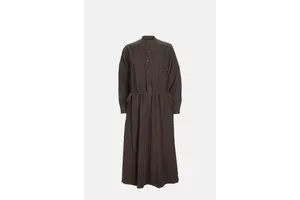
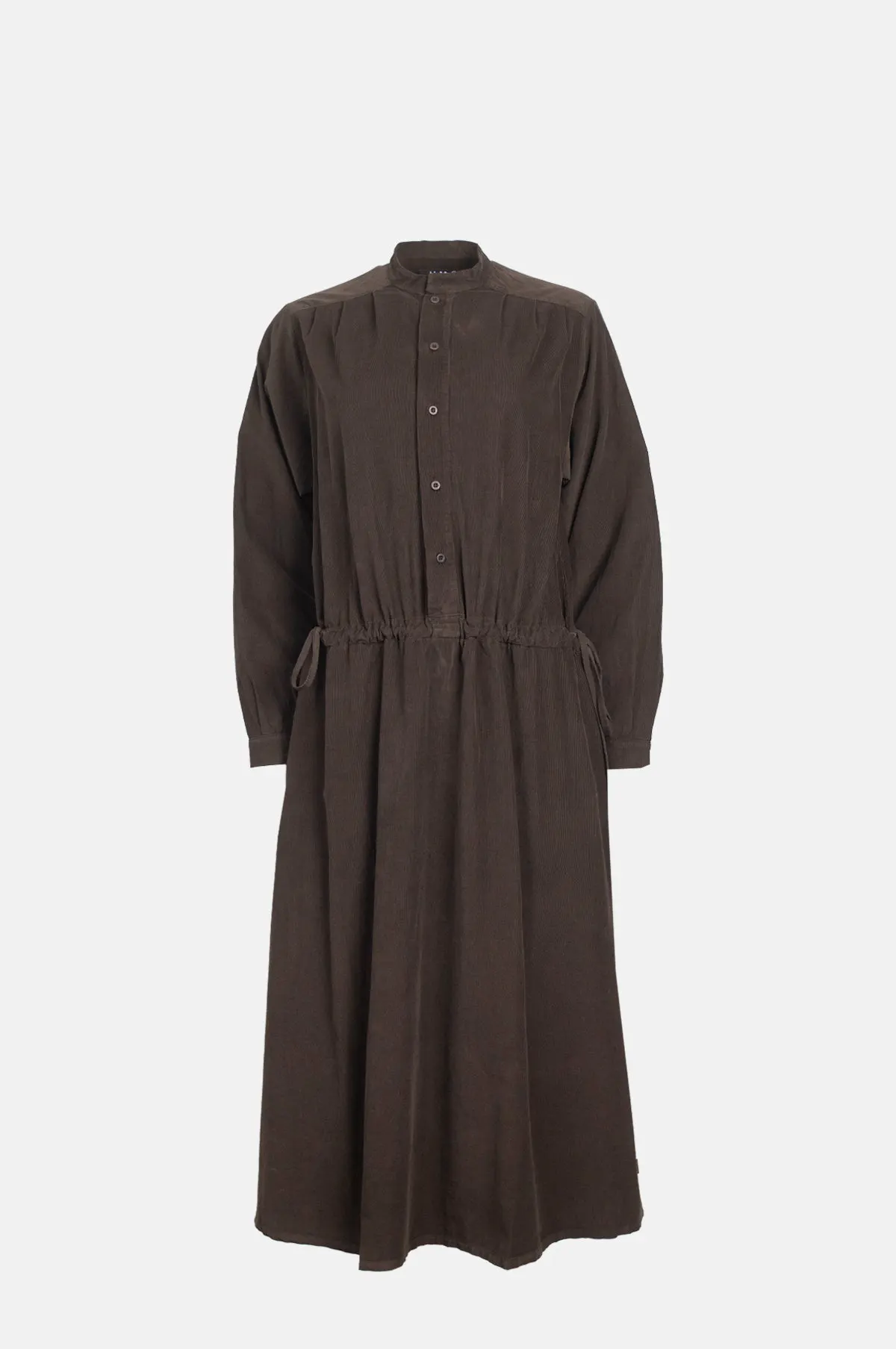

A brown midi dress from LABO.ART in a velvety cotton needlecord, with long sleeves, a band collar, a back yoke, a button-down front and a tie channel at the dropped waist that lets the dress be cinched, listed at 275 GBP with all five sizes in stock. It publishes pit to pit, sleeve and length for all five sizes, and two things on it are worth more than the colour. The first is the chest grade, which runs 2, 2, 4 and 4 centimetres across the five sizes, so the top of the range opens up at twice the rate of the bottom of it. The second is that the one design feature the copy leads with, the tie channel that cinches the waist, has no waist measurement anywhere on the page. Needlecord is also the closest this run has come to a wale being named on a corduroy. The reference is the Clio Lampo Dress in Cacao. Dongguan Bafinasa Garments Co., Ltd. develops comparable dresses on OEM and ODM terms, from cloth selection and tie channel construction to retail or FBA ready packing. We publish this as a development reference and build your own version of it, and we do not supply the branded original or reproduce anyone else's label.
Key Features
- Five sizes with three columns published for all five, all five in stock
- Chest grading 2, 2, 4 and 4 centimetres flat per size, so the grade doubles in the middle of the range. See the note below
- 100% cotton needlecord as stated, which is the nearest this run has come to a wale being named. See the note below
- Tie channel at the dropped waist as stated, which is the design feature and which has no waist measurement. See the note below
- Band collar, back yoke and button-down front as stated
- Midi length as stated, running 121 to 129 cm. See the note below
- Machine wash at 30 degrees, do not tumble dry, made in Italy as stated
Customisable Options
- Cloth: cotton needlecord to the reference, with the wale count and weight set to your market since only the name is given
- Wale: needlecord to the reference, or a wider wale for a more casual hand, quoted separately
- Waist: tie channel at the dropped waist to the reference, or a fixed waistband, or a separate self belt on loops
- Fit: long and loose to the reference, with the ease reducible by four to six inches for a closer dress
- Length: midi at 121 to 129 cm to the reference, with knee and maxi options
- Collar: band collar to the reference, or a classic collar, or a grandad collar with a longer placket
- Cloth weight, wale count, ease, body length, sleeve length, waist construction, pocket options, size set, colour development, private label and care labelling
Specifications
| Style | Long sleeve needlecord midi shirt dress with a tie waist |
| Reference | LABO.ART, Clio Lampo Dress, style L972FA002 020, brown, size 0 to 4, given as 0/XS through 4/XL |
| Composition | 100% cotton as stated |
| Cloth | Velvety soft needlecord as stated, which is a fine wale corduroy, with no wale count and no weight given. See the note below |
| Fit | Long, loose, straight and relaxed as stated |
| Collar | Band collar as stated |
| Back | Back yoke as stated |
| Front | Button-down fastening as stated |
| Sleeves | Long sleeves as stated |
| Waist | Tie channel at the dropped waist as stated, allowing the dress to be cinched. See the note below |
| Length | Midi length as stated |
| Care | Machine wash at 30 degrees, do not tumble dry, as stated |
| Sizes Offered | 0 to 4, five sizes, all in stock |
| Measurements Published | Pit to pit, sleeve length and total length for all five sizes. See the note below |
| Published Chest | Pit to pit 52, 54, 56, 60 and 64 cm flat, or 20.5, 21.3, 22.0, 23.6 and 25.2 in. See the note below |
| Published Sleeve | 58, 60, 62, 64 and 66 cm, grading two centimetres per size throughout. Origin not stated |
| Published Length | 121, 123, 125, 127 and 129 cm, grading two centimetres per size throughout |
| Published Waist | None, despite the tie channel being the leading design feature. See the note below |
| Model | None stated, no height and no body measurements |
| Photographs | One. See the note below |
| Cloth Weight | Not stated |
| Production | Made in Italy as stated |
| Reference Retail | 275 GBP as listed, quoted to show the price band this sits in, not as our price |
| Category | Filed by the reference under dresses |
| Occasion | Autumn and winter, everyday, work, weekend, with tights and boots as the reference suggests |
| MOQ | 100 pcs per style per colourway, mixed sizes and colourways accepted |
| Sampling | 7-10 days after tech pack or reference sample confirmation |
| Bulk Lead Time | 20-30 days after sample approval and deposit |
| Service | OEM / ODM / private label, needlecord sourcing, tie channel and yoke construction, retail or FBA ready packing |
Size Chart as Published by the Reference
| Size | Pit to Pit (flat) | Sleeve Length | Total Length |
|---|---|---|---|
| 0 / XS | 52 cm | 58 cm | 121 cm |
| 1 / S | 54 cm | 60 cm | 123 cm |
| 2 / M | 56 cm | 62 cm | 125 cm |
| 3 / L | 60 cm | 64 cm | 127 cm |
| 4 / XL | 64 cm | 66 cm | 129 cm |
The chest figures are flat half measures taken with the dress laid down, doubling to 104, 108, 112, 120 and 128 cm around, or 40.9 through 50.4 in. Against the body chart that is about ten inches of ease at size 0, falling to about nine at size 2 and then rising again to about eleven at size 4, because the grade is not even: two centimetres of flat width between the first three sizes and four between the last two. Length and sleeve both grade a clean two centimetres per size. No waist measurement is published even though the dress has a tie channel, and the total length runs 121 to 129 cm, which is a long midi.
Our Proposed Body Chart
| Size | Body Bust | Sleeve | Body Waist | Body Hips | Length | Source |
|---|---|---|---|---|---|---|
| 0 / XS | 31 in / 79 cm | 58 cm | 24 in / 61 cm | 34 in / 86 cm | 121 cm / 47.6 in | Our proposal |
| 1 / S | 33 in / 84 cm | 59 cm | 26 in / 66 cm | 36 in / 91 cm | 123 cm / 48.4 in | Our proposal |
| 2 / M | 35 in / 89 cm | 60 cm | 28 in / 71 cm | 38 in / 97 cm | 125 cm / 49.2 in | Our proposal |
| 3 / L | 37 in / 94 cm | 61 cm | 30 in / 76 cm | 40 in / 102 cm | 127 cm / 50 in | Our proposal |
Occasions and Styling
Suits autumn and winter, everyday wear, work, weekends and layering. The reference suggests tights and boots, which is right for a needlecord at this length, and the tie channel means the same dress can be worn loose as a column or cinched at the waist, which is the reason it works for both a desk and a weekend.
Production and Quality Control
The reference states its fibre, names the cloth as needlecord, publishes three columns for all five sizes, describes the collar, the yoke, the placket, the sleeves and the waist treatment, gives a care instruction and states the country of make. Three things follow: what an uneven grade does to the fit across a size range, what a tie waist means when no waist is measured, and what midi is when the number is 121 centimetres.
Two, two, four, four, and the fit that changes character across the range, and that is the first thing. The chest runs 52, 54, 56, 60 and 64 cm flat, so it grades two centimetres between the first three sizes and four between the last two. Now, a grade that opens up at the top of a range is a normal and often deliberate decision, and this run has met it before on the horseshoe jeans, where the top size jumped three centimetres where the ones below moved one, and the note there said that a pattern cutter will let the grade open up at the top of a range on purpose. What is different here is that the opening is not at the very top size, it starts at the third step and continues for two sizes, so half the range grades at one rate and half at another, and the effect on the fit is not a single anomaly but a change in character. Worked against the body chart, the ease runs about ten inches at size 0, nine and a half at 1, nine at 2, then back up to ten at 3 and eleven at 4. So the dress gets closer to the body through the middle of its range and then swings out again at the top, which is the opposite of what most ranges do and which means a customer who finds the dress too loose at a size 2 will not solve it by going down, because the ease is barely moving in that part of the range. Whether any of this is deliberate cannot be told from the page, and that is the complaint: an unusual grade is defensible and should be visible, and when it is not visible it looks like a transcription error, which is the reading most people will take. There is a practical check that settles it in a minute, and it is the one we run on any reference before copying a grade: put the numbers in a column, subtract each from the next, and look at the differences, because a deliberate grade shows a shape and a transcription error shows a step. Here the differences are 2, 2, 4, 4, which is clean enough to be deliberate and unusual enough to be worth saying so on the page.
A tie channel with no waist measurement, and that is the second thing. The copy leads with the tie channel at the dropped waist, describing it as what allows the dress to be cinched, and no waist measurement appears anywhere on the page. The published columns are chest, sleeve and length, so the one dimension the design feature controls is the only dimension relevant to it that is not given. That matters for three reasons. A customer cannot know how much the tie will actually take in, since a channel that draws a 110 cm circumference down to 90 is a different proposition from one that draws it down to 80, and a dress that cinches to a defined waist is a different product from one that merely gathers. The dropped waist position is not specified either, and on a long dress the difference between a tie at the natural waist and one five centimetres below it changes the whole proportion, and it is the kind of detail the copy is clearly proud of. And there is a production point that belongs in any quote. A tie channel is not a trivial addition: it needs a separate channel, either a turned and topstitched band or a tunnel formed from a seam allowance, with openings at the centre front or the sides, a drawcord or a self tie fed through it, and a way of anchoring it so it does not pull out in the wash, and all of that is several extra operations on a garment that otherwise reads as a simple shirt dress. It is worth quoting separately from the version without it, because the cost is real and the feature is the reason some customers will buy this dress rather than the plainer one. We would also specify what the tie is made from, since a self fabric tie on a needlecord is bulky and a flat tape or a cord is cheaper and lies better, and we would test that the channel does not pucker the cloth, which a fine wale corduroy will show more than a plain weave does.
Needlecord, one hundred and twenty one centimetres, and the rest, and that is the third thing. Needlecord is the first corduroy in this run to be described by its wale at all, and it is worth noting how partial that is: needlecord means a fine wale, generally somewhere above sixteen wales to the inch, which is a real piece of information and is more than the wide wale corduroy pages in this run gave, but it is still a category rather than a count, and a 16 wale and a 21 wale cloth are visibly different and cost differently. One number would settle it. Then there is the length. This is called a midi and it runs 121 to 129 cm of total length, which is measured from the shoulder, so the dress finishes somewhere between mid calf and the ankle on most heights, and where exactly depends entirely on how tall the wearer is, and no model height and no body measurements appear on the page to help. It is worth setting that beside the midi skirt earlier in this run, which was 86 to 90 cm and was also called midi: the same word describes two garments fifty centimetres apart, because one is measured from the waist and the other from the shoulder, and neither page says so. A dress length is only interpretable against a height, and the cheapest fix available to any brand is a model height or a simple statement of where the garment falls on a person of a given height. The sleeve is published at 58 to 66 cm with no origin, so it carries the same ambiguity as most of this run. One photograph appears, a single front view, so the back yoke, the tie channel and the fall of the dress are described but not shown, and on a garment whose whole argument is its length and its shape that is the gap most likely to cost a sale. Every bulk shipment gets a measurement report against your approved chart.
Optional upgrades include stating the wale count in ribs per inch, since needlecord is a category and not a number, publishing a waist measurement and the cinched range, which is the one dimension the tie channel controls, stating the dropped waist position, adding a model height or a statement of where the length falls, publishing the sleeve origin, adding back and side views and a close view of the tie channel, stating the cloth weight, quoting the tie channel version and a plain version separately, offering a fixed waistband and a self belt on loops as alternatives, knee and maxi lengths, a closer fit with four to six inches less ease, side seam pockets, size set, colour development, private label, hangtag and care labelling.
Pre-production sample approval, in-line inspection during cutting and sewing, and a final AQL inspection before packing, with measurement reports and photos shared before shipment.
Send us your tech pack, a photo or a reference garment and we will quote within 24 hours. Contact bafinasa@bafinasa.com or WhatsApp +86 13827222469.