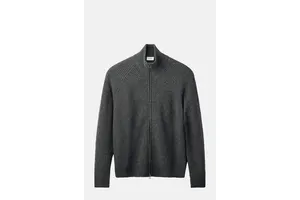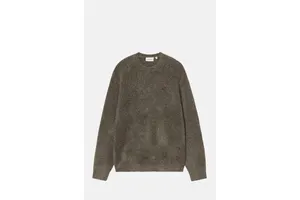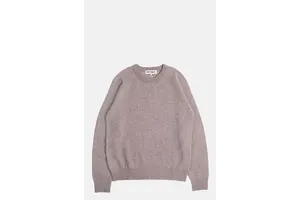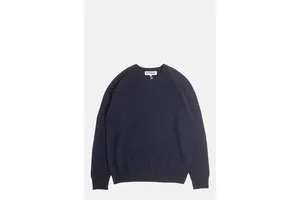
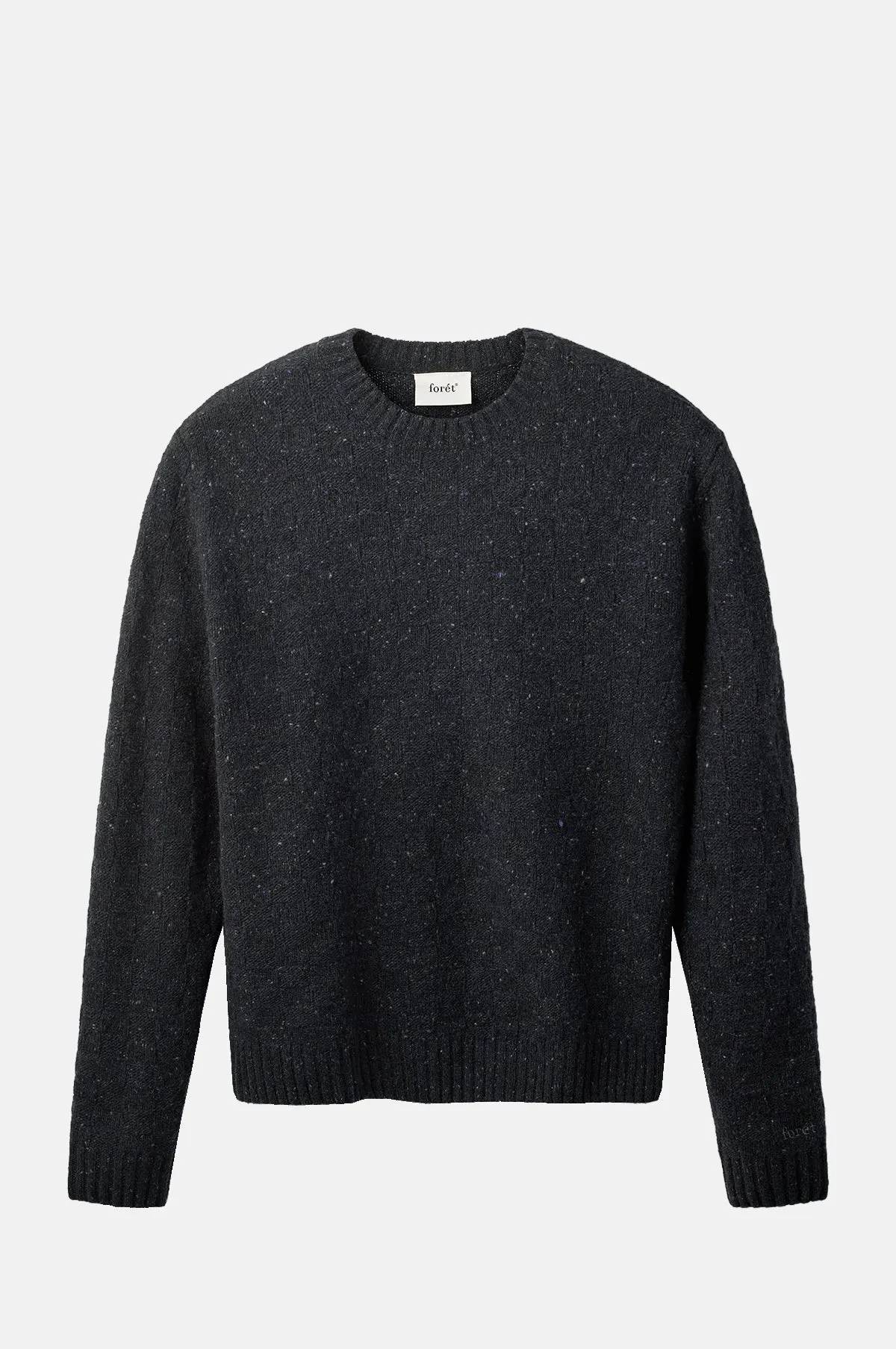

The Area Wool Knit in Navy from Foret, a regular fit knit in a wool blend with a cross hatch stitch and a ribbed collar, cuffs and hem, listed at 195 GBP with every size in stock. It is worth beginning with the chest row, because the run is going to do something to it that it has never done before. It is worth then reading it, which is twenty point one, twenty point nine, twenty-one point seven and twenty-two point four inches. It is worth then converting it back, and it is worth then stating what comes out, which is fifty-one, fifty-three, fifty-five and fifty-seven centimetres. It is worth then doing the same to the length, and it is worth then stating what comes out, which is sixty-six, sixty-eight, seventy and seventy-two. It is worth then stating what that establishes, and it is the point of this garment: the page says inches and it is a centimetre chart that has been converted and rounded. It is worth then stating what the run now has, which is a test it can run on every chart it has ever read. It is worth then turning to the composition, which is given twice on one page, and it is worth then stating what the two agree on, which is every number, and what they disagree on, which is how they are written. It is worth then turning to the care, which is two words. The reference is the Area Wool Knit. Dongguan Bafinasa Garments Co., Ltd. develops comparable knitwear on OEM and ODM terms, from fabric and trim development to retail or FBA ready packing. We publish this as a development reference and build your own version of it, and we do not supply the branded original or reproduce anyone else's label.
Key Features
- A chart that converts back to round centimetres, so the page says inches and was written in centimetres, and the run now has a test for every chart it has ever read. See the note below
- Three fibres with every share stated, summing to one hundred, including five per cent, which is the smallest share any page in this run has bothered to publish. See the note below
- The composition given twice on one page, agreeing in every number and disagreeing in how it is written, so the two places are maintained by hand. See the note below
- Wool blend in the bullets and 65 per cent wool in the composition, so the run can now see what blend meant: a third is not wool. See the note below
- A cross hatch knit, the second knit structure word in this run, and still no gauge. See the note below
- A care instruction of two words, against a hundred and twenty on another knitted garment in this same batch. See the note below
- Every size in stock, the second garment in this batch and the second in a hundred and seven. See the note below
- A Danish brand made in China, the third house in two batches whose paragraph names a different country from the one on the made in line. See the note below
Customisable Options
- Cloth: a 65% wool, 30% nylon and 5% alpaca knit to the reference with the yarn count and the gauge stated, or a 100% wool with the count and gauge stated, or a wool and cotton blend with both shares stated, or a lambswool with the micron stated, each quoted separately. See the note below
- Stitch: a cross hatch knit to the reference with the stitch name and the gauge stated, or a plain knit with the same figures, or a rib knit with the same, or a cable with the same, each quoted separately. See the note below
- Unit: the measurements published in the unit they were taken in, and where a conversion is printed, the original figure kept alongside it. See the note below
- Composition: the composition stated once, in one place, in one form, or stated in two places that agree in every number and in how they are written, each quoted separately. See the note below
- Trim: a ribbed collar, cuffs and hem to the reference with the rib width stated, or a plain hem with the depth stated, or a contrast rib with both colour references stated, each quoted separately
- Fit: a regular fit to the reference with the chest, waist and hem all published and the ease held steady across the range, or a relaxed fit with the same figures, or a loose fit with the same figures, each quoted separately. See the note below
- Composition with every share stated and summing to one hundred and stated identically wherever it appears, the yarn count, the knit gauge as stitches per inch, the stitch name, the rib width, chest with the flat or round method stated, sleeve length with the measurement point stated and measured from the shoulder, shoulder width, the front and back length, the collar width and depth, a stock line for every colourway, shrinkage figures for both length and width, pilling grade, colour fastness to washing, rubbing and light, a cleaning method with the temperature as a number, the detergent type, the drying method and a storage instruction, size set, colour development, private label and care labelling
Specifications
| Style | Regular fit knit in a wool blend with a cross hatch stitch and a ribbed collar, cuffs and hem |
| Reference | Foret, Area Wool Knit, colour Navy, style F1485, sizes S to XL |
| Unit | Inches as printed, and the figures convert back to round centimetres. See the note below |
| Unit Recovered | Chest 51, 53, 55, 57 cm and length 66, 68, 70, 72 cm. See the note below |
| Composition | 65% Wool, 30% Nylon and 5% Alpaca, as stated, three fibres, summing to one hundred. See the note below |
| Composition Locations | Two: a care line and a second tab, and they agree in every number and disagree in how they are written. See the note below |
| Smallest Share Published | 5%, which is the smallest share any page in this run has stated with a number. See the note below |
| Blend Meaning | Wool blend in the bullets, and 65% wool in the composition, so a third is not wool. See the note below |
| Certification | None named |
| Fabric Weight | Not stated, in any form |
| Knit Structure | Cross hatch knit, as stated, the second knit structure word in this run. See the note below |
| Knit Gauge | Not stated, and a knit structure carries a gauge. See the note below |
| Yarn Count | Not stated |
| Fit Word | Regular, as stated, and used once only |
| Fit Guidance | None given |
| Sizes Offered | S, M, L and XL, four sizes, and every size is in stock. See the note below |
| Chart Columns | Four, against four sizes on offer, so the chart and the offer agree |
| Size Conversion | Not stated, the sizes given as letters only |
| Model | Not given |
| Chest | Pit to pit 20.1, 20.9, 21.7 and 22.4 in, or 40.2 to 44.8 in around |
| Chest Around | 40.2, 41.8, 43.4 and 44.8 in |
| Ease at the Chest | About 3.2, 2.8, 2.4 and 1.8 in. See the note below |
| Ease Against the Word | Not placed against a word. This run no longer places ease against fit words |
| Ease Direction | It falls at every step, and it loses forty-four per cent of itself across the range. See the note below |
| Chest Grading | Steps 0.8, 0.8 and 0.7 in, which are two centimetres, two centimetres and a rounding. See the note below |
| Waist | Not measured |
| Hip | Not measured |
| Shoulder | Not measured |
| Sleeve | 20, 21, 22 and 23 in, stepping 1.0 throughout, and this row does not convert back to round centimetres. See the note below |
| Sleeve Measurement Point | Not stated |
| Total Length | 26, 26.8, 27.6 and 28.3 in, stepping 0.8, 0.8 and 0.7, and converting back to 66, 68, 70 and 72 cm. See the note below |
| Length Measurement Point | Not stated |
| Neck | Ribbed collar, as stated, with no collar width and no collar depth given |
| Cuffs | Ribbed cuffs, as stated, with no rib width given |
| Hem | Ribbed hem, as stated, with no hem circumference and no hem depth given |
| Closure | None stated, so this is a pullover and not a cardigan |
| Pockets | None stated |
| Care | Hand wash only, as stated, two words, with no temperature, no detergent, no drying and no ironing instruction. See the note below |
| Bullet List | Three, covering the fibre, the fit and the trim |
| Measurements Published | Pit to pit, sleeve and length for all four sizes |
| Photographs | Four, all named for the product |
| Production | Made in China as stated, and the house paragraph calls the house Danish. See the note below |
| Style Number | F1485, as stated, a bare code with no key, and the run has only one of them. See the note below |
| Reference Retail | 195 GBP as listed, quoted to show the price band this sits in, not as our price |
| Category | Filed by the reference under knitwear |
| Occasion | Everyday, layering, casual, weekends, outdoors |
| MOQ | 100 pcs per style per colourway, mixed sizes and colourways accepted |
| Sampling | 7-10 days after tech pack or reference sample confirmation |
| Bulk Lead Time | 20-30 days after sample approval and deposit |
| Service | OEM / DDM / private label, wool, wool blend, lambswool, alpaca and cotton knit sourcing with every share stated and summing to one hundred and the yarn count and micron stated, cross hatch, plain, rib and cable stitch development with the stitch named and the gauge given as stitches per inch, regular, relaxed and loose fit development with the chest, waist and hem published and the ease held steady across the range rather than falling away, ribbed collar, cuff and hem development with the rib width stated, sleeve development with the measurement point stated and the sleeve taken from the shoulder, measurements published in the unit they were taken in and the original figure kept where a conversion is printed, composition stated once and in one form, multi-colourway development with a stock line for each, shrinkage measured in both directions and published, pilling grade tested and published, colour fastness to washing, rubbing and light, care labelling with a cleaning method, the temperature as a number, the detergent type, the drying method and a storage instruction, size set, colour development, private label and care labelling, retail or FBA ready packing |
Size Chart as Published by the Reference
| Size | Pit to Pit (in) | Sleeve (in) | Length (in) |
|---|---|---|---|
| S | 20.1 in | 20 in | 26 in |
| M | 20.9 in | 21 in | 26.8 in |
| L | 21.7 in | 22 in | 27.6 in |
| XL | 22.4 in | 23 in | 28.3 in |
The pit to pit figures are flat half measures, doubling to 40.2, 41.8, 43.4 and 44.8 in around. Against men's bodies of roughly 37 to 43 in at the chest, the ease runs 3.2, 2.8, 2.4 and 1.8 in, so it falls at every step and loses forty-four per cent of itself from the smallest size to the largest, which is why the largest size here fits tighter than the smallest. Note what the chest figures convert back to: 51, 53, 55 and 57 centimetres, and note what the length converts back to: 66, 68, 70 and 72. Note what that establishes, which is that this page is a centimetre chart converted to inches and rounded, and note what the run now has, which is a test: convert a row back and see whether the series is round. Note the sleeve, which is 20, 21, 22 and 23 in and which does not convert back to anything round, so on this one chart two rows were written in centimetres and one was not. Note the body table, which is men's of 37 to 43 in. Note that another garment in this same batch holds its ease at exactly four inches at every size while this one loses nearly half of it, and note what that means: the run cannot read a steady ease as the better garment, because the steady one is the generated chart and this one looks measured. Our proposal below publishes the gauge as stitches per inch, the yarn count, the measurements in the unit they were taken in, the sleeve measurement point with the sleeve taken from the shoulder, the rib width, and holds the ease steady across the range.
Our Proposed Body Chart
| Size | Body Bust | Sleeve | Body Waist | Body Hips | Length | Source |
|---|---|---|---|---|---|---|
| S | 37 in / 94 cm | 51 cm | 31 in / 79 cm | 37 in / 94 cm | 66 cm / 26 in | Our proposal |
| M | 39 in / 99 cm | 52 cm | 33 in / 84 cm | 39 in / 99 cm | 68 cm / 26.8 in | Our proposal |
| L | 41 in / 104 cm | 53 cm | 35 in / 89 cm | 41 in / 104 cm | 70 cm / 27.6 in | Our proposal |
| XL | 43 in / 109 cm | 54 cm | 37 in / 94 cm | 43 in / 109 cm | 72 cm / 28.3 in | Our proposal |
Occasions and Styling
Suits everyday wear, layering, weekends and time outdoors. A wool blend knit carries a tee or a shirt under it and a coat over it, and it reads dressed without being formal.
Production and Quality Control
The reference publishes three measurements for all four sizes, three fibres with every share stated and summing to one hundred, a knit structure word, a fit word, its collar, cuffs and hem, a style number, and its country of manufacture, and every size is in stock. It gives no fabric weight, no knit gauge although it names the stitch, no yarn count, no sleeve measurement point, no shoulder width, no waist, no hip, no hem circumference or depth although the hem is called ribbed, no collar width or depth, no rib width, no washing temperature although it gives a washing method, no detergent, no drying method, no ironing instruction, no certification, no model, no size conversion, no shrinkage figure and no pilling grade, and its care instruction is two words. Three things follow: a chart that converts back to round centimetres, so the declared unit is not the unit the chart was written in; a composition given twice that agrees in every number and disagrees in how it is written, which means two fields maintained by hand; and an ease that falls by nearly half across four sizes, so the largest size is a different garment from the smallest.
Twenty point one, twenty point nine, twenty-one point seven, twenty-two point four, and that is the first thing, and it is worth doing something to these numbers that the run has never done. It is worth then converting them back, and it is worth then stating what comes out, which is fifty-one, fifty-three, fifty-five, fifty-seven centimetres. It is worth then doing the same to the length and stating what comes out, which is sixty-six, sixty-eight, seventy, seventy-two. It is worth then stating what that establishes, which is that the page says inches and is a centimetre chart converted and rounded. It is worth then stating the test, which is: convert a row back, and if the series is round, the chart was written in that unit. It is worth then stating what the run can now do, which is sort every chart it has read into two piles. It is worth then stating what it should say about its own unit row, which has said inches throughout, and what it should say now, which is inches as printed. It is worth then stating the one row that does not convert, which is the sleeve, at twenty, twenty-one, twenty-two, twenty-three, and noting what that makes this chart: two rows in centimetres and one that is not, so the page is not even in one unit.
Sixty-five, thirty, five, and that is the third thing, and it is worth saying what the run has been saying about shares before saying what this does to it. It is worth then stating what it has been saying, which is that shares are withheld, and what this page does, which is publish three of them including one of five per cent. It is worth then stating what a five per cent share proves, which is that the small ones are not worth hiding either, and that some houses publish everything. It is worth then turning to the two places the composition appears. It is worth then stating what they agree on, which is every fibre and every number, and what they disagree on, which is the spacing, the case and the punctuation. It is worth then stating what that is, which is not a contradiction of fact but a contradiction of form, and what it tells the run, which is that two fields are maintained by hand. It is worth then stating what follows: two fields maintained by hand will one day disagree on a number and not only on a space. It is worth then closing on the care, which is two words, and it is worth then stating what another knitted garment in this same batch gives, which is a hundred and twenty. It is worth then stating the factor, which is sixty, and it is worth then saying what the run should ask from here, which is not whether a house publishes care but how much.
Optional upgrades include the knit gauge as stitches per inch, the yarn count, the fabric weight in grams per square metre, the sleeve measurement point with the sleeve taken from the shoulder, the shoulder width, the waist and the hip, the hem circumference and depth, the collar width and depth, the rib width, the measurements published in the unit they were taken in with the original figure kept alongside any conversion, the composition stated once and in one form, a washing temperature as a number alongside the method, a detergent type, a drying method, an ironing instruction, a storage instruction, the ease held steady across the range, a size conversion table, shrinkage figures for both length and width, a pilling grade, colour fastness to washing, rubbing and light, a style number with a key, 100% wool, wool and cotton and lambswool options, plain, rib and cable stitch options, relaxed and loose fit options, size set, colour development, private label and care labelling.
Pre-production sample approval, in-line inspection during cutting and sewing, and a final AQL inspection before packing, with measurement reports and photos shared before shipment.
Send us your tech pack, a photo or a reference garment and we will quote within 24 hours. Contact bafinasa@bafinasa.com or WhatsApp +86 13827222469.