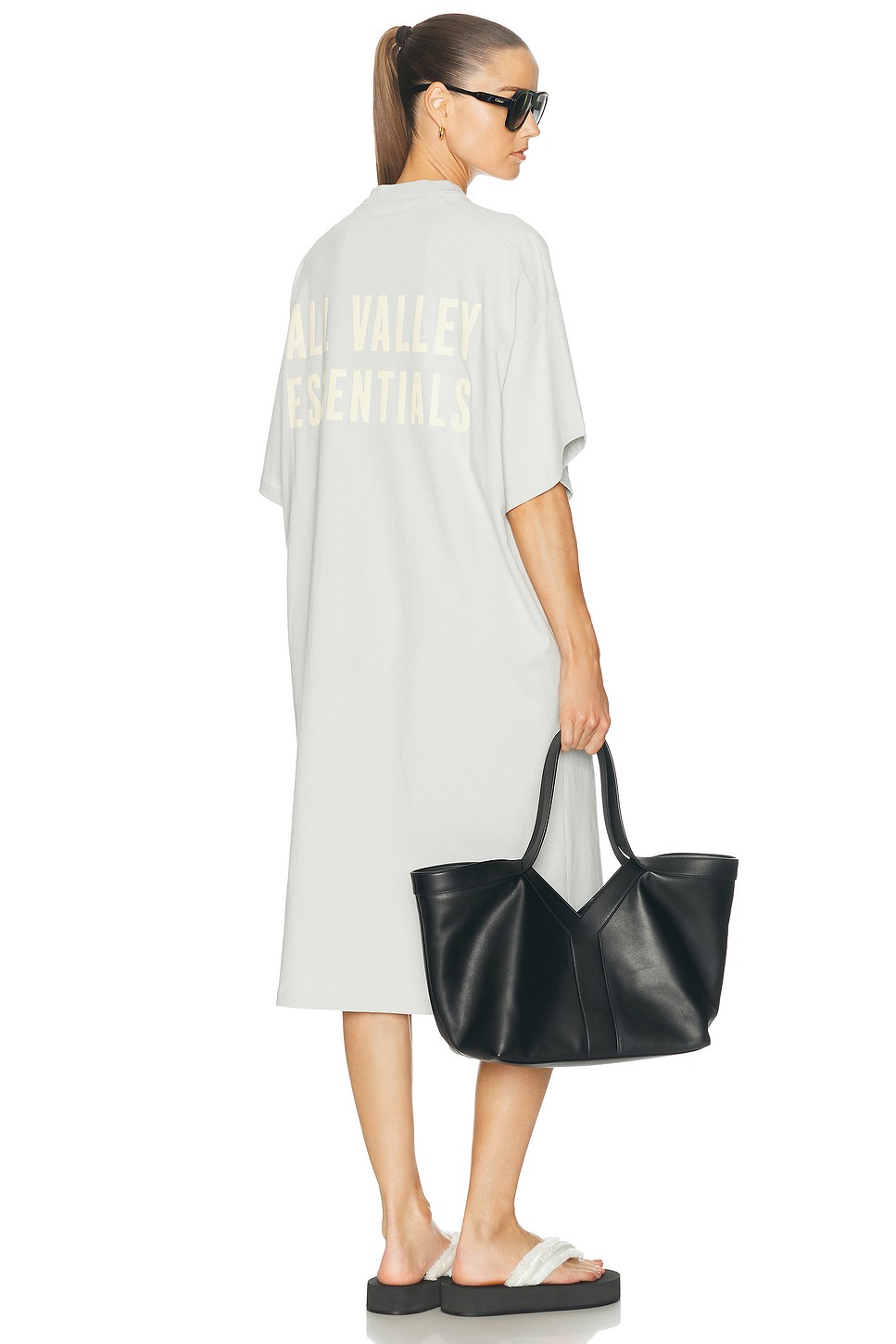
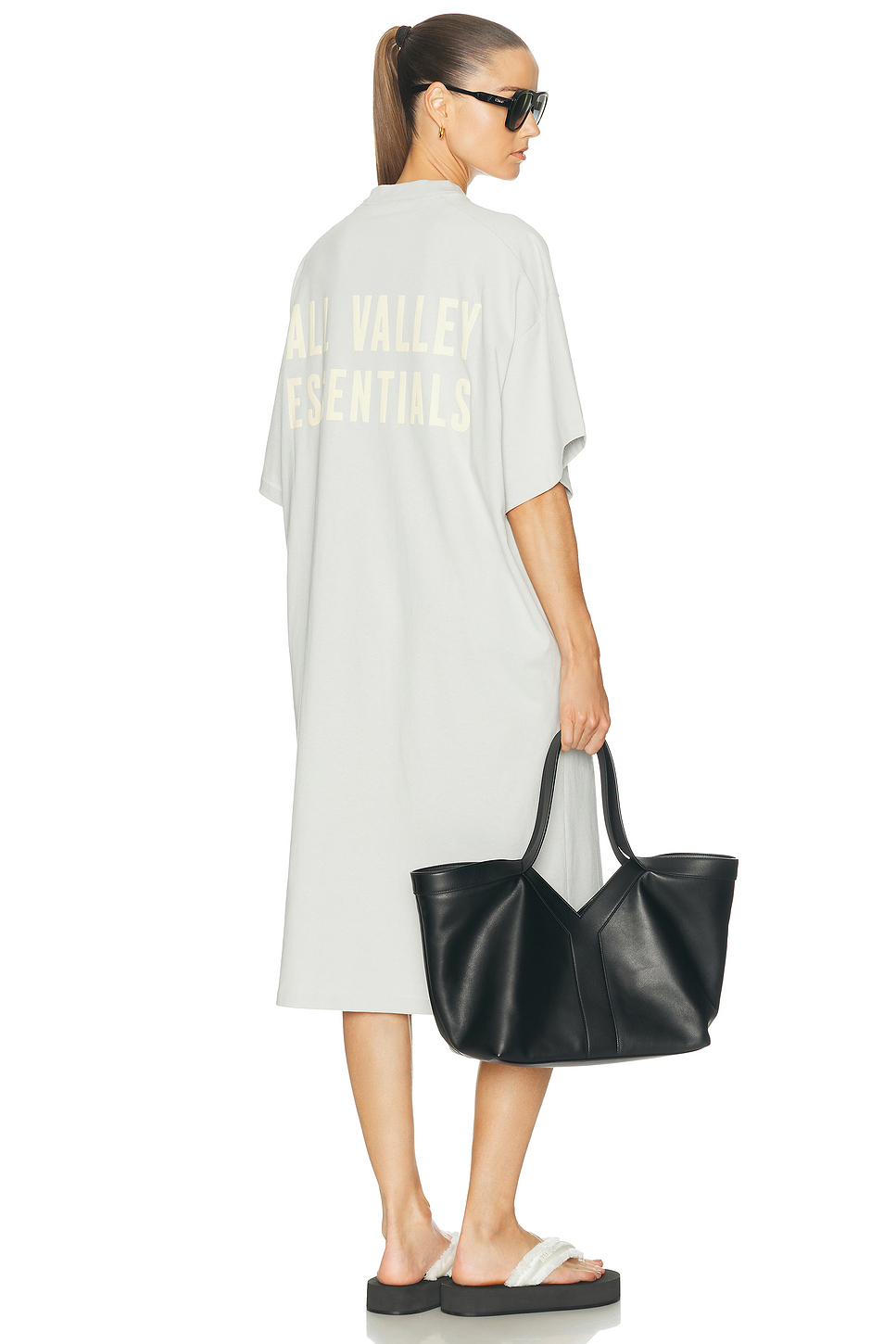
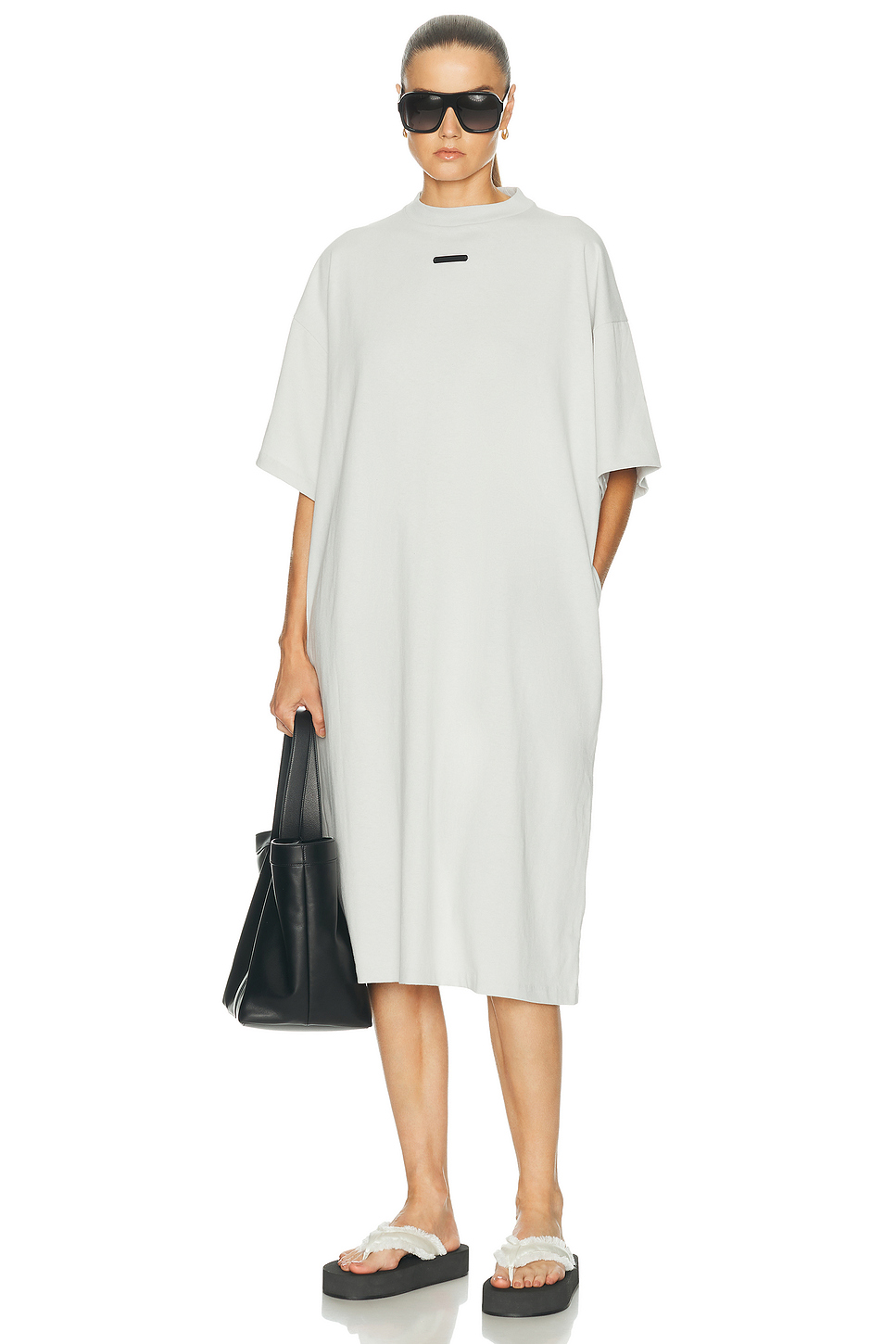
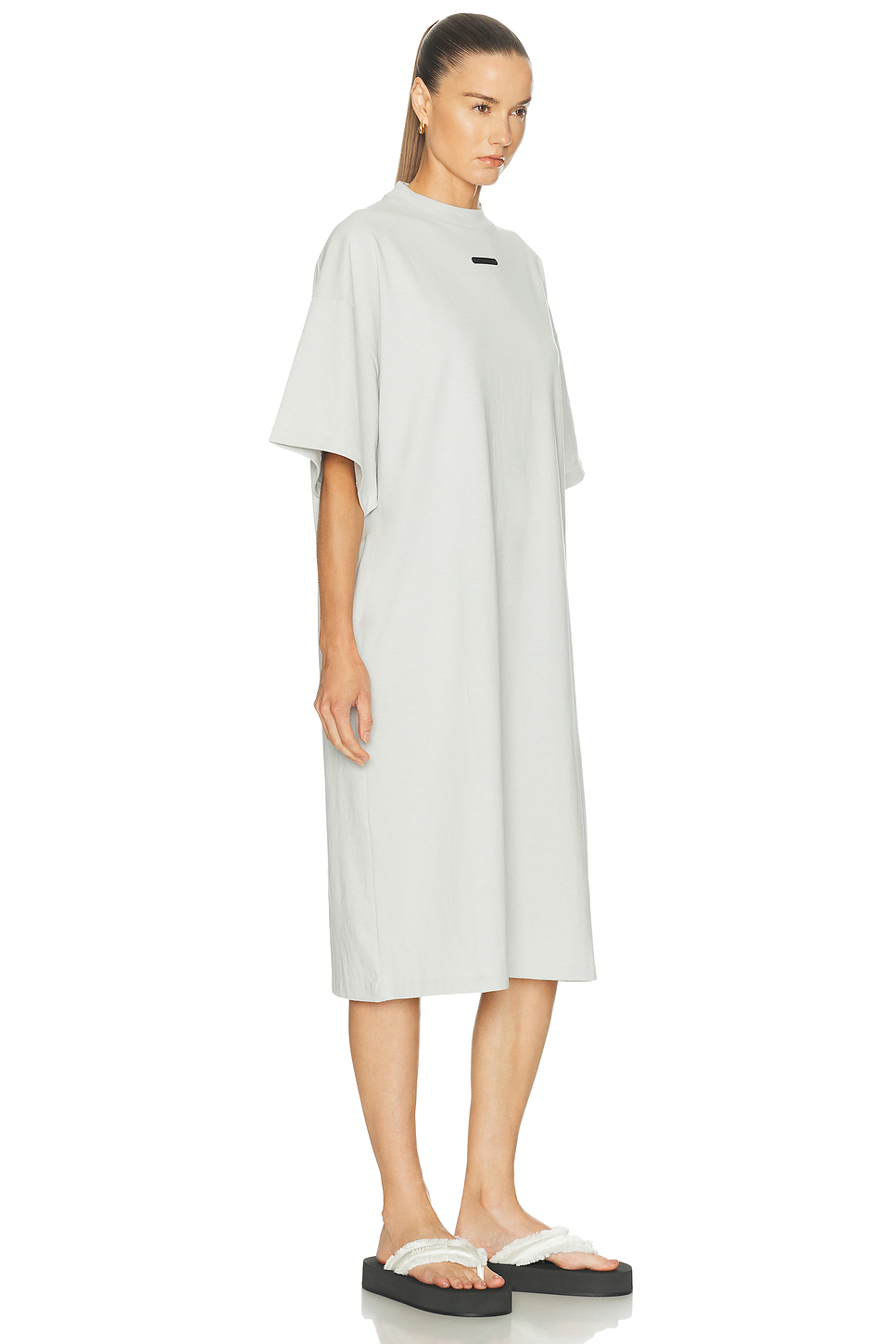
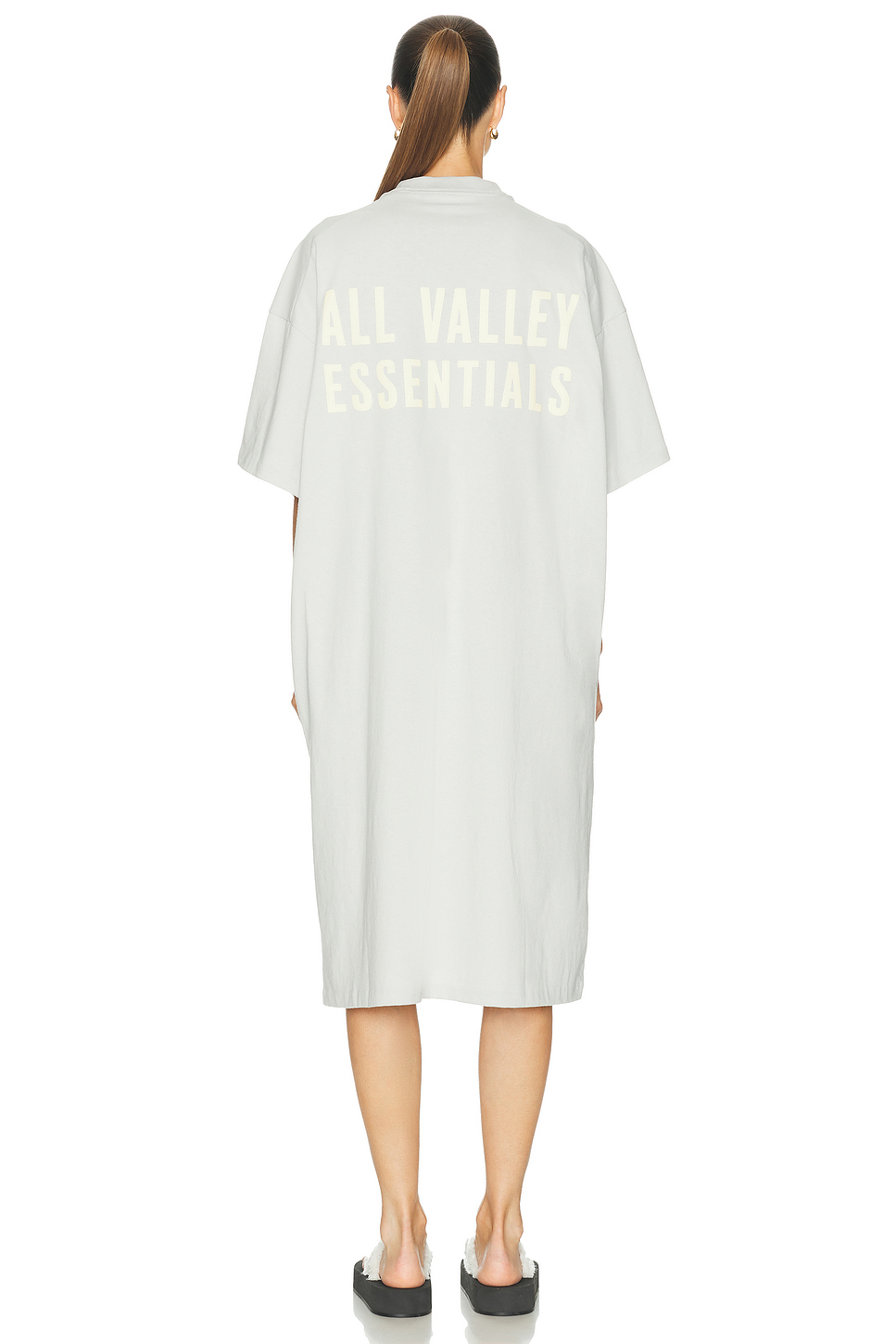
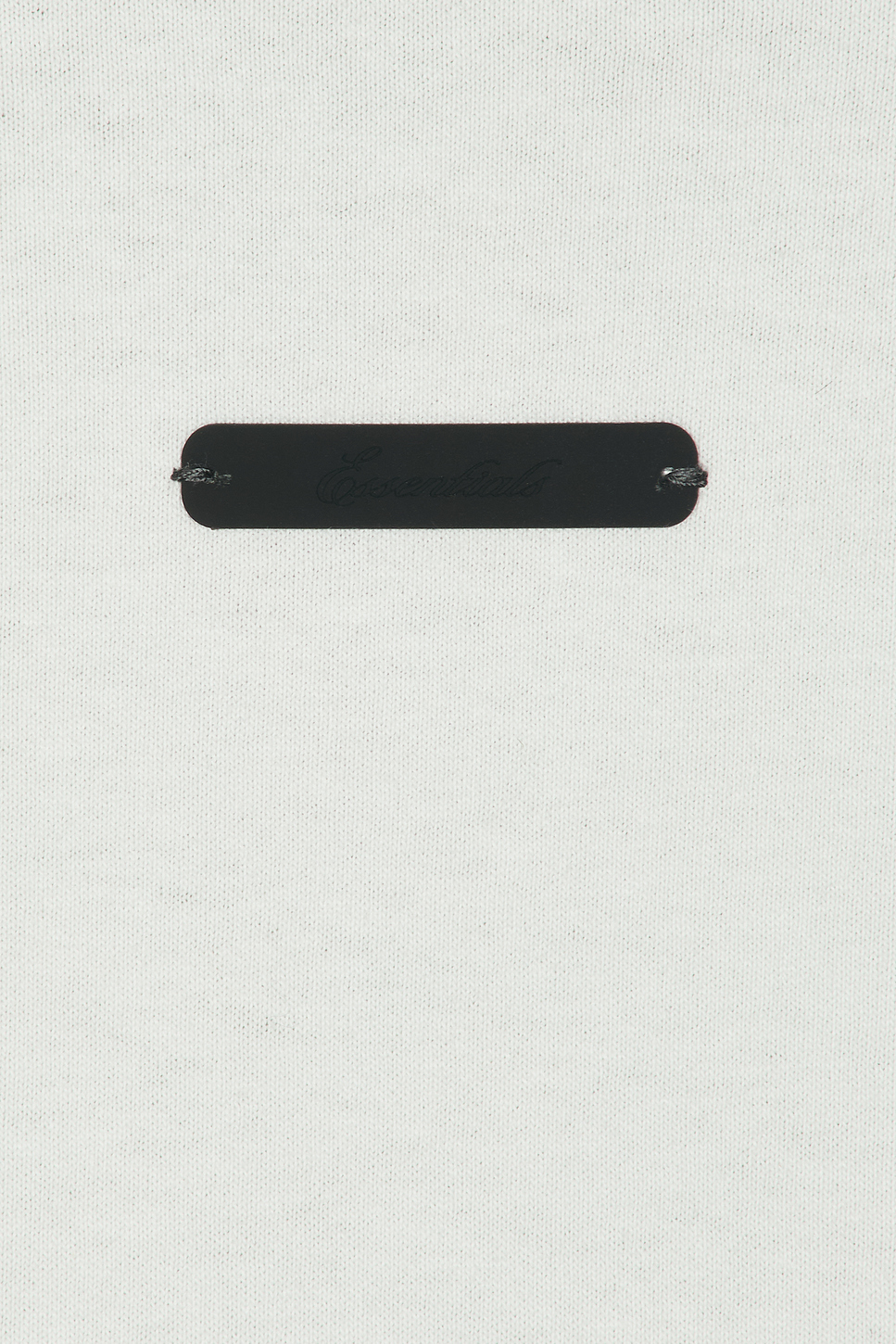
A long t-shirt dress listed as 100% cotton in a mid-weight cotton jersey cloth, unlined, pull-on with no closure, short sleeved, hand wash cold, made in Vietnam, ranked second in the retailer's t-shirt dress list, at 120 dollars. There are no reviews and no fit votes, so there is no score to quote. This is the least expensive garment this series has examined and it publishes more than almost any of them, which completes an argument that has been building for many batches. It also states its own knit construction in a field rather than a title, which settles by example something that has otherwise needed arguing. And it publishes a sleeve measurement, which is rarer than it should be. The reference is the Long T-Shirt Dress by Fear of God ESSENTIALS in Overcast. Dongguan Bafinasa Garments Co., Ltd. develops comparable jersey dresses on OEM and ODM terms, from cotton yarn sourcing to retail or FBA ready packing. We publish this as a development reference and build your own version of it, and we do not supply the branded original or reproduce anyone else's label.
Key Features
- 100% cotton as stated
- Mid-weight cotton jersey cloth as stated, which names the construction in a field rather than a title. See the note below
- Short sleeve, filed as such and also measured. See the note below
- Unlined as stated
- Pull-on styling with no closure as stated
- Hand wash cold as stated, which is a reasonable answer for cotton jersey
- Measurements published for one size including length 43 in and sleeve 9 in
- Made in Vietnam as stated
Customisable Options
- Fabric: cotton jersey to the reference, with the weight set from a tested sample and stated in grams
- Weight: mid-weight kept, and we would quote it rather than leave it as a word
- Fit: oversized proportions to the reference, since twenty two inches over at the bust is the design
- Finish: pre-shrinking, and tubular or open width knitting both available
- Length from thigh to ankle, sleeve length, neckline rib, size set, colour development, private label and care labelling
Specifications
| Style | Long cotton jersey t-shirt dress |
| Reference | Fear of God ESSENTIALS, Long T-Shirt Dress, style FALF-WD9, manufacturer style RW00335, colour Overcast |
| Composition | 100% cotton as stated |
| Fabric | Mid-weight cotton jersey cloth as stated, which names the construction. See the note below |
| Sleeve | Short sleeve, filed under short sleeve dresses and measured at 9 in. See the note below |
| Lining | Unlined as stated |
| Closure | Pull-on styling, no closure stated |
| Care | Hand wash cold as stated |
| Sizes Published | XS, S, M, L, XL, which is five sizes |
| Measurements Published | S: bust 56 in, waist 52 in, hips 52 in, length 43 in, sleeve 9 in |
| Chart Note | Every circumference is far above the model. See the note below |
| Coverage | Only size S has figures. XS, M, L and XL are blank |
| Model | 179 cm, wearing size S, bust 86 cm, waist 61 cm, hips 86 cm |
| Production | Made in Vietnam as stated |
| Reference Retail | 120 USD, the lowest reference price in this series so far |
| Customer Reviews | None on the reference listing, so we quote no score |
| Best Seller Badge | Rank 2 in the retailer's t-shirt dress list, the highest position seen in this series |
| Categories | Filed by the retailer under t-shirt dresses and short sleeve dresses |
| Occasion | Everyday, casual, travel, layering, warm weather |
| MOQ | 100 pcs per style per colourway, mixed sizes and colourways accepted |
| Sampling | 7-10 days after tech pack or reference sample confirmation |
| Bulk Lead Time | 20-30 days after sample approval and deposit |
| Service | OEM / ODM / private label, cotton jersey knitting, washing and finishing, retail or FBA ready packing |
Size Chart
| Size | Bust | Waist | Hips | Length | Source | ||||||||||||
|---|---|---|---|---|---|---|---|---|---|---|---|---|---|---|---|---|---|
| S | 56 | in | 52 | in | 52 | in | 43 | in / | 109 | cm | As published | ||||||
| XS | 31 | in / | 79 | cm | 24 | in / | 61 | cm | 34 | in / | 86 | cm | 109 | cm / | 42.9 | in | Our proposal |
| S | 33 | in / | 84 | cm | 26 | in / | 66 | cm | 36 | in / | 91 | cm | 111 | cm / | 43.7 | in | Our proposal |
| M | 35 | in / | 89 | cm | 28 | in / | 71 | cm | 38 | in / | 97 | cm | 113 | cm / | 44.5 | in | Our proposal |
| L | 37 | in / | 94 | cm | 30 | in / | 76 | cm | 40 | in / | 102 | cm | 115 | cm / | 45.3 | in | Our proposal |
| XL | 39 | in / | 99 | cm | 32 | in / | 81 | cm | 42 | in / | 107 | cm | 117 | cm / | 46.1 | in | Our proposal |
The published size S gives a 56 inch bust, a 52 inch waist, a 52 inch hip, a 43 inch length and a 9 inch sleeve against a model at roughly 34, 24 and 34. Everything is far above her, and for a t-shirt dress that is the silhouette rather than an error.
Occasions and Styling
Suits everyday wear, casual wear, travel, layering and warm weather. A long cotton jersey t-shirt dress is an everyday piece, and it is worth knowing that the proportions here are deliberately generous rather than oversized by accident, since that decides whether size S is the right choice.
Production and Quality Control
There are no reviews and no fit votes on this listing, so there is no score to quote. This is the cheapest garment yet examined and among the best documented, and it also does two things that pages costing twenty times as much do not manage.
One hundred and twenty dollars, nine pieces of information, and that completes an argument, and that is the first thing. This series has argued throughout that disclosure has no relationship to what a garment costs, and built the case slowly: many listings above a thousand dollars publishing four lines or fewer; a batch with three separate garments above 1,900 dollars disclosing identically little; the highest priced garment yet examined at 3,448 dollars offering less than most things costing a tenth of it; and a pair of near identical white cotton pages around 2,200 dollars that published the composition, the country and nothing else at all. Alongside that ran the objection this series kept having to answer, which is that cheap garments might say more because they have nothing else to sell, and recent batches have been narrowing the price gap to close that escape: a twenty five per cent difference that came with roughly twice the disclosure, and now this. This garment costs 120 dollars. It publishes the fibre, the country, a care instruction, whether it is lined, how it closes, the fabric weight, the fabric construction, measurements across five labelled sizes including both length and sleeve length, and model body figures, and there are five photographs. Setting that beside the 2,283 dollar page in this same batch, the cheaper garment costs about one nineteenth as much and discloses roughly four times as much. There is no longer any room for the objection, because the cheap garment has less to sell and still says more. It is worth adding what this does and does not establish, since precision matters more than the point being scored. What it establishes is that the missing information is cheap to supply, not that expensive garments are worse made. Every cost this series has identified as standing behind silence is a labour cost rather than a materials one: photography needs a session, copy needs a writer, measurements need somebody with a tape over a sample, and all three scale with how many styles are being shot rather than with what any one garment cost. That is why the correlation is absent rather than merely weak. There is one further consideration specific to a garment like this one, which is that categories with less margin tend to be shot in greater volume and more routinely, so the practical question for anybody building a listing is whether the process exists at all rather than whether it can be afforded for one garment.
Knit stated in a field rather than a title, and there is now a comparator proving this is a choice rather than a limitation, and that is the second thing. This series has spent a good deal of space establishing how important it is to know whether a cloth is knit or woven, because knit changes almost every answer: it explains how one garment can cover more than one body, since loops open where warp and weft are locked; it explains negative ease, having been deduced as the only remaining mechanism on one garment once three others were eliminated; and it bears on care, since open thread structures behave differently from interlocked ones. Yet stating it is rare, and this series has counted the ways it goes unstated. There was the word for knit hidden in a French product title, discoverable only by a French speaker. There was a garment whose knit structure was available only by inference from the retailer having filed it under sweater dresses. There was jersey confined to a product name on a t-shirt dress, where supplying the mechanism was useful but the placement was not. And there was a recent listing whose description stated ponte along with its weight, at which point it was noted that demonstrably this can be done. This garment does the same thing, stating cotton jersey in a description field along with the weight, and the two together settle the question this series flagged when it first noticed how often the fact went missing. It is not that knit cannot be stated. It is a choice, and two garments in one batch choosing to state it is enough to say so. There is one caveat worth adding rather than glossing, since it applies to the weight word rather than to the construction. Mid-weight is doing real work here and is better than nothing, because it tells the customer this is substantial jersey rather than the light cloth used for layering tees. But it is still a word rather than a number, and there is no established agreement about where mid-weight begins and heavy ends, so two makers using the same word can mean quite different things. Grams per square metre would settle it and costs nothing to print. Now, the third thing this page does is publish a sleeve measurement, and that deserves separate mention because of how rarely it appears. This series noted recently that another page disclosed its coverage only through being filed under long sleeve dresses, and observed that while a category label contributed genuinely needed information when nothing else did, it said the sleeve existed without saying how long it was, and that a sleeve can stop anywhere from the wrist to well past the hand. Here the retailer files this under short sleeve dresses and separately publishes nine inches, which is about twenty three centimetres. So both pieces are present and they agree with each other, which is exactly the arrangement this series has been recommending but has rarely found. It is worth noting how much that one small number resolves, since nine inches means this sleeve genuinely stops short rather than reaching the elbow, and without it a customer choosing between this and something with a longer sleeve is working from photography taken on one body.
Twenty two inches over at the bust, and asking what that is for now has four answers rather than three, and that is the third thing. The published size gives a bust of 56 inches against a model at roughly 34, a waist of 52 against 24 and a hip of 52 against 34. So the bust is around twenty two inches above her and the waist twenty eight above. This series has several times asked what large positive measurements are for rather than treating them as carelessness, and has accumulated reasons. The first was that positive measurements replace a missing closure, since a garment with no zip and no stretch fibre has to pass over the shoulders and hips without opening, which explained a cotton dress about ten inches over at the bust. The second was that they describe how the fabric behaves, since openwork lace has no reason to be pulled close and holding it against the body defeats both its appearance and its comfort. The third was that they describe the silhouette itself, evidenced by a garment filed under shift dresses where ease at the waist was not something to explain away but the definition of the shape, and that instance still holds the record with about twenty four inches at the waist. This garment supplies a fourth, and although it resembles the third, it is worth separating because it operates through a different route. That shift was labelled as such by the retailer, so the explanation arrived ready made. Here the filing says t-shirt dress, which describes an origin rather than a silhouette, so there is nothing in the category telling anybody why the measurements are what they are. What does the work instead is the combination of the garment's name and its cloth: jersey t-shirt garments in cotton are made oversized as a matter of convention, and heavy enough jersey to drape rather than cling is part of how that reads. So the practical advice is the opposite of what somebody unfamiliar might assume, and it is worth being blunt about it. A customer seeing fifty six inches at the bust should not conclude this garment runs large and order down, because at 120 dollars with five sizes there is room to size either way and sizing down here would remove exactly the quality that makes it what it is. That is the point where a measurement absent of guidance becomes actively misleading, and it is worth noting in closing that of five published sizes, only size S carries any figures at all. Every bulk shipment gets a measurement report against your approved chart.
Optional upgrades include quoting the jersey weight in grams per square metre rather than leaving mid-weight as a word nobody defines, publishing measurements for the other four sizes since only S carries any, adding a line explaining that the generous proportions are the silhouette rather than a size error, offering pre-shrunk fabric since cotton moves on its first washing and this is a hand wash garment, stating whether the jersey is knitted tubular or open width since that changes whether it twists after washing, the neckline rib construction specified given it is what loses shape first, alternative widths and lengths, rib alternatives, colour development and private label, hangtag and care labelling.
Pre-production sample approval, in-line inspection during cutting and sewing, and a final AQL inspection before packing, with measurement reports and photos shared before shipment.
Send us your tech pack, a photo or a reference garment and we will quote within 24 hours. Contact bafinasa@bafinasa.com or WhatsApp +86 13827222469.