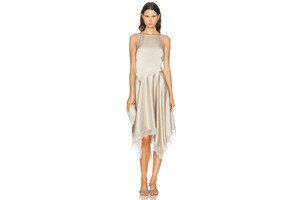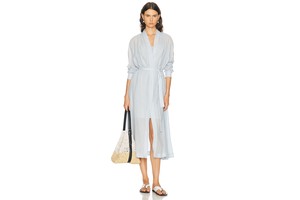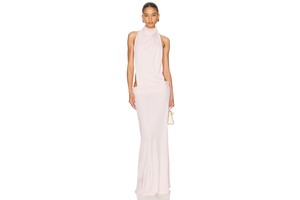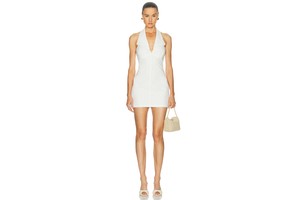
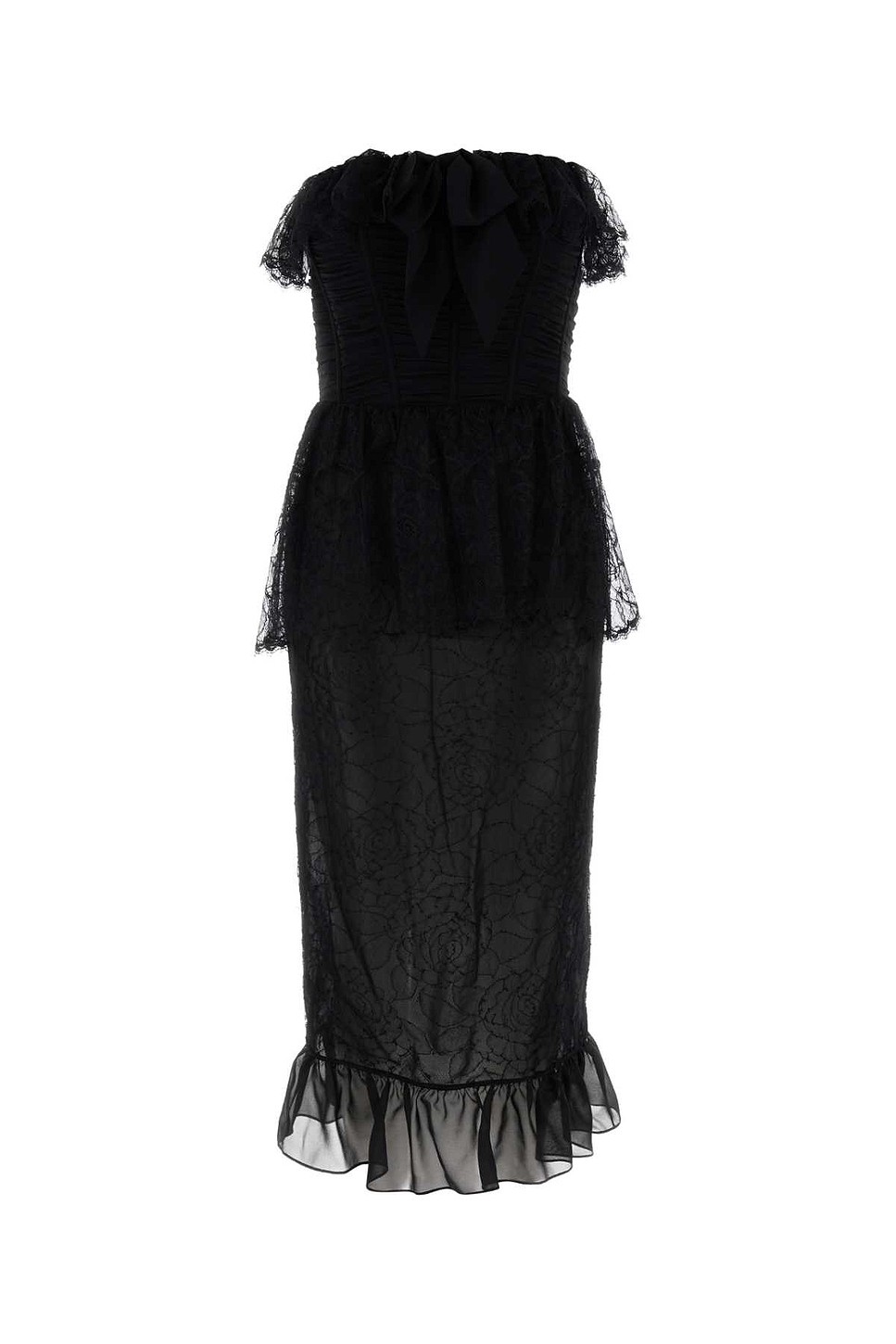
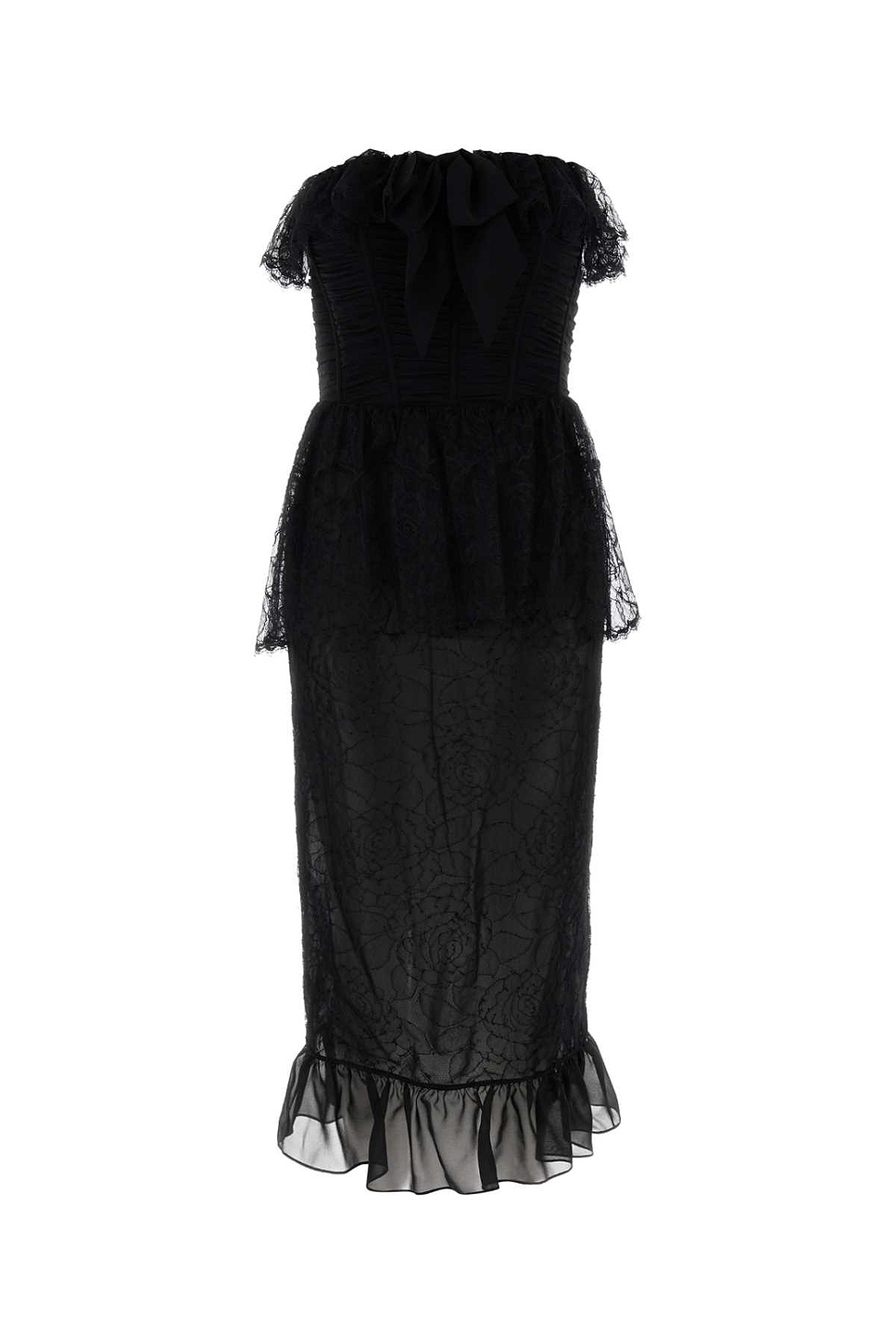
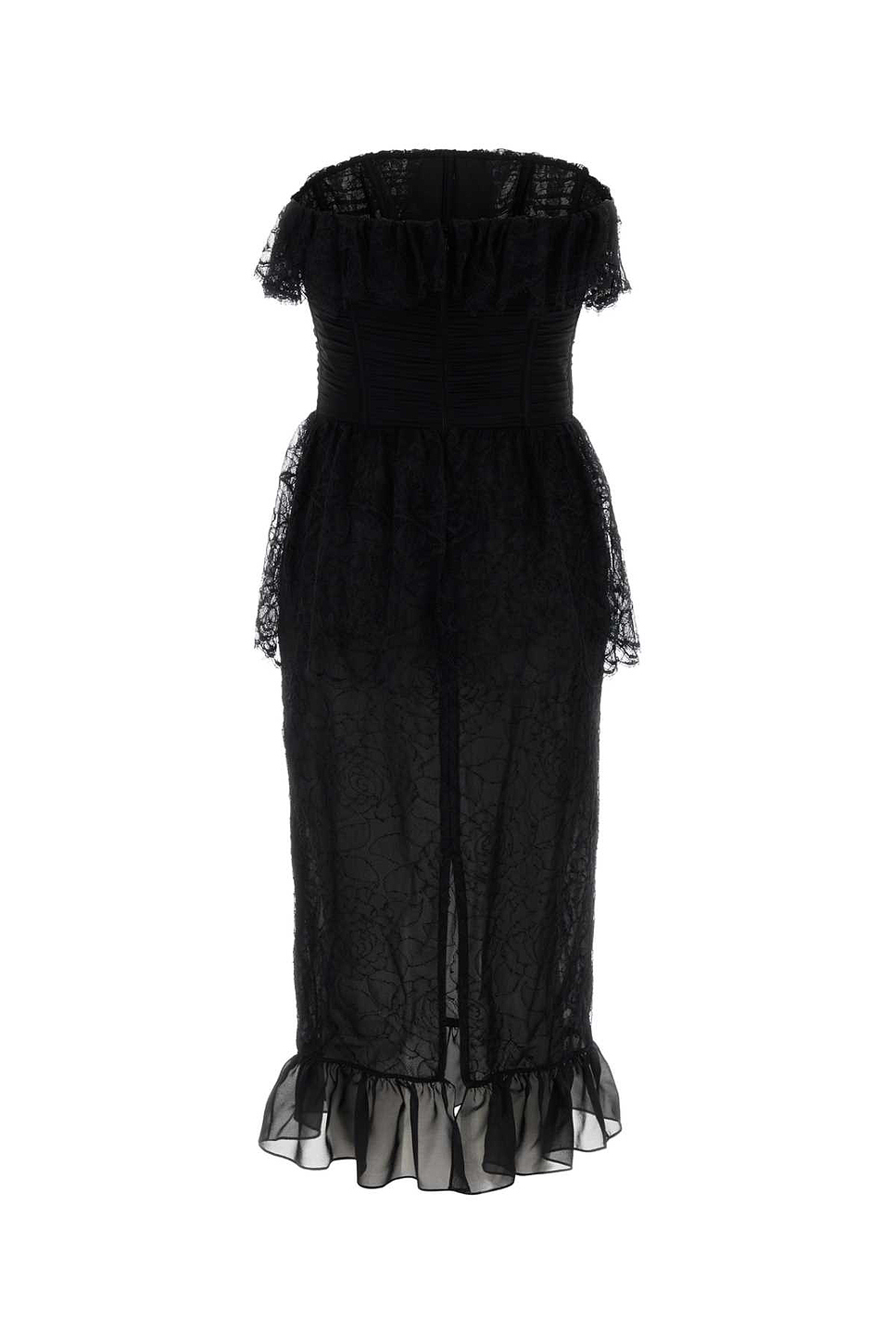
A black lace dress listed as made in Italy, filed by the retailer under midi dresses, at 2,595 dollars. There are no reviews and no fit votes, so there is no score to quote. The two layers are separated and named, which is what this series has spent a great deal of space asking for, and both are then described in the same two words: one hundred per cent fabric. It is worth being precise about why that is worse than saying nothing at all, because arriving here took this series through every other version of this problem. There is also something unusual about this page that deserves credit even while everything else about it fails. The reference is the Alessandra Rich black lace dress in Black. Dongguan Bafinasa Garments Co., Ltd. develops comparable lace dresses on OEM and ODM terms, from lace sourcing and lining selection to retail or FBA ready packing. We publish this as a development reference and build your own version of it, and we do not supply the branded original or reproduce anyone else's label.
Key Features
- Shell and lining both listed separately rather than one being left to implication. See the note below
- Both are described as being made of fabric, which is not a fibre. See the note below
- Lace, named in the product title rather than in a specification, and what lace is decides why the missing information matters more here than anywhere else
- Black, which reduces one question without removing it
- Made in Italy as stated
- One size published: 40
- Filed by the retailer under midi dresses
- No care instruction stated anywhere on the listing
Customisable Options
- Fabric: black lace to the reference, and we would name every component rather than a category word
- Fibre: we offer cotton, nylon, polyester, viscose or blended lace, each tested before it is chosen
- Lining: we would specify the lining fibre rather than only saying there is one, and match it to the lace
- Opacity: we would state plainly what this garment does about it
- Care: we would set the instruction from washing trials rather than from habit, and publish the reason
- Length from knee to ankle, lace pattern and ground, lining options, size set, private label and care labelling
Specifications
| Style | Black lace midi dress |
| Reference | Alessandra Rich, black lace dress, style FEXN-WD1178, manufacturer style FABX4152P4605 0900, colour Black |
| Shell | Stated only as fabric, with no fibre named. See the note below |
| Lining | Stated separately, and also given only as fabric. See the note below |
| Fabric | Lace, named in the product title rather than in a specification. See the note below |
| Opacity | Not stated anywhere on the listing |
| Care | None stated on the listing, which for lace of unknown fibre cannot be reasoned about at all |
| Sizes Published | 40 only |
| Measurements | None published. No size chart and no model body figures on this listing |
| Photographs | Two |
| Production | Made in Italy as stated |
| Reference Retail | 2,595 USD, quoted to show the price band this sits in, not as our price |
| Customer Reviews | None on the reference listing, so we quote no score |
| Best Seller Badge | None. The listing carries no rank |
| Categories | Filed by the retailer under midi dresses, with no second category |
| Occasion | Evenings, occasions, formal events |
| MOQ | 100 pcs per style per colourway, mixed sizes and colourways accepted |
| Sampling | 7-10 days after tech pack or reference sample confirmation |
| Bulk Lead Time | 20-30 days after sample approval and deposit |
| Service | OEM / ODM / private label, lace development, lining matching, retail or FBA ready packing |
Size Chart
| Size | Bust | Waist | Hips | Length | Source | ||||||||||||
|---|---|---|---|---|---|---|---|---|---|---|---|---|---|---|---|---|---|
| 40 | 31 | in / | 79 | cm | 24 | in / | 61 | cm | 34 | in / | 86 | cm | 125 | cm / | 49.2 | in | Our proposal |
| 42 | 33 | in / | 84 | cm | 26 | in / | 66 | cm | 36 | in / | 91 | cm | 127 | cm / | 50 | in | Our proposal |
| 44 | 35 | in / | 89 | cm | 28 | in / | 71 | cm | 38 | in / | 97 | cm | 129 | cm / | 50.8 | in | Our proposal |
| 46 | 37 | in / | 94 | cm | 30 | in / | 76 | cm | 40 | in / | 102 | cm | 131 | cm / | 51.6 | in | Our proposal |
This listing publishes one size, 40, and no size chart, no measurements and no model body figures. There is nothing on the page from which a customer could judge the fit, and no length figure to compare against the retailer's own midi filing.
Occasions and Styling
Suits evenings, occasions and formal events. A black lace midi is an evening piece, and it is worth knowing that lace needs gentler treatment than almost any other cloth, though which treatment this particular garment needs is not something this page can tell you.
Production and Quality Control
There are no reviews and no fit votes on this listing, so we quote no score. Both layers are named separately and both are then described in two words that mean nothing, which is a different failure from any this series has catalogued, and understanding why it is worse requires going back through how the problem developed.
It took its time getting here, and this is worse than the version it replaced, and that is the first thing. This series has spent a great deal of space on one specific question, which is whether a page tells you what a garment is made of when there is more than one layer to it, and the answer has almost always been no. Ten or so instances have accumulated, and they differ mainly in the word chosen: a word meaning shell appearing again and again with no second layer ever named; the same idea as principal material, which once turned out to introduce three full compositions in a row and was therefore doing honest work; the same idea in Portuguese; and most recently the English word exterior with a stray full stop after it. Nine times the pattern held, which was that the word invited a question and the answer never came. Then two listings in succession broke it, naming their second layers outright, and this series credited both while observing that finally getting the number also exposed how far apart the two layers were. Now consider this page. Both layers are named. There is a shell and there is a lining, distinguished from each other in the very same field, which is more than many pages manage and is the outcome this series has been asking for throughout. And then each is described as one hundred per cent fabric. That word is not a fibre. It does not name a substance, it names the thing being described, so the statement reads as suggesting the lace is entirely composed of cloth, which is true of every garment ever made and distinguishes this one from nothing. This is worth separating from every prior failure, and the distinction is the important part. Every earlier version withheld. The word for shell told you what to ask and declined to answer it, leaving the customer aware that something was missing. This one replaces the answer with a synonym, so there is nothing to notice. A customer reading this is not left wondering, because the sentence resolves. It appears to have said something. That is why it is worse than silence, and it is worth being blunt that this is a category error rather than compression: no information was lost in shortening, since the original word describing a fibre was replaced rather than trimmed. The likeliest explanation is also worth naming because it is recoverable. This has the look of a failed conversion somewhere upstream, in which a field expecting a fibre name received a category word instead, and such faults are systematic rather than individual, meaning they tend to affect every garment passing through the same step rather than one listing. Somebody checking one other page would probably find out in a minute. There is one more thing this exposes, which is that giving the structure was the easy half. This page has the hard part right, since separating the layers is what most never manage, and it is the contents that failed.
Lace without a named fibre is the worst combination this series has met, because the range is total, and that is the second thing. This series examined lace several times and was always able to reason about it, and it is worth recalling precisely why that was possible, since it shows what the missing information is doing here. Two garments were compared some batches ago, both described as lace and both one hundred per cent polyester, differing in exactly one respect: one carried a hand wash instruction and the other carried nothing at all. Because the fibre was known, something useful could be established, which is that polyester tolerates machine washing perfectly well, being dimensionally stable and quick drying, so it was not the fibre driving the instruction but the structure, since lace is an open thread construction held in shape by its own geometry rather than by warp and weft locked into each other, and agitation makes those threads catch on each other in ways that cannot be undone. Consider now what happens on this page. Not only is there no instruction, there is no fibre either, so neither half of that reasoning is available, and it is worth being explicit about how wide the range actually is, because it is unusually wide. Cotton lace can generally be washed. Nylon lace is light and very strong, being the commonest choice for lace precisely because it takes fine gauge well. Polyester lace is strong and stable but does not tolerate agitation as just described. Silk lace is considerably more fragile again. Viscose lace would be the weakest of all, since viscose loses around half its strength when wet, and this series has noted elsewhere how much worse that becomes in an open structure, having observed that a single thread fails before a whole cloth does. So the correct instruction for this garment could plausibly be anything from machine washable to dry clean only depending on which of those five it turns out to be, and there is nothing on the page narrowing it even slightly. That is worth stating as a general principle rather than only about lace: some structures make the fibre decisive rather than incidental, and for those the absence of a fibre name removes the ability to reason at all rather than merely removing one fact among several. There are two further consequences specific to lace that follow, and neither can be assessed here. Weight behaves differently from woven cloth, since lace has no continuous area for weight to spread across, so the way it pulls at seams and shoulders over an evening is particular to its own gauge, and this series noted recently on a sequinned page that added weight matters especially where a garment has to hold itself up. And pressing is awkward, since an open structure has no flat surface to press, so whatever heat the fibre tolerates matters rather more than usual, this series having noted before that plastic trim softens and curls under heat while a fine ground fabric can be marked by an iron directly. Neither can be thought about without knowing what the fibre is.
Two remaining points, one crediting this page for something and one about a name that points at nothing present, and that is the third thing. The credit first, since this series has generally withheld it. The two layers are separated and named in the same field, and although the contents failed, that structure is what the earlier wording had been inviting for nine instances without ever delivering. This series noted when the pattern first broke that finally receiving the number also revealed how far apart the layers were, which was a point about substance rather than about structure. Here the structure arrived and the substance did not, and separating those two is how progress actually happens on pages like these: getting the field right is the stepmost listings have not yet taken, and it is worth saying plainly that this one has. It is also worth noting that separating them tells the customer something immediately even without fibres, since a lined lace garment is a different proposition from an unlined one on exactly the question nobody addresses here, which is what shows through. Now the name. The product name describes this as a lace dress, and separately the composition says fabric, so the naming is doing all the work that was supposed to be done by the composition field. This series has catalogued this displacement many times, having counted five or six cases where a useful fact ended up in a product name rather than a field, beginning with a French title carrying the word for knit, where only a reader of French could find it, and continuing through twill, poplin twice, jersey and broderie anglaise. What distinguishes this case is that the other garments had something in the field to go alongside the clue in the name, however thin: those pages named their fibres even when they hid their constructions. Here the field is empty of content, so a single word in the title carries everything anybody can possibly know about what this garment is made of. That is worth recording as the endpoint of that pattern, since each instance has moved further, from a construction hidden in a name alongside a full composition, to everything resting on the name alone. Finally, there is the practical matter of what a customer can do, and it is worth answering plainly rather than leaving it hanging. Nothing on this page supports a care decision, not the fibre, not the lining, and not an instruction, so the safe assumption is the most conservative one, treating it as dry clean only until somebody can say otherwise. Writing that down would take one line and would remove a guess nobody has any basis for making. Every bulk shipment gets a measurement report against your approved chart.
Optional upgrades include naming the fibre of both the lace and the lining, since both fields currently say fabric and that is not a substance, testing whichever fibre is chosen and setting the care instruction from those trials rather than from habit, publishing the reason for the instruction so a customer knows what she is protecting, stating plainly what happens about opacity now that a lining is known to exist, keeping the separated shell and lining fields, since that part has been done correctly here, and publishing measurements for size 40 at the very least, the length stated so the retailer's own midi filing can be checked, more than one size offered, private label, hangtag and care labelling.
Pre-production sample approval, in-line inspection during cutting and sewing, and a final AQL inspection before packing, with measurement reports and photos shared before shipment.
Send us your tech pack, a photo or a reference garment and we will quote within 24 hours. Contact bafinasa@bafinasa.com or WhatsApp +86 13827222469.