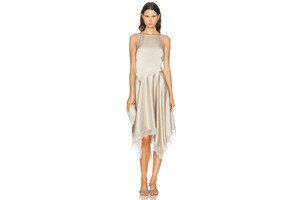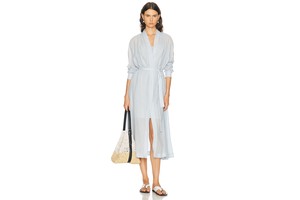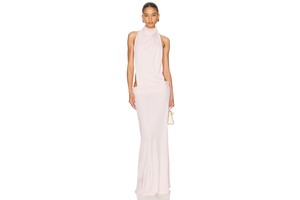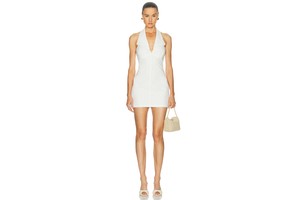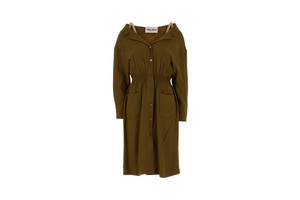
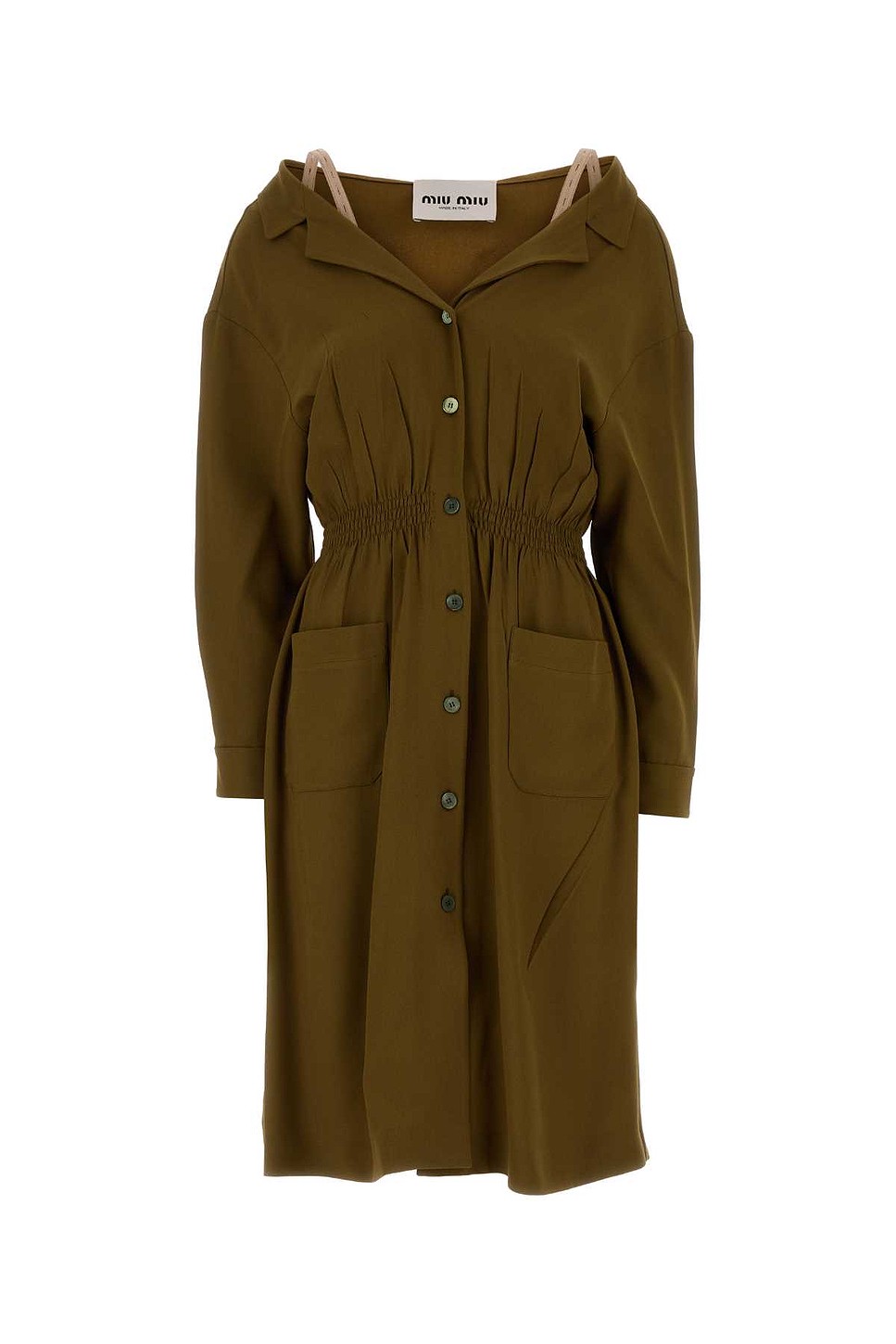
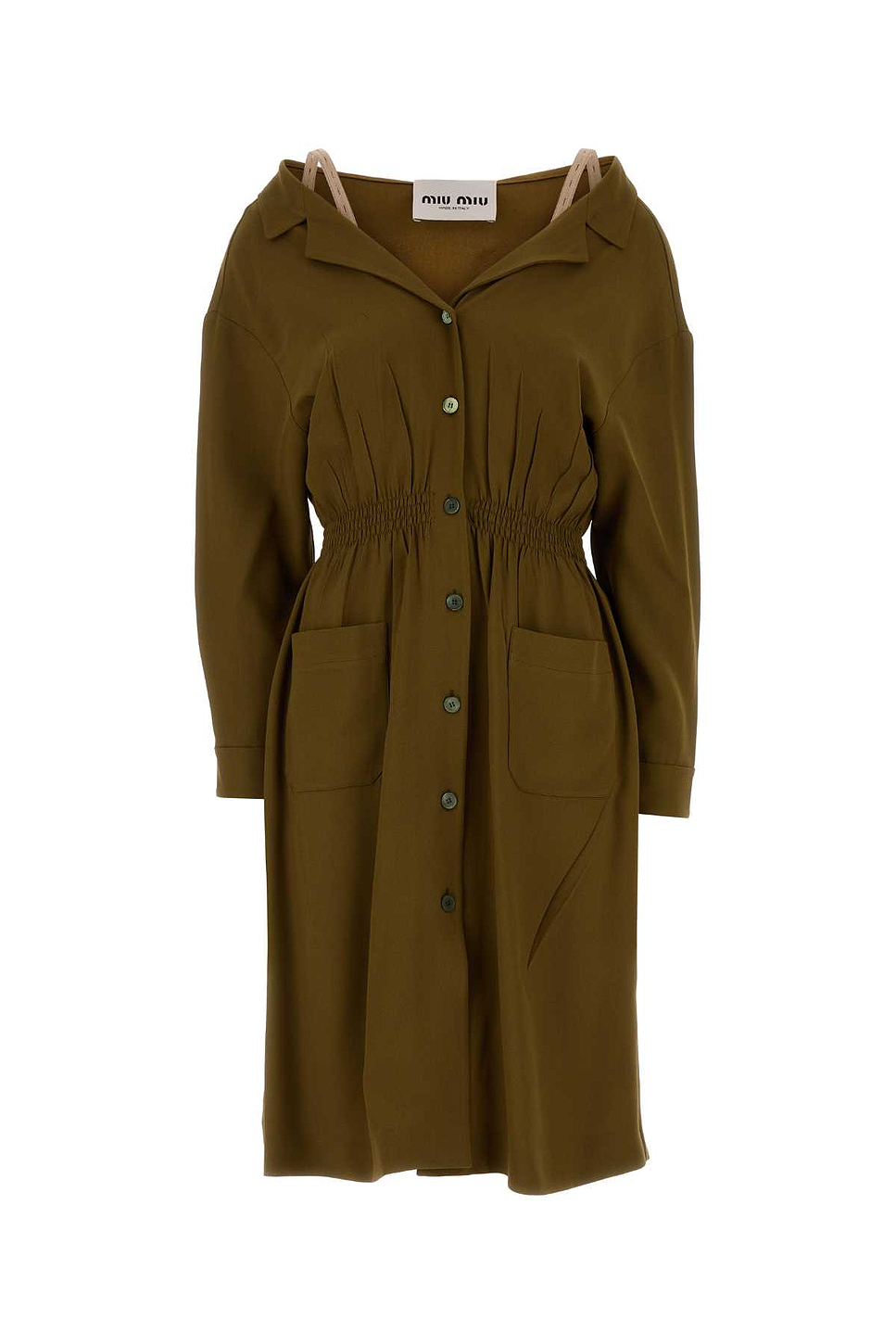
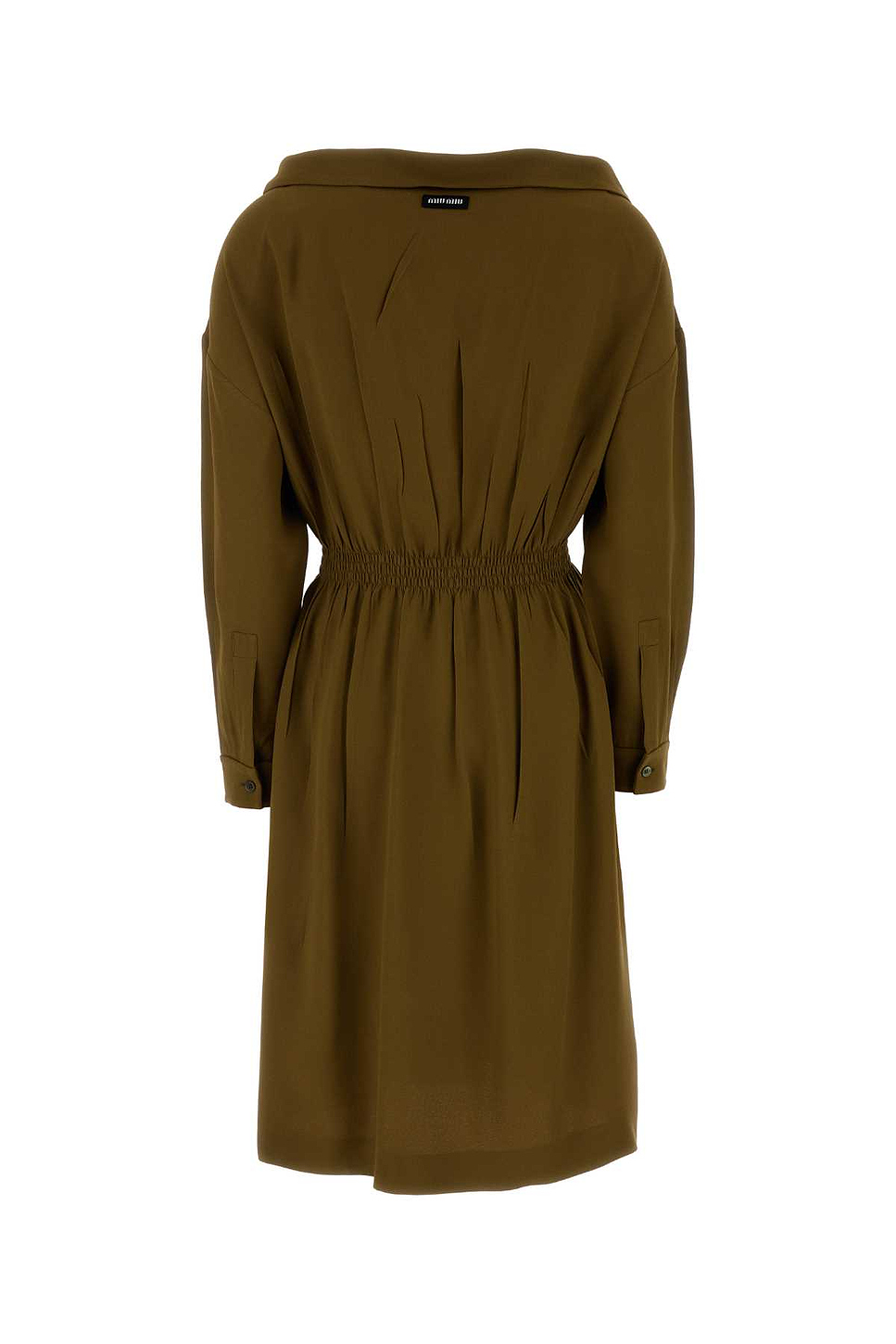

A dress listed with a shell of 74% acetate and 26% viscose, made in Italy, filed by the retailer under mini dresses, at 2,998 dollars. There are no reviews and no fit votes, so there is no score to quote. The product information amounts to the composition, the country and two stock numbers, with two photographs and sizes 40 and 42. The proportions here are identical to a garment examined several batches ago from an unrelated maker, which also happens to have handled the same composition differently, and pairing them gives the cleanest comparison this series has yet had. There is also something in the product name pointing at something absent from the composition, which is worth taking seriously rather than waving away. The reference is the Miu Miu olive green sable dress in Green. Dongguan Bafinasa Garments Co., Ltd. develops comparable acetate dresses on OEM and ODM terms, from fabric sourcing to retail or FBA ready packing. We publish this as a development reference and build your own version of it, and we do not supply the branded original or reproduce anyone else's label.
Key Features
- Shell: 74% acetate, 26% viscose as stated, which matches another maker's figures exactly. See the note below
- The cleanest paired comparison this series has had. See the note below
- Second layer not stated, though the composition is given as a shell
- Sable named in the product title, with nothing animal in the composition. See the note below
- Olive green, which sits at neither end of the opacity question
- Made in Italy as stated
- Two sizes published: 40 and 42
- No care instruction stated anywhere on the listing, unlike the other maker using these same proportions
Customisable Options
- Fabric: acetate viscose to the reference, with the weight set from a tested sample
- Ratio: seventy four and twenty six to the reference, and we would test shifting either way for drape
- Care: dry clean only added, since both fibres need it and this is what its pair states
- Hand: if a particular softness is wanted we would source that deliberately rather than name a fibre for it
- Length from mini to knee, cloth weight, second layer options, size set, colour development, private label and care labelling
Specifications
| Style | Acetate viscose mini dress |
| Reference | Miu Miu, olive green sable dress, style FEXN-WD1308, manufacturer style MF6052SOOO16Z1 F0334, colour Green |
| Shell | 74% acetate, 26% viscose as stated. See the note below, since these figures match another maker's exactly |
| Second Layer | Not stated, though the composition is given as a shell |
| Care | None stated on the listing, which its pair states correctly. See the note below |
| Sizes Published | 40 and 42, two adjacent sizes |
| Measurements | None published. No size chart and no model body figures on this listing |
| Photographs | Two |
| Production | Made in Italy as stated |
| Reference Retail | 2,998 USD, quoted to show the price band this sits in, not as our price |
| Customer Reviews | None on the reference listing, so we quote no score |
| Best Seller Badge | None. The listing carries no rank |
| Categories | Filed by the retailer under mini dresses, with no second category |
| Title Note | Sable is named in the product title, and nothing animal appears in the composition. See the note below |
| Occasion | Occasions, evening events, formal daytime |
| MOQ | 100 pcs per style per colourway, mixed sizes and colourways accepted |
| Sampling | 7-10 days after tech pack or reference sample confirmation |
| Bulk Lead Time | 20-30 days after sample approval and deposit |
| Service | OEM / ODM / private label, acetate and viscose sourcing, retail or FBA ready packing |
Size Chart
| Size | Bust | Waist | Hips | Length | Source | ||||||||||||
|---|---|---|---|---|---|---|---|---|---|---|---|---|---|---|---|---|---|
| 40 | 31 | in / | 79 | cm | 24 | in / | 61 | cm | 34 | in / | 86 | cm | 88 | cm / | 34.6 | in | Our proposal |
| 42 | 33 | in / | 84 | cm | 26 | in / | 66 | cm | 36 | in / | 91 | cm | 90 | cm / | 35.4 | in | Our proposal |
| 44 | 35 | in / | 89 | cm | 28 | in / | 71 | cm | 38 | in / | 97 | cm | 92 | cm / | 36.2 | in | Our proposal |
| 46 | 37 | in / | 94 | cm | 30 | in / | 76 | cm | 40 | in / | 102 | cm | 94 | cm / | 37 | in | Our proposal |
This listing offers two sizes, 40 and 42, and publishes no size chart, no measurements and no model body figures. There is nothing on the page from which a customer could judge the fit, and no length figure to compare against the retailer's own mini filing.
Occasions and Styling
Suits occasions, evening events and formal daytime. Both fibres here need water kept away from them and neither failure can be put right afterwards, which is worth knowing before buying, since nothing on the page says so.
Production and Quality Control
There are no reviews and no fit votes on this listing, so we quote no score. The proportions here are identical to another maker's garment which handled them differently, giving the cleanest comparison yet available. There is also a word in the product name pointing at something the composition does not contain.
Identical proportions to another maker's garment, and one has a care instruction and one does not, and that is the first thing. Several batches ago this series examined a dress whose shell was seventy four per cent acetate to twenty six per cent viscose, with a second layer named as polyester and an instruction of dry clean only. This garment's shell is seventy four per cent acetate to twenty six per cent viscose. The two are unrelated makers, so there is no particular reason for anybody to have expected them to coincide, and yet every figure matches. There is a curiosity in that worth noting before drawing anything from it: identical choices of fibre and proportion arrived at twice, independently or otherwise, suggest these proportions are doing something specific that cloth developers keep wanting, rather than being arbitrary. What is interesting is that the pair differs on exactly one thing, and this series has valued that shape of comparison since it first found it. Some batches ago two lace garments were compared that shared their fibre entirely, both being one hundred per cent polyester, both described as lace, differing in precisely one respect, which was that one carried a hand wash instruction and the other none at all. Because everything else was held constant, it became possible to establish that polyester had nothing to do with the instruction, since polyester tolerates machine washing perfectly well, and that therefore it was the open thread structure doing the deciding. Here the same method applies and the variable is even cleaner, since these two share not merely fibre but proportion, differing in whether anybody said anything about care. So what can be concluded is unusually firm. Both components here fail in water by mechanisms this series has described separately: acetate stiffens and dulls and it marks, and those marks are not dirt sitting on the surface but a change in how the surface reflects light, which is why they cannot be cleaned off; and viscose, being regenerated cellulose, loses around half its strength when wet and is liable to shrink and crease badly as it dries. Neither failure can be undone. So the correct answer for this composition is dry clean only, which is exactly what the other garment says, and this one says nothing at all. A clean difference like this rules out the explanations people usually reach for, and it is worth going through them. It cannot be that the maker did not know, since a second maker with the identical cloth wrote the line down. It cannot be that the cloth varies, since the proportions are the same to the figure. It cannot be that these pages have no room, since the field is already there on thousands of listings. What remains is that nobody did it, which is the shape of problem this series has been describing since it first found a cotton twill needing dry cleaning because of its applied decoration. There is one refinement worth adding because it changes how the missing line should be read. Where there is no instruction at all, most customers will assume the garment is washable, since that is the default assumption about fabric, and this series noted the same thing about a lace garment where silence acts as an invitation rather than as a gap. So the absence here does not merely leave a question open, it produces a specific and wrong belief about one of the most fragile pairings met anywhere.
Three quarters acetate is not arbitrary, and the recurring pairing has a reason worth stating, and that is the second thing. This series met its second acetate and viscose pairing recently, at fifty five viscose to forty five acetate, and observed then something useful about proportions: at lopsided ratios there is one dominant failure to plan around, while at near even ratios both kinds of failure are visible at once, and so the situation is better assessed by counting how many different failures are in play than by measuring how fragile the parts are. A third appeared in this same batch at seventy seven acetate to twenty three viscose, and this is the fourth, giving four instances across four makers with ratios spanning almost the whole available range from near parity to very lopsided. Four is enough to ask why this particular pair keeps recurring, and there is a sound answer. Both fibres come from cellulose, one being a chemically modified form and the other a regenerated form, and that common origin is what makes them compatible in practice: they hang, dye and take finish in broadly similar ways, and neither behaves like a synthetic, which is why a blend of them can be made to read like a costly silk without silk's price or silk's particular weaknesses. Acetate brings lustre and a dense heavy drape. Viscose brings softness, better moisture handling and lower cost. Makers are choosing this pair for how it looks and moves, and its behaviour in water is the accepted cost of that choice rather than an oversight, which is a fair position to take, since there is nothing wrong with selecting a difficult cloth deliberately. What is less defensible is leaving the customer to discover the cost afterwards. Now, the ratio here deserves a further word because seventy four to twenty six is decidedly lopsided, and this series established that lopsided proportions mean one failure dominates. At three parts acetate to one part viscose, the dominant risk is acetates own: stiffening, dulling, and marking in a way that cannot be cleaned off. It is worth adding what that means in practice rather than in principle, since it is more specific than it sounds. Because the marks are a change in how the surface reflects light rather than anything deposited on it, they tend to appear where water sat and dried rather than where the garment was soiled, so a splash left to dry can leave evidence even on a garment hardly worn, and no cleaning will remove it. That particular failure mode is the one a customer buying this cloth is accepting, and knowing it would quite reasonably affect how somebody wore it in the first place. One small point about the colour should be included for completeness. Olive green sits somewhere in the middle on opacity, since it is neither pale enough to show much nor deep enough to be safe, and this series has compared colours directly before, observing that a deep berry gown carried genuinely less risk than pale equivalents because deeper dye absorbs more light. But the fabric fails in water regardless of colour, so nothing about the shade changes the conclusion above.
Sable in the name with nothing animal in the composition, and what that kind of word is doing, and that is the third thing. The product name describes this as a sable dress. Sable most commonly denotes a small mammal whose fur has historically been among the most expensive pelts in the trade, being used for the very finest brushes and for fur garments. The composition states acetate and viscose and nothing else. So there is no animal fibre here of any kind, and the word is not describing what this is made of. The likeliest reading is that it describes hand or appearance, and this is common enough practice in the industry, where cloth is given a name evoking the thing its surface resembles, so that a fabric might be called doeskin or a knit called cashmere despite containing none of either. That practice is normal, and this series would rather describe it accurately than treat it as deception, since nobody buying this is being told it is fur. But there are two things worth drawing out, and the first is about how much these words carry. Names do a great deal of work on pages like this, and this series has traced that across many garments: a product name carrying the French word for knit so only French readers could find the construction; twill; poplin now three times; jersey; broderie anglaise, where three words did more than any of the others because they mean openwork and therefore mean the garment is sheer in places; and most recently another name evoking a shape. Some of those carry genuine specification. This one carries none, and nothing tells a customer which kind she is looking at. That is the recurring shape of the problem and worth stating once more, since each instance moves it along: information placed in a product name is available only to whoever can read it and interpret it, and there is no way in advance to know whether what appears to be describing the cloth is doing so literally. The second thing is what this opposes. There is another garment in this batch whose composition field contains no fibre at all, both layers being described simply as fabric, which this series described as a category error, since a word naming the thing being described was put where a substance belonged. In that instance the name said lace and carried everything anybody could possibly learn. Here the field is full and correct, and the name is doing something else entirely, evoking a feel rather than naming a content. So together the pair brackets the thing usefully, and the general principle is worth setting down because it applies to any listing: a composition field and a product name are doing two quite different jobs, one stating what something is and the other evoking it, and neither should be read as though it were performing the other's task. Every bulk shipment gets a measurement report against your approved chart.
Optional upgrades include adding dry clean only, since the proportions match another maker's garment which states it and both fibres need it, explaining what the instruction protects, since acetates particular failure is a change in how the surface reflects light rather than dirt and that is not something anybody would guess, either matching the second layer to the shell or keeping that instruction permanently, using a word other than sable in the name if it is meant to describe feel, or saying so plainly if it is, offering measurements and model figures so the two sizes can be acted on, more than two sizes since two adjacent figures cannot be distinguished from clearing leftovers, publishing the length so the retailer's own mini filing can be checked, alternative ratios tested for drape, alternative fibres if the drape can be reached less expensively in care terms, colour development, private label, hangtag and care labelling.
Pre-production sample approval, in-line inspection during cutting and sewing, and a final AQL inspection before packing, with measurement reports and photos shared before shipment.
Send us your tech pack, a photo or a reference garment and we will quote within 24 hours. Contact bafinasa@bafinasa.com or WhatsApp +86 13827222469.