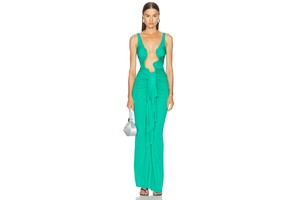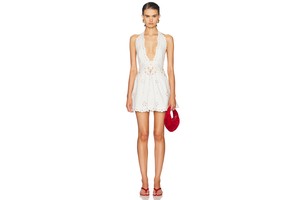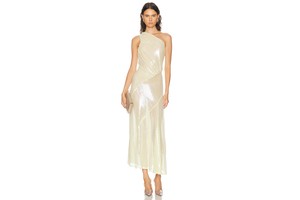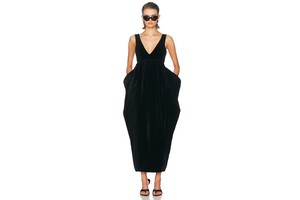
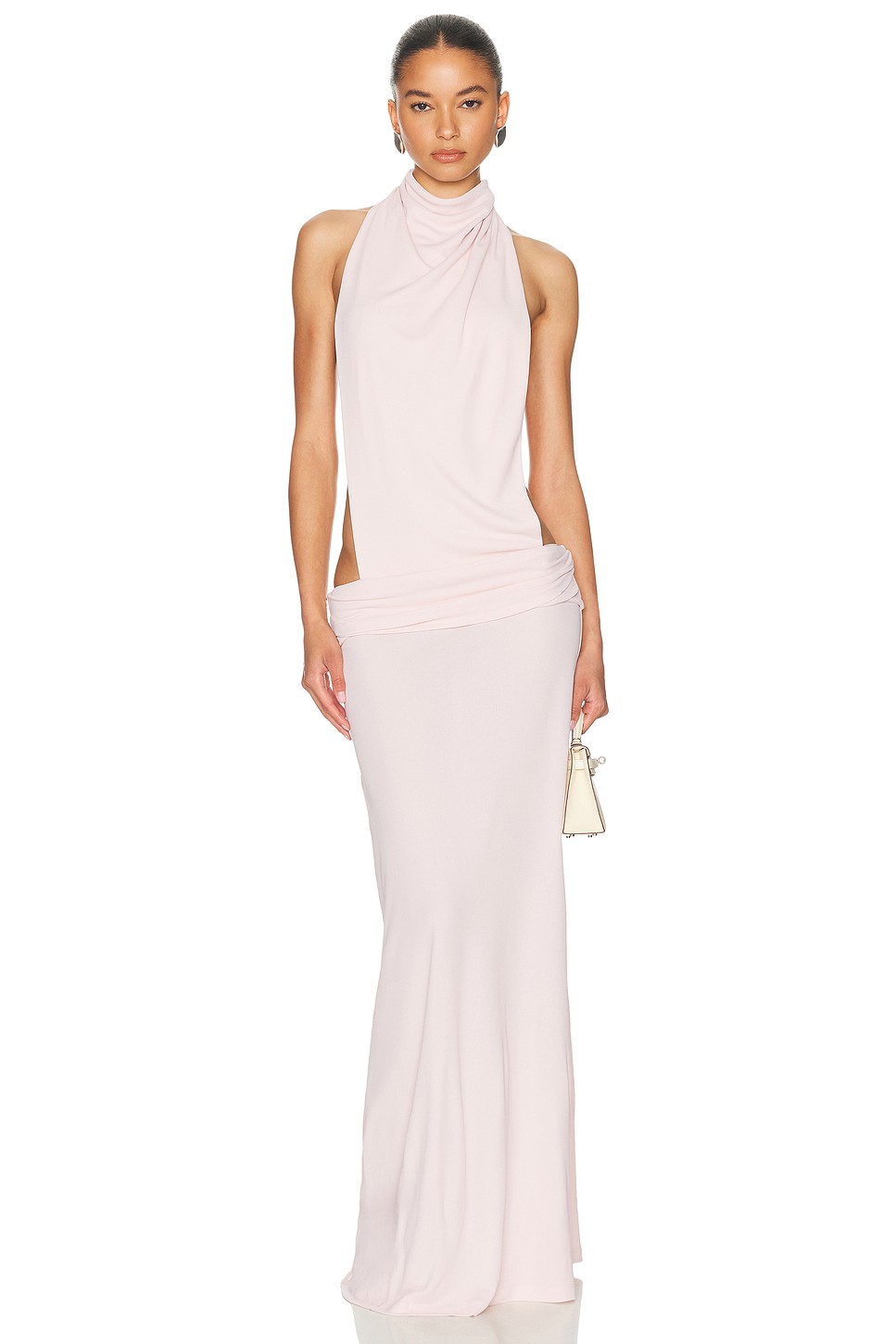
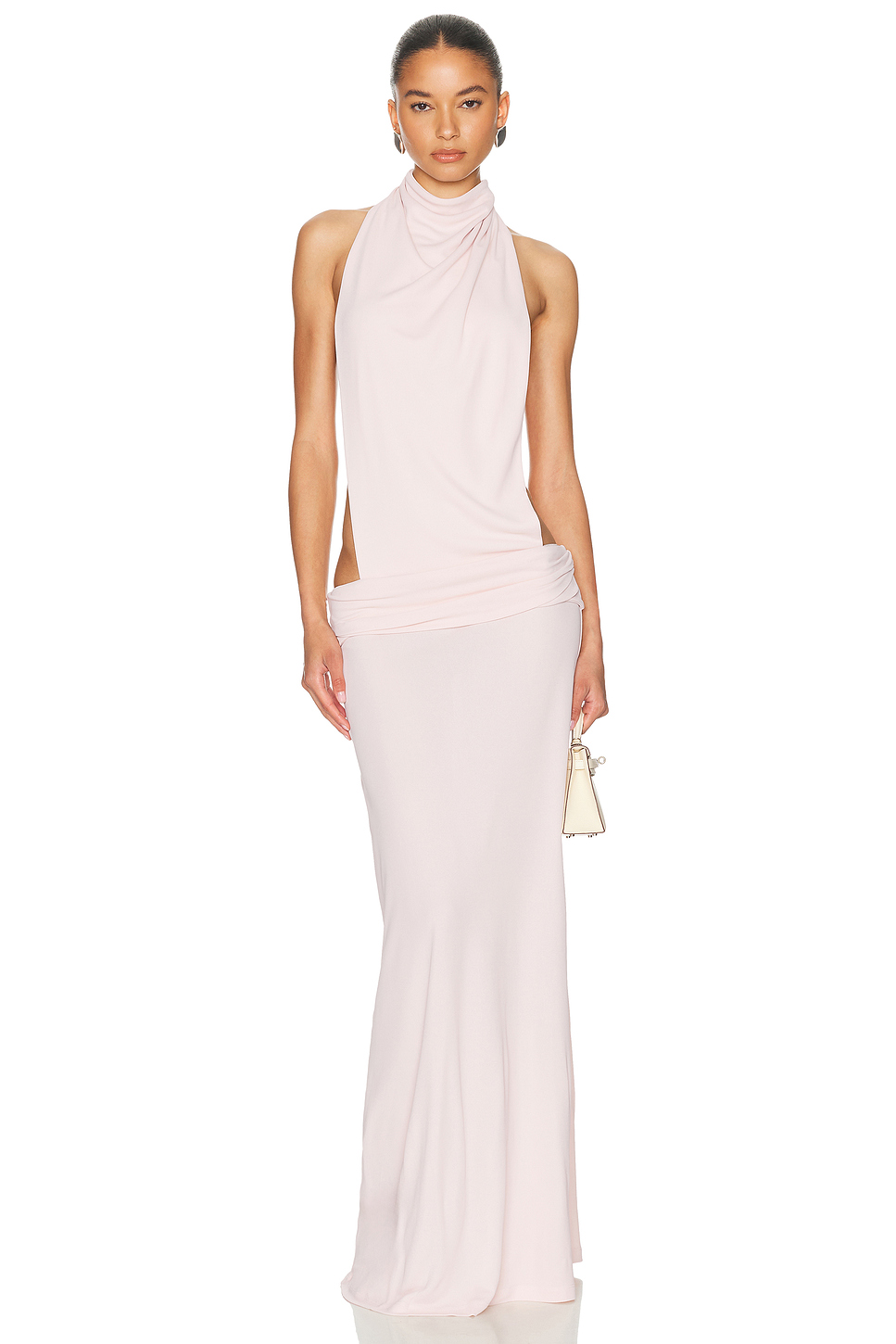
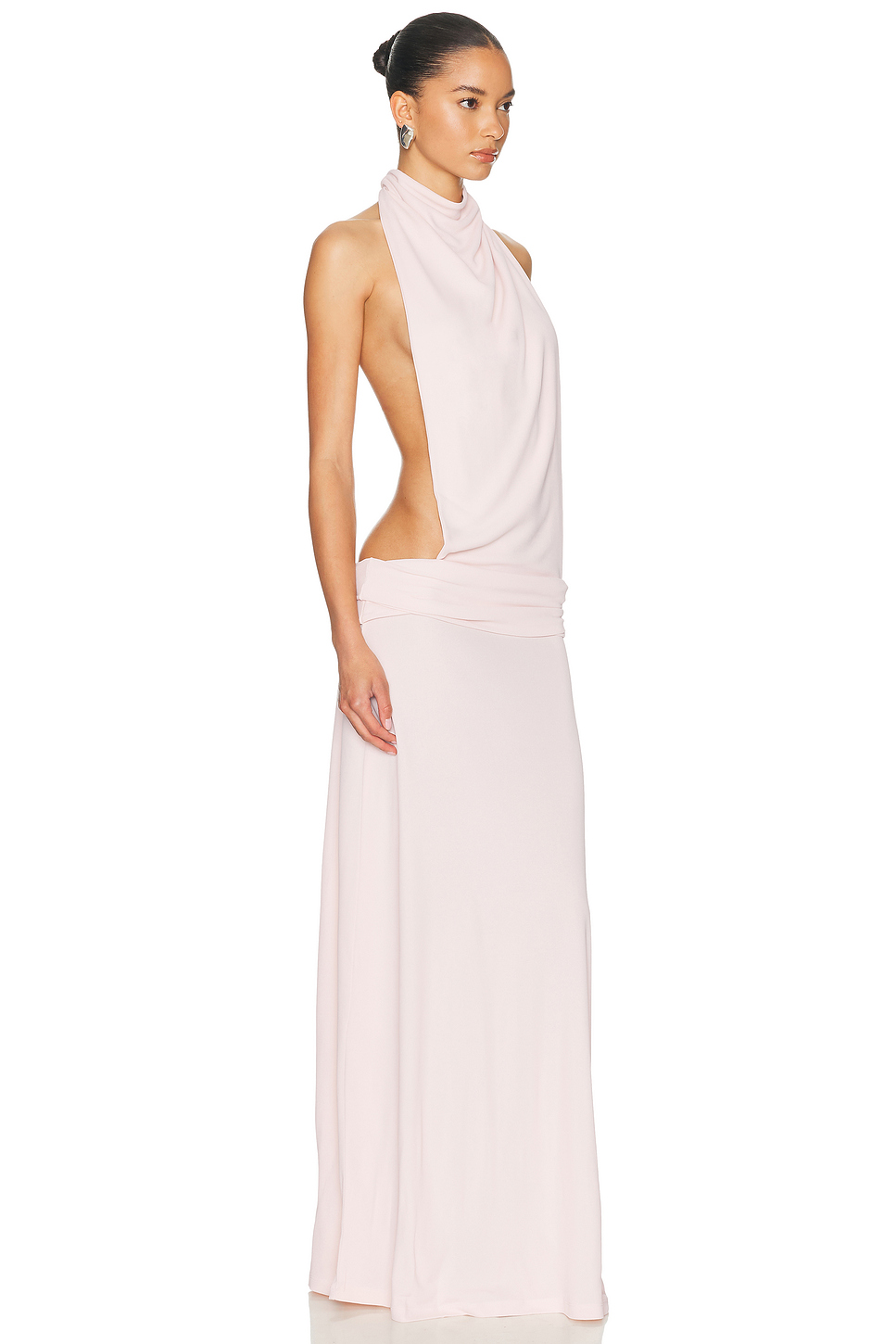
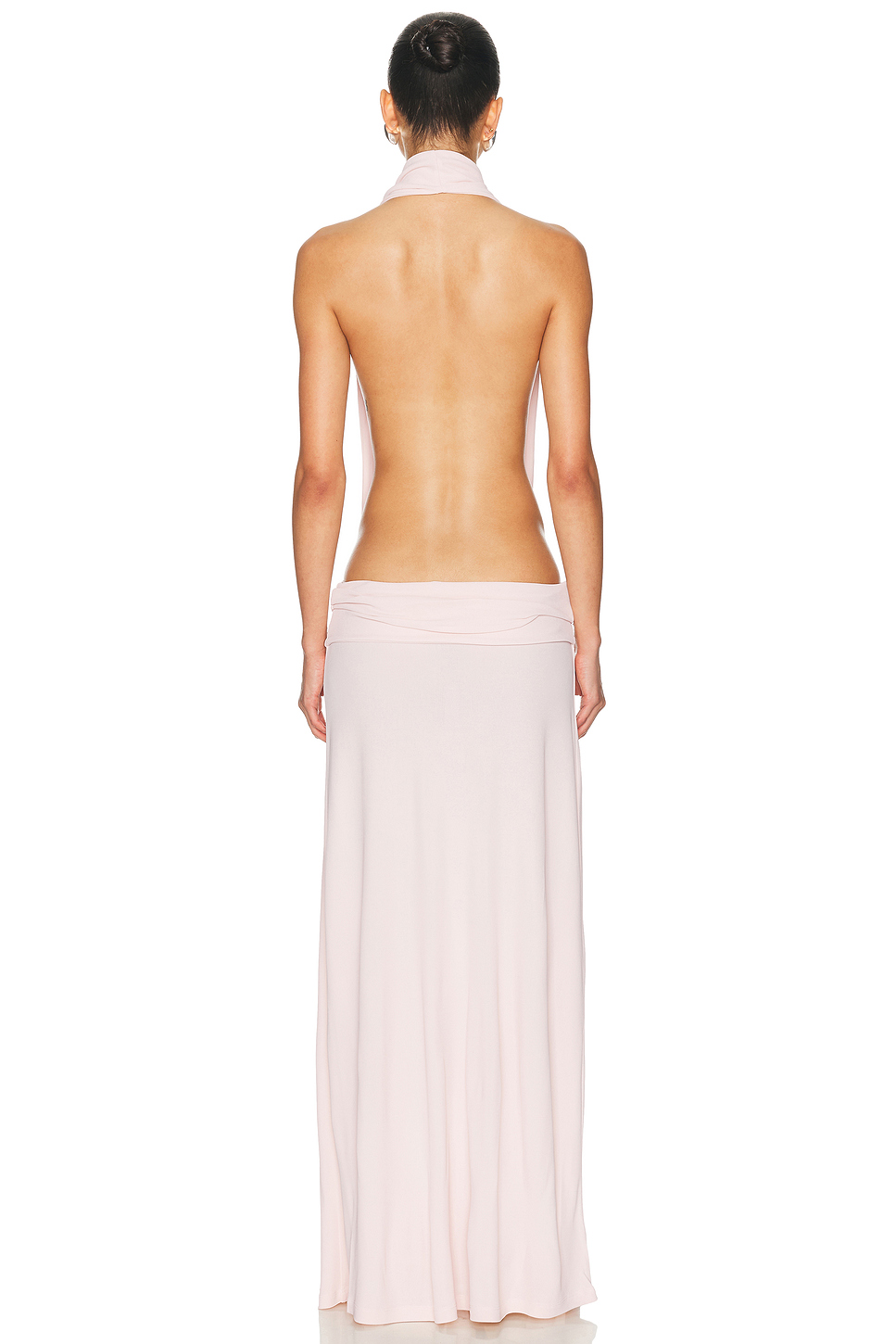
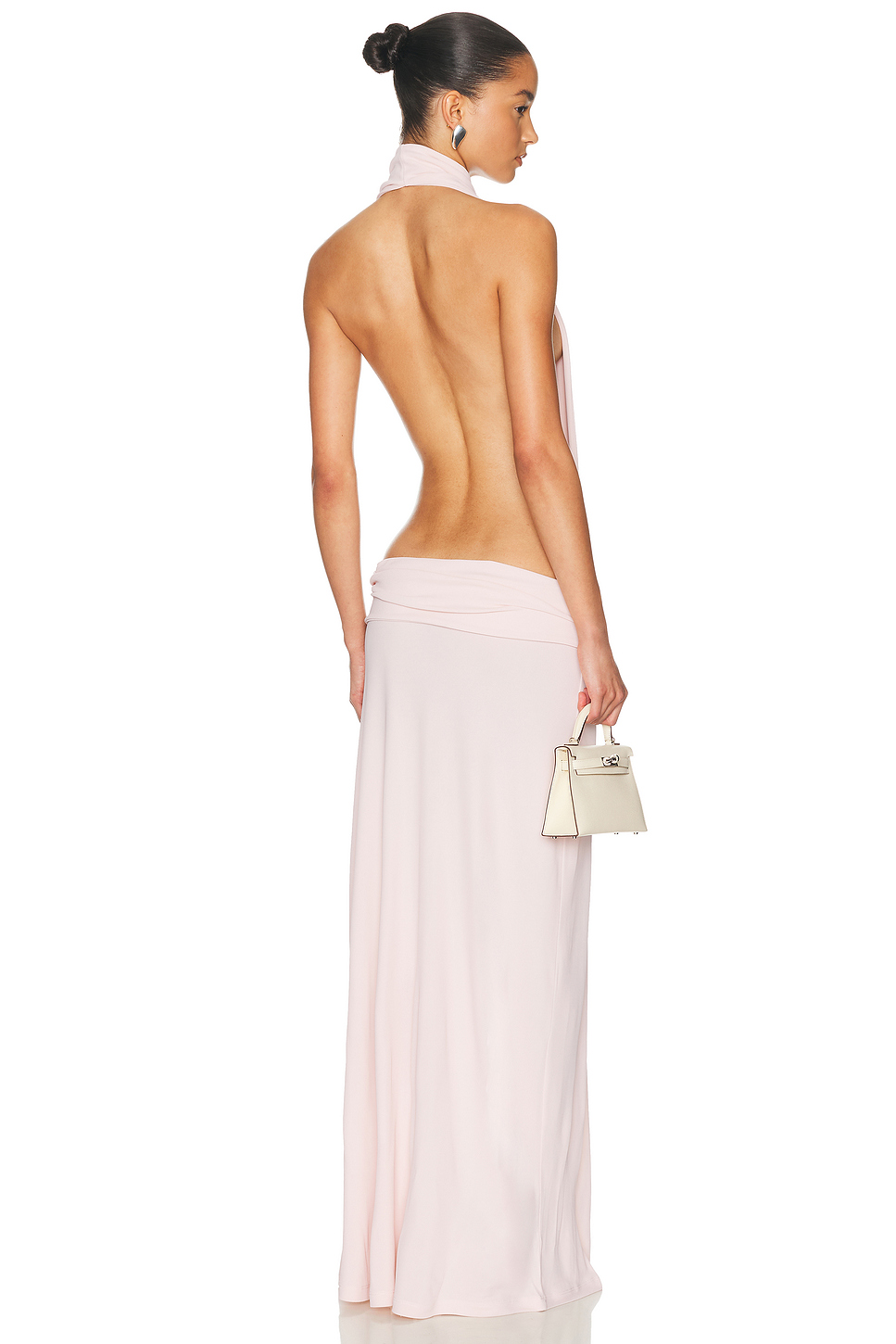
A dress listed in 80% rayon and 20% polyamide, machine washable, partially lined, a pull-on style with a halter neck and an open back, in a heavyweight crepe, made in Portugal, ranked forty first in the retailer's backless dress list, at 850 dollars. There are no reviews and no fit votes, so there is no score to quote. This is the second time this series has met this particular fibre pairing and the two were treated completely differently, with the more fragile of the two permitted the looser instruction, which is not what the reasoning would have predicted. The open back and the partial lining also turn out to be connected in a way worth setting out. The reference is the Ione Dress by Aya Muse in Blush. Dongguan Bafinasa Garments Co., Ltd. develops comparable halter and backless dresses on OEM and ODM terms, from fabric sourcing to retail or FBA ready packing. We publish this as a development reference and build your own version of it, and we do not supply the branded original or reproduce anyone else's label.
Key Features
- 80% rayon, 20% polyamide as stated, and the pairing has been met here before with the opposite instruction. See the note below
- Machine washable as stated, which is the most permissive instruction this series has met
- Partially lined as stated, and the open back explains why it could not be otherwise. See the note below
- Halter neck and open back as stated, and both are named in the retailer's own filing
- Pull-on style as stated, and combined with the open back that raises a fair question. See the note below
- Heavyweight crepe as stated, which is likely part of why machine washing survives here
- Made in Portugal as stated
- Sizes XS to L published, with model figures given but no size chart
Customisable Options
- Fabric: rayon polyamide crepe to the reference, with the weight set deliberately rather than inherited
- Lining: partial to the reference, and we would specify which parts are lined rather than only saying partial
- Care: machine washable to the reference, validated by washing trials rather than assumed
- Neck: halter to the reference, with the tie construction specified
- Open back, rayon nylon ratio, lining placement, crepe weight, size set, colour development, private label and care labelling
Specifications
| Style | Rayon nylon halter backless dress |
| Reference | Aya Muse, Ione Dress, style AYAF-WD128, manufacturer style AMSS2612, colour Blush |
| Composition | 80% rayon, 20% polyamide as stated. See the note below |
| Fabric | Heavyweight crepe as stated |
| Lining | Partially lined as stated. See the note below |
| Care | Machine washable as stated. See the note below |
| Neck | Halter neck design as stated |
| Back | Open back design as stated |
| Closure | Pull-on style as stated |
| Sizes Published | XS, S, M and L |
| Measurements | None published. No size chart, though model figures are given |
| Model | 177 cm, bust 81 cm, waist 60 cm, hips 89 cm, wearing size S |
| Photographs | Four |
| Production | Made in Portugal as stated |
| Reference Retail | 850 USD, quoted to show the price band this sits in, not as our price |
| Customer Reviews | None on the reference listing, so we quote no score |
| Best Seller Badge | Rank 41 in the retailer's backless dress list. Note the category is structural rather than about length |
| Categories | Filed by the retailer under backless dresses and halter dresses, both of which agree with the stated features |
| Occasion | Evenings, occasions, warm weather events |
| MOQ | 100 pcs per style per colourway, mixed sizes and colourways accepted |
| Sampling | 7-10 days after tech pack or reference sample confirmation |
| Bulk Lead Time | 20-30 days after sample approval and deposit |
| Service | OEM / ODM / private label, rayon and polyamide crepe sourcing, partial lining construction, retail or FBA ready packing |
Size Chart
| Size | Bust | Waist | Hips | Length | Source | ||||||||||||
|---|---|---|---|---|---|---|---|---|---|---|---|---|---|---|---|---|---|
| XS | 31 | in / | 79 | cm | 24 | in / | 61 | cm | 34 | in / | 86 | cm | 135 | cm / | 53.1 | in | Our proposal |
| S | 33 | in / | 84 | cm | 26 | in / | 66 | cm | 36 | in / | 91 | cm | 137 | cm / | 53.9 | in | Our proposal |
| M | 35 | in / | 89 | cm | 28 | in / | 71 | cm | 38 | in / | 97 | cm | 139 | cm / | 54.7 | in | Our proposal |
| L | 37 | in / | 94 | cm | 30 | in / | 76 | cm | 40 | in / | 102 | cm | 141 | cm / | 55.5 | in | Our proposal |
Sizes XS to L are offered, and model figures are given at 177 cm wearing size S, but no size chart is published. There is no length figure to indicate where this garment falls and nothing to compare against the retailer's own filing.
Occasions and Styling
Suits evenings, occasions and warm weather events. An open back changes what can be worn underneath as much as it changes anything else, and it is worth knowing before choosing that this is decided by the shape rather than by personal preference.
Production and Quality Control
There are no reviews and no fit votes on this listing, so we quote no score. This is the second time this fibre pairing has appeared and the two were treated oppositely, with the more fragile composition permitted the looser instruction, which is not what the reasoning predicted. The open back and the partial lining also turn out to be connected.
The same fibre pairing again, and this time it is permitted machine washing, and that was not predicted, and that is the first thing. This series met rayon blended with polyamide some batches ago, at sixty seven per cent rayon to twenty nine per cent, alongside a small amount of elastane, and the instruction there was dry clean only. Since then that combination has carried a working expectation: rayon loses around half its strength when wet and is prone to shrinking and creasing badly as it dries, and that loss cannot be avoided by blending, so it was reasonable to expect any rayon rich cloth to be handled conservatively. This garment is eighty per cent rayon to twenty per cent polyamide and it is machine washable. So there are two surprises rather than one, and it is worth being precise about both. The first is that the instruction is looser. The second, which makes the case genuinely interesting, is that this garment contains more of the fragile fibre than the one carrying the stricter instruction did. If rayon content decided the answer, this one should have been stricter, not looser. It is not, so rayon content does not decide the answer, and it is better to say that plainly than to pretend the earlier expectation survived intact. What might explain it is worth setting out, though this series would rather offer candidates honestly than manufacture certainty. The most likely is the cloth construction. That earlier garment was a knit, whereas this is explicitly a heavyweight crepe woven from hard twisted yarns, and the difference matters mechanically: a knit is loops that can shift against each other, so it distorts readily under the agitation of a machine, whereas a closely constructed heavy cloth resists that movement. The second candidate is the absence of elastane, since this garment has none at all while the other had a small percentage, and elastane has an upper temperature limit of its own, with this series having noted before that it degrades under repeated heat in a way the fibres around it do not. The third is weight itself. Heavyweight is stated outright here, and a heavier cloth of the same fibre and construction abrades less against itself in a drum, because there is less relative movement for the same amount of energy. Any of those could be doing it and none can be isolated from a page like this. What can be said firmly is the general lesson, and it is the useful part: whether a garment survives washing is decided by whether the forces applied exceed what the wet construction can take, and not by whether the word rayon appears on the label. The chemistry sets the weakness, but the mechanics decide whether that weakness is ever reached. There is one further point about this being machine washable that deserves separating out, since it is the most permissive instruction met anywhere in this series. Machine washable is a genuine answer rather than an absence, and it tells a customer something actionable: she can clean this at home, which changes what owning it costs and how often it can be worn. This series has spent a great deal of space on instructions that are missing where they were needed. It is worth saying that the opposite is also a real outcome, and that being told you may wash something is information of the same kind as being told you may not.
Partially lined, and this particular garment could not sensibly be anything else, and that is the second thing. Partially lined is new here, and it is worth setting beside the alternatives because it sits deliberately between them. Some garments in this series have said nothing at all about a second layer, which leaves the customer guessing. One recently said it had none, which this series noted was a genuine answer rather than an absence, since it settles the question instead of merely failing to raise it. Others have said they were lined or fully lined, and this series has argued throughout that a lining is the right answer for certain fabrics, having noted recently about openwork that because the holes are the whole point, a lining is not a refinement but the thing making the garment wearable at all. This one says partial, which is the most precise of the four options because it does not merely say whether there is something in there but also that it stops somewhere. Now here is the connection worth drawing, and it is the reason this belongs together with the features rather than merely with the statistics. The page also states that the garment has an open back. Those two facts are not independent. An open back cannot be lined along the opening, since a lining there would fill precisely the space the design exists to leave empty. So the partial lining is not a cost decision, nor an oversight, nor halfway honesty, and saying that is worth something, because otherwise a customer meeting the word partial might reasonably read it as either economy or carelessness. It is forced by the design, and once that is apparent the answer becomes more informative rather than less, because knowing that the lining stops somewhere tells her that the open back is genuinely open rather than backed by cloth. There is an honest consequence to record as well, which is that partial does not eliminate a question but refines it. Having learned the lining stops somewhere, the natural next question is where it stops, and this listing does not say. That is the recurring shape of these things, worth noting once more since it has appeared on nearly every page examined: getting a more precise answer rarely closes a line of enquiry, it makes the next question better defined, which is progress even when the next question is not answered.
Two structures that usually cancel each other, plus what the open back does to support, and that is the third thing. The retailer files this both under backless and under halter, and unusually both agree with what the listing itself states, which distinguishes this from those cases where labels and descriptions disagree. Those two things rarely appear together, and it is worth being clear about why. A halter is a construction in which fabric rises to the neck and is held by a tie or strap at the back of the neck, so the neck carries some of the garment's weight and helps hold the bodice up. An open back is the removal of the coverage across the back. Put those together and the load path becomes narrow: support sits at the front and at the neck, while the largest continuous area of the bodice, which is the back, contributes nothing at all holding it up. Now the listing also says this is a pull-on style, and that deserves a fair question rather than a rhetorical flourish. Pull-on means there is no zip or opening, so the garment is drawn on over the head or stepped into, and everything has to pass through the narrowest point of whichever route is used. With an unlined back opening and no fastening anywhere, quite a lot rests on the halter tie and on how much the cloth gives, and this series has noted that garments with no elastic fibre and no stretch structure rely entirely on their fastenings. This garment has none at all in its composition, twenty per cent polyamide being nylon rather than an elastomer and contributing strength and abrasion resistance rather than stretch. So the tie is doing real work, and nothing describes its construction. There is one further consequence of an open back which this series has not previously had reason to set down and which belongs here because it is practical rather than technical. An open back decides what can be worn underneath, and unlike the opacity question that recurs throughout these examinations, this constraint is structural rather than about degree. Opacity is a matter of how much light passes and can be solved by a lining or by choosing what goes under it. An open back cannot be solved that way, since there is no cloth to receive whatever is underneath. It is worth adding that this listing gives no length and no size chart, and model figures alone will not supply either, so there is also no way to check how far the opening extends, and that is the most variable thing about it. Every bulk shipment gets a measurement report against your approved chart.
Optional upgrades include stating where the partial lining stops, since the open back forces a partial answer and the next question is always where, validating the machine wash claim by actual washing trials rather than only asserting it, and stating the crepe weight numerically since heavyweight is doing real work here, publishing how the halter tie is constructed given that it is carrying load with no stretch in the composition, explaining that machine washing is permitted by the construction rather than despite the rayon, which reframes the whole question, adding a size chart and length so this can be compared against anything else, offering more than four sizes, private label, hangtag and care labelling.
Pre-production sample approval, in-line inspection during cutting and sewing, and a final AQL inspection before packing, with measurement reports and photos shared before shipment.
Send us your tech pack, a photo or a reference garment and we will quote within 24 hours. Contact bafinasa@bafinasa.com or WhatsApp +86 13827222469.