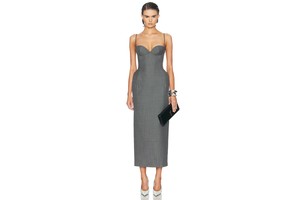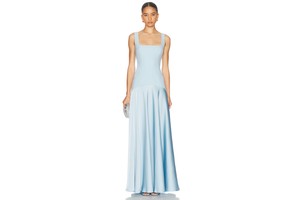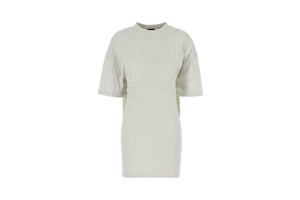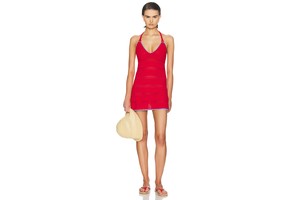
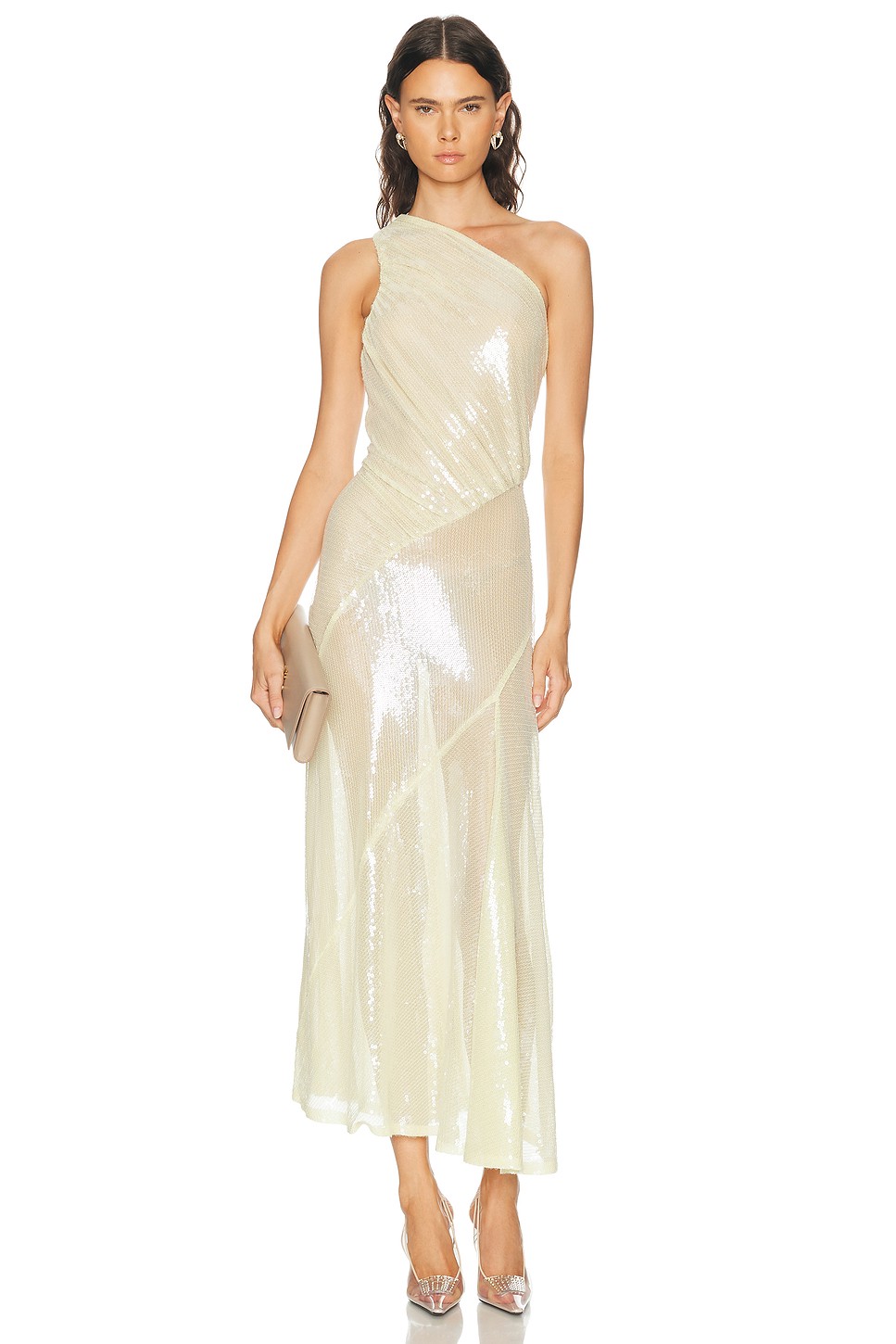
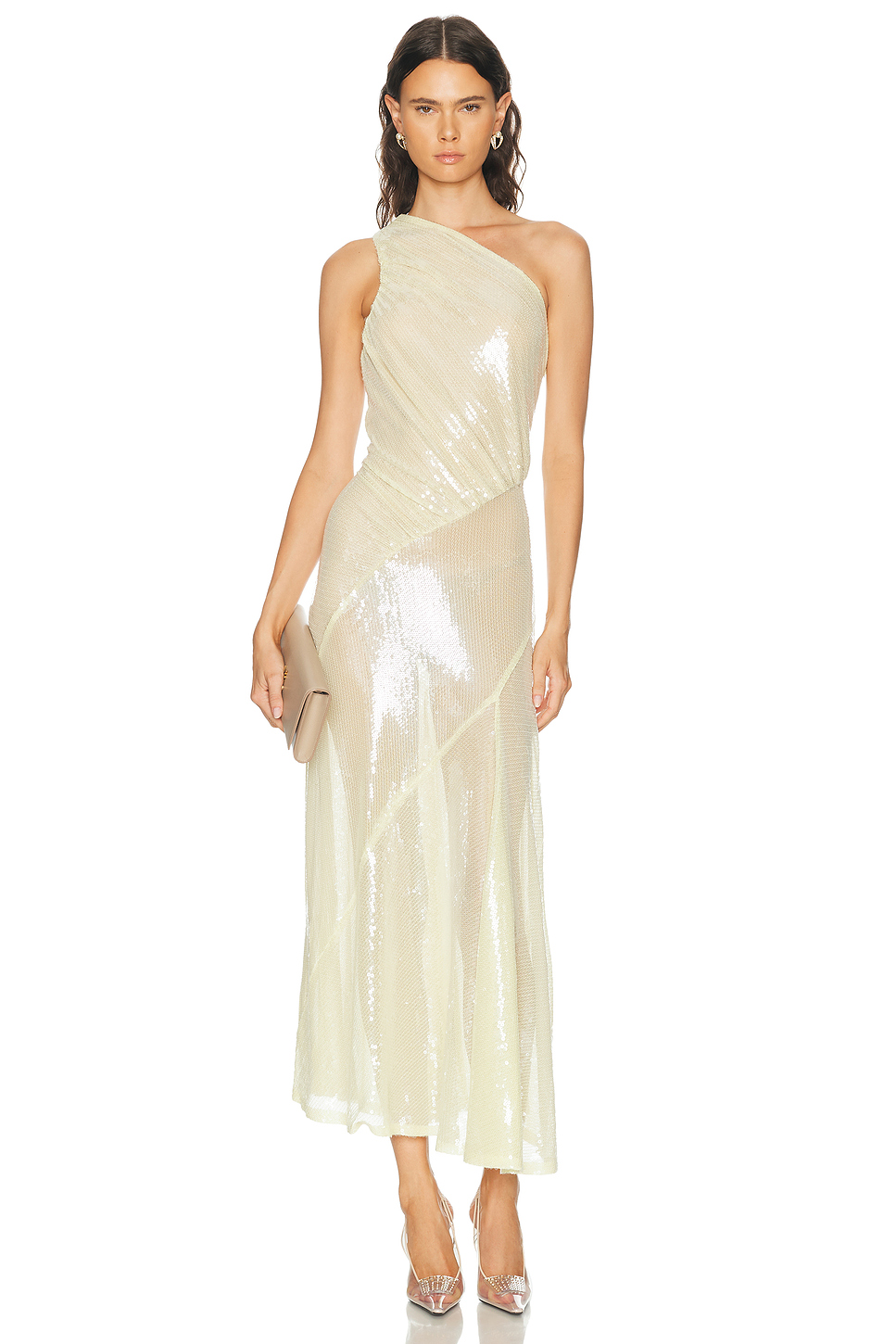
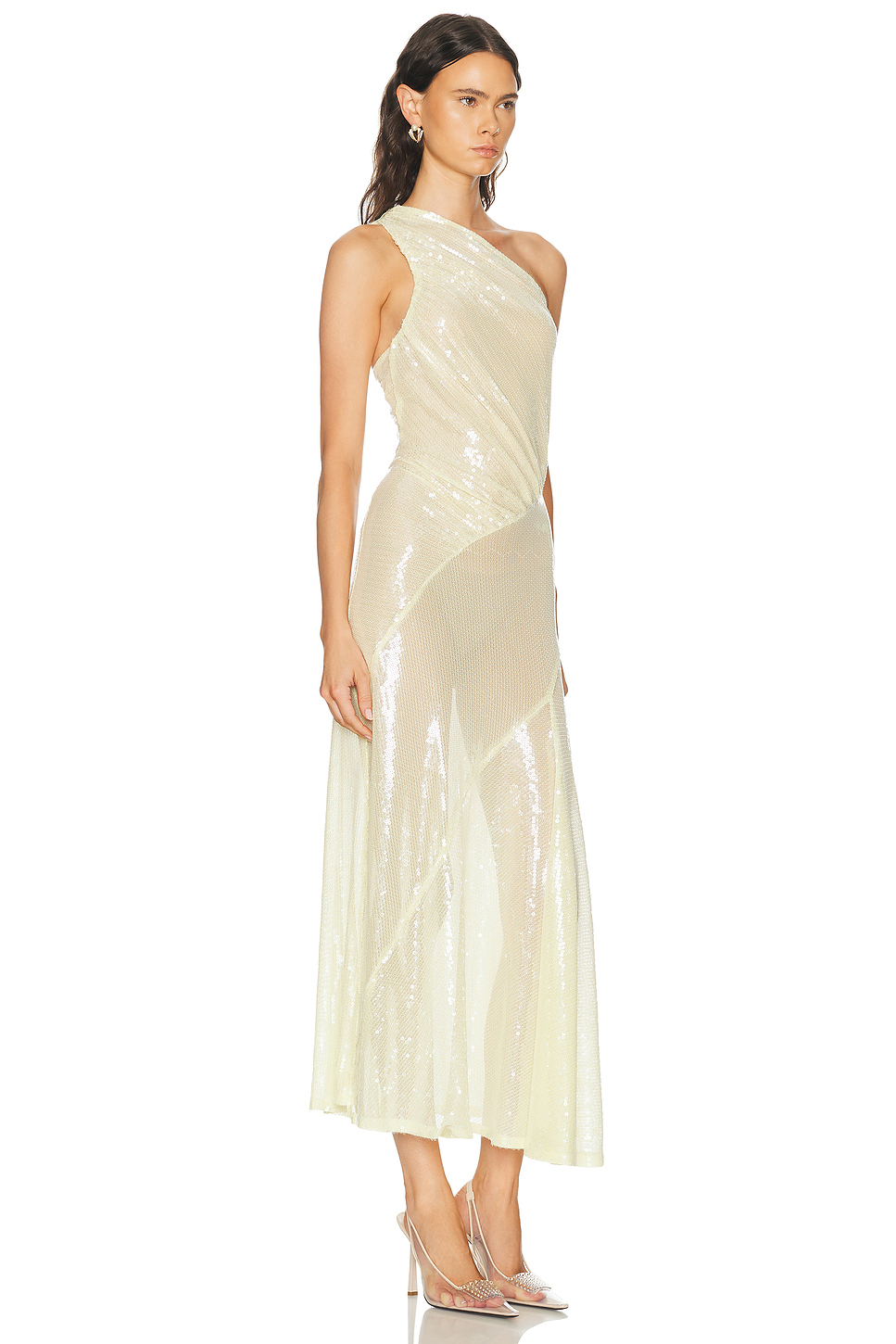
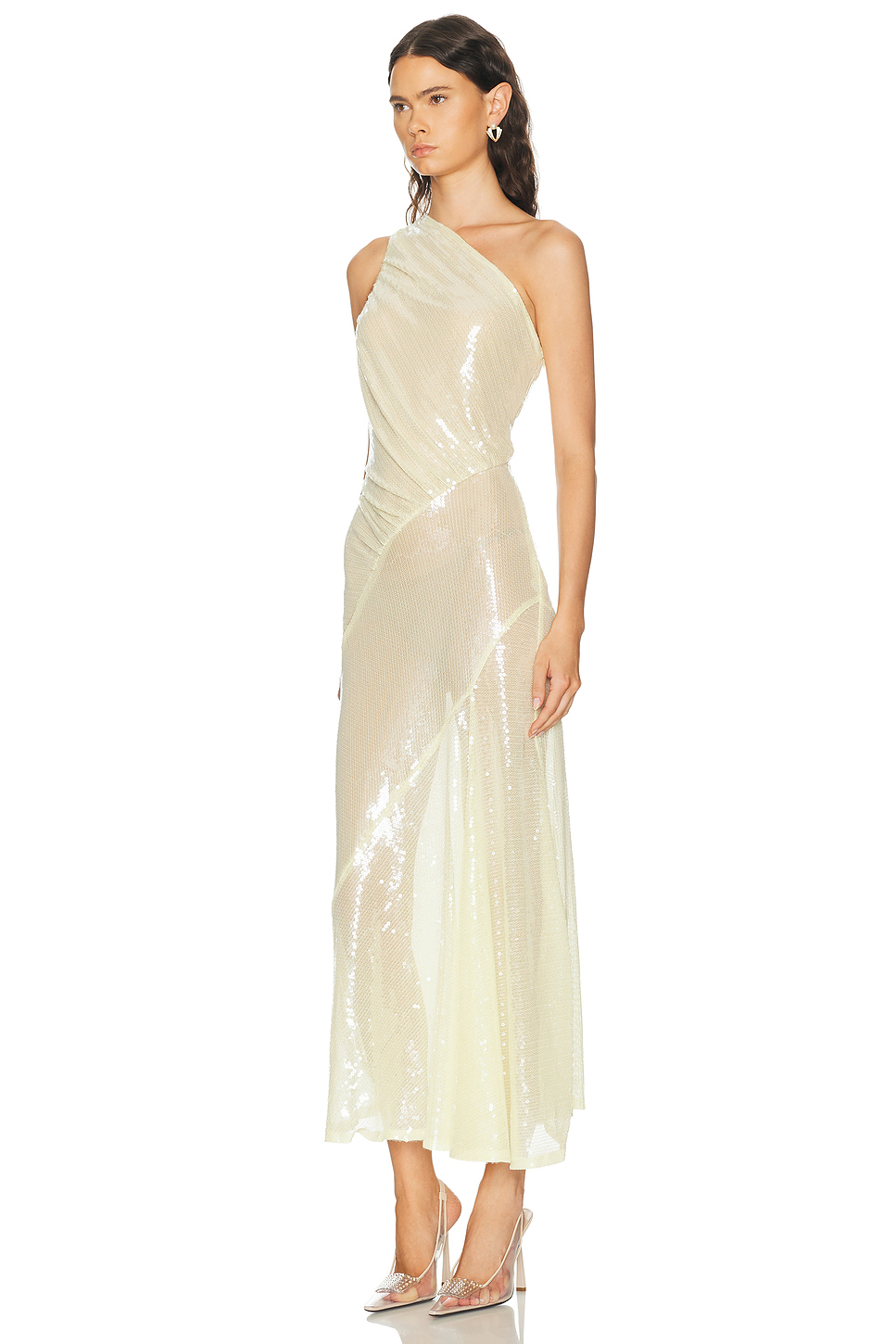
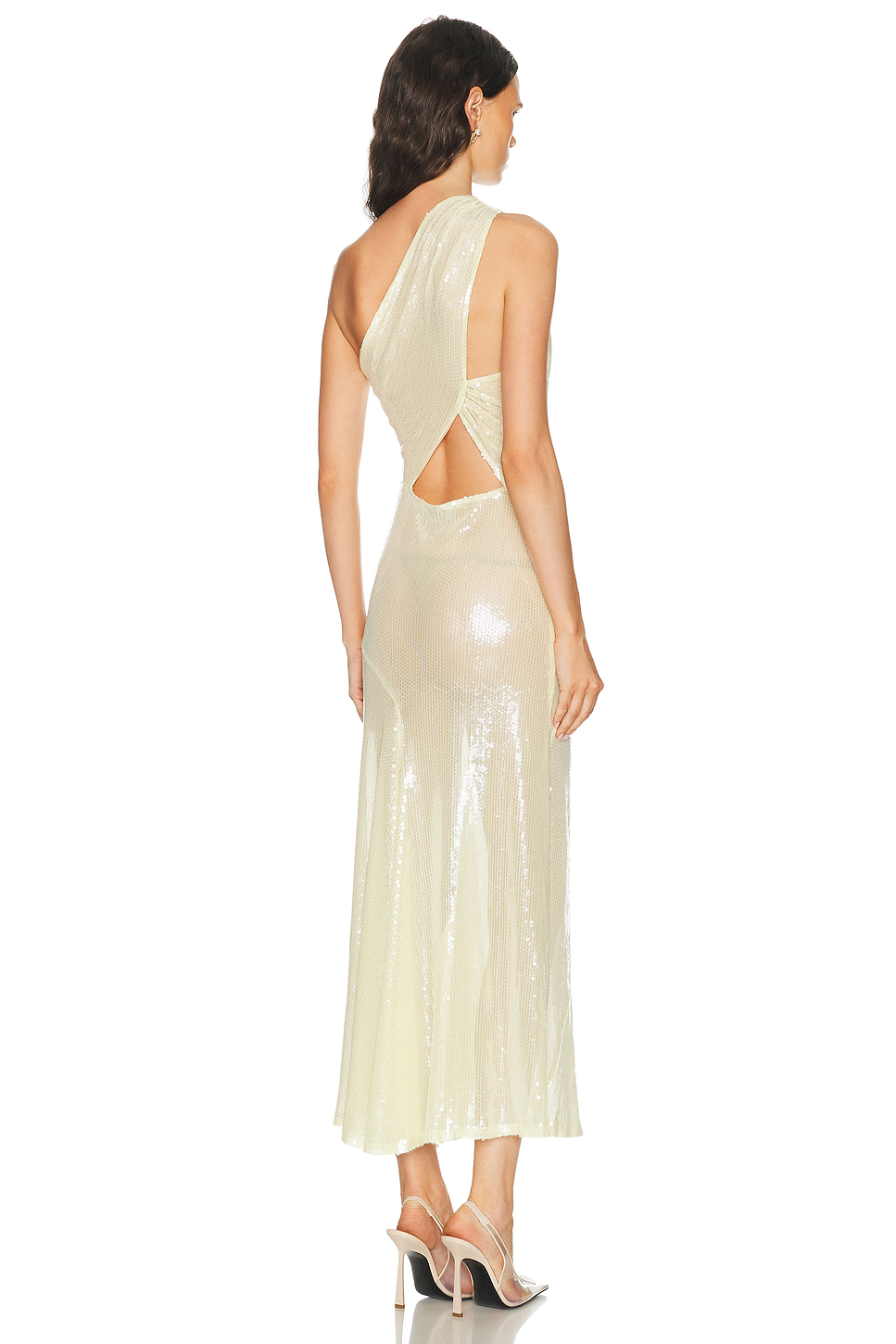
A midi dress listed in 100% polyester, dry clean only, partially lined, in a mid-weight mesh carrying sequins, closing with a hidden zip at the side, made in Turkey, ranked thirteenth in the retailer's one shoulder dress list, at 745 dollars. There are no reviews and no fit votes, so there is no score to quote. This is the second sequinned garment encountered here and this one is paired with the strictest instruction rather than the weaker one, which makes comparing the two worthwhile. Every published measurement also sits below the model's body, which has not happened anywhere else and forces the catalogue of explanations to be used rather than assumed. The reference is the Breeze Dress by ILA in Butter Yellow. Dongguan Bafinasa Garments Co., Ltd. develops comparable sequin dresses on OEM and ODM terms, from mesh sourcing and sequin application to retail or FBA ready packing. We publish this as a development reference and build your own version of it, and we do not supply the branded original or reproduce anyone else's label.
Key Features
- 100% polyester as stated, and polyester tolerates washing well, which makes the instruction worth examining. See the note below
- Dry clean only as stated, and there are several things here that justify it. See the note below
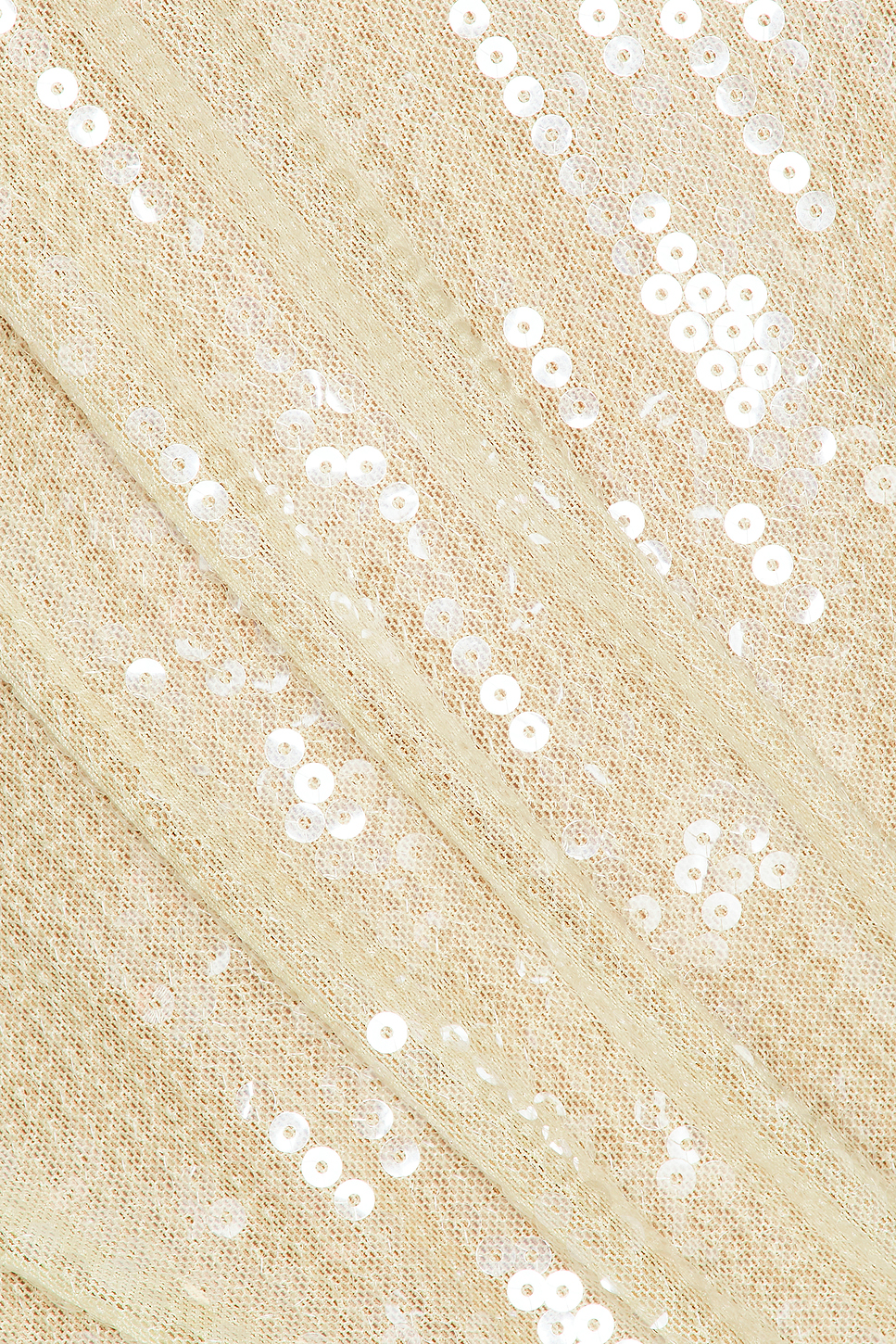
- Mid-weight mesh carrying sequins as stated, which is the second sequinned garment here. See the note below
- Partially lined as stated, and this is now the fourth use of a word that means something different each time
- Hidden zip at the side as stated
- One shoulder, as the retailer records it, which is unusual and useful. See the note below
- Made in Turkey as stated
- Measurements published for one size, and every one sits below the model. See the note below
Customisable Options
- Fabric: sequinned mesh to the reference, and we would specify how the sequins are attached rather than only that they are there
- Sequins: PET or recycled PET on request, and we would test what heat and agitation do to whatever is chosen
- Lining: we would offer partial or full and state which parts rather than only saying partial
- Care: dry clean only, and we would say what it protects, since several candidates are in play here
- Length from midi to maxi, sequin density and size, mesh gauge, lining options, size set, colour development, private label and care labelling
Specifications
| Style | Sequin mesh one shoulder midi dress |
| Reference | ILA, Breeze Dress, style ILAF-WD63, manufacturer style IWPS26JDR0409Q, colour Butter Yellow |
| Composition | 100% polyester as stated |
| Fabric | Mid-weight mesh carrying sequins as stated. See the note below |
| Lining | Partially lined as stated. See the note below |
| Care | Dry clean only as stated. See the note below, since polyester alone would not require it |
| Closure | Hidden zip at the side as stated |
| Sizes Published | 34, 36, 38 and 40, four consecutive sizes |
| Measurements Published | 36: bust 30 in, waist 22 in, hips 32 in, length 55 in. See the note below |
| Chart Note | Every measurement sits below the model's body, which has not happened anywhere else here. See the note below |
| Coverage | Only size 36 has figures. Sizes 34, 38 and 40 are blank |
| Model | 182 cm, bust 86 cm, waist 58 cm, hips 91 cm, wearing size 36 |
| Production | Made in Turkey as stated |
| Reference Retail | 745 USD, quoted to show the price band this sits in, not as our price |
| Customer Reviews | None on the reference listing, so we quote no score |
| Best Seller Badge | Rank 13 in the retailer's one shoulder dress list. Note the category is structural rather than about length |
| Categories | Filed by the retailer under midi dresses and one shoulder dresses |
| Occasion | Occasions, parties, evenings, celebrations |
| MOQ | 100 pcs per style per colourway, mixed sizes and colourways accepted |
| Sampling | 7-10 days after tech pack or reference sample confirmation |
| Bulk Lead Time | 20-30 days after sample approval and deposit |
| Service | OEM / ODM / private label, sequinned mesh sourcing, lining construction, retail or FBA ready packing |
Size Chart
| Size | Bust | Waist | Hips | Length | Source | ||||||||||||
|---|---|---|---|---|---|---|---|---|---|---|---|---|---|---|---|---|---|
| 36 | 30 | in | 22 | in | 32 | in | 55 | in / | 140 | cm | As published | ||||||
| 34 | 31 | in / | 79 | cm | 24 | in / | 61 | cm | 34 | in / | 86 | cm | 140 | cm / | 55.1 | in | Our proposal |
| 36 | 33 | in / | 84 | cm | 26 | in / | 66 | cm | 36 | in / | 91 | cm | 142 | cm / | 55.9 | in | Our proposal |
| 38 | 35 | in / | 89 | cm | 28 | in / | 71 | cm | 38 | in / | 97 | cm | 144 | cm / | 56.7 | in | Our proposal |
| 40 | 37 | in / | 94 | cm | 30 | in / | 76 | cm | 40 | in / | 102 | cm | 146 | cm / | 57.5 | in | Our proposal |
The published size 36 gives bust 30 in, waist 22 in, hips 32 in and length 55 in against a model at roughly 34, 24 and 34. Every figure sits below the corresponding body measurement, which has not happened anywhere else in this series.
Occasions and Styling
Suits occasions, parties, evenings and celebrations. A sequinned mesh dress is an event piece, and it is worth knowing that sequins decide how this can be cleaned and stored, which matters rather more than the fibre does.
Production and Quality Control
There are no reviews and no fit votes on this listing, so we quote no score. This is the second sequinned garment here and it carries the strict instruction rather than the weaker one, which makes the pair worth examining. Every measurement also sits below the model, which has not happened before and requires the explanations to be worked through rather than assumed.
Every single measurement below the body, and what survived scrutiny to explain it, and that is the first thing. Bust thirty against roughly thirty four, waist twenty two against twenty four, hip thirty two against thirty four, so all three sit under her, by four inches at the bust and two each at the waist and hip. This series has met measurements below the body many times and built a method for them, which is worth applying carefully here because this case is different in kind from all the others. Until now every instance has been a bust sitting below while its neighbours sat at or above, and the rule established was to ask first whether the garment is strapless, halter or sleeveless, since each removes or weakens the landmarks a bust figure depends on. Here there is nothing for that contrast to work on, because nothing is above her, so the whole garment is stated to be smaller than the body wearing it, and the question is simply what permits that. There are four known mechanisms plus one recently added. Knit structure works because loops open. Elastane at around a fifth works because the cloth draws inward. Bias cutting works, though along one direction rather than uniformly. Shirring works because gathered elastic draws cloth in and releases it. And adjustable closure was added recently, where nothing stretches and the circumference is drawn manually. Taking them in turn against this page: there is no elastane at all, so compression is unavailable. There is no tie or hook described as drawing anything closed, so the newest one is out. Shirring is not mentioned, and though absences on pages like this prove little, there is nothing pointing to it. That leaves knit and bias, and being honest about which is likelier matters more than appearing decisive. Mesh can be knitted or woven, and nothing here says which, though a mid-weight cloth covered in applied sequins is more often a warp knitted base, since that construction holds an applied load better than a loose plain weave does. If it is knitted, that alone accounts for most of what is seen here, because knit is the most common answer across this whole series and the one that permits the largest shortfalls. If it is woven, then bias is doing the work, which unlike knit gives in one direction rather than all of them, and this series noted long ago that bias works along one line rather than uniformly. So the honest answer is that this page does not determine it, and the single missing word that would is whether the mesh is knitted. That is worth dwelling on for a reason beyond this garment, which is how much difference one word makes. Every other possibility has been eliminated by what is stated, and the remaining uncertainty rests entirely on a fabric field nobody filled in. There is one more thing worth adding, which is the shape category. This is filed among one shoulder dresses, and this series extended its rule to cover that recently on the grounds that it removes a landmark just as the other three do. This is the first instance where that extension has been needed, and it behaves correctly, though for once the rule is not doing very much, since with everything below the body there is no need to explain a single disagreeing figure.
The second sequinned garment, and this time the strict instruction is the one given, and that is the second thing. This series met sequins once before, on a boned garment whose instruction was the weaker of the two meanings, permitting professional cleaning without ruling washing in or out, and the objection there was that a rayon rich lining alone should have forced the stricter line. Two things were noted about sequins then which are worth building on now. The first is weight, since sequins are many small objects applied across a surface, and together they weigh substantially more than the cloth carrying them, which puts the garment under continuous downward pull all evening, and this matters particularly where a garment has to hold itself up. The second is what sequins are made of, since most are plastic film, frequently metallised to give them their shine, and this series noted recently that plastic trim softens and curls under heat and that metallic surfaces lose brightness permanently once they have oxidised. Now add what this page supplies that the earlier one did not, which is a reason to think carefully about the mesh underneath. Mesh is an open structure, and this series has argued repeatedly about what that means, most sharply when comparing two lace garments that shared their fibre entirely and differed only in instruction, from which it was established that polyester tolerates machine washing perfectly well and therefore the open thread construction was what decided the answer. Open constructions are held in shape by their own geometry rather than by warp and weft locked together, so agitation lets them catch on themselves and on each other, and once distorted they do not recover. There is also a fourth candidate specific to this garment, which is how the sequins are attached. Each one is held by one or two stitches passing through the mesh, so across a whole garment there are thousands of needle holes in a cloth that has no redundancy, and every one of those holes is a place a thread can begin to run. So there are four separate reasons here, each sufficient alone, and that is worth contrasting with how these decisions have looked elsewhere. This series has concluded several times that strict instructions were habit rather than judgement, having examined garments whose stated contents could not account for them at all. That conclusion is unavailable here, and it is available even less so on this page than on some others because polyester would otherwise be washable without complaint. When a page says something inconvenient about a garment that could have taken the easier answer, that is the mark of the instruction having been considered. It still does not say which of the four it is protecting, and that omission has now appeared on page after page: knowing to keep water away is not the same as knowing which part needs care.
Partial lining for the fourth time, and each instance has meant something different, and that is the third thing. The word has now appeared four times in this series and it is worth drawing them together, because this is turning into one of the recurring puzzles rather than a one off. The first was on a garment with an open back, where the answer followed necessarily from the design, since lining across the opening would fill exactly the space the garment existed to leave empty, and this series noted then that this was forced rather than chosen and therefore more informative than it looked. The second was on a garment whose open embroidery was placed rather than distributed, so lining the open parts and not the rest was a coherent local decision. The third was where a band was described but nothing else was, and the absence of any stated reason made it difficult even to guess what was being covered. This is the fourth, on a sequinned mesh, and there is a plausible reason but no stated one. Two general observations come out of assembling them. The first is that the same word is doing four different jobs, which means a customer meeting it cannot carry knowledge from one garment to the next, and this is structurally the same problem identified repeatedly elsewhere with things having several names: knowing one does not grant the other. The second is more interesting, which is that these four suggest partial lining is nearly always a response to something rather than a default. On a sequinned garment the obvious reading is the least comfortable one: sequins are backed by thread and film that scratch and prick, and mesh has no natural softness either, so what gets lined is probably whatever sits against skin rather than whatever is most transparent. If that reading is right, then this particular instance is solving a comfort problem rather than an opacity one, which none of the earlier three were doing. It would be considerably more useful if the listing said which, since the two concerns point a customer at completely different questions. There are two smaller notes to close on, and they are mixed. On the credit side, this page names mid-weight, which very few do and which this series argued recently converts a fabric name into something estimable. On the complaint side, only one size out of four is measured, and that proportion has now repeated itself across enough garments to describe as standard practice rather than as an occasional oversight. Every bulk shipment gets a measurement report against your approved chart.
Optional upgrades include saying whether the mesh is knitted or woven, since every other explanation for the measurements has been excluded and this single word decides which remains, stating which parts are lined and why, since the four instances of that word have meant four different things and this one is probably about comfort rather than opacity, saying which of the four candidates the instruction protects, since knowing what needs care is different from knowing to avoid water, offering full lining as an option given how much scratch there is in this combination, publishing measurements for sizes 34, 38 and 40, since one out of four has become standard practice rather than occasional oversight, specifying how the sequins are attached and testing that method rather than inheriting it, offering different sequin densities since that decides both weight and drape, colour development, private label, hangtag and care labelling.
Pre-production sample approval, in-line inspection during cutting and sewing, and a final AQL inspection before packing, with measurement reports and photos shared before shipment.
Send us your tech pack, a photo or a reference garment and we will quote within 24 hours. Contact bafinasa@bafinasa.com or WhatsApp +86 13827222469.